What you'll learn
- How Kohlberg’s theory explains gender development through three stages: gender identity, gender stability and gender constancy.
- How Martin and Halverson’s gender schema theory explains early gender stereotypes and preferences.
- How to apply both theories to child behaviour in AO2 scenarios.
- How to evaluate the theories using research evidence, methodological issues and ethical considerations.
The starting point: cognition and gender
A cognitive explanation focuses on how mental processes shape behaviour. In this topic, the key idea is that children do not simply copy gender roles from adults. Instead, they actively think about gender, organise gender-related information, and use that understanding to guide their behaviour.
Cognitive explanation
A cognitive explanation of gender development argues that children’s understanding, beliefs and mental representations about gender influence how their gender identity and gender-typed behaviour develop.
Gender development means the process through which children develop an understanding of gender and begin to show behaviours, preferences and attitudes linked to gender in their culture.
A gender stereotype is a shared belief about what boys/men or girls/women are “supposed” to be like. For example, “boys like trucks” or “girls are caring” are stereotypes, not biological facts.
A gender-typed behaviour is behaviour that a particular culture sees as typical for one gender, such as choosing certain toys, clothes or activities.
The big cognitive idea
Cognitive theories see children as active thinkers: they build an understanding of gender, then use that understanding to decide what to notice, remember and imitate.
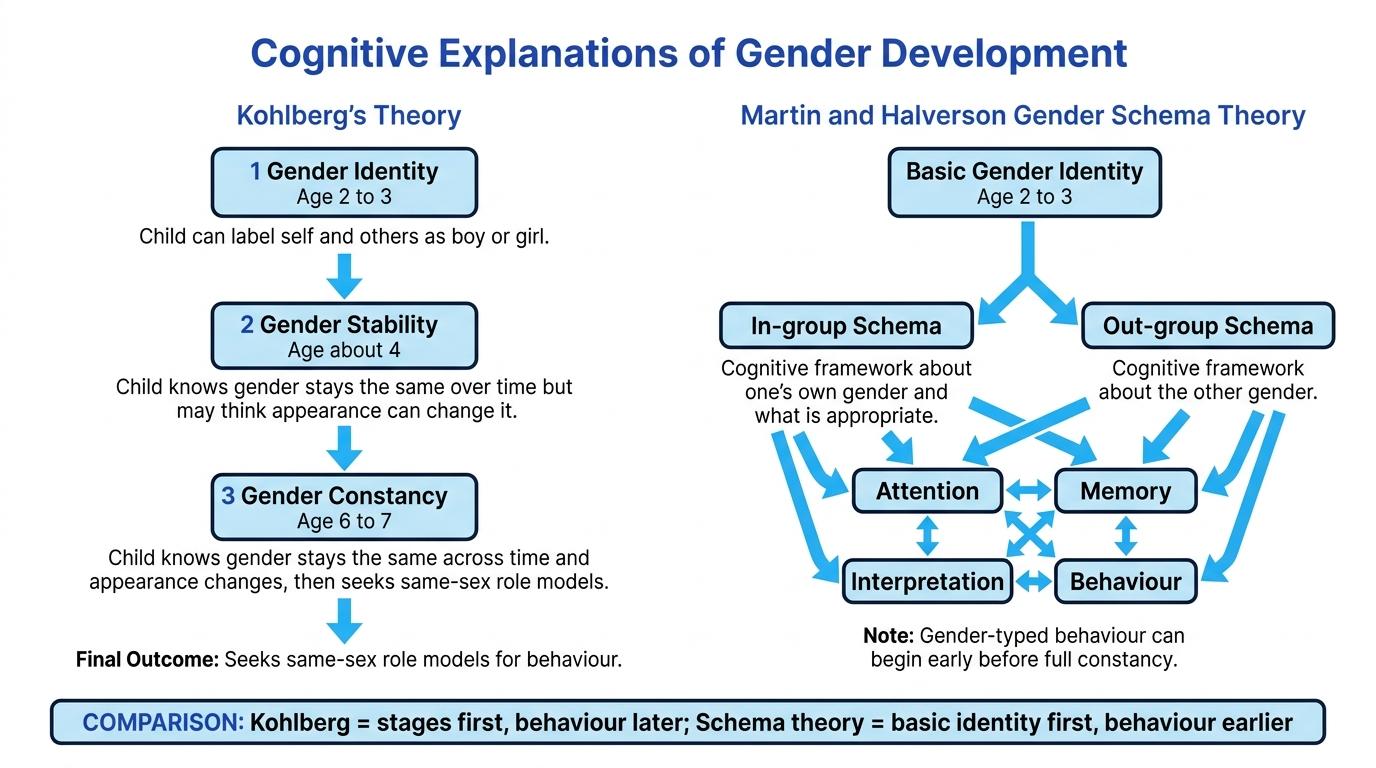
This summary diagram shows the main difference between Kohlberg’s stage theory and Martin and Halverson’s gender schema theory.
Kohlberg’s theory of gender development
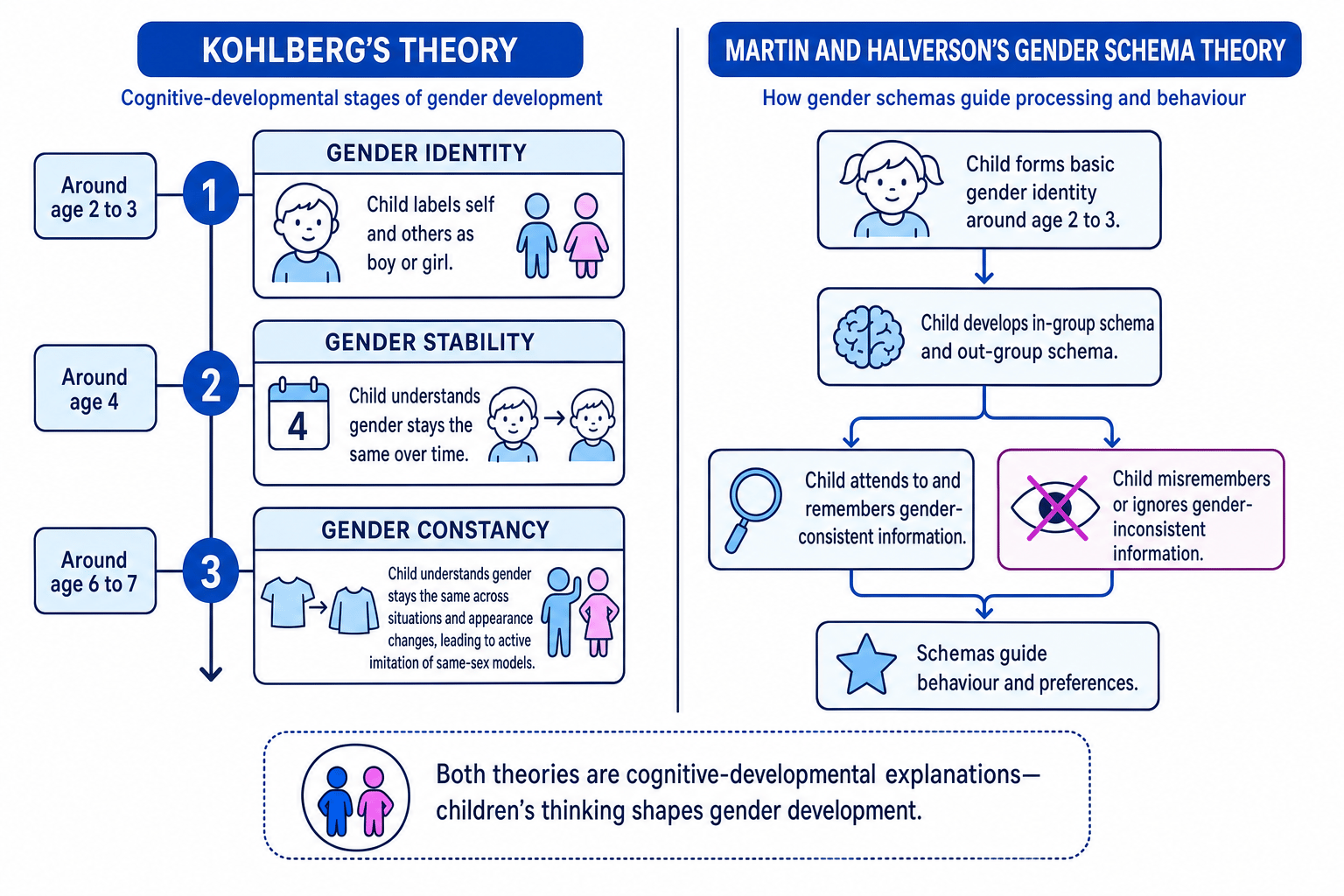
Kohlberg’s theory, developed by Lawrence Kohlberg (1966), is a cognitive-developmental theory. This means it explains gender development as the result of children’s thinking becoming more mature with age.
Kohlberg was influenced by Piaget’s view that children’s thinking develops in stages. He argued that children only fully understand gender once they achieve gender constancy. After this point, they become more motivated to behave in ways that match their gender.
Stage 1: gender identity
Gender identity is the first stage, usually around age 2 to 3.
At this stage, children can label themselves and others as a boy or a girl. For example, a child might say, “I am a boy” or “That person is a lady.”
However, this understanding is quite basic. A child at this stage may not realise that gender stays the same over time or across changes in appearance.
Gender identity
In Kohlberg’s theory, gender identity is the stage where a child can correctly label their own gender and the gender of others, usually around age 2 to 3.
Stage 2: gender stability
Gender stability is the second stage, usually around age 4.
At this stage, children understand that gender stays the same over time. For example, a girl understands she will grow into a woman, and a boy understands he will grow into a man.
But children may still be confused by changes in appearance. A young boy might think he could become a girl if he wore a dress or grew long hair.
Stage 3: gender constancy
Gender constancy is the final stage, usually around age 6 to 7.
At this stage, children understand that gender stays the same across time, situations and changes in appearance. A child with gender constancy knows that a boy wearing a skirt is still a boy, and a woman with short hair is still a woman.
Kohlberg argued that once children reach gender constancy, they become more motivated to seek out and imitate same-sex models. This is because they now understand which gender group they belong to permanently.
Gender constancy
Gender constancy is the understanding that gender remains the same across time, situations and superficial changes in appearance.
Identifying Kohlberg’s stage
A child says: “I’m a girl and I’ll be a mummy when I grow up, but if I wore my brother’s football kit I might become a boy.”
-
The child can label her own gender, so she has achieved gender identity.
-
She understands that she will grow up to be an adult female, so she also shows gender stability.
-
However, she thinks clothing might change her gender, so she has not achieved gender constancy. The best answer is that she is at the gender stability stage.
Do not treat the stages as just age labels
In an AO2 scenario, identify the stage from the child’s reasoning, not just their age. A 5-year-old who is still fooled by clothing changes is not showing full gender constancy.
Evaluation of Kohlberg’s theory
Strength: support from Slaby and Frey
Slaby and Frey (1975) tested children’s level of gender constancy, then showed them a split-screen film with a male and female model performing the same activities.
They found that children with higher gender constancy spent longer watching the same-sex model. This supports Kohlberg’s claim that once children understand gender as constant, they become more interested in same-sex role models.
However, this evidence is not perfect. The study is correlational: it shows a relationship between gender constancy and attention to same-sex models, but it does not prove that constancy causes imitation.
Strength: cross-cultural support
Some cross-cultural research suggests that children in different cultures pass through a similar sequence: identity, then stability, then constancy. This supports the idea that gender understanding may develop in a broadly universal order.
However, the ages at which children reach each stage can vary. This suggests that culture, language and social experience may also influence gender development.
Weakness: gender-typed behaviour appears earlier
A major challenge is that children often show gender-typed preferences before they have full gender constancy.
For example, Martin and Little (1990) found that young children could show gender stereotypes and gender-linked toy preferences even if they had not yet achieved gender constancy. This weakens Kohlberg’s claim that constancy is needed before children become motivated to behave in gender-typed ways.
Weakness: problems studying young children
Research into Kohlberg’s stages often relies on interviews or questions with very young children. This creates a methodological issue: children may fail because they misunderstand the wording, not because they lack the concept.
For example, a child might understand that gender is stable but become confused by an adult’s unusual question about hair, clothes or future identity.
Ethical considerations
Studies with children require careful ethics. Researchers need parental consent and, where possible, the child’s assent. Children should be protected from distress, allowed to withdraw, and debriefed in age-appropriate language. Confidentiality is also important, especially because gender can be a sensitive topic.
Martin and Halverson’s gender schema theory
Martin and Halverson’s gender schema theory (1981) agrees that children are active thinkers, but it disagrees with Kohlberg about timing.
They argued that children begin organising information about gender as soon as they have basic gender identity, usually around age 2 to 3. They do not need full gender constancy first.
Gender schema
A gender schema is an organised mental framework containing beliefs and expectations about what is appropriate for boys and girls.
A child’s schema might include ideas like “trucks are for boys”, “nurses are women”, or “boys should not cry”. These ideas may come from parents, peers, media, school and wider culture.
In-group and out-group schemas
Once children know their own gender, they form an in-group schema for their own gender and an out-group schema for the other gender.
The in-group is the group the child sees themselves as belonging to. A boy’s in-group schema is his mental framework for “what boys do”. A girl’s in-group schema is her framework for “what girls do”.
Martin and Halverson argued that children pay more attention to information linked to their in-group. They are also more likely to remember information that fits their schema and ignore or distort information that does not fit.
How schemas guide behaviour
Gender schemas influence:
- Attention: children notice gender-consistent information more easily.
- Memory: children remember schema-consistent information better.
- Interpretation: children may distort gender-inconsistent information.
- Behaviour: children choose toys, clothes and activities that fit their schema.
This helps explain why young children can become very rigid about gender rules. A child might insist that “boys can’t wear pink” even if they have not yet reached gender constancy.
Applying gender schema theory
A boy refuses to play with a toy kitchen after being told it is “for girls”, even though he enjoyed it before.
-
The label “for girls” activates the child’s gender schema, especially his in-group schema about what boys should play with.
-
The toy is now processed as out-group information, so he is less motivated to explore it because it does not fit his idea of “boy behaviour”.
-
Gender schema theory explains the refusal as self-socialisation: the child is guiding his own behaviour using gender categories, rather than simply responding to direct reward or punishment.
How schema theory differs from Kohlberg
Kohlberg says full gender constancy comes before strong gender-typed motivation. Martin and Halverson argue that basic gender identity is enough for children to start using gender schemas.
Evaluation of gender schema theory
Strength: explains early gender-typed behaviour
Gender schema theory explains why children may show gender preferences before they understand gender constancy. This is a clear advantage over Kohlberg’s theory.
The theory fits findings such as Martin and Little (1990), where children showed gender stereotypes and gender-linked preferences without full gender constancy.
Strength: support from memory research
Research by Martin and Halverson (1983) found that children were more likely to remember gender-consistent information and sometimes misremember gender-inconsistent information in a schema-consistent way.
For example, if shown a male nurse or female mechanic, children might later recall the person as the gender more stereotypically associated with that job. This supports the idea that schemas shape memory.
Strength: support from toy-labelling research
Bradbard et al. (1986) found that children were more interested in novel toys when the toys were labelled as appropriate for their own gender. This supports the idea that gender schemas guide attention and motivation.
However, labelling studies can be artificial. Children may respond to what they think adults expect, so demand characteristics may affect the results.
Weakness: where do schemas come from?
A limitation is that gender schema theory explains how children use gender information, but it is less detailed about where the content of schemas comes from.
Social learning theory would argue that children learn gender stereotypes from reinforcement, punishment, modelling and media. Biological explanations would point to hormones and chromosomes. A strong essay can argue that gender development is likely to involve both cognitive and social influences.
Weakness: may overemphasise stereotypes
Gender schema theory is useful for explaining rigid gender stereotypes, but it can make children seem more stereotype-driven than they always are. Some children are flexible, reject stereotypes, or grow up in families where gender roles are less traditional.
This means the theory may not fully explain individual differences.
Ethical and real-world applications
Research on gender schemas must avoid reinforcing harmful stereotypes. Researchers should debrief children carefully and avoid making them feel that certain activities are “wrong” for their gender.
A real-world application is education. If schemas filter attention and memory, then schools and parents may need to provide repeated counter-stereotypical examples, such as male nurses, female engineers, nurturing fathers and adventurous girls. One example may not be enough because children may ignore information that does not fit their existing schema.
Essay comparison shortcut
Use this contrast: Kohlberg = stages first, behaviour later. Gender schema theory = basic identity first, schemas and behaviour early.
Bringing the two theories together
Both theories are cognitive because they focus on the child’s thinking. Both also see children as active in their own gender development.
The main disagreement is about when gender-typed behaviour begins. Kohlberg places the strongest motivation after gender constancy, around age 6 to 7. Martin and Halverson argue that gender schemas begin influencing behaviour much earlier, once basic gender identity is established.
For AQA essays, it is useful to write:
- AO1: describe the stages or schemas accurately.
- AO2: apply the theory to a child’s statements, toy choices or memory errors.
- AO3: evaluate using research evidence, methodological issues, ethics and alternative explanations.
In the exam
-
For Kohlberg, always name and explain all three stages: gender identity, gender stability and gender constancy.
-
For gender schema theory, focus on how schemas affect attention, memory and behaviour, not just toy choice.
-
In evaluation, make your point comparative: explain whether the evidence supports Kohlberg, supports schema theory, or challenges one theory more than the other.
Check yourself
- Why does Kohlberg think gender constancy is important for imitation?
- How does a gender schema affect what a child notices and remembers?
- Which theory better explains gender-typed behaviour in very young children, and why?