What you'll learn
- What gender incongruence means, and how it differs from gender dysphoria.
- How biological explanations use evidence from genes, prenatal hormones, and brain structure.
- How social and cultural explanations focus on learning, family/peer influences, and cultural norms.
- How to evaluate the explanations in a balanced, respectful A-Level essay.
Starting point: key terms
Before you evaluate explanations, you need to be clear on the language.
Sex assigned at birth refers to the label, usually male or female, given to a baby based mainly on physical characteristics such as external genitalia.
Gender identity is a person’s internal sense of their own gender, for example being male, female, both, neither, or another identity.
Cisgender means a person’s gender identity matches their sex assigned at birth. Transgender is an umbrella term for people whose gender identity does not fully match their sex assigned at birth.
Gender incongruence
Gender incongruence is when a person’s experienced gender identity differs from the sex they were assigned at birth. It may involve a strong desire to live and be recognised as another gender.
Gender dysphoria is related, but not identical. It refers to the distress or discomfort that can arise from gender incongruence, especially when a person’s body, social role, or treatment by others does not match their gender identity.
Incongruence is not the same as distress
A person can experience gender incongruence without necessarily experiencing severe distress. In exams, avoid writing as if being transgender is itself a mental disorder.
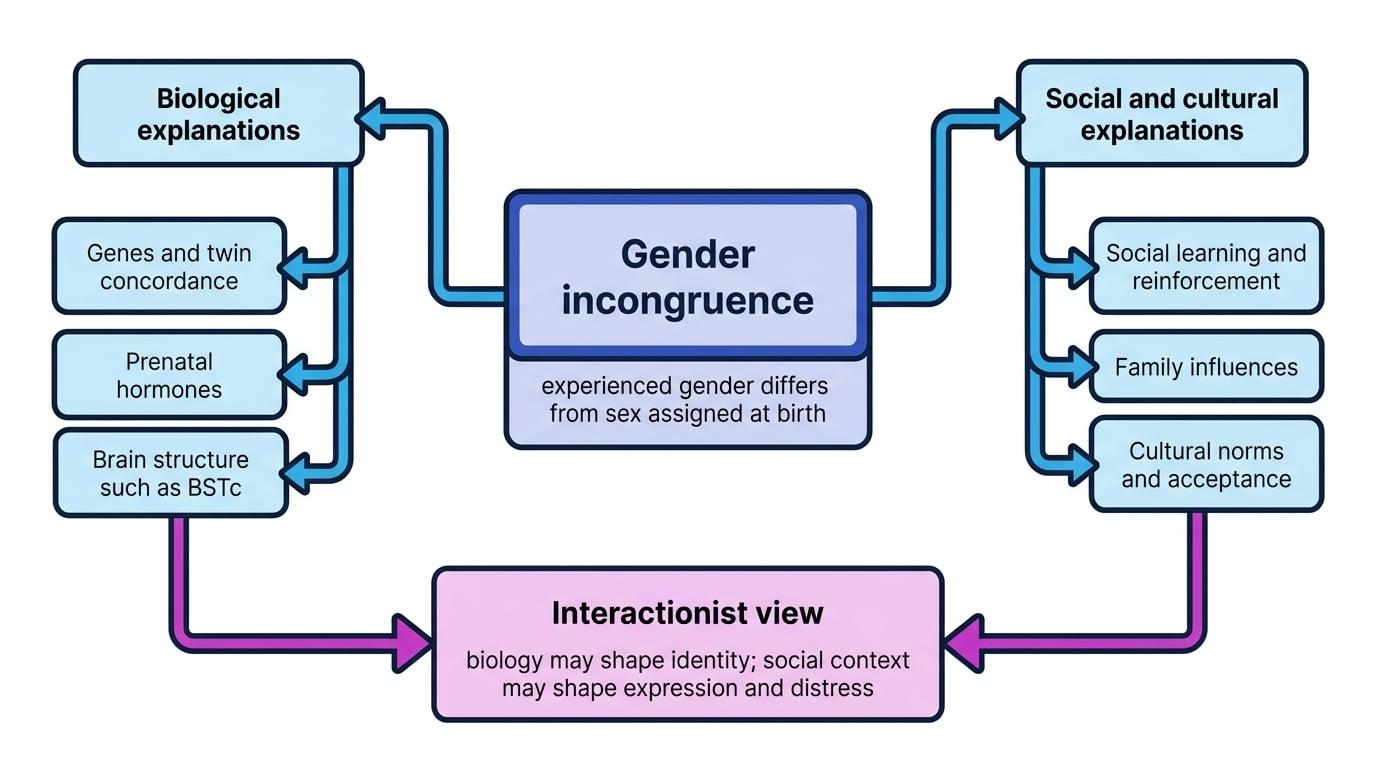
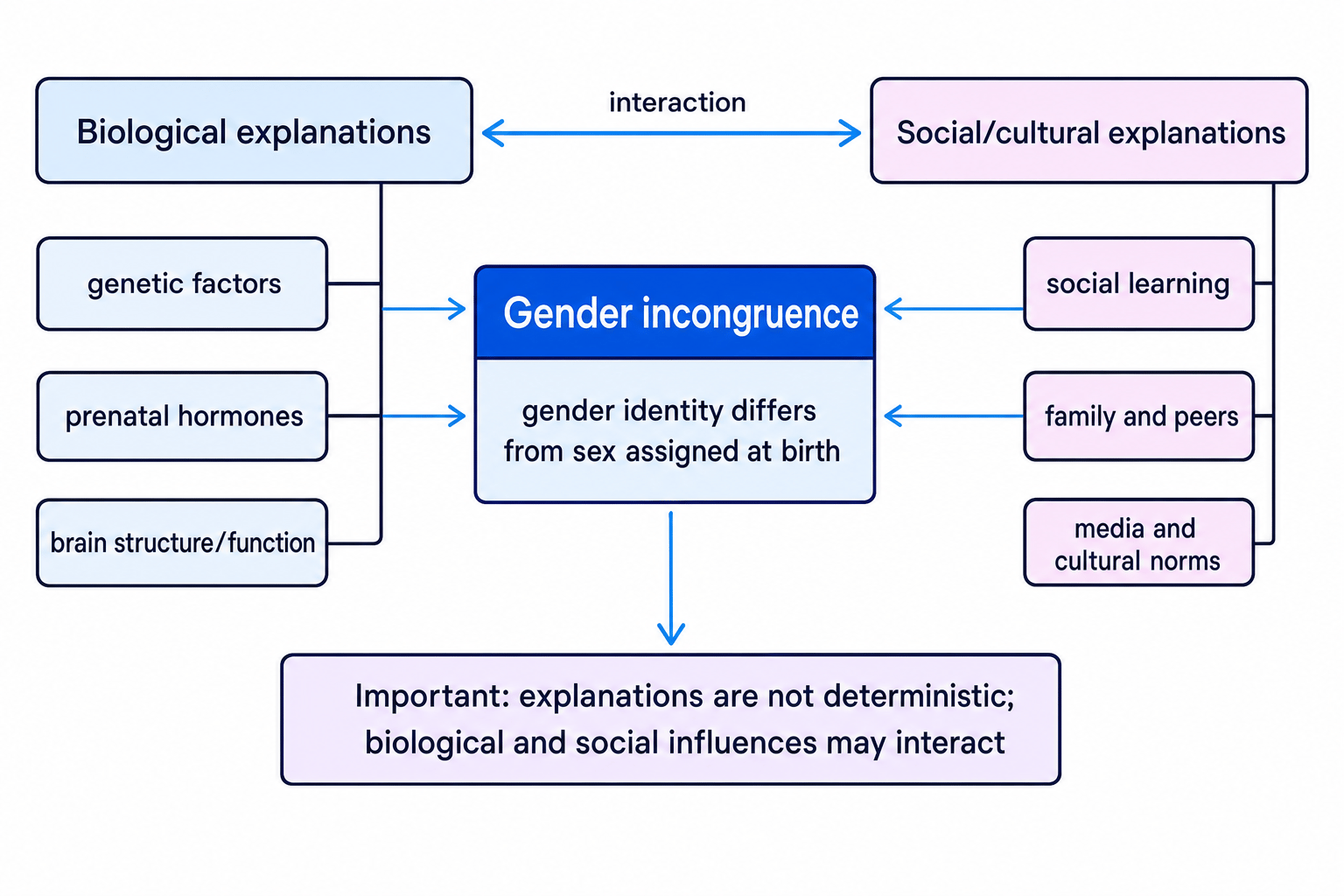
This overview shows the two broad groups of explanations you need for AQA: biological explanations and social/cultural explanations. The strongest answers usually recognise that these influences may interact rather than competing in a simple “nature versus nurture” way.
Biological explanations
The basic biological assumption
Biological explanations argue that gender incongruence may partly result from differences in biological development. These explanations often focus on genes, hormones before birth, and brain structure or function.
Sexual differentiation means the biological process through which bodies and brains develop in typically male or typically female directions. This process is influenced by chromosomes, hormones, and genes.
Genetic explanations
A genetic explanation suggests that inherited biological factors may increase the likelihood of gender incongruence.
One common source of evidence is twin studies. Monozygotic twins are identical twins who share almost all their genes. Dizygotic twins are non-identical twins who share about half their genes, like ordinary siblings.
If gender incongruence has a genetic component, we would expect higher concordance rates in monozygotic twins than in dizygotic twins. A concordance rate is the percentage of twin pairs in which both twins show the same characteristic.
Research evidence includes Coolidge et al. (2002), who studied gender identity disorder symptoms in children and estimated a substantial genetic contribution. Heylens et al. (2012) found that concordance for gender dysphoria was higher in monozygotic twins than dizygotic twins, suggesting a possible genetic influence.
Interpreting twin evidence
- Compare the genetic similarity of the twins: monozygotic twins share almost all their genes, while dizygotic twins share roughly half.
- Compare concordance rates: if monozygotic twins show much higher concordance for gender incongruence than dizygotic twins, this supports a genetic influence.
- Avoid a deterministic conclusion: if many monozygotic twin pairs are still discordant, genes cannot be the whole explanation.
- Add an environmental issue: identical twins may also be treated more similarly than non-identical twins, so higher concordance may partly reflect shared environment.
Evaluation of genetic explanations
A strength is that twin evidence gives a useful way to separate biological and environmental influences. It supports the idea that gender incongruence is not simply a “choice” or the result of parenting.
However, twin studies often use small samples because gender incongruence is relatively uncommon in the general population. This makes findings harder to generalise. There is also a problem of shared environment: identical twins may be treated more similarly, so differences between monozygotic and dizygotic twins are not purely genetic.
There are ethical issues too. Studies involving gender identity require careful confidentiality, informed consent, and protection from harm, because participants may be vulnerable to stigma or discrimination.
Prenatal hormone explanations
Prenatal hormones are hormones present before birth. A key hormone in gender development is testosterone, which is associated with masculinisation of the body and, potentially, parts of the brain.
A prenatal hormone explanation suggests that atypical exposure to hormones before birth may influence the development of gender identity. For example, if the brain is exposed to hormone patterns that do not match the development of the external body, this could contribute to later incongruence between gender identity and assigned sex.
Evidence sometimes comes from conditions such as congenital adrenal hyperplasia, often shortened to CAH. CAH can expose XX fetuses to unusually high levels of androgens, including testosterone. Research has found that girls with CAH may show more traditionally masculine toy and activity preferences.
Evaluation of prenatal hormone explanations
This explanation has biological plausibility because hormones clearly influence sexual development. It also links gender incongruence to early development, which fits reports from some transgender people that their gender identity felt present from childhood.
However, CAH evidence is not direct evidence for gender incongruence. Most girls with CAH still identify as female. This suggests prenatal hormones may influence some gender-related behaviours, but they do not straightforwardly determine gender identity.
A major methodological issue is that researchers cannot ethically manipulate prenatal hormone exposure in humans. Much evidence is therefore correlational or based on naturally occurring conditions, so cause and effect are difficult to establish.
Overclaiming hormones
Do not write “testosterone causes gender incongruence”. A better answer says prenatal hormones may contribute to gender-related development, but the evidence is indirect and not deterministic.
Brain structure explanations
A major biological explanation is the brain-sex theory. This argues that some brain structures in transgender people may be more similar to their experienced gender than to their sex assigned at birth.
One important brain area is the bed nucleus of the stria terminalis, often shortened to BSTc. It is part of the hypothalamic region and has been linked to sex-related behaviour. It is described as sexually dimorphic, meaning it differs on average between males and females.
Zhou et al. (1995) carried out a post-mortem study and found that the BSTc in transgender women was more similar in size to that of cisgender women than cisgender men. Kruijver et al. (2000) also reported differences in neuron number in the BSTc that appeared to align more closely with experienced gender.
More modern brain imaging research, such as Rametti et al. (2011), has looked at white matter patterns in transgender individuals before hormone treatment. Some findings suggest brain patterns may be closer to experienced gender than assigned sex, although results are complex and not always consistent.
Evaluation of brain structure explanations
A strength is that brain studies use objective biological measures rather than relying only on self-report. They also provide a possible mechanism for why gender identity can feel deeply rooted and resistant to social pressure.
However, many studies have very small samples. Zhou et al.’s research, for example, involved only a small number of transgender participants. This reduces generalisability.
There is also a serious cause-and-effect problem. If brain differences are found, we cannot easily know whether they caused gender incongruence, resulted from life experiences, or were affected by hormone treatment. Some post-mortem participants had received cross-sex hormone therapy, which may have influenced brain structure.
Evaluation phrase to learn
For brain studies, a strong AO3 point is: “The research shows a correlation between brain structure and gender identity, but it does not prove that brain differences cause gender incongruence.”
Social and cultural explanations
The basic social/cultural assumption
Social and cultural explanations argue that gender identity and the distress linked to incongruence are shaped by social experiences. These include reinforcement, modelling, family relationships, peer responses, media representation, and cultural gender norms.
This does not mean gender incongruence is “made up” or simply copied. A careful answer says social and cultural factors may influence how gender identity is understood, expressed, labelled, and responded to.
Social learning explanations
Social learning theory suggests that behaviour is learned through observation, imitation, modelling, and reinforcement.
A child may observe gendered behaviour in parents, siblings, peers, or media figures. If certain behaviours are rewarded, the child may be more likely to repeat them. Vicarious reinforcement occurs when someone observes another person being rewarded and is then more likely to imitate that behaviour.
Applied to gender incongruence, a social learning explanation might suggest that cross-gender identification or behaviour could be strengthened if it receives attention, approval, or modelling from others.
Evaluation of social learning explanations
Social learning theory explains gender role behaviour quite well, such as toy preferences or clothing choices. However, it is weaker as a full explanation of gender incongruence.
Many transgender people report that their gender identity persisted even when it was punished, discouraged, or hidden. This challenges the idea that gender incongruence is mainly learned through reinforcement.
It is also difficult to explain why many children exposed to the same family, school, and media influences do not develop gender incongruence. Therefore, social learning may explain aspects of gender expression better than the origin of gender identity itself.
Family and psychodynamic explanations
Some older social explanations focused on early family relationships. For example, Stoller (1975) suggested that gender incongruence in some boys might be linked to an overly close mother-son relationship and a distant or absent father.
Coates et al. (1991) used a case study of a boy with gender identity issues and suggested his gender dysphoria may have developed as a response to early anxiety and family stress.
Evaluation of family explanations
These explanations are highly controversial. They often rely on case studies, which provide rich detail but are difficult to generalise from. Case studies are also vulnerable to researcher interpretation and hindsight bias.
A major ethical weakness is that these explanations can blame parents, especially mothers, without strong evidence. They may also increase stigma by implying that gender incongruence is the result of family “damage”.
Blaming parents
Avoid saying that an absent father or overinvolved mother “causes” gender incongruence. These are older theories with weak evidence and serious ethical concerns.
Cultural explanations
A cultural explanation focuses on how societies define gender categories and how they respond to people who do not fit binary expectations.
Some cultures recognise gender-diverse roles, such as fa’afafine in Samoa, hijra communities in South Asia, and some Indigenous Two-Spirit identities. These examples show that gender diversity is not limited to modern Western societies.
Culture may influence whether gender incongruence is accepted, stigmatised, medicalised, or given a recognised social role. In a strongly binary culture, a person may experience more distress because others reject their identity. In a more accepting cultural setting, the same incongruence may be less distressing.
Evaluation of cultural explanations
Cultural evidence is useful because it shows that gender categories are not identical across societies. This supports the idea that gender identity and gender expression are partly shaped by social meanings.
However, cultural evidence does not prove that culture causes gender incongruence. It may show more about how people interpret, label, and live with gender diversity. There is also a risk of ethnocentrism, where researchers judge other cultures using Western assumptions.
Applying explanations to a scenario
A person assigned female at birth has identified as male since childhood. Their family rejects this, but online communities help them understand their identity.
- Identify the key issue: their experienced gender differs from their assigned sex, so this is gender incongruence.
- Apply a biological explanation cautiously: their long-standing identity could be consistent with an early biological influence, such as genes, prenatal hormones, or brain development.
- Apply a social/cultural explanation: family rejection may increase distress, while online communities may provide language, support, and models for understanding the identity.
- Reach a balanced conclusion: the scenario does not prove one cause, but it shows how biological identity and social context can interact.
Best overall approach: interaction
The strongest explanation is usually interactionist. This means gender incongruence may involve biological factors that influence gender identity, while social and cultural factors influence how that identity is expressed, accepted, and experienced.
Interaction is the safest conclusion
Biological explanations may help explain why gender identity feels stable and deeply rooted, while social and cultural explanations help explain variation in distress, acceptance, labels, and lived experience.
In the exam
- Start by defining gender incongruence and, if relevant, distinguish it from gender dysphoria.
- For AO1, describe at least one biological explanation, such as genes, prenatal hormones, or brain structure, and one social/cultural explanation.
- For AO3, evaluate using evidence quality: small samples, correlation versus causation, confounding variables, ethical issues, and the danger of deterministic or pathologising language.
Check yourself
- How is gender incongruence different from gender dysphoria?
- Why does higher concordance in monozygotic than dizygotic twins support a genetic explanation?
- Why might cultural evidence explain distress and expression better than the original cause of gender incongruence?