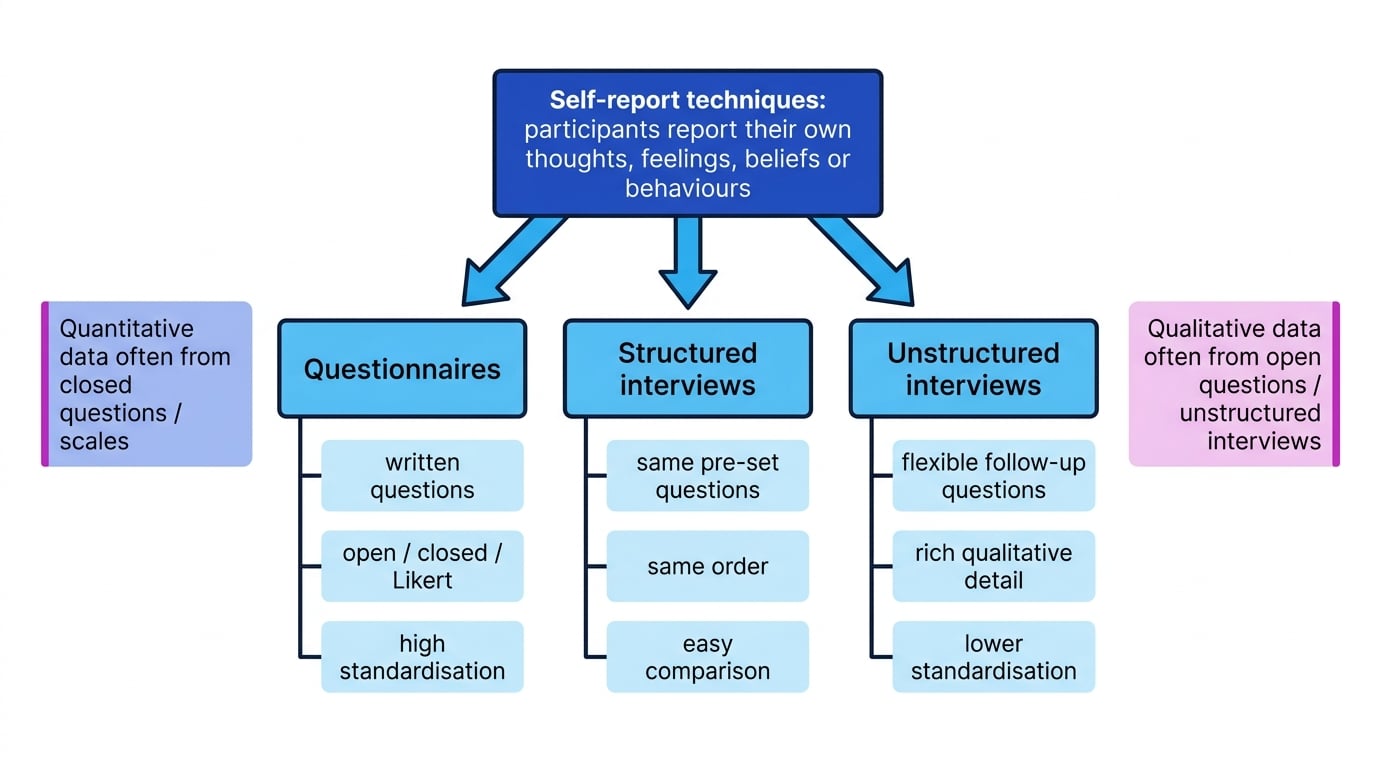
What you'll learn
- What self-report techniques are and why psychologists use them.
- How questionnaires collect data using open, closed and scaled questions.
- How structured and unstructured interviews differ.
- How to evaluate self-report methods for validity, reliability, bias and ethics.
The starting point: what is a self-report technique?
A self-report technique is any research method where participants provide information about themselves directly. This might include their thoughts, feelings, attitudes, symptoms, memories or behaviours.
Psychologists use self-reports when the thing being studied is not directly visible. For example, you cannot simply observe someone’s level of exam anxiety, but you can ask them about it.
Self-report technique
A self-report technique is a method of collecting data by asking participants to report their own experiences, beliefs, feelings or behaviours.
Self-report techniques usually produce either:
- Quantitative data: numerical data, such as ratings on a scale.
- Qualitative data: non-numerical data, such as detailed written or spoken answers.
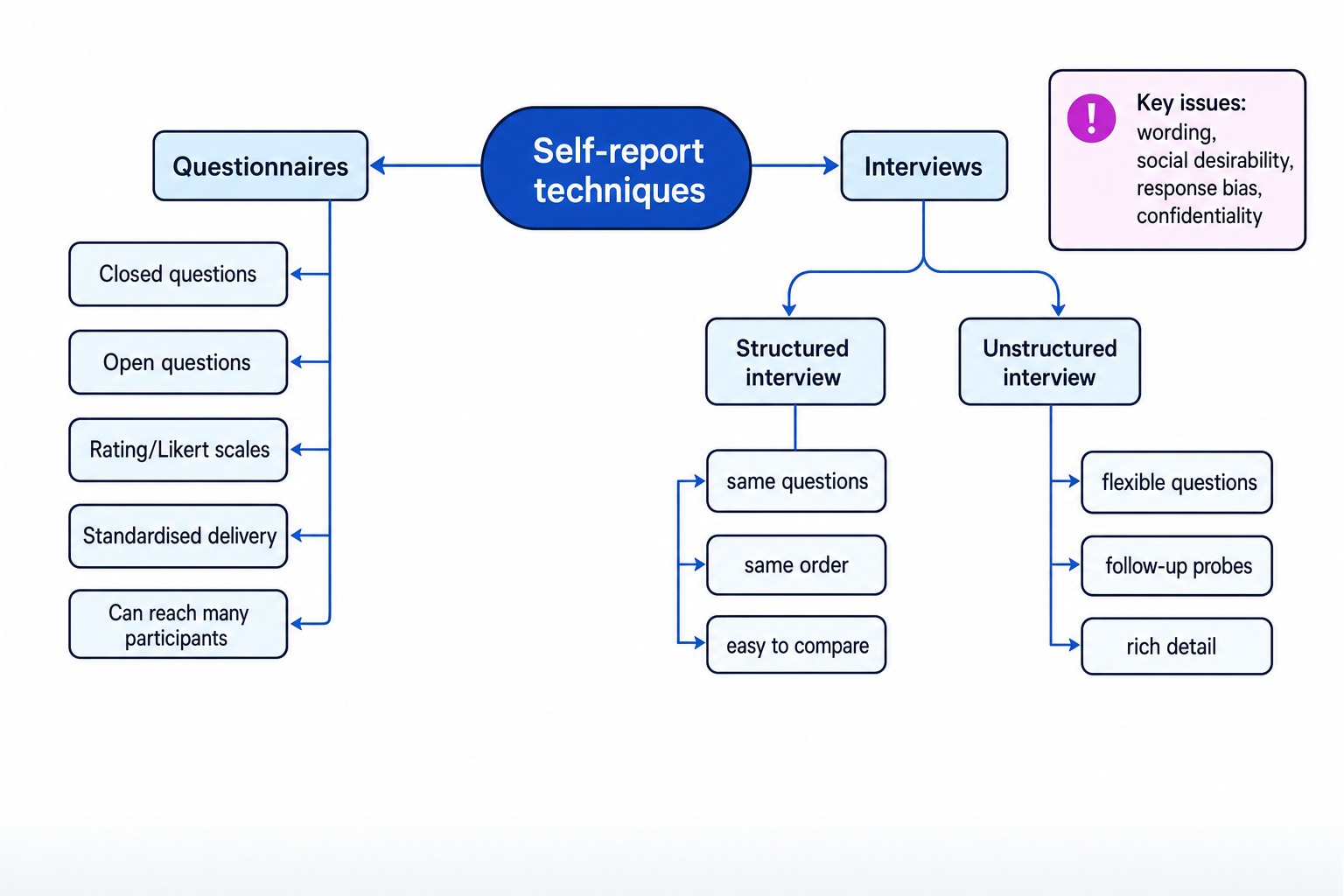
The big trade-off
Self-report methods are useful because they give access to private experiences, but they depend on participants being willing and able to report accurately.
Questionnaires
A questionnaire is a set of written questions that participants answer. It may be completed on paper, online, or sometimes verbally if the researcher reads out the questions.
Questionnaire
A questionnaire is a self-report method made up of a standardised set of questions given to participants to collect information from them.
Questionnaires are common in psychology because they are practical. A researcher can collect data from a large number of people relatively quickly, especially online.
Standardisation
A method is standardised when every participant receives the same instructions, questions and response options in the same order. This helps make responses easier to compare.
Standardisation improves reliability, which means consistency. If a questionnaire is reliable, it should produce similar results when repeated with the same person under similar conditions.
Open and closed questions
Questionnaires can include open questions or closed questions.
An open question allows participants to answer in their own words. For example:
- “Describe how you usually feel before an exam.”
A closed question gives fixed response options. For example:
- “Before an exam, do you feel anxious? Yes / No”
Closed questions can also use a rating scale, where participants choose a number, or a Likert scale, where they choose how much they agree with a statement.
For example:
- “I feel anxious before exams.”
- Strongly agree / Agree / Neither agree nor disagree / Disagree / Strongly disagree
Likert scale
A Likert scale is a type of rating scale where participants show their level of agreement with a statement, usually using options such as “strongly agree” to “strongly disagree”.
Open versus closed questions: strengths and limits
Open questions can produce rich, detailed qualitative data. This may improve validity, meaning the method measures what it is supposed to measure, because participants can explain their real experiences in their own terms.
However, open responses are harder to analyse. The researcher may need to group responses into categories, which can introduce researcher bias.
Closed questions are easier to analyse and compare. They are useful for gathering quantitative data from large samples. However, they may oversimplify complex feelings or force participants into choosing an option that does not quite fit.
Improving a questionnaire item
A researcher writes: “Don’t you agree that exam stress is caused by too much homework and pressure from parents?”
-
The item asks about two possible causes at once: homework and parental pressure. This is a double-barrelled question, so a participant may agree with one part but not the other.
-
The phrase “Don’t you agree” pushes the participant towards agreement. This makes it a leading question, because the wording suggests a preferred answer.
-
The researcher should separate the two ideas and make the wording neutral. For example: “Homework contributes to my exam stress” and “Pressure from parents contributes to my exam stress.”
-
A Likert scale would allow degrees of agreement, so the participant is not forced into a simple yes/no answer.
Calling every question a questionnaire
A single question is not really a questionnaire. A questionnaire is the whole set of questions used as the measuring instrument.
Designing good questionnaires
A good questionnaire should be clear, neutral and easy to complete.
Useful design principles include:
- Avoid leading questions, where the wording suggests the desired answer.
- Avoid ambiguous questions, where the meaning is unclear.
- Avoid double-barrelled questions, where two things are asked at once.
- Use simple language suitable for the target participants.
- Keep sensitive questions respectful and only ask what is needed.
- Consider using a pilot study, which is a small trial run used to identify problems before the main study.
Question wording matters. Loftus and Palmer (1974) showed that wording can affect memory reports: participants gave different speed estimates depending on whether they were asked how fast cars were going when they “hit” or “smashed” into each other. This is a useful reminder that self-report data can be influenced by the way questions are phrased. Ethically, studies using potentially deceptive wording should include informed consent where possible, protection from harm and a clear debrief.
A quick wording check
If a question seems to contain an opinion, judgement or emotional push, it may be leading or loaded. Neutral wording usually improves validity.
Evaluating questionnaires
Strengths
Questionnaires are often very practical. They can reach large samples quickly and cheaply, especially online. This may improve generalisation, because larger samples can be more representative if they are selected well.
They are also usually standardised. Every participant receives the same questions, which improves reliability and makes responses easier to compare.
Questionnaires can be anonymous. This may reduce social desirability bias, where participants give answers that make them look better rather than answers that are fully honest.
Weaknesses
Questionnaires can suffer from response bias, which is a tendency for participants to answer in a particular way regardless of the actual question. For example, some people may agree with most statements; this is called acquiescence bias.
They can also be affected by demand characteristics, which are cues that reveal the aim of the study and influence participants’ behaviour. If participants guess what the researcher is investigating, they may alter their answers.
Validity can be low if participants misunderstand questions, lack insight into their own behaviour, forget events, or deliberately lie.
There can also be low response rates, especially with online or postal questionnaires. If only certain types of people respond, the sample may become biased.
Interviews
An interview is a self-report method where a researcher asks questions and records the participant’s answers. Interviews can be carried out face-to-face, by phone or online.
Interview
An interview is a self-report method in which a researcher asks participants questions directly and records their responses.
Interviews are especially useful when the researcher wants more detail than a questionnaire can provide. They also allow the researcher to notice tone, hesitation and emotional responses, although these must be interpreted carefully.
Structured interviews
A structured interview uses a fixed list of questions, asked in the same order to every participant.
Structured interview
A structured interview is an interview where all participants are asked the same pre-set questions in the same order.
Structured interviews are similar to questionnaires, but the researcher is present. This can help if participants need instructions clarified, although the researcher must be careful not to influence answers.
Evaluation of structured interviews
Structured interviews are highly standardised, so they tend to have good reliability. Because every participant is asked the same questions, responses can be compared more easily.
They are also easier to replicate than unstructured interviews. Another researcher could use the same interview schedule and check whether similar findings are produced.
However, structured interviews may lack depth. If participants give an interesting answer, the interviewer usually cannot explore it freely without breaking standardisation.
They can also be affected by interviewer effects, where characteristics of the interviewer influence responses. For example, a participant may answer differently depending on the interviewer’s age, gender, authority or perceived expectations.
Unstructured interviews
An unstructured interview is more flexible. The researcher may begin with a general topic, but the exact questions can change depending on what the participant says.
Unstructured interview
An unstructured interview is an interview with no fixed set of questions, allowing the interviewer to follow up interesting points and explore responses in depth.
Unstructured interviews are often used when researchers want rich qualitative data, especially for complex or sensitive topics.
Evaluation of unstructured interviews
A key strength is depth. Participants can explain their experiences in detail, and the interviewer can ask follow-up questions. This may improve validity because the data can reflect the participant’s own meaning more closely.
They may also build rapport, which means a trusting relationship between interviewer and participant. Rapport can encourage more honest and detailed answers, especially on sensitive topics.
However, unstructured interviews are less reliable because each participant may be asked different questions. This makes responses harder to compare.
They are also more vulnerable to interviewer bias. The researcher’s tone, follow-up questions or reactions may unintentionally guide the participant.
Analysis can be time-consuming. The researcher may need to transcribe interviews and identify themes, and different researchers might interpret the same response differently.
Choosing a self-report method
A researcher wants to investigate why some students avoid seeking help for anxiety. The topic is sensitive and the researcher expects complex, personal reasons.
-
The research aim requires depth because “why students avoid help” may involve embarrassment, stigma, family attitudes, previous experiences or lack of information.
-
A closed questionnaire would be efficient, but it might miss reasons the researcher had not thought of when designing the response options.
-
A structured interview would improve comparability, but it would still restrict follow-up questions.
-
An unstructured interview would be most suitable for rich qualitative data, provided the researcher protects participants through informed consent, confidentiality, the right to withdraw and support information after the interview.
Assuming interviews are always more valid
Interviews can give detailed data, but they can still be biased by social desirability, interviewer effects and poor question wording.
Ethical issues in self-report research
Self-report methods often ask about private thoughts, feelings or behaviours, so ethics matter.
Key ethical considerations include:
- Informed consent: participants should know what the research involves before agreeing.
- Right to withdraw: participants should be able to leave the study or withdraw their data where practical.
- Protection from harm: sensitive topics may cause distress, so researchers should minimise risk and provide support information.
- Confidentiality: personal responses should be stored securely and not linked to names unless necessary.
- Deception: if the true aim cannot be fully revealed beforehand, participants should be debriefed afterwards.
- Debrief: participants should be told the purpose of the research and given a chance to ask questions.
Ethics and validity connect
If participants trust that their answers are confidential and that they will not be judged, they may give more honest responses, improving validity.
How to compare questionnaires and interviews
Questionnaires are usually best when the researcher wants lots of standardised data from many people. They are efficient, easy to score and useful for identifying patterns.
Structured interviews are useful when the researcher still wants standardisation but also wants the advantages of a researcher being present.
Unstructured interviews are best when the researcher wants depth, flexibility and detailed understanding, especially early in a research area.
The choice depends on the research aim. A study measuring how many students experience exam anxiety may use a questionnaire. A study exploring what exam anxiety feels like may use an unstructured interview.
In the exam
-
For AO1, define the technique precisely and describe how it works, including whether questions are open, closed, structured or flexible.
-
For AO2, link the method to the scenario: decide whether the researcher needs numerical comparison, standardisation, rich detail or sensitivity.
-
For AO3, evaluate using reliability, validity, bias, practicality and ethics rather than making vague claims like “it is good” or “it is accurate”.
Check yourself
- What is the difference between a structured interview and an unstructured interview?
- Why might a Likert scale be more useful than a yes/no question?
- How can social desirability bias reduce the validity of self-report data?