What you'll learn
- How psychologists use observations to study behaviour systematically.
- The three main type-pairs: naturalistic vs controlled, covert vs overt, and participant vs non-participant.
- How to classify an observation from a scenario.
- How to evaluate observations using validity, reliability, practicality, and ethics.
Starting point: what is an observation?
In Psychology, an observation is a research method where the researcher watches and records behaviour. This is different from a questionnaire or interview because the participant does not simply report what they think they do — the researcher records what they actually do.
A good observation is systematic, meaning the researcher has a clear plan for what counts as the behaviour being studied.
Observation
An observation is a research method in which behaviour is watched and recorded in a structured, planned way.
The key word is behaviour. Psychologists cannot directly observe thoughts, feelings, or intentions, so they need to operationalise them.
Operationalisation
Operationalisation means defining a concept in a clear, measurable way so that researchers know exactly what to record.
For example, “aggression” is too vague. A researcher could operationalise it as “hitting, kicking, pushing, or shouting insults at another child”.
Operationalising playground aggression
A psychologist wants to observe aggression during break time.
- Decide what the broad concept means in visible behaviour: aggression must be something the observer can actually see or hear.
- Turn the concept into specific categories: “pushing”, “kicking”, “snatching objects”, and “shouting insults”.
- Exclude unclear behaviours: “looking annoyed” is not included because it involves interpreting emotion rather than recording visible behaviour.
The big idea: observations have three separate choices
AQA expects you to know three pairs of observational techniques:
- Naturalistic or controlled: where the observation happens.
- Covert or overt: whether participants know they are being observed.
- Participant or non-participant: whether the observer joins in.
These choices can be combined. For example, an observation could be naturalistic, covert, and non-participant if a researcher secretly watches behaviour in a real-world setting without joining in.
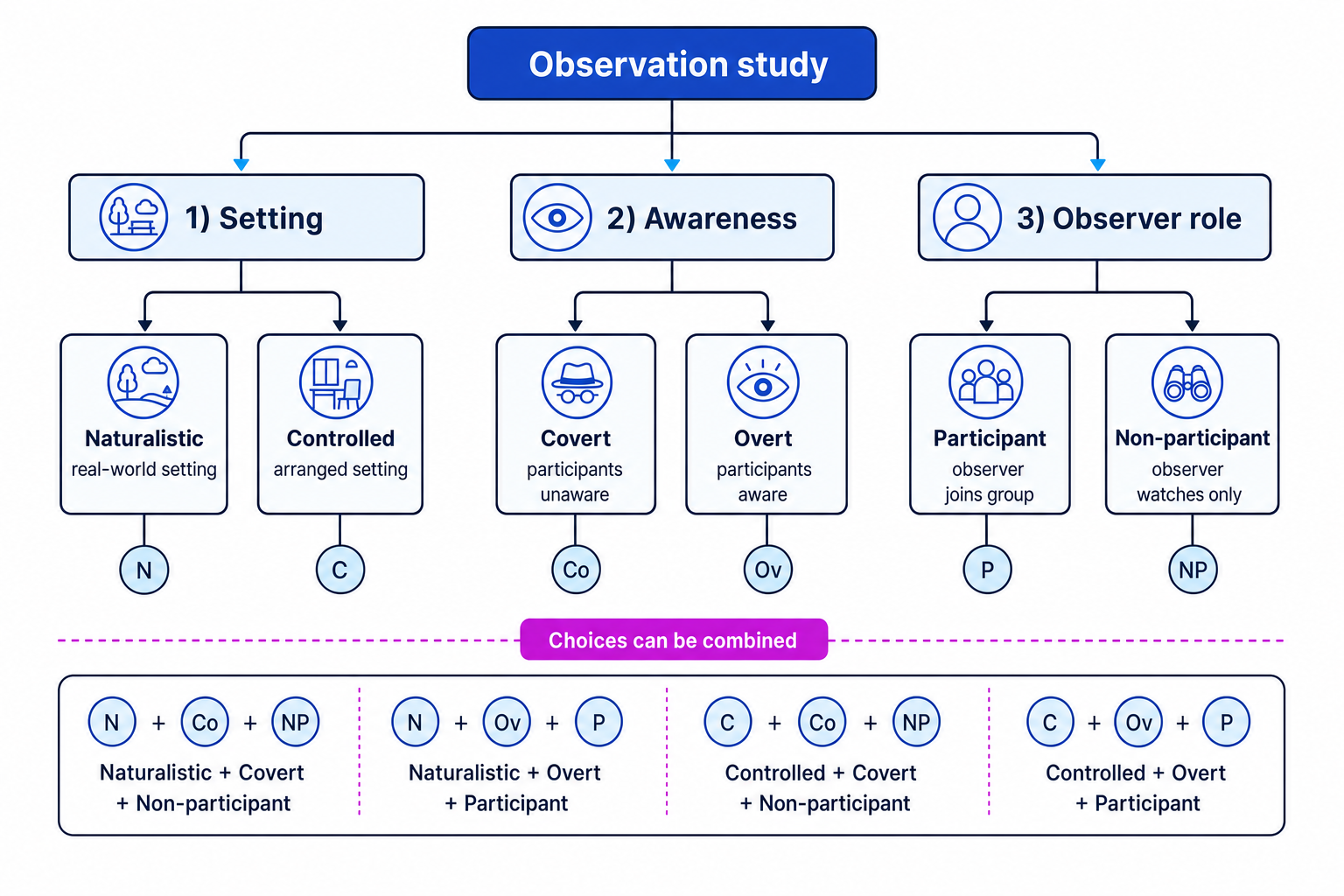
Three independent choices
Do not treat the type-pairs as one single scale. A study can be naturalistic and overt, controlled and covert, participant and naturalistic, and so on.
Naturalistic and controlled observations
Naturalistic observation
A naturalistic observation takes place in the participant’s normal environment, without the researcher arranging an artificial task or setting.
Naturalistic observation
A naturalistic observation is an observation of behaviour in a real-life setting where it would normally occur.
Examples include observing children sharing toys in a nursery, shoppers queuing in a supermarket, or students interacting in a school common room.
Strengths of naturalistic observation
Naturalistic observations often have high ecological validity.
Ecological validity
Ecological validity is the extent to which findings reflect behaviour in real-life settings.
Because people are observed in ordinary situations, their behaviour may be more natural and less affected by the research setting.
Limitations of naturalistic observation
The main weakness is low control. Many extraneous variables may affect behaviour.
Extraneous variable
An extraneous variable is any factor other than the main focus of the study that could influence behaviour.
For example, children may share more on one day because a teacher has just praised sharing, not because sharing is typical for that group.
Controlled observation
A controlled observation takes place in a structured situation arranged by the researcher. This may be a laboratory or another standardised setting.
Controlled observation
A controlled observation is an observation where the researcher sets up or standardises the situation in which behaviour is recorded.
A classic example is Ainsworth’s Strange Situation (Ainsworth, 1978), where infants’ attachment behaviours were observed during a set sequence of separations and reunions. This was controlled because each child experienced the same procedure. Ethically, parental consent was needed, the infant’s distress had to be monitored, and the parent could withdraw the child.
Strengths of controlled observation
Controlled observations are often easier to replicate because the procedure is standardised. They can also improve reliability.
Reliability
Reliability means consistency. In observations, this often means different observers would record the same behaviour in the same way.
Limitations of controlled observation
The artificial setting may reduce ecological validity. Participants may also show demand characteristics, where they change behaviour because they guess what the researcher expects.
Demand characteristics
Demand characteristics are cues in a study that lead participants to alter their behaviour because they think they know the aim.
Controlled observation is not automatically an experiment
A controlled observation may involve a standardised setting, but it does not necessarily manipulate an independent variable. If the researcher only watches and records behaviour, it is still an observation.
Choosing between naturalistic and controlled observation
A researcher wants to study how often young children comfort each other when upset.
- If the aim is to see comfort in everyday life, a naturalistic nursery observation is stronger because the behaviour occurs in its normal social context.
- If the aim is to compare children fairly, a controlled observation may be better because each child can experience the same mild situation.
- The ethical issue becomes more serious in the controlled version because the researcher may be creating distress, so protection from harm and the right to withdraw must be built into the procedure.
Covert and overt observations
Covert observation
A covert observation is one where participants do not know they are being observed.
Covert observation
A covert observation is an observation where participants are unaware that their behaviour is being recorded for research.
This can reduce the observer effect, where people change their behaviour because they know they are being watched.
Observer effect
The observer effect occurs when participants behave differently because they are aware of being observed.
Rosenhan’s study of psychiatric hospitals (Rosenhan, 1973) involved covert participant observation: pseudo-patients entered hospitals and staff did not know they were being studied. This produced powerful real-world evidence, but it raised ethical issues around deception, lack of informed consent, and possible harm to staff or hospital reputations. Confidentiality and debriefing were especially important concerns.
Overt observation
An overt observation is one where participants know they are being observed.
Overt observation
An overt observation is an observation where participants are aware that their behaviour is being recorded for research.
Overt observations are usually more ethical because participants can give informed consent, know their right to withdraw, and receive a debrief afterwards.
However, overt observation may reduce validity if participants act in a socially desirable way. For example, students who know they are being observed may appear more cooperative than usual.
Judging whether covert observation is justified
A researcher wants to observe whether people give up seats for elderly passengers on buses.
- Covert observation may improve validity because passengers are less likely to change their behaviour if they do not know they are being watched.
- The ethical cost is that passengers cannot give informed consent or exercise the right to withdraw during the observation.
- A reasonable compromise would be to record only anonymous behaviour in a public setting, avoid collecting identifying details, and consider whether a debrief is practical.
Participant and non-participant observations
Participant observation
A participant observation is where the researcher joins the group or situation being studied.
Participant observation
A participant observation is an observation where the researcher becomes part of the group or activity being observed.
This can give rich, detailed insight because the researcher experiences the situation from the inside. It is especially useful when studying closed groups or complex social settings.
However, participant observers may lose objectivity. They may become too involved, interpret behaviour through personal experience, or influence the group’s behaviour by taking part.
Non-participant observation
A non-participant observation is where the researcher observes without joining in.
Non-participant observation
A non-participant observation is an observation where the researcher remains separate from the people or behaviour being observed.
This can be more objective because the researcher is not directly involved. It is also easier to use a checklist, video recording, or multiple observers to improve reliability.
The downside is that the observer may miss the meaning behind the behaviour. Watching from the outside can produce less detailed understanding than being part of the group.
Quick classification shortcut
Ask three questions in order: Where is it happening? Naturalistic or controlled. Do participants know? Covert or overt. Does the observer join in? Participant or non-participant.
Classifying a combined observation
A researcher joins an online gaming community using a normal player account. They do not tell members they are a psychologist. They record how often players offer emotional support after a teammate makes a mistake.
- The setting is the community’s normal online environment, so this is a naturalistic observation.
- Members do not know they are being studied, so it is covert.
- The researcher joins the group as a player, so it is participant observation.
Evaluating observations in AO3
For AO3, do not just say “this is good” or “this is bad”. Link each technique to a specific issue: validity, reliability, ethics, or practicality.
| Technique | Main strength | Main limitation |
|---|---|---|
| Naturalistic | High ecological validity because behaviour occurs in real life | Low control over extraneous variables |
| Controlled | Easier to standardise, replicate, and compare participants | May be artificial and create demand characteristics |
| Covert | Reduces observer effect and may increase natural behaviour | Ethical problems with consent, deception, and withdrawal |
| Overt | More ethical because participants know they are being studied | Participants may alter behaviour |
| Participant | Rich insight into the group’s experience | Risk of bias and loss of objectivity |
| Non-participant | More detached and easier to record systematically | May miss deeper meanings behind behaviour |
Ethics in observational research
The key ethical issues are:
- Informed consent: do participants know what they are agreeing to?
- Deception: are participants misled about being observed?
- Right to withdraw: can participants leave or remove their data?
- Protection from harm: could the observation cause stress, embarrassment, or reputational damage?
- Confidentiality: are identities protected?
- Debrief: are participants told the true aim afterwards where possible?
Covert observations are the most ethically sensitive, but even overt observations need care. For example, observing children requires parental consent, child-friendly explanations where possible, and protection from distress.
In the exam
- When asked to identify a type of observation, classify it using the three separate dimensions: setting, awareness, and observer role.
- When evaluating, make the trade-off clear: for example, covert observation may improve validity but creates ethical problems.
- Use scenario details precisely. If the researcher joins the group, say participant; if they only watch or record, say non-participant.
Check yourself
- How is a naturalistic observation different from a controlled observation?
- Why might a covert observation have higher validity but weaker ethics?
- In what situation would participant observation be more useful than non-participant observation?
