What you'll learn:
- How genetics can create a biological vulnerability to addiction.
- The role of personality traits, such as impulsivity and antisocial personality disorder.
- How social influences from family members and peers shape addictive behaviours.
- Why no single risk factor works in isolation, and how they interact to cause addiction.
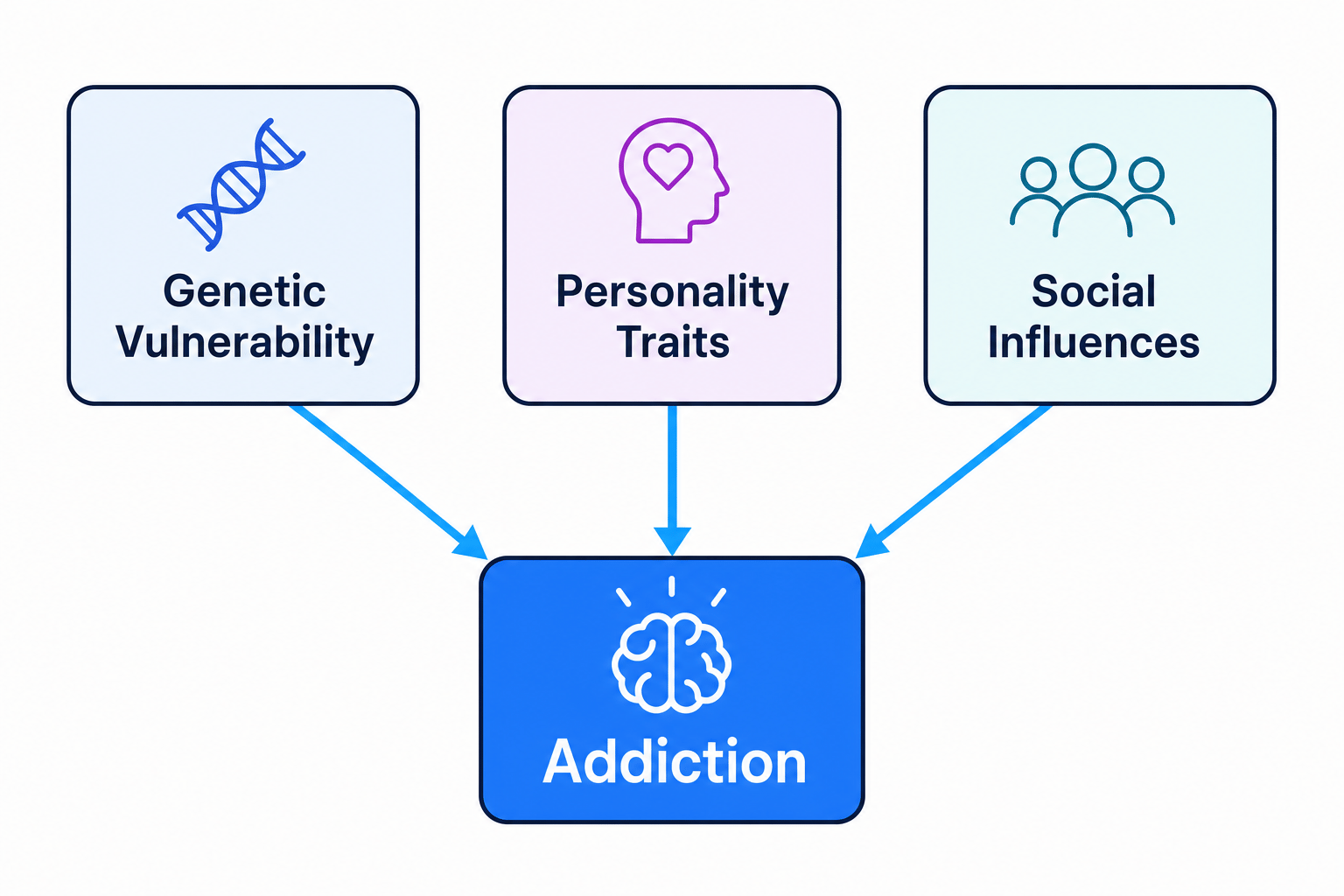
Why do some people try smoking once and never touch a cigarette again, while others develop a lifelong dependency? The answer lies in risk factors. Rather than pointing to a single cause, psychologists look at a combination of biological, psychological, and social variables that increase an individual's vulnerability to addiction.
Genetic vulnerability
You cannot inherit an "addiction" directly, but you can inherit a biological predisposition that makes you much more likely to become addicted if you are exposed to a substance or behaviour.
Genetic vulnerability
An inherited predisposition that increases the risk of a disorder or condition (like addiction) developing, usually through the inheritance of specific gene variants.
Genetics can affect addiction in two main ways: dopamine systems and metabolism.
The dopamine system
The neurotransmitter dopamine is deeply involved in the brain's reward pathway. Some people inherit genes that leave them with fewer D2 dopamine receptors. Because they have abnormally low levels of baseline dopamine activity, they may turn to addictive substances or behaviours (like drugs or gambling) to artificially boost their dopamine levels and feel "normal" or experience pleasure.
Metabolism
Genetics also dictate how quickly our bodies break down (metabolise) substances. For instance, some people inherit a fully functioning version of the CYP2A6 enzyme, which breaks down nicotine very quickly. Because the nicotine leaves their system fast, they need to smoke more frequently to maintain the effects, putting them at a higher risk of nicotine addiction. People with a defective CYP2A6 gene metabolise nicotine much more slowly, and so they are significantly less likely to become addicted to smoking.
Key research: Kendler et al. (2012) used data from the National Swedish Adoption Study. They found that adopted children who had a biological parent with a severe addiction were at a significantly greater risk of developing an addiction themselves, compared to those without an addicted biological parent. Because these children were raised in a different environment to their biological parents, this strongly supports the role of genetics.
Spotting the difference
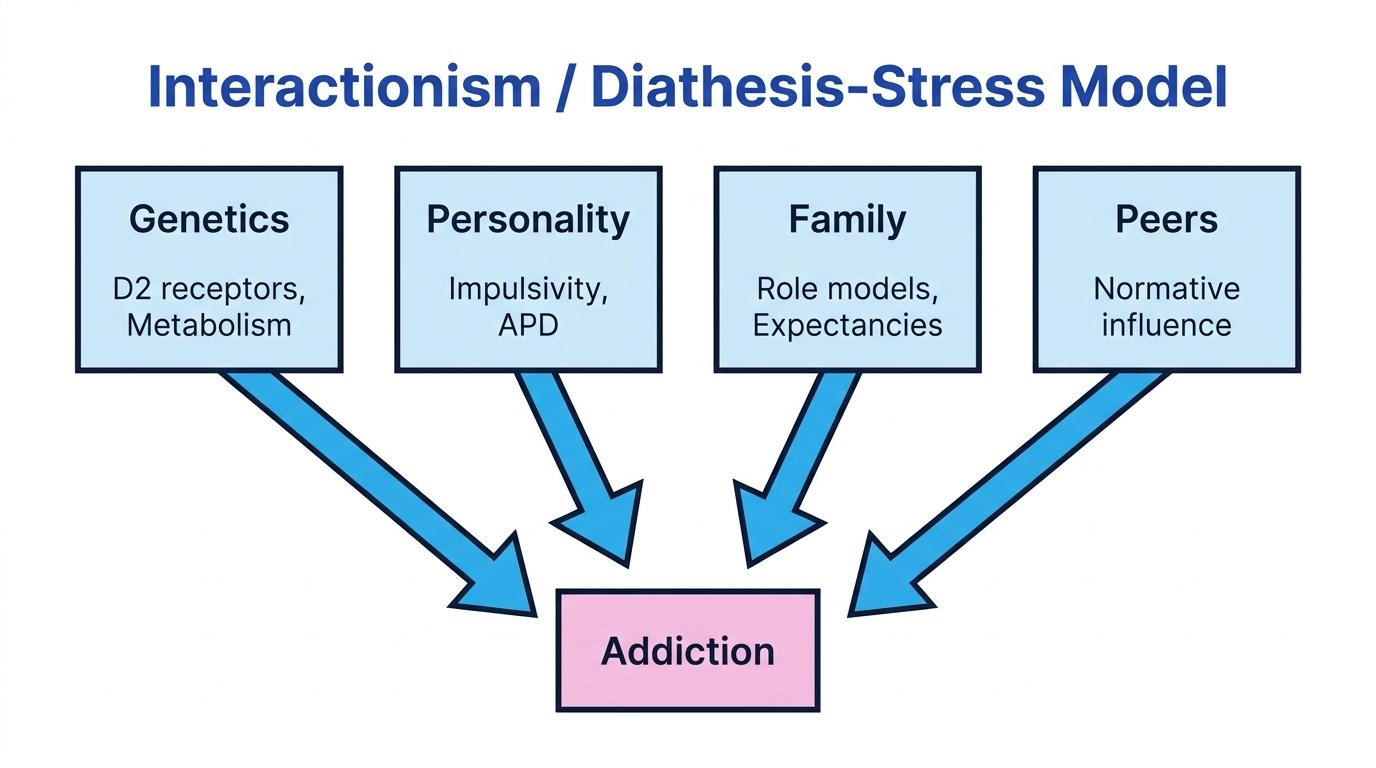
Remember that genetic vulnerability does not mean addiction is inevitable. Genes load the gun, but the environment pulls the trigger. This is known as a diathesis-stress model.
Personality
Psychologists have identified several personality traits that correlate strongly with addiction. There is no single "addictive personality", but certain traits drastically increase vulnerability.
Impulsivity
Impulsivity is a core personality trait involved in addiction. Impulsive individuals act on a whim without considering the long-term consequences of their actions. Because they are seeking immediate gratification, they are more likely to take risks, such as trying illicit drugs or gambling, and less likely to stop when negative consequences arise.
Antisocial Personality Disorder (APD)
APD is heavily linked to addiction. APD is characterised by a lack of regard for social norms, deceitfulness, and a lack of remorse.
Key research: Ivanov et al. (2008) reviewed studies on the link between impulsivity, APD, and addiction. They concluded that many of the characteristics of APD (particularly high impulsivity) are a direct cause of addiction, suggesting that early treatment of severe impulsivity could prevent the later development of addictive behaviours.
Cause and effect
A major pitfall in exam answers is stating that personality definitely causes addiction. Much of the research is correlational. It is entirely possible that a lifetime of addiction alters a person's brain chemistry and personality, making them more impulsive. This is known as a bidirectional relationship.
Social influences: Family
The people we grow up around have a profound impact on our behaviour. Family influences operate largely through the principles of Social Learning Theory.
Observation and imitation
According to Social Learning Theory (Bandura, 1977), we learn by observing the behaviour of role models. Parents and older siblings are our primary role models during childhood. If a child grows up watching their parents drink alcohol heavily or smoke to relieve stress, they are likely to imitate this behaviour.
Expectancies
Through watching family members, children form cognitive schemas about what a substance does. These are called expectancies. If a teenager has seen their mother drink wine every time she is stressed and subsequently appear more relaxed, the teenager develops a positive expectancy: alcohol cures stress. This makes them highly vulnerable to using alcohol as a coping mechanism themselves.
Social influences: Peers
As children transition into adolescence, peer groups often overtake the family as the primary social influence.
Normative social influence
Peers introduce individuals to addictive behaviours and provide opportunities to engage in them. This is often driven by normative social influence — the desire to fit in and be accepted by the group.
Social Identity Theory
O'Connell et al. (2009) proposed that there are three major elements to peer influence in alcohol addiction:
- At-risk adolescents associate with peers who consume alcohol.
- The peer group provides more opportunities for the individual to drink.
- The individual over-estimates how much their peers are drinking (they think "everyone is getting drunk all the time"), which creates a skewed social norm that they strive to match.
Interactionism
In reality, no single risk factor operates alone. A teenager might have a genetic vulnerability (low D2 receptors), but if they are raised in a supportive family and have peers who despise smoking, they may never develop an addiction. Risk factors interact.
Applying risk factors to a scenario
In AO2 application questions, you may be given a scenario and asked to explain the development of an addiction. Let's look at how to break down a case study:
Scenario: Maya has recently developed a severe gambling addiction. Her biological father, whom she has never met, was treated for alcoholism. Maya has always been a thrill-seeker who acts without thinking. Recently, she started working at a casino where her colleagues frequently place bets after their shifts.
Here is how you would systematically apply the risk factors to Maya's case:
- Identify the genetic vulnerability: State that Maya's biological father had an addiction (alcoholism). Explain that, despite never meeting him, she may have inherited a genetic predisposition (such as a deficiency in D2 dopamine receptors) which makes her biologically vulnerable to addictive behaviours.
- Identify the personality factor: Pick out the phrase "thrill-seeker who acts without thinking". Explicitly link this to the personality trait of impulsivity. Explain that this trait means Maya seeks immediate gratification and ignores long-term financial consequences, driving her gambling.
- Identify the social influence (peers): Identify her casino colleagues as the peer influence. Explain that through Social Learning Theory and normative social influence, she is observing her peers gambling and joining in to fit into the workplace social group.
- Combine using interactionism: Conclude by stating that Maya's addiction is a result of a diathesis-stress interaction: her genetic vulnerability (diathesis) was triggered by her impulsive personality and the environmental stressor of a gambling-heavy peer group.
Evaluating risk factors
When writing an essay on risk factors, use these evaluation points to build a critical argument:
Methodological issues (Retrospective data)
A major weakness of research into risk factors—especially family and peer influences—is that it often relies on retrospective data. Addicts are asked to recall their childhoods, family dynamics, and teenage peer groups. Addiction can warp a person's memory and perception, meaning their recall might be inaccurate or biased, lowering the internal validity of the research.
Real-world application
A significant strength of understanding these risk factors is that it allows for targeted interventions. If we know that high impulsivity and a family history of addiction are severe risk factors, schools and health professionals can identify at-risk youths early. Interventions can then be put in place, such as teaching emotional regulation or providing alternative coping mechanisms, preventing the addiction from developing in the first place.
In the exam
- Watch the command word: If the question asks for "Social influences", you must discuss family or peers. Do not waste time discussing genetics unless the question asks for "Risk factors" broadly.
- Link back to addiction: Don't just describe a trait like impulsivity; you must explain how it leads to addiction (e.g., ignoring negative consequences to seek an immediate "high").
- Use the Diathesis-Stress model for your conclusion: In a 16-mark essay, the easiest way to secure top AO3 marks is to argue that looking at risk factors in isolation is reductionist, and an interactionist approach is far more valid.
Check yourself
- Can you explain how inheriting fewer D2 dopamine receptors increases the risk of addiction?
- What are the two main personality traits linked to addiction?
- How does Social Learning Theory explain the role of family in the development of addiction?
- Why is it difficult to establish a cause-and-effect relationship between personality and addiction?