What you'll learn
- What psychologists mean by addiction, including substance and behavioural addictions.
- The difference between physical dependence and psychological dependence.
- How tolerance and withdrawal syndrome help explain why addictions can continue.
- How to apply these ideas to scenarios and evaluate them for AO3.
Starting point: what counts as addiction?
Addiction is not just “liking something a lot”. In psychology, addiction describes a pattern of behaviour where a person finds it difficult to control their use of a substance or engagement in a behaviour, even when it causes harm.
A substance addiction involves repeated use of a drug, such as nicotine, alcohol, heroin or cannabis. A behavioural addiction involves repeated engagement in an activity, such as gambling, gaming or online activity, without taking a drug into the body.
Addiction
Addiction is a compulsive pattern of substance use or behaviour that involves loss of control, continued use despite negative consequences, and often dependence, tolerance and withdrawal.
Addiction is best understood as a cluster of features, not a single symptom. For example, one person may show strong cravings and relapse, while another may show severe physical withdrawal. Both could still be described as addicted if the overall pattern is compulsive and harmful.
Addiction is a pattern
For AQA, the key descriptive features are physical dependence, psychological dependence, tolerance and withdrawal syndrome. These help you describe what addiction looks like.
Reinforcement: why addiction can be maintained
Before we look at the main descriptive terms, it helps to understand reinforcement. Reinforcement means a consequence that makes a behaviour more likely to happen again.
Positive reinforcement occurs when a behaviour produces something pleasant, such as pleasure, excitement or relaxation. For example, smoking a cigarette may produce a short-term feeling of calm.
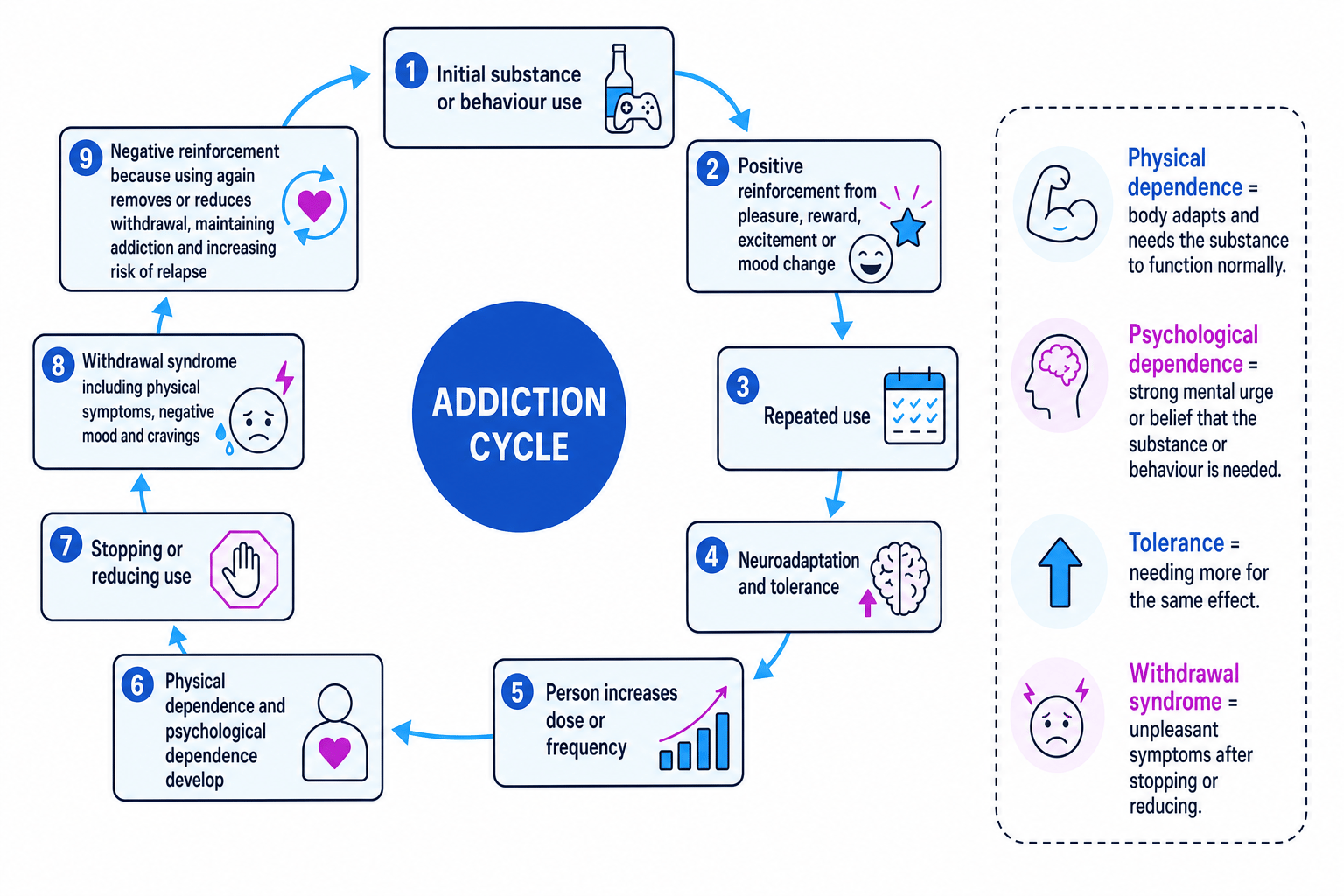
Negative reinforcement occurs when a behaviour removes something unpleasant. For example, smoking again may remove nicotine withdrawal symptoms, making the person more likely to smoke in future.
This matters because addictions may begin through positive reinforcement but become maintained by negative reinforcement.
Physical dependence and psychological dependence
Dependence means that the person has come to rely on the substance or behaviour. A useful distinction is between physical and psychological dependence.
Physical and psychological dependence
Physical dependence is when the body has adapted to a substance, so the person needs it to avoid unpleasant bodily symptoms.
Psychological dependence is when the person feels a strong mental need, urge or craving for the substance or behaviour, often believing they need it to cope or feel normal.
A craving is an intense desire or urge to use a substance or repeat a behaviour. Cravings are especially important in psychological dependence because they can trigger relapse even after physical symptoms have faded.
Physical dependence is most obvious in substance addictions. For example, a person dependent on alcohol may experience shaking, sweating or nausea when they stop drinking. Psychological dependence can occur in both substance and behavioural addictions. For example, a gambler may feel unable to relax unless they place a bet.
| Feature | Physical dependence | Psychological dependence |
|---|---|---|
| Main focus | Body adaptation | Mental urge or emotional reliance |
| Common signs | Shaking, sweating, nausea, headaches, sleep disturbance | Cravings, preoccupation, anxiety, feeling unable to cope |
| Often seen in | Substance addictions | Substance and behavioural addictions |
| Example | Needing nicotine to avoid irritability and headaches | Believing “I can’t get through the day without vaping” |
Psychological does not mean imaginary
Psychological dependence is real and can be extremely powerful. Do not imply it is “less serious” just because it is not mainly about bodily symptoms.
Classifying dependence in a scenario
Ali used to vape occasionally, but now vapes before lessons, during breaks and after school. When he cannot vape, he feels shaky and irritable. He also says, “I can’t concentrate unless I vape.”
- The increased frequency suggests Ali’s vaping has become more central to his daily routine, which supports the idea of dependence.
- Feeling shaky when he cannot vape suggests physical dependence, because his body appears to react unpleasantly when nicotine is absent.
- Saying “I can’t concentrate unless I vape” suggests psychological dependence, because Ali believes he needs vaping to function normally.
- The strongest answer would identify both types of dependence and use details from the scenario to justify each one.
Tolerance
Tolerance is about a change in the effect of a substance or behaviour over time. The person may need more of it to get the same effect, or the same amount may produce a weaker effect than before.
Tolerance
Tolerance is when repeated use of a substance or behaviour leads to a reduced effect, so the person needs a larger amount, higher frequency or greater intensity to achieve the same effect.
In substance addictions, tolerance can happen because of neuroadaptation. Neuroadaptation means the brain and body adjust to repeated exposure to a substance. For example, if nicotine is repeatedly present, the nervous system may adapt, so the same number of cigarettes no longer produces the same effect.
In behavioural addictions, tolerance may appear as escalation. A gambler might need to bet larger amounts of money to feel the same excitement.
Tolerance phrasing
You can describe tolerance in either direction: “needing more for the same effect” or “getting less effect from the same amount.” Both are correct.
Identifying tolerance
Maya used to feel relaxed after one glass of wine. Over several months, she finds that one glass has little effect, and she now drinks three glasses to feel the same level of relaxation.
- Compare the original effect with the later effect: one glass used to produce relaxation, but now it produces little effect.
- Identify the change in amount: Maya now drinks three glasses to achieve the same effect.
- Apply the definition: this is tolerance, because she needs more of the substance for the same psychological effect.
- Avoid overclaiming: the scenario does not, by itself, prove withdrawal or addiction unless there is evidence of dependence, loss of control or continued harm.
Withdrawal syndrome
Withdrawal is what may happen when a person stops or reduces use after dependence has developed.
Withdrawal syndrome
Withdrawal syndrome is a collection of unpleasant physical and psychological symptoms that occur when a person stops or reduces a substance or behaviour on which they are dependent.
The word syndrome means a group of symptoms that tend to occur together. Withdrawal symptoms vary depending on the substance or behaviour, but may include shaking, sweating, nausea, headaches, sleep problems, irritability, low mood, anxiety and cravings.
Withdrawal is important because it can maintain addiction through negative reinforcement. If using the substance again removes withdrawal symptoms, the person learns that using brings relief. This makes future use more likely.
Withdrawal can be medically serious
Withdrawal from some substances, especially heavy alcohol use or benzodiazepines, can be dangerous and may require medical supervision. In an exam, avoid treating all withdrawal as merely “feeling uncomfortable”.
Explaining relapse after withdrawal
Sam has stopped smoking for two days. He feels irritable, has headaches and cannot stop thinking about cigarettes. After smoking again, the headache and irritability reduce, and he feels relieved.
- The headaches and irritability after stopping smoking are withdrawal symptoms, suggesting physical dependence on nicotine.
- Thinking constantly about cigarettes shows craving, which is a sign of psychological dependence.
- Smoking again removes unpleasant withdrawal symptoms, so the behaviour is negatively reinforced.
- This helps explain relapse because Sam is more likely to smoke again in future when withdrawal symptoms return.
Putting the features together
In real life, the features overlap. A person may develop tolerance, increase their use, become physically and psychologically dependent, experience withdrawal when they try to stop, and then return to the substance or behaviour to relieve withdrawal.
For example, nicotine addiction may involve:
- Tolerance: needing more cigarettes or stronger nicotine products for the same effect.
- Physical dependence: headaches or irritability when nicotine levels drop.
- Psychological dependence: feeling unable to cope with stress without smoking.
- Withdrawal syndrome: a cluster of symptoms when trying to quit.
- Negative reinforcement: smoking again reduces withdrawal, maintaining the addiction.
Gambling addiction may be slightly different because there is no drug entering the body. However, a gambler may still show psychological dependence, tolerance-like escalation and withdrawal-like symptoms such as restlessness or irritability when trying to stop.
AO3 evaluation: strengths and limitations of these descriptions
Strength: they give clear features to describe
The terms physical dependence, psychological dependence, tolerance and withdrawal give psychologists a shared vocabulary. This is useful in diagnosis, treatment planning and research.
For example, if a person has strong physical dependence on alcohol, treatment may need to include medically supervised detoxification. If psychological dependence is strongest, therapy may focus more on cravings, triggers and coping strategies.
Limitation: physical dependence is not the same as addiction
A person can be physically dependent without showing the full pattern of addiction. For instance, someone taking prescribed medication may develop tolerance or withdrawal symptoms but may not compulsively misuse the drug or continue despite harm.
This means tolerance and withdrawal are useful descriptive signs, but they are not enough on their own to prove addiction.
Limitation: behavioural addictions challenge a purely physical view
Behavioural addictions, such as gambling disorder, show that addiction is not always based on a substance changing the body directly. Gamblers may not have classic drug withdrawal, but they can still experience cravings, distress, loss of control and relapse.
This suggests addiction should be described using both biological and psychological features, rather than only physical dependence.
Methodological and ethical issues
Studying addiction often relies on self-report, such as interviews or questionnaires. This can be useful because it gives insight into cravings and psychological dependence, but people may under-report symptoms due to shame, denial or fear of consequences.
Ethically, psychologists must consider confidentiality, informed consent, protection from harm and the right to withdraw. It would be unethical to deliberately trigger severe withdrawal without proper safeguards, so researchers and clinicians must be especially careful when working with vulnerable participants.
In the exam
- Define each term precisely: physical dependence is bodily reliance, psychological dependence is mental reliance or craving, tolerance is needing more for the same effect, and withdrawal syndrome is unpleasant symptoms after stopping or reducing.
- For AO2 scenarios, quote the behaviour and map it to the term: “shaking when unable to smoke” is stronger evidence for physical dependence than simply saying “he is addicted”.
- For AO3, be nuanced: these features are useful, but addiction is not proved by one feature alone, and behavioural addictions may show the features differently.
Check yourself
- How would you tell the difference between tolerance and withdrawal in a scenario?
- Why might someone be physically dependent on a substance but not necessarily addicted?
- How could gambling show psychological dependence and withdrawal-like symptoms?
