What you'll learn
- How nicotine affects brain neurochemistry, especially dopamine in the reward system.
- How learning theory explains why smoking is started, maintained, and repeated.
- What cue reactivity means and why it helps explain relapse.
- How to evaluate these explanations for AQA essay answers.
Starting point: what is nicotine addiction?
Addiction
Addiction is a pattern of compulsive substance use where a person feels driven to keep using the substance, often despite negative consequences. It can involve physical dependence — the body adapts to the substance — and psychological dependence — the person feels they need it to cope, feel normal, or reduce craving.
Nicotine is the main addictive drug in tobacco products such as cigarettes and vapes. It is psychoactive, meaning it changes brain activity and affects mood, attention, and motivation.
For AQA, you need two main explanations:
- Brain neurochemistry: nicotine changes neurotransmitter activity, especially dopamine.
- Learning theory: smoking is learned through association and reinforcement, especially when cues trigger craving.
The big picture
Nicotine addiction is not just “liking cigarettes”. Nicotine changes the brain’s reward system, while repeated smoking teaches the person that certain situations, moods, and cues predict reward or relief.
Brain neurochemistry: nicotine and dopamine
Brain neurochemistry
Brain neurochemistry refers to how chemical messengers in the brain influence behaviour. A neurotransmitter is a chemical messenger that passes signals between neurons. Dopamine is a neurotransmitter strongly linked to reward, motivation, and reinforcement.
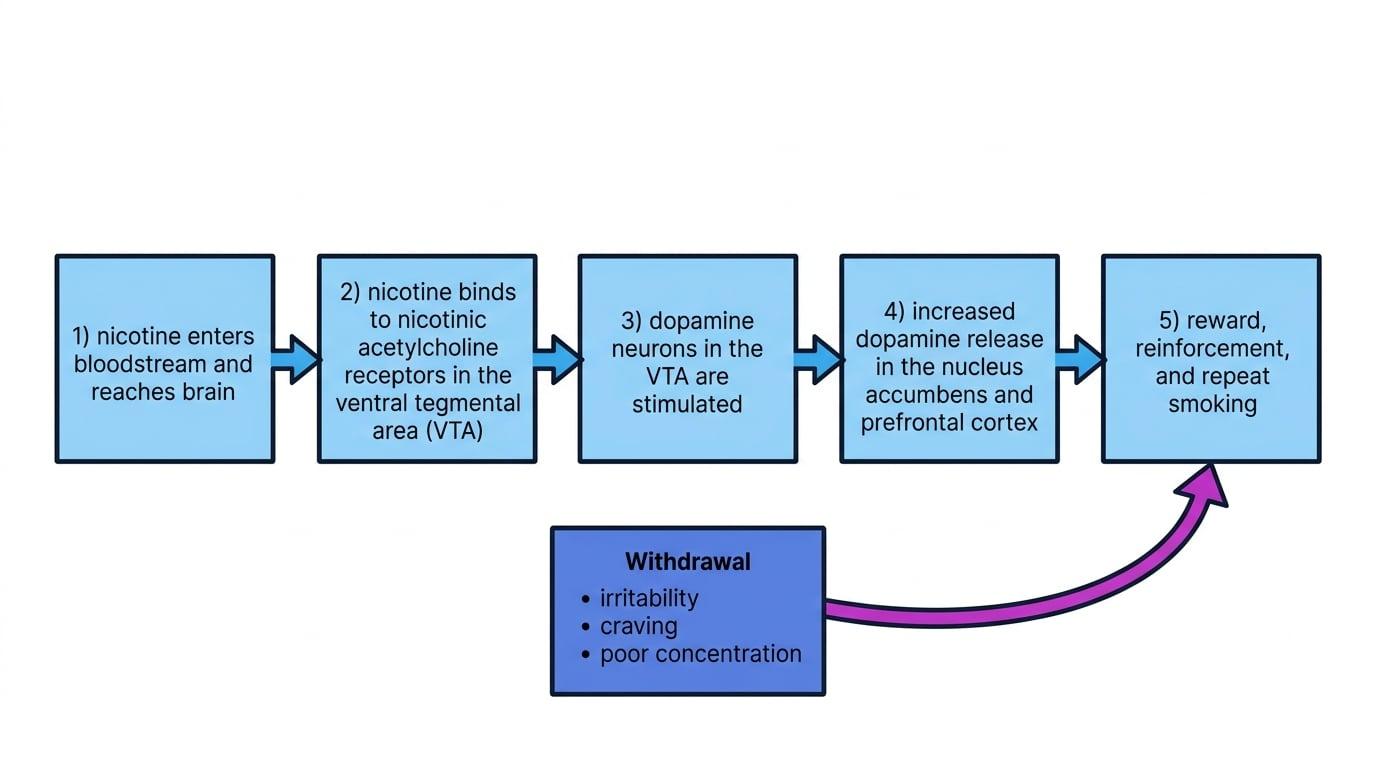
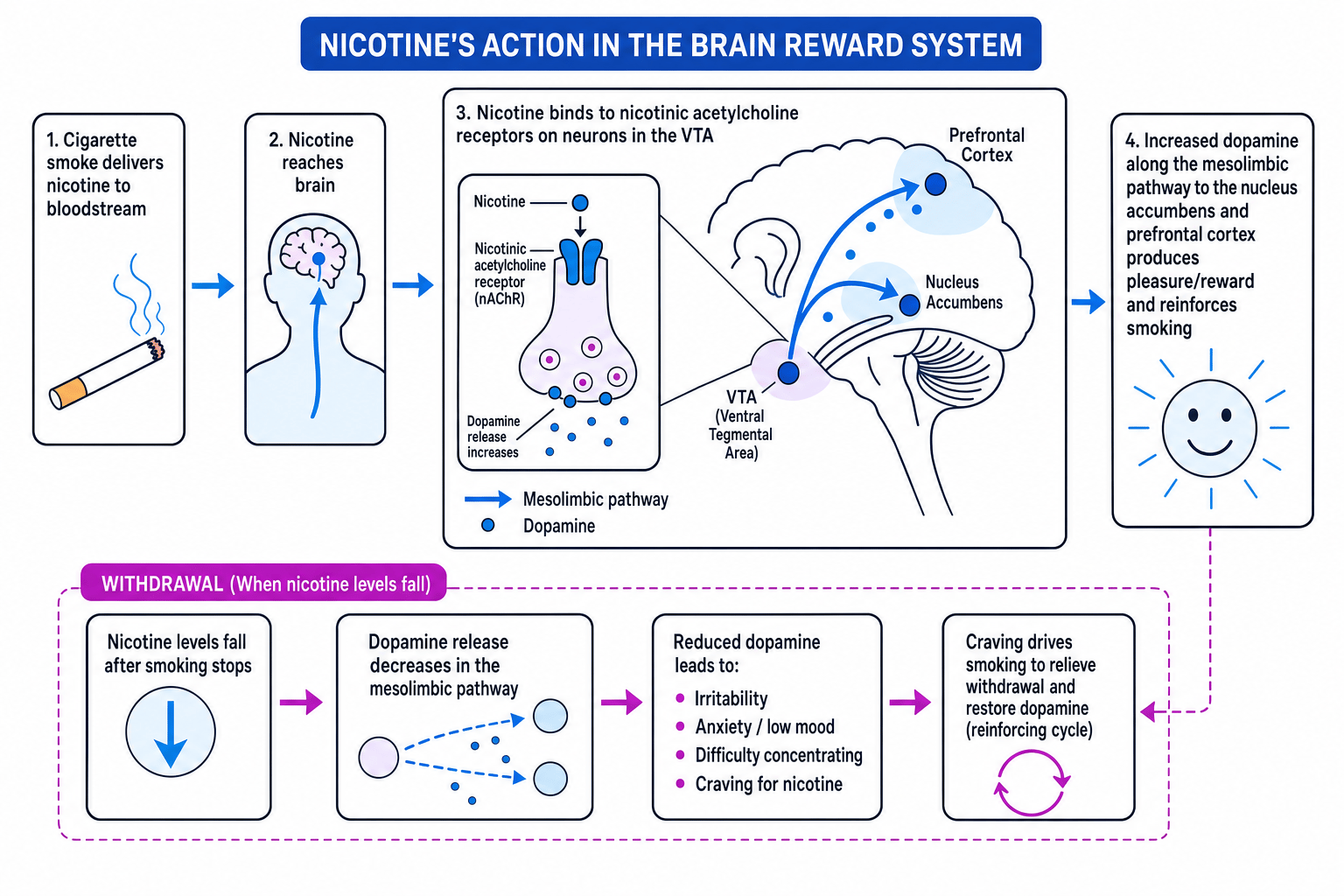
When nicotine enters the bloodstream, it reaches the brain quickly. There it binds to nicotinic acetylcholine receptors, which are receptor sites normally activated by the neurotransmitter acetylcholine.
A key area is the ventral tegmental area, often shortened to VTA, which is part of the brain’s reward system. Nicotine stimulates dopamine neurons in the VTA, increasing dopamine release in the nucleus accumbens, an area involved in pleasure and reinforcement. Dopamine activity also affects the prefrontal cortex, which is involved in planning, attention, and decision-making.
Why dopamine matters
Dopamine does not simply mean “pleasure”. More accurately, dopamine helps the brain learn that a behaviour is worth repeating. If smoking produces a rewarding dopamine response, the brain becomes more likely to repeat smoking in the future.
Over time, repeated nicotine use can lead to tolerance, where the person needs more nicotine to get the same effect. When nicotine levels fall, the person may experience withdrawal, which is a set of unpleasant symptoms such as irritability, low mood, difficulty concentrating, restlessness, and craving.
Tolerance and withdrawal
Tolerance means the body becomes less responsive to a drug after repeated use. Withdrawal means unpleasant physical or psychological symptoms occur when the drug is reduced or stopped.
Explaining morning smoking
A smoker says: “I need a cigarette first thing in the morning because I feel tense and irritable until I smoke.”
- Nicotine from the cigarette reaches the brain and stimulates nicotinic acetylcholine receptors, increasing dopamine activity in the reward pathway.
- The dopamine response makes smoking rewarding, so smoking is more likely to be repeated.
- Overnight, nicotine levels fall, so the smoker may experience withdrawal symptoms such as irritability and tension.
- Smoking again reduces these unpleasant withdrawal symptoms, so the behaviour is strengthened because it brings relief.
Evaluation of the neurochemical explanation
A major strength is that there is supporting evidence from biological research. Corrigall et al. (1992) found that rats would self-administer nicotine, suggesting nicotine has reinforcing properties. When dopamine activity in the mesolimbic reward pathway was disrupted, nicotine self-administration reduced. This supports the role of dopamine in maintaining nicotine use.
Human research also supports the explanation. Brody et al. (2004) used brain-imaging evidence to show that cigarette smoking was associated with dopamine release in reward-related brain areas. This gives the explanation scientific credibility because it links nicotine use to observable brain activity.
However, there are methodological and ethical issues. Animal studies allow tight control over variables, but rats do not have the same social, cultural, and cognitive reasons for smoking as humans. Animal addiction research also raises ethical concerns about harm, so researchers should justify the value of the study and follow the principles of reduction, refinement, and replacement where possible.
Human brain-imaging research has better relevance to real smokers, but participants must give informed consent, understand any risks, have the right to withdraw, and be debriefed. Researchers also need to protect participants from harm, especially if the study involves smoking or exposure to smoking-related cues.
A practical strength is that the neurochemical explanation has led to treatments. Nicotine replacement therapy, such as patches or gum, gives controlled doses of nicotine without tobacco smoke. Varenicline partly stimulates nicotinic receptors, reducing withdrawal and making smoking less rewarding. This shows that understanding brain chemistry can help reduce addiction.
Dopamine is not the whole answer
Do not write that nicotine addiction is “caused by dopamine” as if dopamine is the only factor. Dopamine is important, but addiction also involves learning, cues, stress, social influences, and individual differences.
Learning theory: how smoking becomes a habit
Learning theory
Learning theory explains behaviour as something acquired through experience. In nicotine addiction, smoking is learned because it becomes associated with rewards, relief, people, places, emotions, and routines.
There are two key learning processes: classical conditioning and operant conditioning.
Classical conditioning and smoking cues
Classical conditioning
Classical conditioning is learning by association. A previously neutral stimulus becomes linked with a response because it has been repeatedly paired with something meaningful.
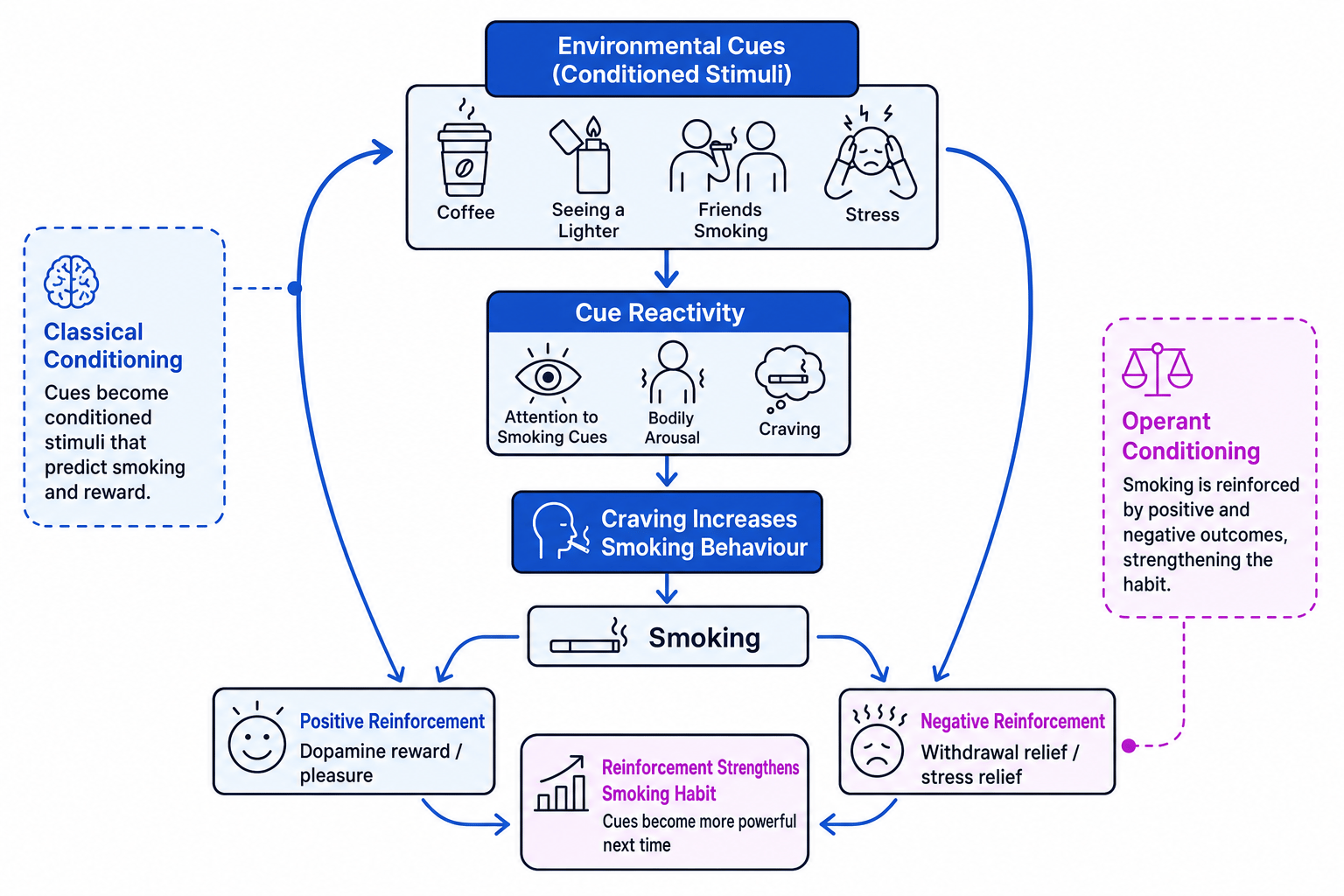
At first, objects such as a lighter, coffee, a pub, or a certain group of friends may be neutral. After repeated pairing with smoking, these become conditioned stimuli, meaning they can trigger craving on their own. The craving is the conditioned response.
For example, if someone always smokes while drinking coffee, coffee may begin to trigger cravings even when no cigarette is present.
Operant conditioning: reward and relief
Operant conditioning
Operant conditioning is learning through consequences. A behaviour is more likely to be repeated if it is reinforced. Positive reinforcement means gaining something pleasant. Negative reinforcement means removing something unpleasant.
Smoking can be maintained by both types of reinforcement:
- Positive reinforcement: nicotine produces a rewarding dopamine effect, so the person repeats smoking.
- Negative reinforcement: smoking reduces withdrawal symptoms or stress, so the person repeats smoking to feel normal again.
Negative reinforcement is not punishment
Negative reinforcement does not mean the behaviour is punished. It means the behaviour increases because it removes something unpleasant, such as cravings or irritability.
Cue reactivity: why relapse can feel sudden
Cue reactivity
Cue reactivity is the psychological and physical response triggered by addiction-related cues. In nicotine addiction, cues such as seeing cigarettes, smelling smoke, feeling stressed, or being with smoking friends can produce craving, attention to smoking cues, and bodily arousal.
Cue reactivity links biological and learning explanations. The brain has learned that certain cues predict nicotine reward or withdrawal relief. When those cues appear, the person experiences craving, which increases the chance of smoking or relapse.
Explaining relapse after a cue
Aisha has stopped smoking for three weeks. At a party, she smells cigarette smoke and sees her friends smoking outside. She suddenly craves a cigarette and relapses.
- The smell of smoke and seeing friends smoking are conditioned stimuli because they have been repeatedly paired with smoking in the past.
- These cues trigger cue reactivity: Aisha’s attention focuses on cigarettes and she experiences craving.
- If she smokes, nicotine may produce reward, which is positive reinforcement.
- If smoking also reduces craving or social discomfort, it is negative reinforcement, making relapse more likely in similar situations later.
Evaluation of learning theory and cue reactivity
A strength is strong research support. Carter and Tiffany (1999) reviewed cue-reactivity studies and found that drug-related cues reliably increased craving. This supports the idea that environmental triggers can produce learned responses in addiction.
Learning theory also has real-world application. Treatments such as cognitive behavioural therapy can help smokers identify high-risk cues and plan coping strategies. For example, someone might avoid smoking areas, change their coffee routine, or practise refusal skills with smoking friends.
However, cue exposure treatments have had mixed success. Conklin and Tiffany (2002) argued that extinction learning can be highly context-specific. Extinction means a learned association weakens when the cue is repeatedly presented without the reward. A smoker may cope with cues in a clinic but still relapse in a pub, at work, or during stress because real-life cues are more complex.
There are also ethical issues in cue-reactivity research. Showing smoking cues to dependent smokers may increase craving and risk relapse. Researchers must gain informed consent, protect participants from harm, remind them of their right to withdraw, keep data confidential, and debrief them with support information if needed.
A limitation is that learning theory may explain maintenance and relapse better than the very first cigarette. Many people first smoke because of peer influence, curiosity, identity, stress, or availability. Learning processes then make the behaviour more automatic and harder to stop.
Best essay balance
A strong answer does not treat biological and learning explanations as rivals. Use the neurochemical explanation for why nicotine is rewarding, then use learning theory and cue reactivity to explain why particular situations trigger craving and relapse.
Bringing the explanations together
The most convincing explanation is interactionist, meaning it combines more than one level of explanation.
Nicotine affects the dopamine reward system, so smoking feels rewarding or relieving. Through classical conditioning, cues such as coffee, stress, alcohol, friends, or the smell of smoke become linked to nicotine. Through operant conditioning, smoking is reinforced because it produces reward and removes withdrawal. Cue reactivity then explains why relapse can happen even after a period of abstinence.
In the exam
- Start with clear AO1: describe nicotine binding to nicotinic acetylcholine receptors, dopamine release in the reward pathway, and reinforcement.
- Add learning theory: use the terms classical conditioning, operant conditioning, positive reinforcement, negative reinforcement, and cue reactivity accurately.
- Evaluate with evidence and limitations: mention research support, real-world applications, animal or lab-method issues, and ethical concerns in human cue-reactivity studies.
Check yourself
- How does nicotine increase dopamine activity in the brain’s reward pathway?
- What is the difference between positive reinforcement and negative reinforcement in smoking?
- Why might a smoking cue trigger relapse even after someone has stopped for several weeks?