Welcome to the topic of Obedience! In our daily lives, we follow instructions from teachers, police officers, and managers without a second thought. But what happens when an authority figure asks us to do something harmful?
What you'll learn:
- How situational factors like location, uniform, and physical distance affect obedience (based on Milgram’s famous research).
- The social-psychological explanations for obedience: the agentic state and legitimacy of authority.
- The dispositional (personality) explanation for obedience: the Authoritarian Personality.
Setting the Scene: Milgram's Baseline Study (1963)
To understand this topic, you first need a quick grasp of Stanley Milgram’s classic baseline study. Milgram wanted to know why the German population obeyed Hitler's orders during the Holocaust.
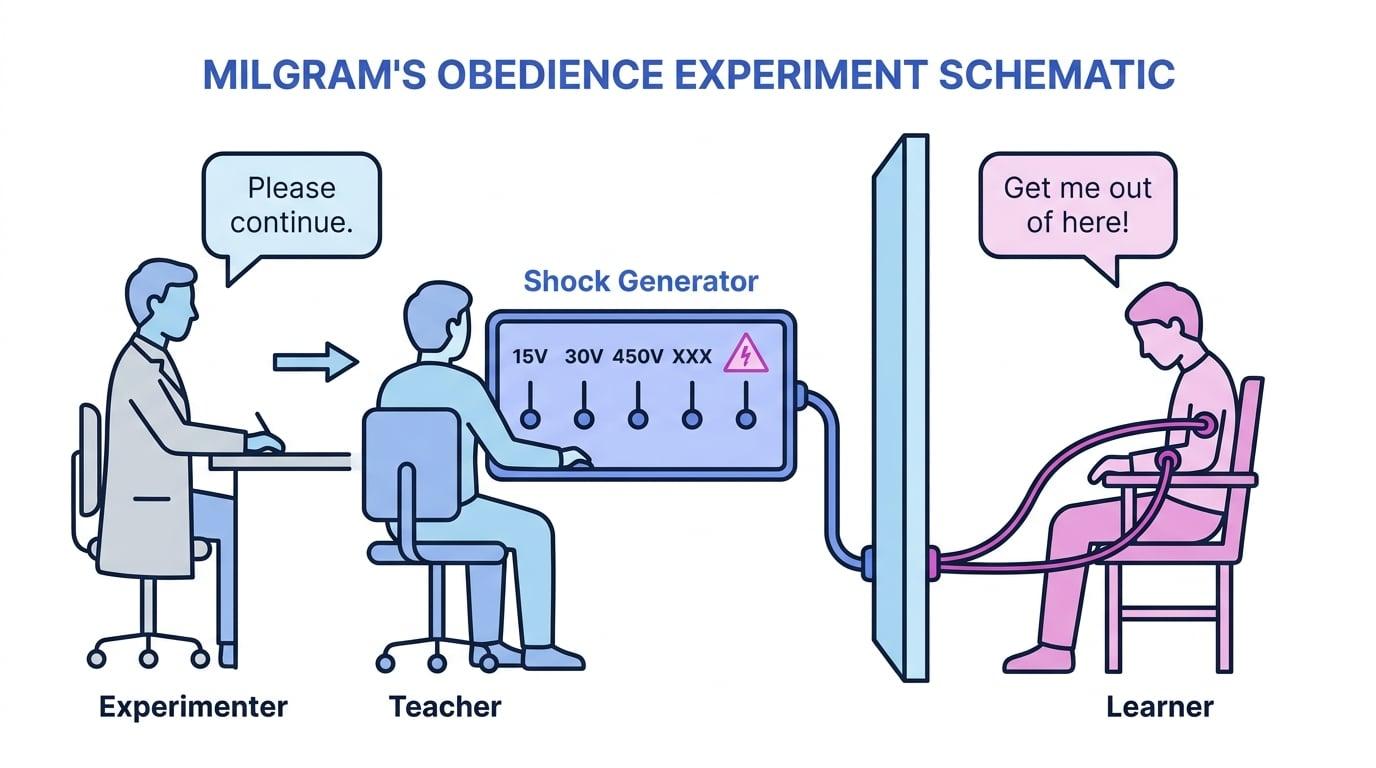
He set up a lab experiment at Yale University where participants (naive volunteers) were told to act as a "Teacher". An experimenter in a grey lab coat ordered them to give increasingly severe electric shocks to a "Learner" (a confederate actor) in the next room every time they answered a memory question incorrectly. The shocks were fake, but the Teacher didn't know that.
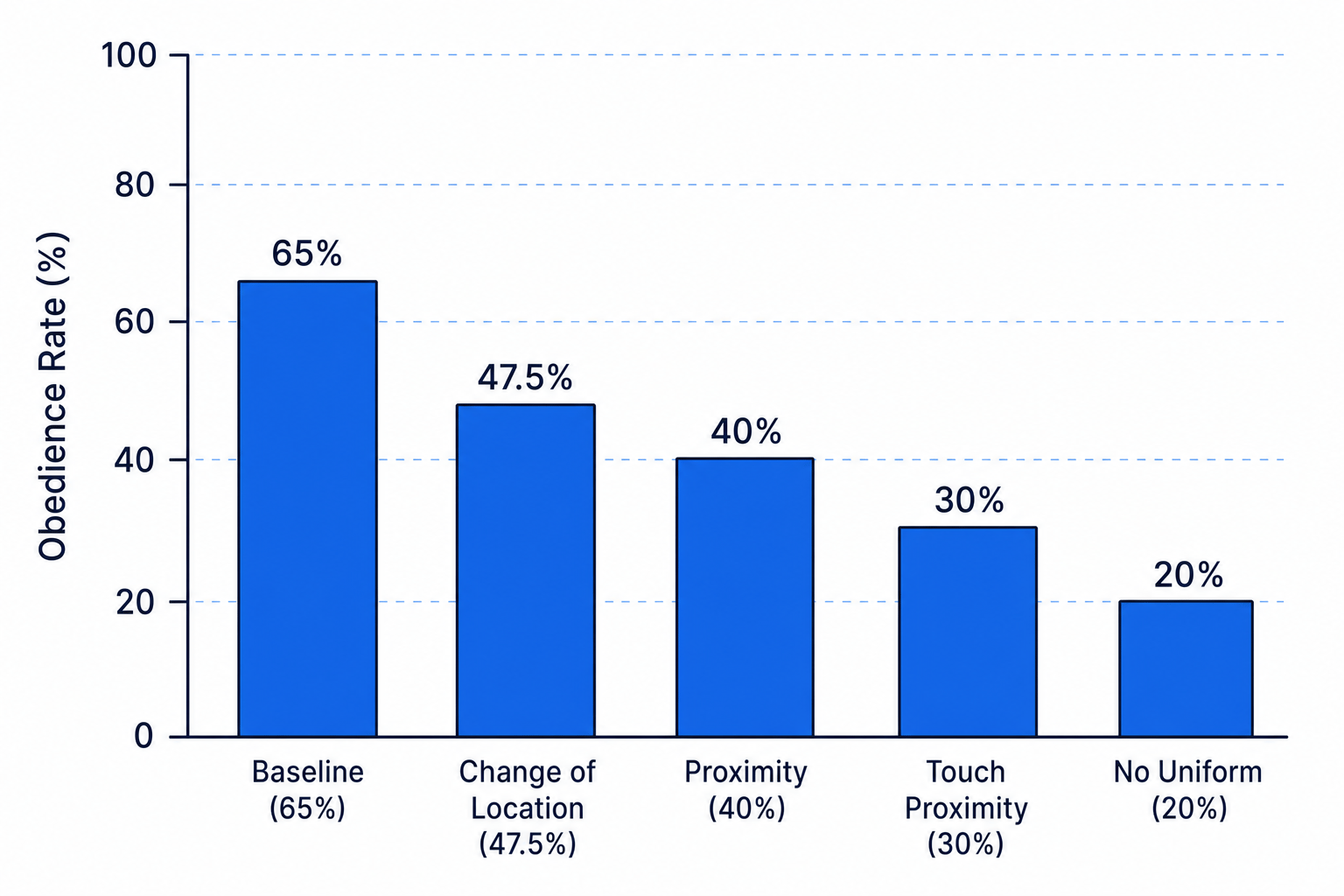
The results shocked the world: 65% of participants continued all the way to the maximum 450 volts, even when the Learner screamed in agony and then fell completely silent.
Obedience vs. Conformity
While conformity is about yielding to peer pressure (following the majority), obedience is about following a direct order from someone of a higher status (an authority figure).
Situational Variables Affecting Obedience
Milgram didn't stop at the baseline study. He ran numerous variations to see how changing the situation (the environment or setup) changed obedience levels. He identified three key situational variables.
1. Proximity
Proximity refers to the physical distance between the authority figure, the person following orders, and the victim.
- Proximity variation: When the Teacher and Learner were placed in the same room, obedience dropped from 65% to 40%.
- Touch proximity: When the Teacher had to physically force the Learner's hand onto an "electroshock plate", obedience fell to 30%.
- Remote instruction: When the Experimenter left the room and gave orders by telephone, obedience dropped to 20.5%.
Why? Increased proximity allows the person to fully see the consequences of their actions, making it harder to mentally distance themselves from the harm they are causing.
2. Location
The original study took place in the prestigious labs of Yale University. This gave the study a strong sense of legitimacy.
- Location variation: Milgram moved the experiment to a run-down office block in a seedy part of town.
- Obedience fell to 47.5%.
Why? The prestigious university environment gave the experimenter more perceived authority. Without that backdrop, the participants felt less compelled to obey.
3. Uniform
In the baseline study, the Experimenter wore a grey lab coat—a symbol of scientific authority.
- Uniform variation: The Experimenter was called away for an "urgent telephone call" and was replaced by an "ordinary member of the public" (another confederate) wearing everyday clothes.
- Obedience plummeted to 20%—the lowest of all the variations.
Why? Uniforms are widely recognised symbols of legitimate authority (think of police officers or doctors). Without the uniform, the person giving orders has no right to expect our obedience.
Evaluating Uniforms
A great study to use to support the power of uniforms is Bickman (1974). He had three confederates dress as a milkman, a security guard, and in a jacket/tie. They stood in the street asking passers-by to pick up litter or give them a coin for the parking meter. People were twice as likely to obey the security guard compared to the man in the jacket/tie.
Social-Psychological Explanations
Now we look at why people obey. Social-psychological explanations focus on how the presence and status of others affect our mindset.
The Agentic State
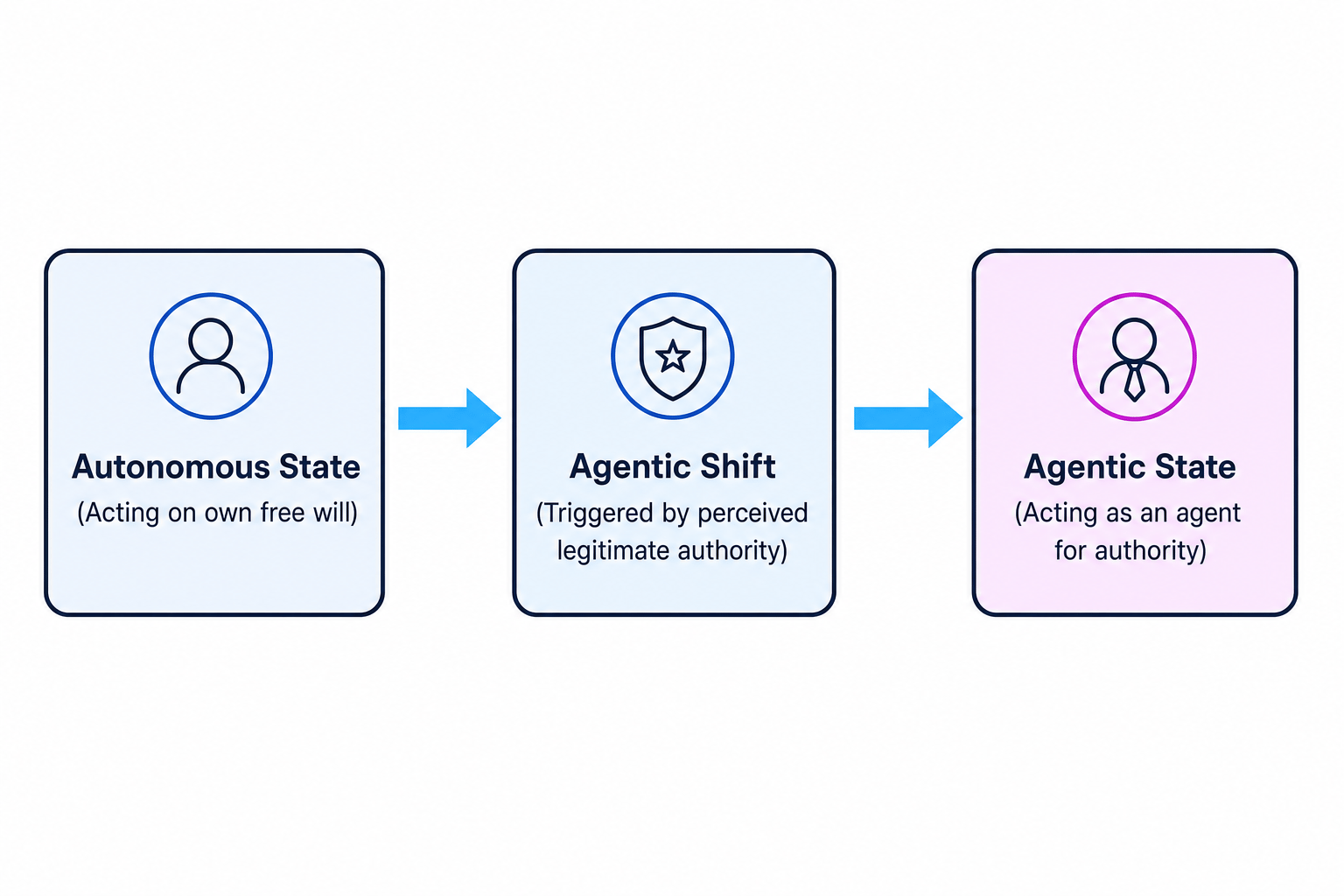
Milgram proposed that we switch between two mental states when making decisions.
Autonomous State
A state of mind where a person is free to behave according to their own principles and feels fully responsible for their own actions.
Agentic State
A mental state where a person feels no personal responsibility for their behaviour because they believe themselves to be acting as an "agent" for an authority figure.
The movement from the autonomous state to the agentic state is called the agentic shift. Milgram suggested this occurs when we perceive someone else as a legitimate authority figure who has greater power because of their position in a social hierarchy.
But why do people stay in the agentic state, even when they realise they are doing something wrong? Milgram pointed to binding factors. These are aspects of the situation that allow the person to ignore or minimise the damaging effect of their behaviour, reducing the "moral strain" they feel. For example, in Milgram's study, participants shifted responsibility to the victim ("He was foolish to volunteer") or denied the damage they were doing.
Legitimacy of Authority
We are taught from childhood to obey people who have authority over us (parents, teachers, police). This authority is "legitimate" because it is agreed by society; most of us accept that authority figures have to be allowed to exercise social power to keep society running smoothly.
However, this can lead to destructive authority. Problems arise when legitimate authority becomes destructive. History has shown that powerful leaders (like Hitler, Stalin, or Pol Pot) can use their legitimate powers for destructive purposes, ordering people to behave in callous, cruel, and dangerous ways.
Evaluating Social-Psychological Explanations
Strength: Legitimacy of authority is a great way to explain cultural differences. Kilham & Mann (1974) replicated Milgram's procedure in Australia and found only 16% went to 450v. But Mantell (1971) found an 85% obedience rate in Germany. This shows that in some cultures, authority is more likely to be accepted as legitimate and entitled to demand obedience!
Weakness: The agentic state cannot explain why some participants in Milgram's study did not obey. Humans are social animals in social hierarchies, so we should all technically experience the agentic shift.
Dispositional Explanation: The Authoritarian Personality
Situational factors (the environment) and social-psychological factors (mindset and hierarchy) focus on the external world. But what if obedience comes from within? Dispositional explanations suggest obedience is caused by an individual's personality characteristics.
Theodor Adorno et al. (1950) wanted to understand the extreme anti-Semitism of the Holocaust. They suggested that unquestioning obedience is a psychological disorder, located in the personality.
Characteristics of the Authoritarian Personality
People with this personality type:
- Have an extreme respect for authority and submissiveness to it.
- Show contempt for people they perceive as having inferior social status.
- View society as "going to the dogs" and believe we need strong, powerful leaders to enforce traditional values (love of country, religion, and family).
- Are inflexible in their outlook—everything is either right or wrong (black-and-white thinking).
Origin of the Authoritarian Personality
Adorno theorised that this personality type forms in childhood, mostly as a result of harsh parenting. This parenting style features:
- Extremely strict discipline.
- An expectation of absolute loyalty.
- Impossibly high standards.
- Severe criticism of perceived failings.
- Conditional love (the parents' love depends entirely on how the child behaves).
This creates resentment and hostility in the child. Because the child cannot express these feelings directly against their parents (out of fear of punishment), the fears are displaced onto others who are perceived to be weaker. This is known as scapegoating.
The F-Scale
Adorno developed several scales to measure this, most notably the F-scale (Fascism scale). It contains statements such as "Obedience and respect for authority are the most important virtues children should learn". People who score highly on the F-scale are considered to have an Authoritarian Personality.
Correlation vs. Causation
A common evaluation trap is stating that strict parenting causes the authoritarian personality. Adorno's research only found a correlation between the two. We cannot say for certain that harsh parenting causes authoritarianism; there could be a third variable, such as lower levels of education, that causes both.
Applying Theories to Scenarios (AO2)
In the exam, you will often be given a scenario (a "stem") and asked to apply psychological knowledge to it.
Applying obedience explanations to a scenario
Scenario: Year 12 students are in a study period. The Headteacher walks in wearing a smart suit and orders a student, Jamie, to pick up some litter that isn't his. Jamie is annoyed but does it anyway. Later, a Year 7 student asks Jamie to pick up a dropped pen, and Jamie ignores them.
Use psychological explanations to explain Jamie's behaviour.
- Identify the behaviour to explain: Jamie obeys the Headteacher but ignores the Year 7 student.
- Apply Legitimacy of Authority: The Headteacher occupies a higher position in the school's social hierarchy, which Jamie recognises as legitimate. Jamie therefore feels obligated to obey him to keep the social order of the school intact. The Year 7 student has no legitimate authority over Jamie, so Jamie feels no obligation to obey.
- Apply Situational Variables (Uniform): The Headteacher is wearing a smart suit, which acts as a symbol of his legitimate authority and status, reinforcing Jamie's compliance.
- Apply Agentic State: When the Headteacher gave the order, Jamie likely underwent an agentic shift. Even though he was annoyed (suggesting he didn't really want to do it and experienced moral strain), he shifted into the agentic state, acting as an agent for the Headteacher rather than on his own autonomous free will.
In the exam
- Be specific with your terms. Don't just say "they felt they had to do it". Use the exact terms: agentic state, legitimate authority, autonomous state, and binding factors.
- Link methodology to conclusions. If evaluating Milgram, mention how his highly controlled lab setting gave it good internal validity, but Orne and Holland argued it lacked ecological validity because participants might have been play-acting (demand characteristics).
- Check the requirement. If an essay asks for situational variables, do not write about the Authoritarian Personality. The Authoritarian Personality is a dispositional variable!
Check yourself
- Can you identify the three situational variables investigated by Milgram, and state which one caused the biggest drop in obedience?
- How does the autonomous state differ from the agentic state?
- What is the name of the questionnaire Adorno used to measure the Authoritarian Personality?
- How does harsh parenting theoretically lead to scapegoating in later life?