When an addiction becomes deeply ingrained, breaking the cycle often requires professional intervention. Psychological and medical professionals use different strategies to help clients overcome their addictions, depending on whether they view the root cause as biological, behavioural, or cognitive.
In this topic, you will learn:
- How drug therapies target brain chemistry to reduce cravings or block the effects of a drug.
- How behavioural interventions use classical conditioning to replace the pleasure of addiction with negative associations.
- How Cognitive Behaviour Therapy (CBT) helps clients identify their triggers and change faulty thinking patterns.
Drug therapy
The biological approach to reducing addiction assumes that because addiction physically changes the brain (such as altering dopamine pathways), the most effective treatment is to use chemical interventions to reverse or manage these changes.
There are three main categories of drug therapy used in addiction treatment: agonists, antagonists, and aversives.
Agonists (Replacement therapy)
Agonist
A substance that binds to a receptor in the brain and activates it, mimicking the effects of the naturally occurring neurotransmitter or the addictive drug.
Agonists are used to provide a safer, medically controlled dose of a substance that satisfies the user's physical craving without delivering the intense "high" that fuels the psychological addiction. This prevents severe withdrawal symptoms and allows the client to gradually taper off the dosage over time.
A common example is Nicotine Replacement Therapy (NRT) (like nicotine patches or gum) for smoking. Another is Methadone, a synthetic opioid used to treat heroin addiction. It binds to the same receptors as heroin, preventing withdrawal, but releases dopamine much more slowly.
Antagonists (Blocking therapy)
Antagonist
A substance that binds to a receptor but does not activate it. By occupying the receptor site, it blocks the addictive drug from binding and producing its rewarding effects.
If a client takes an antagonist and then relapses by using their addictive drug, they will not experience the usual euphoria because the receptors are blocked. Naltrexone is widely used to treat opioid addiction; if a person takes heroin while on naltrexone, the heroin cannot reach the opioid receptors, meaning there is no "high".
Aversives (Punishing therapy)
Aversive drugs do not target the brain's reward pathways directly. Instead, they produce highly unpleasant physical side effects if the addictive substance is consumed.
The most famous example is Disulfiram (Antabuse), used to treat alcoholism. If a person drinks alcohol while taking Antabuse, the drug interferes with the liver's ability to break down the alcohol, leading to an immediate buildup of toxins. Within ten minutes, the person experiences severe nausea, vomiting, sweating, and heart palpitations.
Categorising a pharmacological intervention
Imagine a psychiatrist is trialling a new medication called Buprenorphine for opioid addiction. The medical notes state: "The drug binds tightly to opioid receptors, providing a mild, ceiling-level activation to stop cravings, but its tight binding prevents other opioids from accessing the receptors." To determine how this drug works:
- Identify the mechanism of action from the description (it binds to and activates the receptor mildly).
- Compare this to the three definitions (an agonist activates, an antagonist blocks, an aversive causes illness).
- Classify the primary function: because it activates the receptor to satisfy cravings, it is acting primarily as an agonist (though its blocking property means it acts as a partial antagonist too, the mild activation to replace heroin makes it an agonist therapy).
Evaluating drug therapies
- Effectiveness: Drug therapies are highly effective at treating the immediate biological symptoms of addiction. They offer a quick intervention that can stabilise a client enough to engage in psychological therapies.
- Side effects: A major limitation is that the drugs themselves have side effects (e.g., sleep disturbances and dizziness from NRT, or the severe physical distress of aversives).
- Compliance: Because aversives like Antabuse make the user feel terrible, clients often just stop taking the medication so they can drink again.
- Reductionism: Critics argue drug therapy is a palliative treatment—it treats the biological symptoms but ignores the underlying psychological or social reasons why the person became addicted in the first place.
Behavioural interventions
The behaviourist approach argues that addictions are learned via conditioning. Therefore, they can be unlearned using the same principles. Behavioural interventions aim to break the association between the addictive behaviour and the reward (pleasure), replacing it with an association with something highly unpleasant.
Aversion therapy
Aversion therapy is based on classical conditioning. It works by repeatedly pairing the addictive behaviour (which the client currently enjoys) with an unpleasant stimulus until the addictive behaviour itself causes an aversive response.
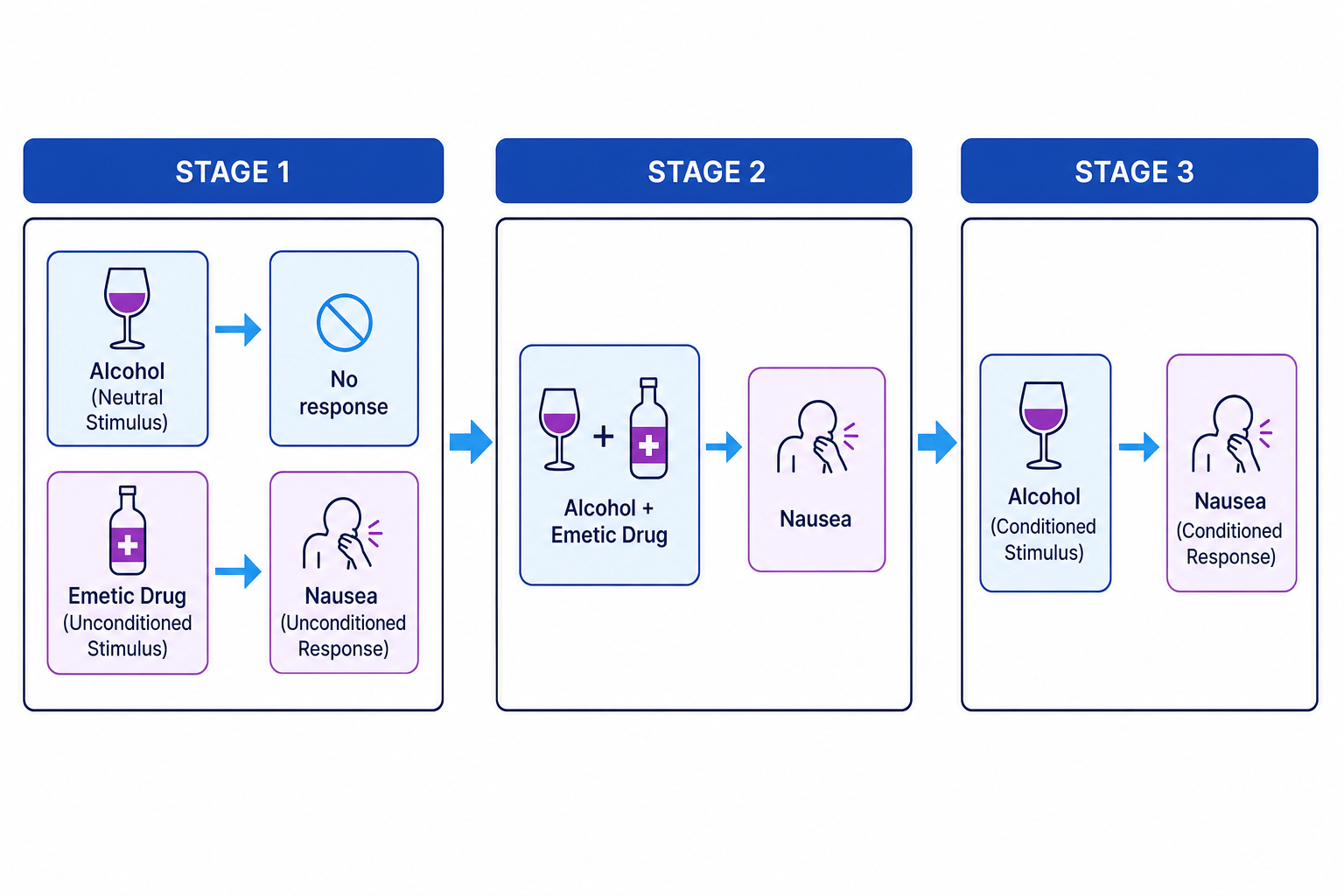
If treating alcoholism, the alcohol is initially a Neutral Stimulus (NS) that the client wants to consume. The therapist administers an emetic drug (an Unconditioned Stimulus, UCS), which naturally forces the body to vomit (Unconditioned Response, UCR). The client is then given a drink of alcohol just as the emetic drug takes effect. After repeated pairings, the alcohol becomes a Conditioned Stimulus (CS) that triggers a Conditioned Response (CR) of extreme nausea, even without the emetic drug.
Ethical issues with aversion therapy
Aversion therapy deliberately inflicts extreme physical distress (nausea, vomiting, or sometimes electric shocks) on the client. Even with informed consent, this raises serious ethical issues regarding protection from harm. Because the experience is so traumatic, attrition (dropout) rates are exceptionally high.
Covert sensitisation
Because of the severe ethical and practical problems with in vivo (real-life) aversion therapy, psychologists developed covert sensitisation.
Covert sensitisation
A type of behavioural therapy where classical conditioning is done in vitro (in the imagination). The client is guided to vividly imagine engaging in their addiction while simultaneously imagining a horrific or highly distressing consequence.
Instead of actually vomiting, a smoker might be asked by a therapist to close their eyes and imagine lighting a cigarette. The therapist then vividly describes a scenario where, as the client inhales, they suddenly feel violently ill, vomit all over themselves, and are looked at with disgust by their peers. The more graphic and emotionally engaging the imagined scene, the better the conditioning works.
The evidence for covert sensitisation
Research shows covert sensitisation is generally superior to physical aversion therapy. McConaghy et al. (1983) compared the two in treating gambling addiction. After one year, 90% of the covert sensitisation group had reduced their gambling, compared to only 30% of the aversion therapy group. Furthermore, covert sensitisation has far lower dropout rates because it does not cause physical pain.
Cognitive Behaviour Therapy (CBT)
While behavioural therapies focus only on observable associations, Cognitive Behaviour Therapy (CBT) targets the faulty thinking processes (cognitive biases) that drive the addiction.
The core assumption of CBT is that addicts have distorted beliefs about their addiction (e.g., a gambler believing they have a "system" to beat the odds, or a smoker believing a cigarette is the only way they can cope with stress). CBT aims to identify these irrational thoughts and teach the client practical skills to overcome them.
CBT for addiction generally involves two main elements:
1. Functional analysis
The therapist and client work together to identify the specific situations, emotions, and thoughts that trigger the addictive behaviour. They analyse the "function" of the addiction—what is the client getting out of it?
If a client drinks heavily when stressed at work, the therapist helps them recognise the cognitive pathway: Work stress → "I can't cope with this" → "Alcohol will make me feel better" → Drinking. By bringing these automatic triggers into conscious awareness, the client learns to anticipate high-risk situations.
2. Skills training
Once triggers are identified, the therapist helps the client develop cognitive and behavioural coping skills to replace the addiction. This involves:
- Cognitive restructuring: Challenging faulty beliefs and replacing them with rational ones.
- Assertiveness training: Teaching the client how to confidently say "no" if pressured by peers in social situations.
- Specific problem-solving: Finding healthier ways to manage the emotions that usually trigger relapse (e.g., using exercise or meditation for stress instead of drugs).
Applying cognitive restructuring to gambling
A therapist is treating a client with a gambling addiction who has just lost a lot of money on a roulette machine. The client says, "I've lost ten times in a row, which means a big win is definitely due on the next spin. I have to keep playing."
- Identify the specific cognitive bias present in the client's statement (the client is exhibiting the gambler's fallacy—the belief that past independent events affect future probabilities).
- Challenge the irrational logic by stating the mathematical reality of the situation (each spin of a roulette wheel is entirely independent; the probability of winning remains exactly the same on the eleventh spin as it was on the first).
- Formulate a rational replacement thought for the client to practice (e.g., "The machine has no memory. My previous losses do not increase my chances of winning right now").
Evaluating CBT
- Long-term effectiveness: CBT is excellent at preventing relapse. Unlike drug therapy, which only works as long as the drug is taken, CBT equips the client with lifelong coping skills.
- Motivation: CBT requires a massive amount of commitment and cognitive effort from the client. Someone in the severe throes of chemical withdrawal may lack the psychological resources to engage in CBT, which is why it is often combined with drug therapy.
- Flexibility: CBT can be tailored to the individual's specific triggers and social environment, making it a highly personalised treatment.
In the exam
- When asked to evaluate treatments, compare them directly. For example, contrast the physical passivity of taking a drug with the active cognitive effort required for CBT.
- If an essay asks about "learning theory applications to reducing addiction", you must discuss behavioural interventions (aversion therapy and/or covert sensitisation).
- Do not confuse the three types of drug therapies. Remember: Agonists = replace/mimic, Antagonists = block, Aversives = punish. Use these specific terms rather than just saying "pills that stop them drinking".
- Always bring in ethical issues when evaluating aversion therapy; the deliberate induction of harm and nausea is a massive AO3 point.
Check yourself
- Which type of drug therapy binds to a receptor but does not activate it, preventing the addictive substance from having an effect?
- What are the Unconditioned Stimulus (UCS) and the Conditioned Stimulus (CS) in aversion therapy for alcoholism?
- Why is covert sensitisation considered ethically superior to traditional aversion therapy?
- What is the purpose of 'functional analysis' in CBT for addiction?
