What you'll learn
- How learning theory explains gambling through conditioning and reinforcement.
- Why partial and variable reinforcement make gambling especially hard to stop.
- How cognitive theory explains gambling through biased thinking.
- How to evaluate these explanations using evidence, limitations, ethics, and applications.
The starting point: what is gambling addiction?
Gambling addiction is a behavioural addiction, meaning the person becomes addicted to an activity rather than to a substance such as nicotine or alcohol. In A-Level Psychology, you should focus on why gambling begins, why it continues, and why the person may struggle to stop even when it causes harm.
Gambling addiction
A gambling addiction is persistent gambling behaviour that continues despite negative consequences, such as financial loss, relationship conflict, guilt, anxiety, or reduced control over time and money.
Not everyone who gambles is addicted. The key issue is loss of control: the person keeps gambling even when they intend to stop, and gambling becomes unusually important in their life.
Two explanations you need to know
AQA asks you to know two main explanations for gambling addiction:
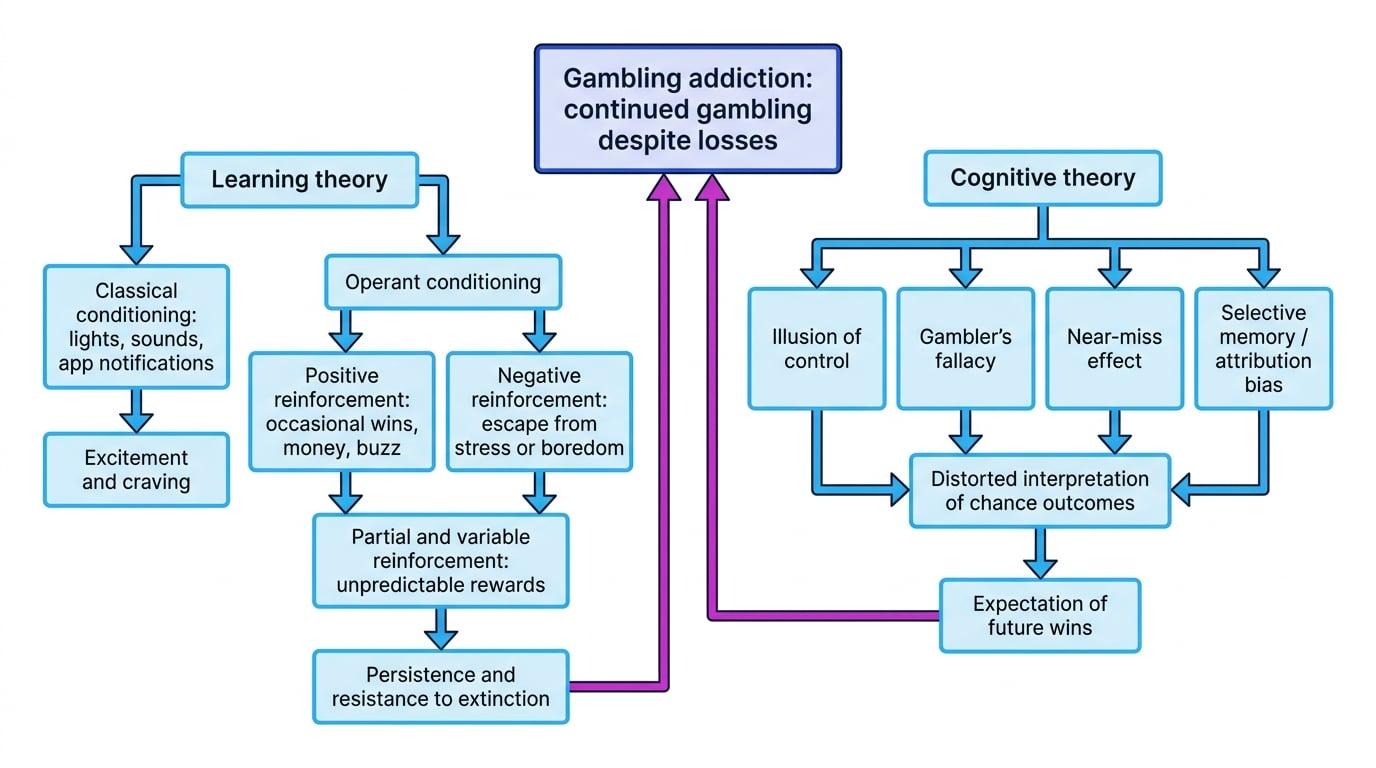
- Learning theory: gambling is learned and maintained through conditioning and reinforcement.
- Cognitive theory: gambling is maintained by biased thoughts and mistaken beliefs about chance, skill, and probability.
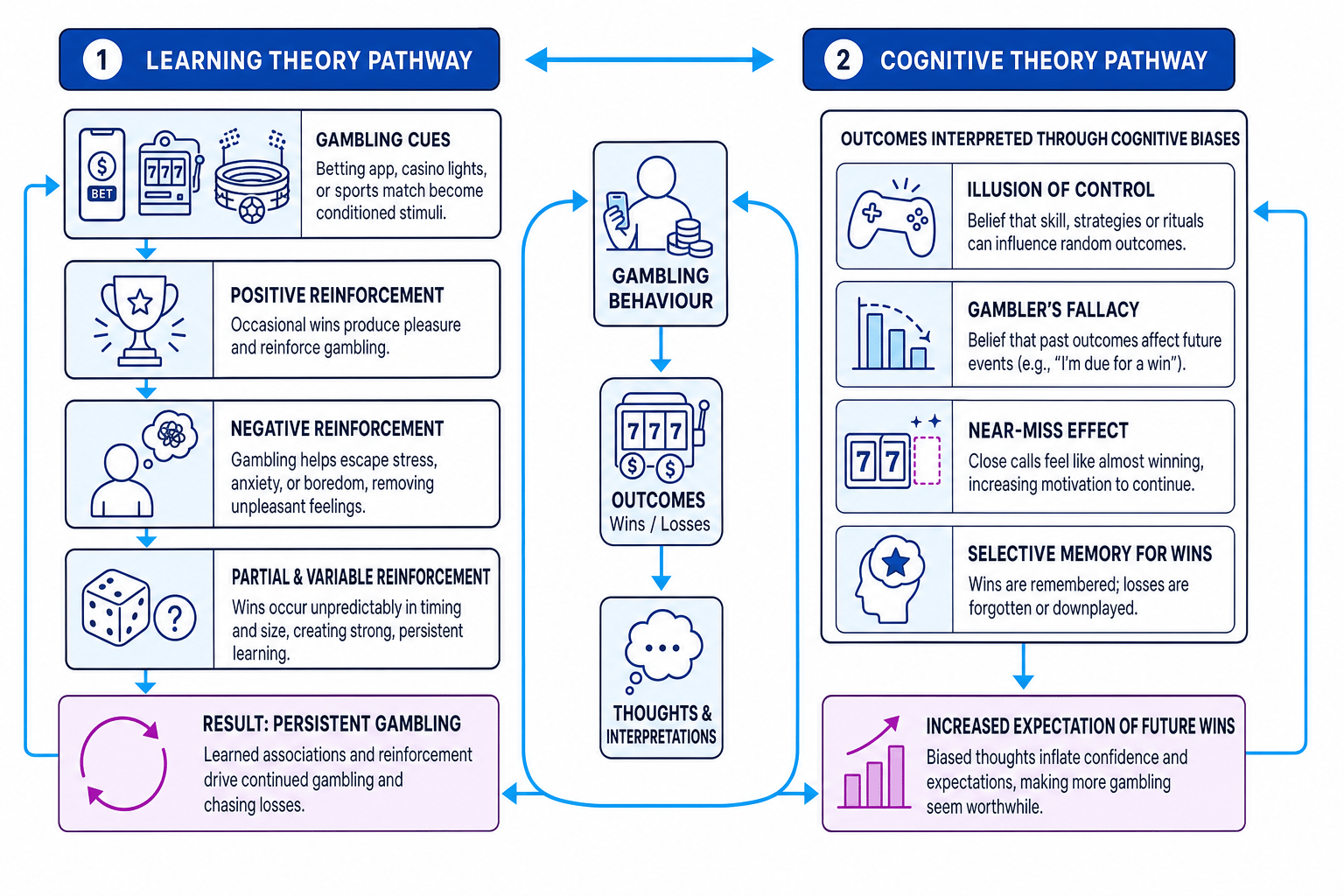
These explanations are not rivals in a simple “one is right, one is wrong” way. They often work together: gambling can be reinforced by occasional wins, while cognitive biases make the gambler interpret losses as reasons to keep going.
Learning theory as an explanation
Classical conditioning: learning through association
Classical conditioning is learning by association. A person learns to associate one stimulus with another.
In gambling, previously neutral cues — such as a betting app notification, casino lights, football commentary, or the sound of a fruit machine — may become associated with excitement, anticipation, or winning.
A conditioned stimulus is a cue that has gained power because it has been repeatedly paired with an emotional response. For example, the sight of a betting app might trigger craving because it has been linked to previous gambling excitement.
Operant conditioning: learning through consequences
Operant conditioning is learning through the consequences of behaviour. If a behaviour is followed by a rewarding consequence, it is more likely to be repeated.
Reinforcement
Reinforcement is any consequence that increases the likelihood of a behaviour happening again. Positive reinforcement adds something pleasant, such as money or excitement. Negative reinforcement removes something unpleasant, such as boredom, stress, or low mood.
In gambling:
- A win can act as positive reinforcement because it brings money, excitement, status, or a “buzz”.
- Gambling can act as negative reinforcement if it helps the person escape stress, loneliness, boredom, or anxiety.
- The person may start “chasing losses”, meaning they keep gambling to try to win back money already lost.
Negative reinforcement is not punishment
Negative reinforcement does not mean “something bad happens”. It means an unpleasant feeling is removed, which makes the behaviour more likely to happen again.
Partial and variable reinforcement
This is the most important learning-theory idea for gambling.
Partial and variable reinforcement
Partial reinforcement means a behaviour is rewarded only some of the time. Variable reinforcement means the reward is unpredictable, such as not knowing when the next win will happen or how large it will be.
Gambling rarely rewards every bet. Instead, wins happen occasionally and unpredictably. This makes gambling resistant to extinction, which means the behaviour does not easily weaken when rewards stop.
Slot machines are a clear example. You might lose many times, then win unexpectedly. That unpredictability keeps the person thinking, “Maybe the next one will be the win.”
Why gambling is hard to stop
Gambling is powerful because the reward is not guaranteed. Unpredictable wins can produce strong persistence because the gambler learns that losing does not necessarily mean the reward has disappeared.
Applying learning theory to a slot-machine player
A student says: “Amira keeps playing a slot machine even though she usually loses. She says the lights and sounds make her excited, and she often plays when she feels stressed.”
- Identify the classically conditioned cues: the lights and sounds have become associated with gambling excitement, so they can trigger arousal and craving.
- Identify positive reinforcement: occasional wins give Amira money or pleasure, making slot-machine gambling more likely in future.
- Identify negative reinforcement: gambling removes stress temporarily, so she learns to use gambling as emotional escape.
- Apply partial and variable reinforcement: because wins are unpredictable, losing does not teach Amira to stop; it may make her continue because the next spin might be rewarded.
AO3 evaluation of learning theory
Strength: explains persistence very well
Learning theory is strong because it explains why gamblers continue despite repeated losses. Partial and variable reinforcement schedules are known to produce persistent behaviour. This fits gambling products such as slot machines, scratch cards, and betting apps, where rewards are unpredictable.
Research into operant conditioning, including Skinner’s work on reinforcement schedules, supports the general idea that behaviour can be shaped and maintained by rewards. Although Skinner’s research was often based on animals rather than human gamblers, it provides a useful mechanism for understanding persistent behaviour.
Strength: real-world application
Learning theory has useful applications. If gambling is maintained by cues and reinforcement, then treatment and regulation can target these mechanisms. For example:
- betting apps can limit notifications and “free bet” prompts;
- casinos can reduce cue-heavy environments;
- therapy can help gamblers avoid triggers and develop alternative ways to manage stress.
This gives learning theory practical value.
Weakness: it can be reductionist
A reductionist explanation oversimplifies behaviour by focusing on only one level of explanation. Learning theory can explain reinforcement, but it may ignore thoughts, emotions, personality, family influences, financial stress, and biological factors such as reward pathways in the brain.
It also struggles to explain why many people experience the same gambling reinforcement schedules but do not become addicted.
Ethical issues in learning research
When researchers study gambling behaviour, they must protect participants from harm. Asking people, especially problem gamblers, to gamble in a study could trigger cravings or relapse. Researchers should use informed consent, allow the right to withdraw, protect confidentiality, limit gambling exposure, and provide a full debrief with support information.
Cognitive theory as an explanation
The basic idea
Cognitive theory argues that gambling addiction is maintained by the way people think about gambling. The person may misinterpret random events, overestimate their chance of winning, or believe they have more control than they really do.
Cognitive bias
A cognitive bias is a systematic error in thinking that affects judgement. In gambling, cognitive biases make chance events seem more predictable, controllable, or favourable than they actually are.
Key cognitive biases in gambling
Illusion of control
The illusion of control is the mistaken belief that personal skill, rituals, or choices can influence a chance outcome.
For example, a gambler may believe choosing their own lottery numbers gives them a better chance, or that pressing a slot-machine button in a certain way changes the result.
Langer (1975) found that people who chose their own lottery ticket valued it more highly than people who were given a ticket, even though the chance of winning was the same. This supports the idea that people can overestimate control in chance situations.
Gambler’s fallacy
The gambler’s fallacy is the mistaken belief that past random outcomes affect future random outcomes.
For example, if a roulette wheel lands on black five times, a gambler may think red is now “due”. In reality, each spin is independent.
Near-miss effect
A near miss is a loss that feels close to a win, such as getting two matching symbols and one just above the payline on a slot machine. Near misses can encourage continued gambling because they feel like evidence of progress or skill, even though they are still losses.
Selective memory and attribution bias
Selective memory means remembering wins more clearly than losses. Attribution bias means explaining wins and losses in a biased way. A gambler might say, “I won because I’m good at this,” but “I lost because I was unlucky.”
Easy AO1 phrase
A strong cognitive-theory sentence is: “Cognitive biases distort the gambler’s interpretation of chance outcomes, making continued gambling seem rational even when the odds are against them.”
Identifying cognitive biases in gambling thoughts
A gambler says: “I nearly won that time, so I’m getting better. I’ve lost six times in a row, which means a win must be coming. I always pick my lucky machine.”
- “I nearly won” shows the near-miss effect because a loss is interpreted as a sign of progress.
- “A win must be coming” shows the gambler’s fallacy because the gambler wrongly assumes past losses change future odds.
- “My lucky machine” shows the illusion of control because the gambler believes a personal choice can influence a random outcome.
- Together, these biases increase the expectation of winning, making further gambling more likely.
AO3 evaluation of cognitive theory
Strength: strong supporting evidence
Griffiths (1994) studied regular and non-regular fruit-machine gamblers using a “thinking aloud” method. Regular gamblers showed more irrational thoughts while gambling, such as treating near misses as meaningful and believing skill was involved. This supports cognitive theory because problem gambling was linked with biased thinking.
Langer (1975) also supports cognitive theory by showing that people can develop an illusion of control in chance-based tasks.
Methodological issues
Griffiths’ “thinking aloud” method provides direct insight into gamblers’ thoughts, which is useful because cognitive theory is about mental processes. However, verbalising thoughts may change natural behaviour, so the method may lack some ecological validity. Samples of regular gamblers may also be small or unrepresentative.
Langer’s research supports illusion of control, but it was not necessarily conducted on addicted gamblers. This means it may show a general cognitive bias rather than a full explanation of gambling addiction.
Ethical issues in cognitive research
Studies involving gambling tasks must consider protection from harm, especially if participants are vulnerable to gambling problems. Researchers should avoid encouraging harmful gambling, use clear consent, maintain confidentiality, allow withdrawal, and debrief participants. If deception is used, for example about the purpose of a probability task, debriefing is especially important.
Strength: useful for treatment
Cognitive theory has strong real-world application because it supports cognitive behavioural therapy, often shortened to CBT. CBT helps gamblers identify distorted thoughts, challenge them, and replace them with more realistic interpretations.
For example, a therapist might help a gambler see that a near miss is still a loss, or that a losing streak does not make a win more likely.
Weakness: cause and effect problem
Cognitive theory may not always show whether biased thinking causes gambling addiction or whether repeated gambling creates stronger biased thinking over time. A gambler may develop irrational beliefs because they gamble frequently, rather than gambling frequently because they already held those beliefs.
Bringing both explanations together
A strong exam answer can combine the two explanations:
- Learning theory explains how gambling behaviour is reinforced and becomes persistent.
- Cognitive theory explains why gamblers misinterpret outcomes and continue despite losses.
For example, a slot-machine player may be reinforced by occasional wins, while also believing near misses mean they are “getting close”. Together, these processes make gambling more resistant to stopping.
In the exam
- Start AO1 by naming the explanation clearly: learning theory or cognitive theory. Then use precise terms such as partial reinforcement, variable reinforcement, illusion of control, or gambler’s fallacy.
- For AO2 scenario questions, link each behaviour in the scenario to a concept: cues to classical conditioning, wins to positive reinforcement, stress relief to negative reinforcement, and “I’m due a win” to gambler’s fallacy.
- For AO3, use evidence plus a limitation. For example, Griffiths (1994) supports cognitive bias, but thinking aloud may alter natural gambling behaviour.
Check yourself
- How do partial reinforcement and variable reinforcement help explain why gambling continues after losses?
- What is the difference between the illusion of control and the gambler’s fallacy?
- Why might cognitive theory be useful for treating gambling addiction?