What you'll learn
- How Prochaska’s model explains behaviour change in addiction.
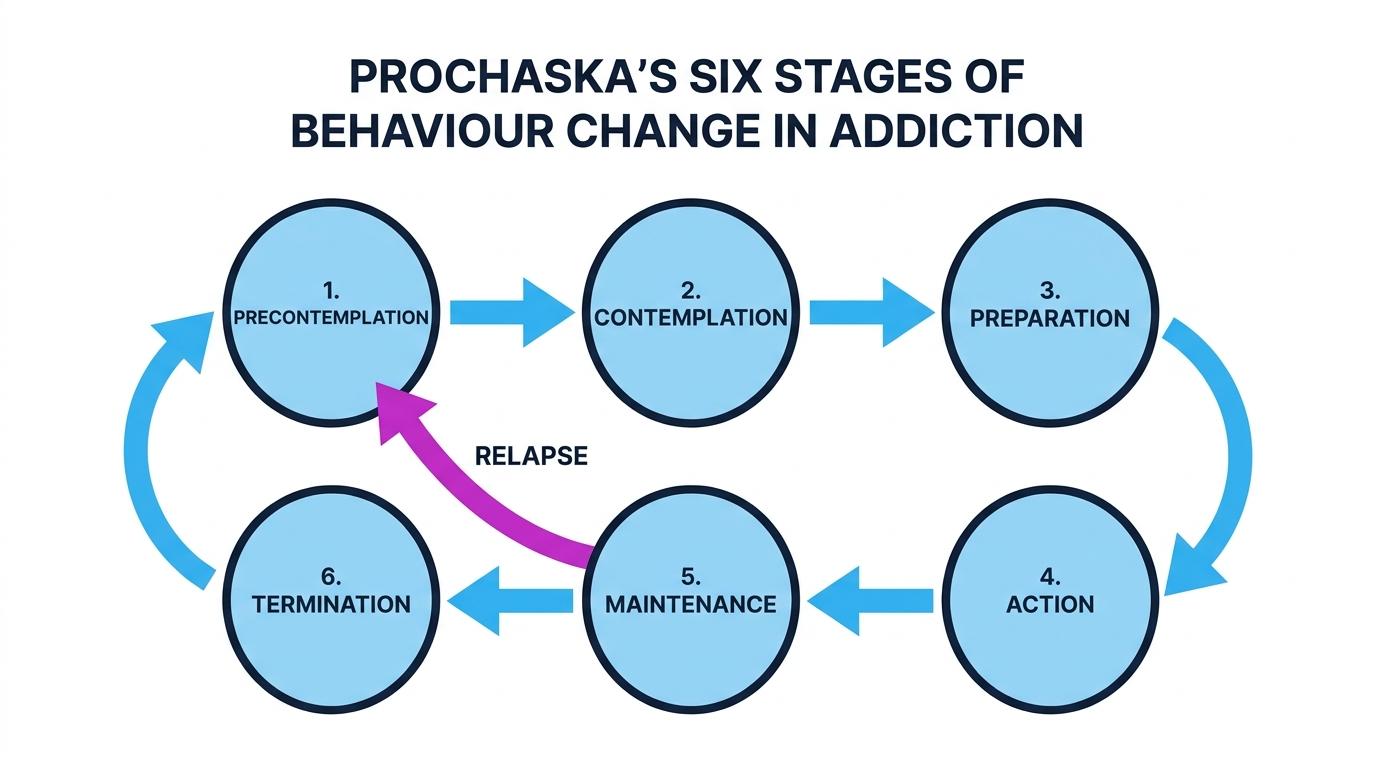
- The six stages: precontemplation, contemplation, preparation, action, maintenance, termination.
- How to apply the model to scenarios involving smoking, alcohol, drug use or gambling.
- How to evaluate the model using research evidence, methodological issues, ethics and real-world applications.
Why behaviour change matters in addiction
Addiction is not usually changed by simply telling someone to “just stop”. People differ in how ready they are to change, how much they understand the harm, and how confident they feel about coping without the addictive behaviour.
Addiction
Addiction is a pattern of behaviour where a person repeatedly uses a substance or carries out an activity despite negative consequences, often involving cravings, reduced control and difficulty stopping.
Prochaska and DiClemente’s model is useful because it treats recovery as a process, not a single decision. Someone may move forwards, get stuck, or return to an earlier stage after a lapse.
Transtheoretical model
The transtheoretical model, developed by Prochaska and DiClemente in the 1980s, is a model of behaviour change which suggests that people pass through a series of stages as they become ready to change an unhealthy behaviour.
The big idea: readiness to change
The model is based on readiness to change, meaning how willing and able a person currently is to alter their behaviour.
This matters because the same treatment will not suit everyone. A person who denies they have a gambling problem needs different support from someone who has already stopped gambling and is trying not to relapse.
Stage-matched support
The main application of Prochaska’s model is stage-matching: choosing an intervention that fits the person’s current stage of change rather than giving everyone the same advice.
The six stages of change
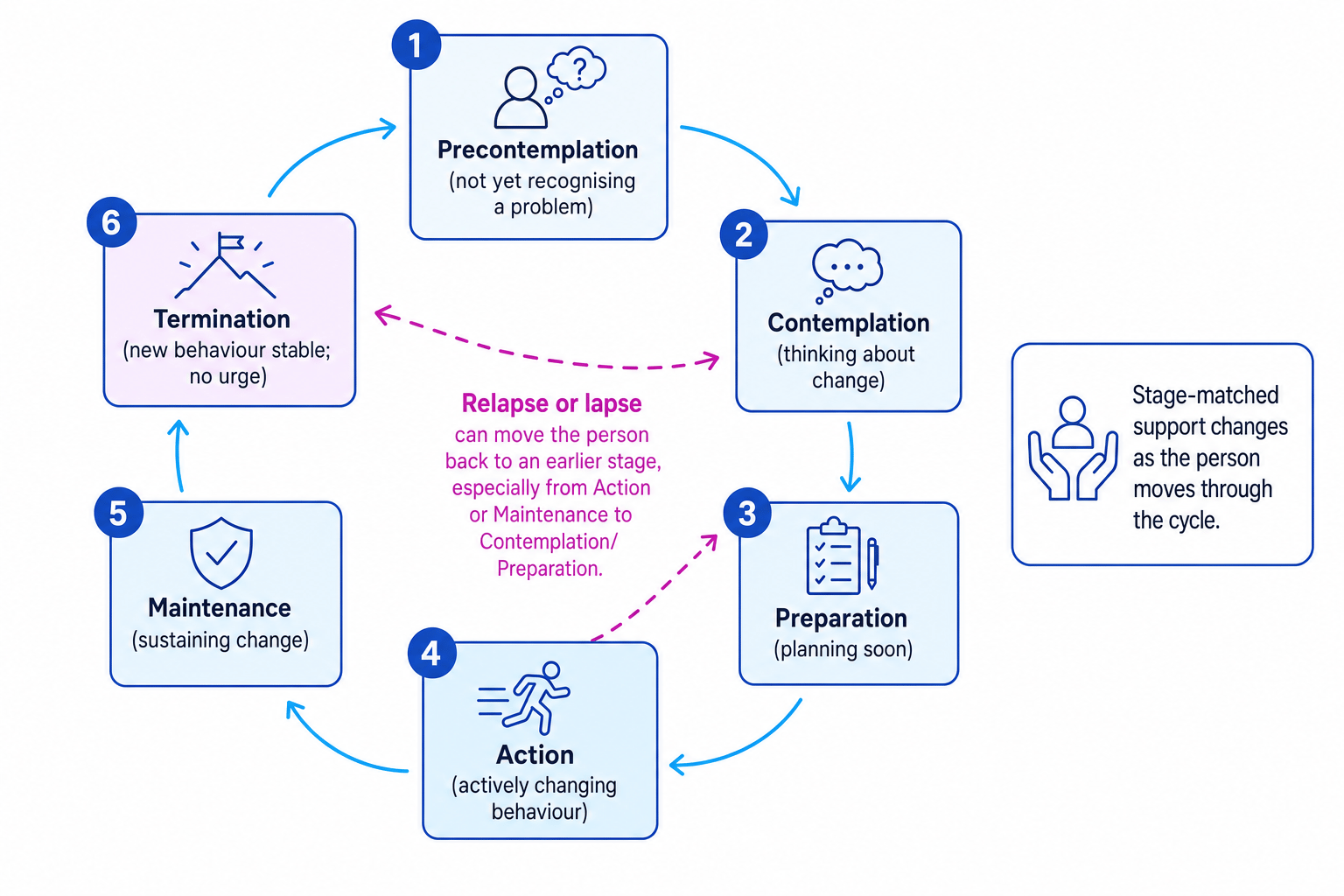
The model is often shown as a cycle because behaviour change is rarely a neat straight line.
1. Precontemplation
In precontemplation, the person is not yet seriously thinking about changing. They may not see the behaviour as a problem, or they may feel too demoralised to try.
For example, a smoker might say, “I know people exaggerate the risks — I’m fine,” or a gambler might blame bad luck rather than recognising loss of control.
2. Contemplation
In contemplation, the person is aware there may be a problem and is thinking about change, but they feel uncertain. This is often described as ambivalence, meaning mixed feelings.
For example, someone may say, “I know drinking is affecting my relationship, but it helps me cope after work.”
3. Preparation
In preparation, the person intends to change soon and starts making practical plans. They may choose a quit date, tell others, contact support services, or remove triggers.
A trigger is a cue that increases the urge to carry out the addictive behaviour, such as payday for gambling or going to a pub for alcohol use.
4. Action
In action, the person is actively changing their behaviour. This could involve stopping smoking, attending counselling, using nicotine replacement therapy, avoiding gambling websites, or changing their social routine.
Nicotine replacement therapy means using products such as patches or gum to reduce withdrawal symptoms from stopping smoking.
5. Maintenance
In maintenance, the person has sustained the change and is trying to prevent a return to the addictive behaviour.
This stage often involves building coping strategies, avoiding high-risk situations and developing a new identity, such as “I’m a non-smoker” or “I don’t gamble anymore”.
6. Termination
In termination, the person no longer feels tempted and has high confidence that they will not return to the behaviour.
Self-efficacy means a person’s belief that they can succeed in a specific situation. In termination, self-efficacy is very high.
Relapse and the sixth stage
Some textbooks describe relapse as a separate stage, but the usual six-stage version ends with termination. For AQA, it is safest to know the six named stages and explain that relapse is common in addiction and can move a person back to an earlier stage.
Lapse and relapse
A lapse is a one-off return to the addictive behaviour, such as smoking one cigarette after weeks of abstinence.
A relapse is a fuller return to the previous pattern of behaviour, such as returning to daily smoking.
This distinction is important because Prochaska’s model does not treat relapse as total failure. Instead, relapse can be part of the cycle of change. The person may learn from what triggered the relapse and re-enter contemplation, preparation or action.
Treating the model like a staircase
Do not write as if everyone moves smoothly from stage 1 to stage 6. The model is cyclical: people can move forwards, pause, or return to earlier stages after a lapse or relapse.
Placing a person in a stage
Sam smokes cannabis daily. He says, “It’s not really affecting me — my parents just overreact.” He attends a support appointment only because his college referred him, and he has no plan to stop.
-
Sam’s language shows he does not recognise the behaviour as a problem, which points towards precontemplation rather than contemplation.
-
Although he has attended an appointment, this does not automatically mean preparation, because the appointment was externally prompted and he has made no active plan to change.
-
The best classification is precontemplation, so suitable support would focus on gentle feedback, increasing awareness of consequences and avoiding a confrontational “you must quit now” approach.
Applying the model to addiction treatment
The model is especially useful because it tells practitioners what kind of support is likely to fit each stage.
Support in precontemplation
The aim is not immediate quitting. The aim is to increase awareness and reduce defensiveness.
Useful approaches include giving personalised feedback, discussing consequences, and using motivational interviewing. Motivational interviewing is a counselling approach that helps people explore their own reasons for change without being pressured or judged.
Support in contemplation
The person is already thinking about change, so support should explore their mixed feelings.
A useful tool is decisional balance, which means weighing up the perceived costs and benefits of changing versus staying the same.
For example, a gambler might list the short-term excitement of betting against the long-term effects on debt, trust and mood.
Support in preparation
The aim is to turn intention into a realistic plan.
This may include setting a quit date, arranging social support, removing cues, planning alternatives, or contacting specialist services.
For gambling addiction, this could involve self-exclusion from betting sites. Self-exclusion means voluntarily blocking yourself from gambling services for a chosen period.
Support in action
The person is now changing behaviour, so support becomes more practical and intensive.
This may include cognitive behavioural therapy, often shortened to CBT. CBT is a psychological therapy that aims to change unhelpful thoughts and behaviours. In addiction, CBT may help someone identify triggers, challenge distorted thinking and practise coping strategies.
Support in maintenance
The focus is relapse prevention.
Relapse prevention means planning how to cope with high-risk situations so that a lapse does not become a full return to the addictive behaviour.
Support in termination
At this stage, support may be minimal. The person is confident and no longer strongly tempted. However, in addiction, some psychologists argue that maintenance is a more realistic long-term goal than full termination because cravings can reappear under stress.
Choosing stage-matched support
Lena says she wants to stop online gambling next Monday. She has installed blocking software, told her partner, and planned to hand over control of her bank card on payday. She has not actually stopped gambling yet.
-
Lena is beyond contemplation because she has made specific practical plans, not just thought about change.
-
She is not yet in action because the new behaviour has not fully started; she has chosen a future point to stop.
-
The best classification is preparation, so support should focus on strengthening her plan: confirming the quit date, preparing for payday as a trigger, arranging support and making access to gambling harder.
Evaluation: strengths of the model
It has strong real-world application
A major strength is that the model helps practitioners avoid a one-size-fits-all approach.
For example, pushing a precontemplator straight into an action plan may backfire because they do not yet accept the need to change. Stage-matched support is more respectful and more likely to keep the person engaged.
This is useful in NHS stop-smoking services, alcohol interventions, drug treatment and gambling support.
It recognises relapse as part of recovery
The model is realistic because addiction recovery often involves lapses and relapses.
This can reduce shame. Instead of saying “you failed”, a therapist can ask, “What stage are you in now, and what support do you need next?”
That makes the model practical for long-term behaviour change.
There is some supporting evidence
DiClemente et al. (1991) studied smokers and found that stage of change predicted later quitting behaviour. People further along the cycle, especially those in preparation, were more likely to make a successful quit attempt than those in precontemplation.
Prochaska, DiClemente and Norcross (1992) also reviewed evidence across addictive behaviours and argued that different processes of change are useful at different stages.
Ethically, research into addiction must protect participants because it involves sensitive information. Good studies need informed consent, confidentiality, the right to withdraw, protection from distress and signposting to support after participation.
Evaluation: limitations of the model
The stages may be too rigid
One criticism is that people may not fit neatly into one stage. Readiness to change may be more continuous than the model suggests.
Sutton (2001) argued that stage models can create artificial categories. For example, the boundary between contemplation and preparation may be unclear if someone is thinking seriously about stopping but has only made a vague plan.
Change can be sudden
The model suggests gradual movement through stages, but some people change suddenly.
West (2005) argued that many smokers make unplanned quit attempts. This challenges the idea that people must move through contemplation and preparation before action.
It may underplay biological and social factors
The model focuses heavily on conscious decision-making. However, addiction is influenced by biological, psychological and social factors together.
Biological factors include withdrawal symptoms and brain reward pathways. Social factors include peer pressure, poverty, stress and easy access to addictive substances or activities.
This means the model is useful, but incomplete. A person may be motivated to change yet still struggle because their environment and biology make relapse more likely.
Evidence can rely on self-report
Many studies use questionnaires or interviews where people report their intentions and behaviour. This can be affected by social desirability bias, where people give answers that make them look better.
For example, a participant may say they are preparing to quit because that sounds responsible, even if they have no realistic plan.
There can also be attrition in long-term studies, meaning participants drop out over time. If those who drop out are more likely to relapse, the results may overestimate success.
Overall judgement
Prochaska’s six-stage model is best seen as a practical framework for understanding and supporting behaviour change, rather than a perfect explanation of addiction.
It is especially useful for AO2 application because you can identify a person’s stage from their thoughts, intentions and behaviour, then suggest suitable support.
For AO3, remember to balance its usefulness against the problems of rigid stages, self-report evidence, sudden change and the wider biological and social causes of addiction.
In the exam
-
Start AO1 by naming the six stages in order and explaining that the model is cyclical, not a simple straight line.
-
For AO2, use the person’s attitude, intention and behaviour to identify their stage, then suggest a stage-matched intervention.
-
For AO3, evaluate using real-world application, research support, relapse, rigid stage boundaries, self-report issues, ethics and the fact that addiction has biological and social influences too.
Check yourself
-
What is the difference between contemplation and preparation?
-
Why might motivational interviewing suit someone in precontemplation better than an action plan?
-
Give one strength and one limitation of applying Prochaska’s model to addiction.