Welcome to psychological explanations of offending behaviour! Rather than looking at genetics or brain structures in isolation, psychological explanations focus on personality types, how our thought processes might be distorted, and how we learn criminal behaviour from the people around us.
What you'll learn:
- How Eysenck's theory combines biological traits with poor socialisation to create a "criminal personality".
- How cognitive explanations, including levels of moral reasoning and cognitive distortions, explain how offenders justify their actions.
- How differential association theory suggests crime is learned purely through social interactions.
Eysenck's theory of the criminal personality
Hans Eysenck proposed a fascinating theory that bridges the gap between biology and psychology. He argued that while our personality traits are biological in origin (determined by our nervous system), it is the interaction of these traits with our environment (how we are socialised) that leads to criminality.
He suggested that personality could be measured across three dimensions:
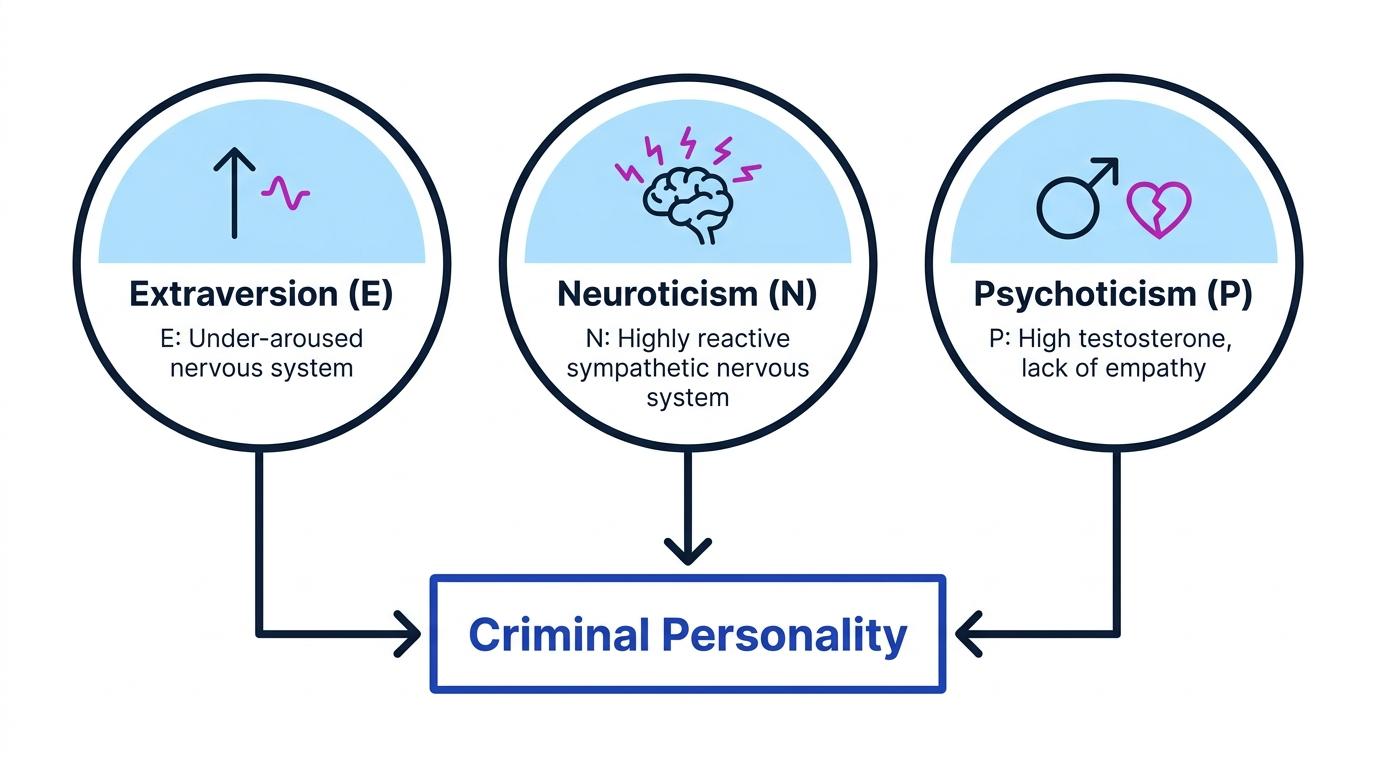
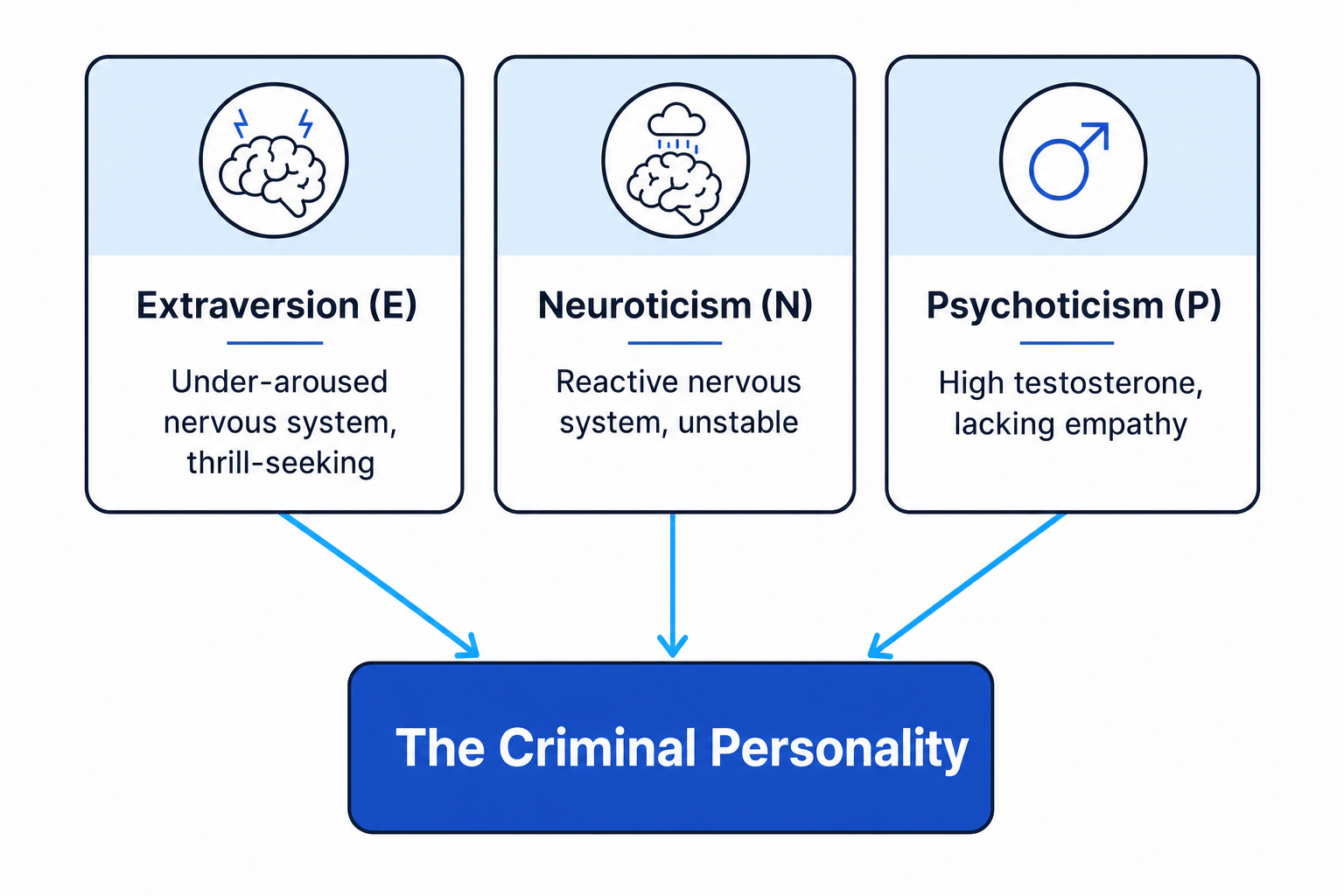
- Extraversion (E): Extraverts have an under-aroused nervous system. To compensate, they constantly seek excitement and stimulation, which can lead to risk-taking or rule-breaking behaviour.
- Neuroticism (N): Neurotics have a highly reactive sympathetic nervous system. They respond strongly to stressful situations, making them nervous, jumpy, and prone to unpredictable, emotionally charged behaviour.
- Psychoticism (P): Individuals high in psychoticism are typically cold, unemotional, and prone to aggression. Eysenck linked this trait to high levels of testosterone.
The Criminal Personality
According to Eysenck, the criminal personality type is a person who scores highly on all three dimensions: Extraversion, Neuroticism, and Psychoticism (high E, high N, high P).
The role of socialisation
Eysenck didn't just blame biology; he emphasised the role of socialisation. In childhood, we are usually taught to delay gratification and act in socially acceptable ways. This is essentially a process of conditioning—we learn that bad behaviour leads to punishment.
However, people with high E and high N scores have nervous systems that make them very difficult to condition. Because they don't learn easily from their mistakes or punishments, they are more likely to act antisocially where the opportunity presents itself.
Evaluating Eysenck's theory
- Supporting evidence: Eysenck and Eysenck (1977) compared 2070 male prisoners with a control group of 2422 non-prisoners. Across all age groups, prisoners scored higher on E, N, and P than the controls.
- Contradictory evidence: Farrington et al. (1982) reviewed several studies and found that while offenders did tend to score highly on P measures, they did not necessarily score highly on E and N.
- Cultural bias: Bartol and Holanchock (1979) studied Hispanic and African-American offenders in a maximum-security prison in New York. They found that these offenders were actually less extraverted than a non-criminal control group. This suggests Eysenck's theory may not be universal across different cultures.
Cognitive explanations of offending
Cognitive explanations focus on mental processes—how an individual's thinking, reasoning, and perception of the world influence their choices. The specification requires you to know two main cognitive areas: level of moral reasoning and cognitive distortions.
1. Level of moral reasoning
Lawrence Kohlberg argued that our sense of right and wrong develops in stages. He proposed a stage theory of moral development, categorised into three main levels:
- Pre-conventional level: Rules are obeyed merely to avoid punishment or gain rewards.
- Conventional level: Rules are obeyed for social approval and to maintain social order.
- Post-conventional level: Rules are obeyed based on an inner, abstract set of ethical principles (e.g., human rights).
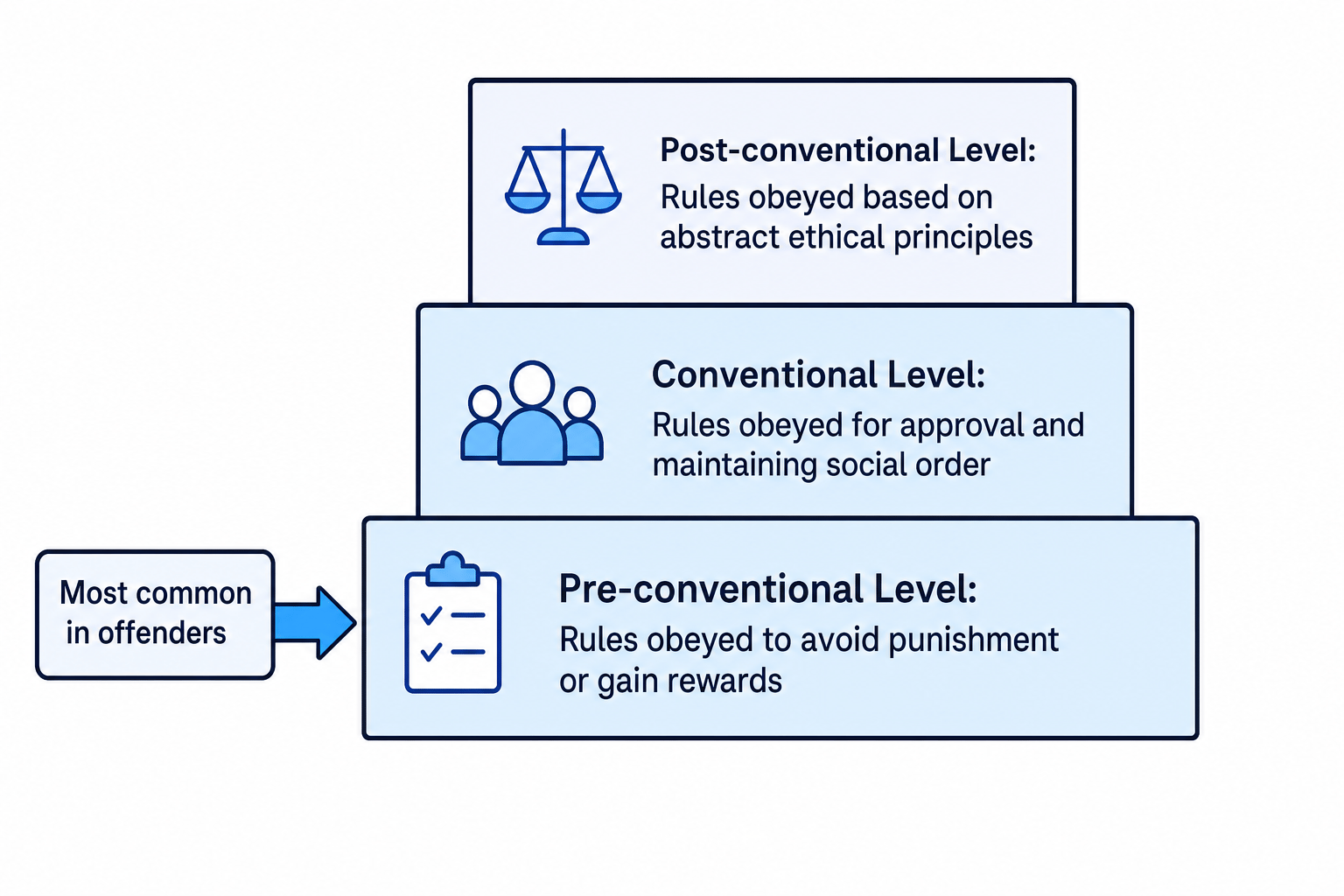
Kohlberg found that a group of violent youths were significantly lower in their moral development than non-violent youths. Offenders are generally stuck at the pre-conventional level. Because they focus on getting away with things or gaining rewards (like money or status), they are more likely to commit crimes if they feel they can avoid punishment.
2. Cognitive distortions
Cognitive distortions
Errors or biases in our information processing system. They are faulty, irrational ways of thinking that mean we perceive ourselves, other people, or the world inaccurately—often in a way that allows offenders to justify or deny their behaviour.
You need to know two specific cognitive distortions:
- Hostile attribution bias: The tendency to misinterpret the actions of others as hostile or aggressive when they are actually benign. For example, an offender might bump into someone on the street, assume the person did it aggressively on purpose, and respond with violence.
- Minimalisation (or minimisation): An attempt to deny or downplay the seriousness of an offence. For example, a burglar might say "I'm just doing my job, and the family has insurance anyway," or a violent offender might describe a severe assault as "just a little scuffle."
Applying cognitive distortions to a scenario
Scenario: Sam is arrested for a violent assault outside a pub. When interviewed, Sam claims the victim "gave him an aggressive stare and was asking for it." Later, Sam tells his lawyer, "I barely touched him, he just fell over awkwardly."
Identify how cognitive distortions apply to Sam's behaviour:
- Identify the trigger for the violence. Sam interpreted a look ("a stare") as a direct threat ("aggressive" and "asking for it").
- Link this to the correct distortion. This is hostile attribution bias because Sam has misread a potentially neutral social cue as hostile, using it to justify his initial violent reaction.
- Identify how Sam explains the outcome. Sam claims he "barely touched" the victim and that the victim "fell awkwardly".
- Link this to the correct distortion. This is minimalisation because Sam is downplaying his own role and the severity of the assault, reducing his own feelings of guilt.
Evaluating cognitive explanations
- Real-world application: Understanding cognitive distortions has led to highly effective treatments. Cognitive Behavioural Therapy (CBT) encourages offenders to "face up" to what they have done and establish a less distorted view of their actions. Studies show that reducing minimalisation in therapy is highly correlated with a reduced risk of reoffending.
- Descriptive, not explanatory: While cognitive models are great at describing the flawed thinking that happens in a criminal's mind, they are less good at explaining where these thoughts came from in the first place. They tell us "how" an offender thinks, but not necessarily "why".
- Gender bias (Kohlberg): Carol Gilligan criticised Kohlberg's theory for being based solely on male samples and a male perspective of justice, arguing it does not accurately reflect female moral reasoning (which she argued is more focused on care and relationships).
Differential association theory
Proposed by Edwin Sutherland (1939), differential association theory suggests that offending behaviour is entirely learned. It marks a huge shift away from biological or "born criminal" theories.
The theory proposes that individuals learn the values, attitudes, techniques, and motives for criminal behaviour through interactions with intimate groups (like family or peer groups).
Differential Association
The mathematical principle behind the theory is simple: if a person's exposure to pro-criminal attitudes outweighs their exposure to anti-criminal attitudes, they will go on to offend.
According to Sutherland, two distinct things are learned:
- Learned attitudes towards crime: When a person is socialised into a group, they are exposed to values. If the group has more positive definitions of crime than negative ones, the individual will adopt those values.
- Learned specific techniques: The individual may also learn how to actually commit the crimes (e.g., how to pick a lock, how to disable a car alarm, or how to commit tax fraud).
This theory helps explain why so many convicts go on to reoffend upon release. While in prison, inmates observe and learn new specific techniques of offending from more experienced criminals, which they can put into practice when they get out.
Evaluating differential association theory
- Shift of focus: Sutherland successfully moved the focus of criminology away from early biological theories (like Lombroso's atavistic form) and "bad genes", pointing out that dysfunctional environments and social circumstances are more to blame.
- Explains white-collar crime: Unlike many other theories that mostly explain working-class, inner-city crime, differential association can explain crimes committed by middle-class and affluent people. Sutherland himself coined the term "white-collar crime", noting that corporate fraud is learned in a similar way within business environments.
- Difficulty in testing: The theory is very difficult to test scientifically. It is almost impossible to mathematically measure the number of "pro-criminal attitudes" a person has been exposed to. Without being able to measure this, we cannot pinpoint the exact point at which the urge to offend triggers, undermining the theory's scientific credibility.
- Risk of stereotyping: It risks stereotyping individuals who come from impoverished, high-crime backgrounds as "unavoidably criminal", ignoring the fact that many people exposed to pro-criminal attitudes choose not to offend.
In the exam
- Ensure you can clearly distinguish between the three main cognitive concepts. Examiners frequently see students mix up hostile attribution bias (the trigger) with minimalisation (the aftermath/excuse).
- For Eysenck, remember the acronym ENP (Extraversion, Neuroticism, Psychoticism) and be prepared to link each trait back to biological nervous system activity (e.g., Extraverts seek thrills because their nervous system is under-aroused).
- If an essay asks you to discuss "psychological explanations", you can evaluate them against biological explanations. For example, praise differential association for avoiding biological determinism, but note that Eysenck blends both approaches.
Check yourself
- Which aspect of Eysenck's personality theory is associated with high levels of testosterone and a lack of empathy?
- According to Kohlberg, at which level of moral reasoning do most offenders operate, and why?
- How does differential association theory explain why an individual from an affluent, middle-class background might commit corporate fraud?