What you'll learn
- How genetic explanations use twin, adoption, and gene-environment evidence to explain offending.
- How neural explanations link offending to brain areas and neurotransmitters.
- Key studies including Lange (1931), Christiansen (1977), Mednick et al. (1984), Brunner et al. (1993), Caspi et al. (2002), and Raine et al. (1997).
- How to evaluate biological explanations using AO3: evidence quality, reductionism, determinism, ethics, and applications.
The basic idea: biology can increase risk
Offending behaviour means behaviour that breaks the criminal law. In forensic psychology, biological explanations argue that some people may be more likely to offend because of inherited characteristics, brain differences, or abnormal chemical processes in the nervous system.
This does not mean “biology makes someone a criminal”. A better way to think about it is: biology may create a vulnerability, which can combine with upbringing, peer influence, poverty, trauma, or opportunity.
Risk, not destiny
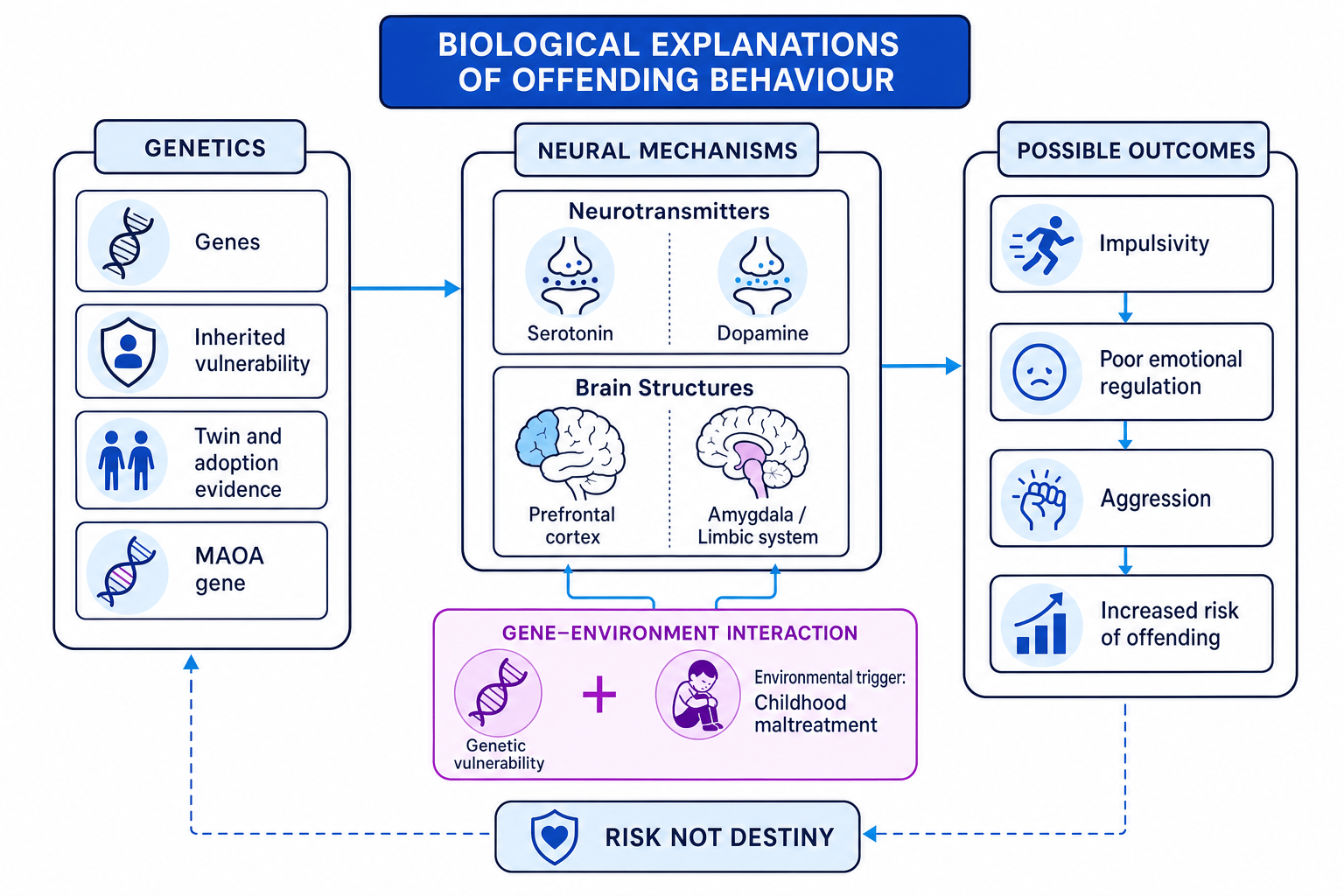
Biological explanations are strongest when they explain offending as an increased probability of behaviour, not as a fixed or inevitable outcome.
Genetic explanations
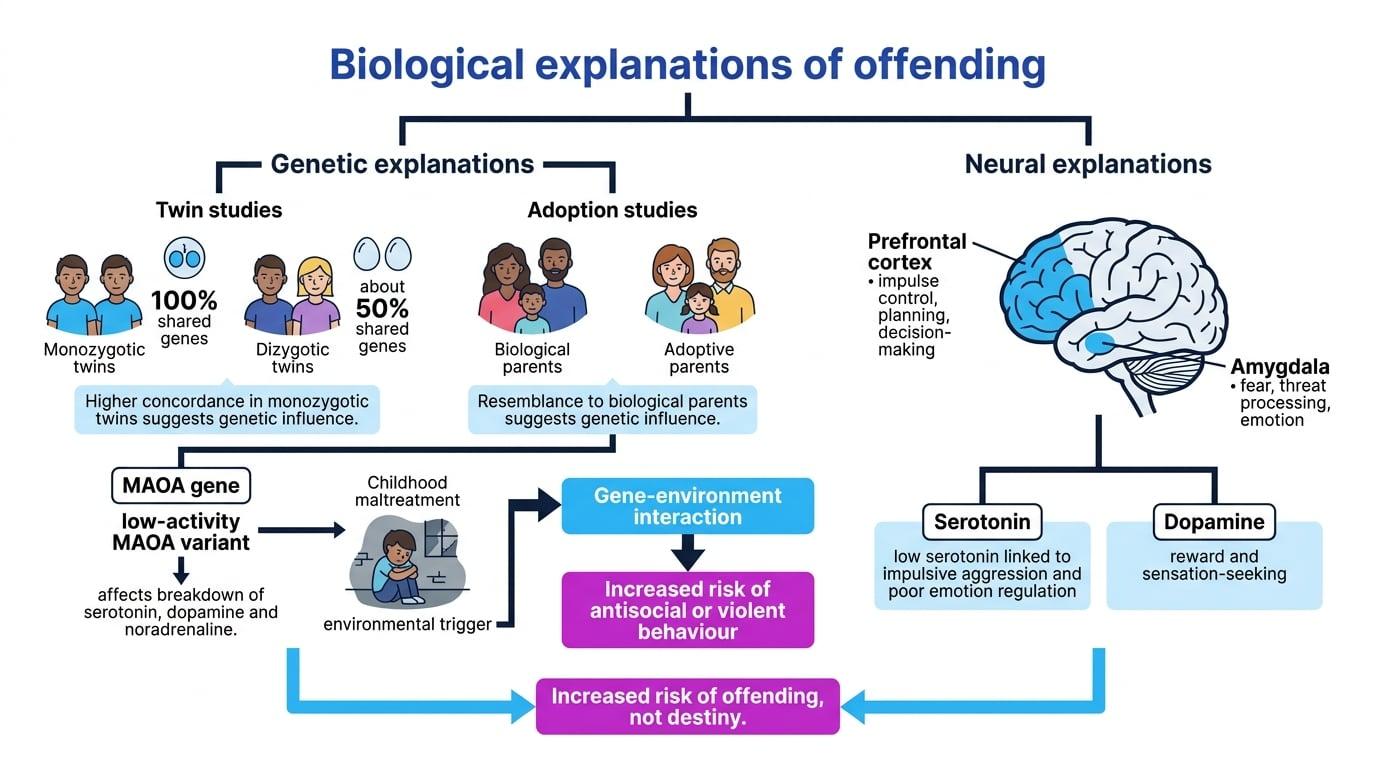
A gene is a section of DNA that contributes to a characteristic. A genetic explanation of offending suggests that inherited biological factors may influence traits linked to criminal behaviour, such as impulsivity, aggression, sensation-seeking, or poor emotional control.
Most psychologists do not claim there is a single “criminal gene”. Offending is more likely to be polygenic, meaning influenced by many genes, each having a small effect.
Heritability
Heritability is the extent to which differences between people in a trait can be explained by genetic differences within a population. It does not mean a behaviour is fixed in one individual.
Twin studies
Twin studies compare monozygotic twins, who come from one fertilised egg and share 100% of their genes, with dizygotic twins, who come from two fertilised eggs and share about 50% of their genes.
A concordance rate is the percentage of twin pairs in which both twins show the same behaviour. If offending is partly genetic, monozygotic twins should show higher concordance for offending than dizygotic twins.
Lange (1931) studied male twins where one twin had been imprisoned. He found that 10 out of 13 monozygotic twin pairs were concordant for imprisonment, compared with 2 out of 17 dizygotic twin pairs. This suggested a genetic influence.
Christiansen (1977) studied over 3,500 Danish twin pairs and found higher criminal concordance in monozygotic twins than dizygotic twins. For male twins, concordance was about 35% for monozygotic twins and 13% for dizygotic twins.
Evaluating twin studies
Twin studies provide useful evidence because they compare people with different degrees of genetic similarity. However, they are not perfect.
Monozygotic twins often share a more similar environment than dizygotic twins. They may be treated more alike by parents, teachers, and peers. This makes it hard to separate genes from environment.
Also, concordance rates are never 100%. Even among identical twins, one twin may offend while the other does not. This shows that genes cannot fully explain offending.
Overstating twin evidence
Do not write that twin studies “prove crime is genetic”. They show an association between genetic similarity and offending, but environmental factors still matter.
Adoption studies
Adoption studies try to separate genetic and environmental influences more clearly. If an adopted child resembles their biological parents, this suggests genetic influence. If they resemble their adoptive parents, this suggests environmental influence.
Mednick et al. (1984) studied Danish adoptees. They found that adoptees were more likely to have criminal convictions if their biological parents had criminal convictions, even when the adoptees were raised by non-criminal adoptive parents. The highest conviction rates were found when both biological and adoptive parents had criminal records.
This supports a genetic explanation, but it also shows that environment matters too. Genetic vulnerability plus a criminal environment produced the greatest risk.
Evaluating adoption studies
Adoption studies are useful because they reduce the problem of shared family environment. However, they still have limitations.
Adoption agencies may use selective placement, where children are placed in adoptive families similar to their biological families. This can blur the distinction between genetic and environmental influence.
Criminal records also measure only detected and convicted crime. They do not capture all offending behaviour. This means the evidence may underestimate or distort the true pattern of offending.
Candidate genes and MAOA
A candidate gene is a specific gene researchers investigate because it may be linked to a behaviour.
One gene often discussed in relation to aggression is the MAOA gene. This gene helps regulate the enzyme monoamine oxidase A, which breaks down neurotransmitters such as serotonin, dopamine, and noradrenaline. A low-activity version of the MAOA gene has been linked to impulsive aggression in some research.
Brunner et al. (1993) studied a Dutch family in which several males showed violent and impulsive behaviour. These males had a rare mutation affecting MAOA activity. This suggested that abnormal MAOA functioning might be linked to aggression.
However, this was a very unusual family, so the findings may not generalise to the wider population.
Gene-environment interaction
A gene-environment interaction occurs when genetic vulnerability only increases risk under certain environmental conditions.
Caspi et al. (2002) studied children from the Dunedin longitudinal study in New Zealand. They found that males with the low-activity MAOA variant were more likely to develop antisocial behaviour, but mainly if they had also experienced childhood maltreatment. Low MAOA alone did not automatically lead to offending.
This is important because it avoids a simplistic “gene causes crime” explanation.
Diathesis-stress model
The diathesis-stress model says that a biological vulnerability, such as a genetic predisposition, may only lead to a behaviour if triggered by environmental stress.
Applying gene-environment interaction
A young man has a family history of violent offending and experienced severe neglect during childhood. He later shows impulsive aggression.
- Identify the possible genetic vulnerability: a family history of violent offending could suggest inherited factors linked to impulsivity or aggression.
- Add the environmental trigger: severe neglect may act as a stressor that increases the chance of the vulnerability being expressed.
- Link the two together: the explanation is stronger if you say offending risk may arise from the interaction between inherited vulnerability and childhood experience.
- Avoid determinism: the young man was not “born criminal”; the biological explanation only suggests an increased risk.
Neural explanations
A neural explanation focuses on the brain and nervous system. It asks whether offenders, especially violent offenders, may have differences in brain structure, brain activity, or neurotransmitter levels.
A neurotransmitter is a chemical messenger that passes signals between neurons. Two neurotransmitters often discussed in relation to offending are serotonin and dopamine.
The prefrontal cortex
The prefrontal cortex is the front part of the brain involved in planning, decision-making, impulse control, and weighing up consequences.
If the prefrontal cortex is underactive or damaged, a person may be less able to control aggressive impulses or consider the long-term consequences of their actions.
Raine et al. (1997) used PET scans to compare 41 murderers pleading not guilty by reason of insanity with 41 matched controls. The murderers showed reduced activity in areas including the prefrontal cortex, as well as abnormalities in some limbic areas. This supports the idea that violent offending may be linked to atypical brain functioning.
The limbic system and amygdala
The limbic system is a group of brain structures involved in emotion and motivation. The amygdala is part of this system and is important for fear, threat detection, and emotional learning.
If the amygdala functions atypically, a person may show reduced fear conditioning, poor emotional regulation, or reduced sensitivity to others’ distress. These traits may increase the risk of violent or antisocial behaviour.
Serotonin and dopamine
Serotonin is linked to mood regulation and impulse control. Low serotonin activity has been associated with impulsive aggression. Scerbo and Raine (1993) reviewed studies and found evidence linking low serotonin with antisocial and aggressive behaviour.
Dopamine is linked to reward and motivation. Abnormal dopamine functioning may make some behaviours feel more rewarding or increase sensation-seeking, although this evidence is less straightforward than the evidence for serotonin.
Simple neural chain
A clear AO1 chain is: reduced prefrontal control → poorer impulse regulation → greater chance of aggressive or risky behaviour → increased risk of offending.
Evaluating neural explanations
Neural evidence is strengthened by the use of brain scanning techniques such as PET scans. These provide objective biological data rather than relying only on self-report.
However, much of the evidence is correlational. If offenders show reduced prefrontal activity, this does not prove the brain difference caused the offending. The brain difference could be a result of drug use, head injury, trauma, poverty, or other factors associated with offending.
There are also sampling issues. Raine et al. (1997) studied murderers pleading not guilty by reason of insanity, so the findings may not apply to all offenders, especially non-violent offenders.
Ethically, biological research on offenders must protect confidentiality and avoid harmful labelling. Brain differences or genetic vulnerabilities could lead to stigma if people are seen as “biologically criminal”. Researchers also need valid consent, protection from harm, and careful debriefing, especially when using medical procedures or vulnerable participants.
Overall AO3: strengths and weaknesses
Strength: scientific and practical value
Biological explanations are supported by objective evidence from twin records, adoption studies, genetic research, and brain imaging. They have real-world applications because they may help identify risk factors and develop interventions, such as support for impulse control, early help for maltreated children, or treatment for brain injury and substance misuse.
Weakness: reductionism
Reductionism means explaining a complex behaviour at too simple a level. Offending is influenced by many factors, including family, education, poverty, peer groups, cognition, and social learning. A purely biological explanation may ignore these wider influences.
Weakness: determinism
Biological determinism is the idea that behaviour is fixed by biology. This is problematic because it may reduce personal responsibility and could have serious legal implications. If offending is seen as biologically caused, courts may treat offenders differently.
A balanced answer should say biological factors can increase risk, but they do not remove choice or guarantee offending.
In the exam
- For AO1, describe both genetics and neural explanations: include twin/adoption evidence, MAOA, prefrontal cortex, limbic system, and neurotransmitters.
- For AO3, avoid generic evaluation. Link each point directly to offending, such as “concordance is not 100%, so genes cannot be a complete explanation”.
- For higher marks, use an interactionist conclusion: biological vulnerability is most convincing when combined with environmental triggers.
Check yourself
- Why do adoption studies help separate genetic and environmental explanations of offending?
- How does the low-activity MAOA gene link to childhood maltreatment in Caspi et al. (2002)?
- Why is reduced prefrontal cortex activity relevant to impulsive or violent offending?