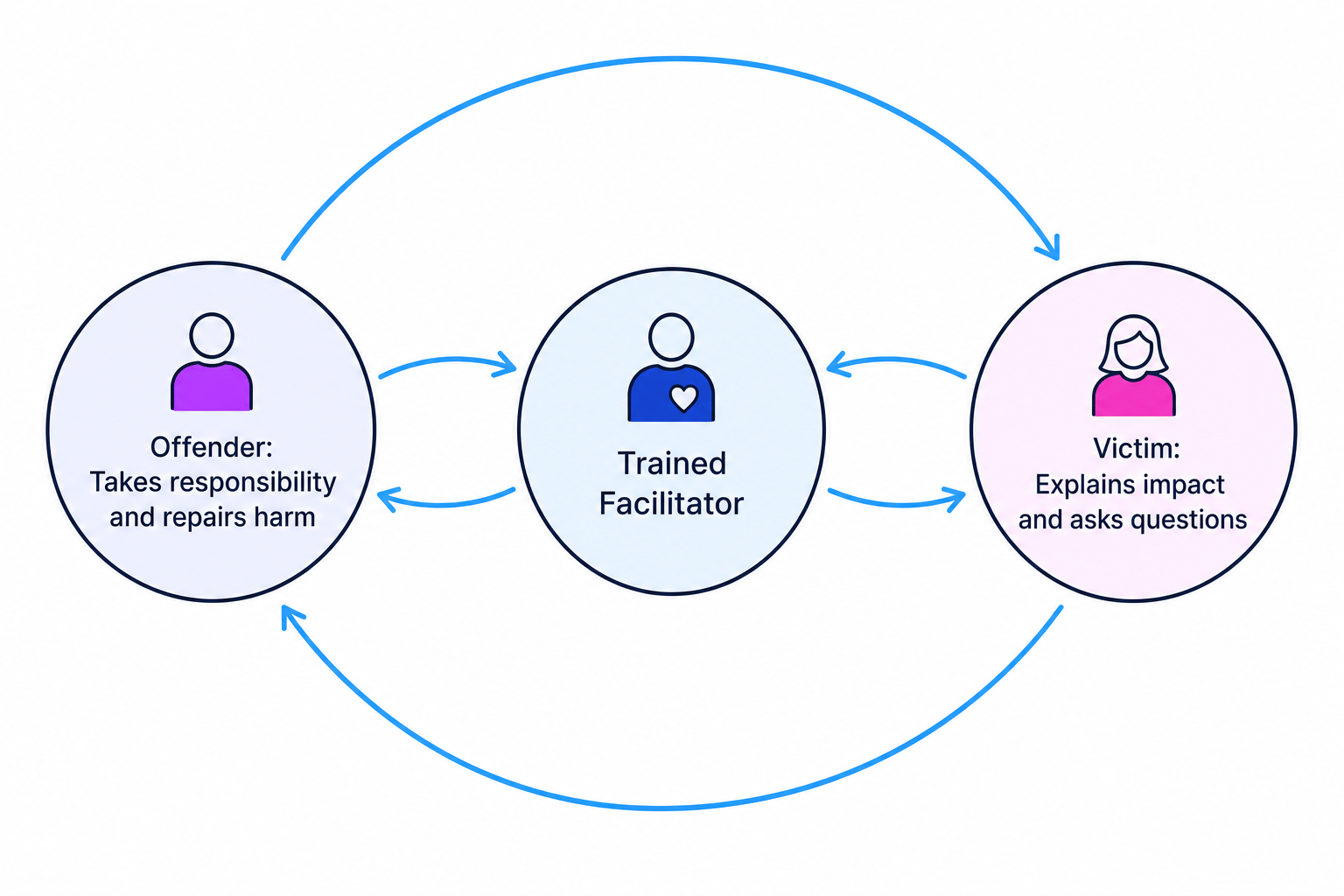
Evaluating Restorative Justice (AO3)
- Positive outcomes: Shapland et al. (2007) conducted a large review of restorative justice programmes and found that every £1 spent on RJ saved the criminal justice system £8 through reduced reoffending. It also boasts very high victim satisfaction rates.
- Relies on remorse: The system completely collapses if the offender is not genuinely remorseful. If they are only taking part to get a reduced sentence, the victim can be re-traumatised by their apathy.
- Not suitable for all crimes: It is rarely used in cases of domestic abuse or severe violent crimes where the power imbalance is too great, as the victim may feel intimidated or coerced into participating.
Tip
Contrasting Methods
If you get a 16-mark essay asking you to evaluate methods of dealing with offending behaviour, comparing them against each other is a great way to earn high AO3 marks. For example, contrast the passive learning of a token economy with the active cognitive effort required for anger management. Or contrast the state-focused punishment of prison with the victim-focused healing of restorative justice.
Exam technique
In the exam
- When answering an AO2 application question about a scenario, explicitly match your knowledge to the text. If the scenario says an offender "can't handle it when people look at him funny", explicitly state that this is an irrational cognitive trigger that would be addressed in the Cognitive Preparation stage of anger management.
- For token economies, remember the specific terminology: ensure you mention target behaviours, secondary reinforcers, and primary reinforcers.
- Don't forget the ethical implications as an AO3 point. Whether it's the high suicide rates in custodial sentencing, the human rights debates surrounding token economies, or the potential for psychological harm to victims in restorative justice, ethics is always a valid evaluation point.
Self review
Check yourself
- Can you name and explain the four main aims of custodial sentencing?
- Why is a token in a token economy considered a 'secondary' reinforcer?
- What are the three stages of anger management as proposed by Novaco?
- How does restorative justice fundamentally differ from traditional custodial sentencing?
