What you'll learn
- How family dysfunction may contribute to the development or maintenance of schizophrenia.
- How cognitive explanations link schizophrenia symptoms to problems in attention, reasoning and self-monitoring.
- How to apply these explanations to scenario questions.
- How to evaluate them using research evidence, causality issues, ethics and real-world applications.
Big picture: what counts as a psychological explanation?
A psychological explanation explains behaviour and experience in terms of mental processes, social experiences and learning, rather than purely biological factors such as genes, dopamine or brain structure.
For schizophrenia, psychological explanations do not usually claim that “bad parenting” or “faulty thinking” is the only cause. A better way to think about them is as risk factors or maintenance factors.
Risk factor and maintenance factor
A risk factor increases the likelihood that a disorder may develop. A maintenance factor helps keep symptoms going or makes relapse more likely after recovery.
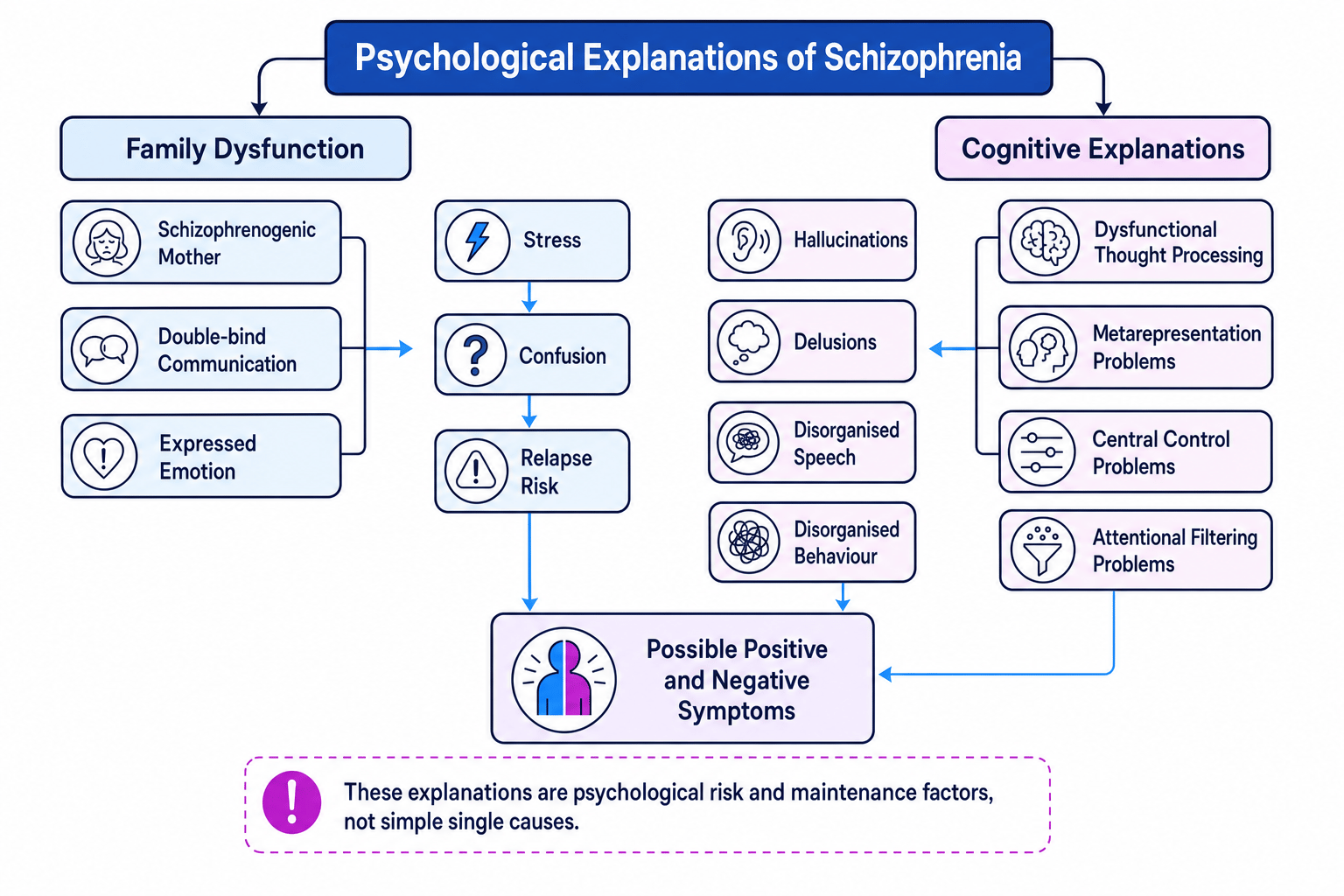
Schizophrenia includes positive symptoms, such as hallucinations and delusions, and negative symptoms, such as avolition and speech poverty. Psychological explanations mainly try to explain how unusual family environments or dysfunctional thought processing could contribute to these symptoms.
Main takeaway
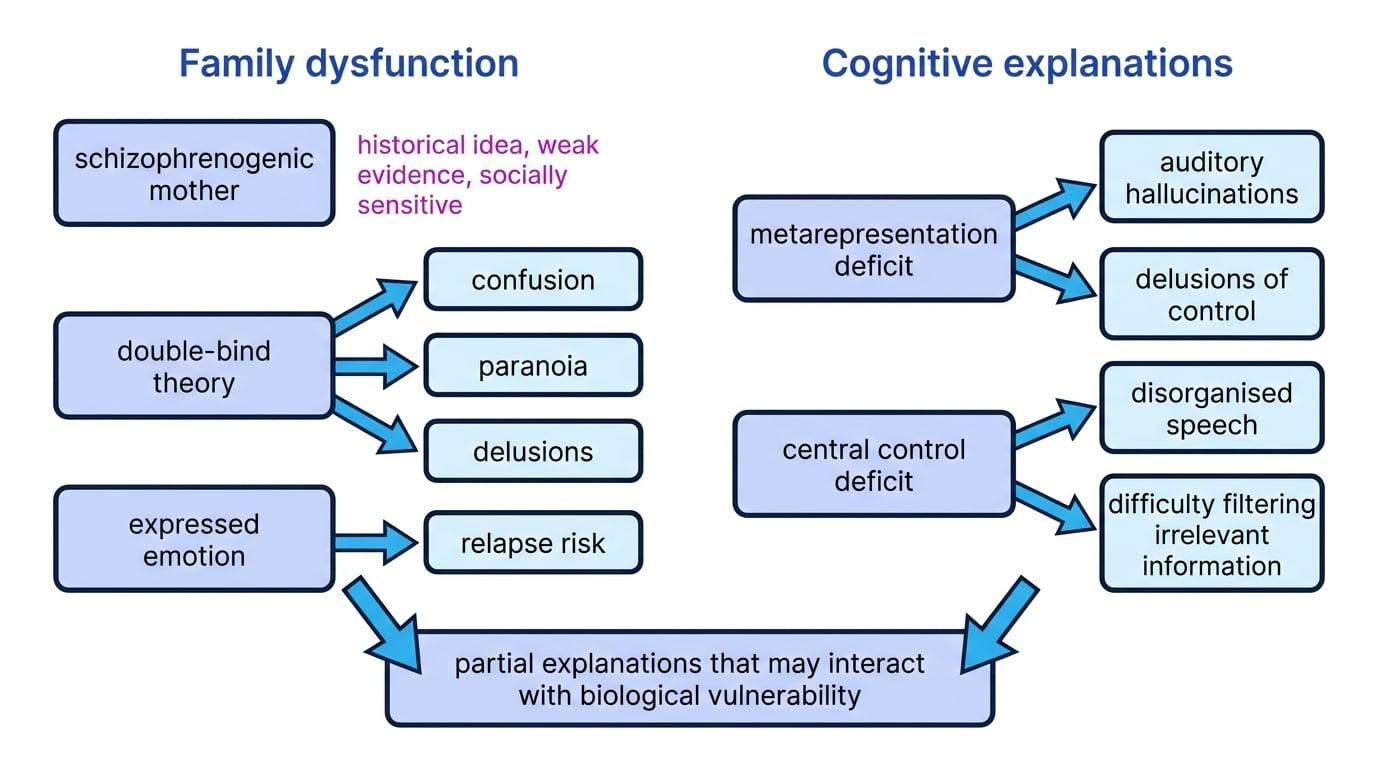
In AQA essays, treat psychological explanations as partial explanations: they may help explain why symptoms start, worsen or return, but they work best when combined with biological vulnerability in an interactionist account.
Family dysfunction
Family dysfunction refers to abnormal or unhealthy patterns of communication, emotion and relationships within a family. In schizophrenia, the main family-based explanations are:
- the schizophrenogenic mother
- double-bind theory
- expressed emotion
These are not equally accepted today. Some are historically important but ethically and scientifically problematic.
The schizophrenogenic mother
The idea of the schizophrenogenic mother was proposed by Fromm-Reichmann in 1948. She suggested that some mothers were cold, rejecting and controlling, while also being overprotective. This was argued to create a family climate of tension and mistrust, increasing the child’s risk of developing schizophrenia.
Schizophrenogenic mother
A schizophrenogenic mother is a mother who is supposedly cold, rejecting, controlling and overprotective, creating emotional tension that may contribute to schizophrenia.
This explanation is rarely accepted as a serious cause today, but it is useful for understanding the history of psychological explanations.
Evaluation of the schizophrenogenic mother
A major weakness is that the explanation is socially sensitive. It appears to blame mothers for a severe mental disorder, which could increase guilt, stigma and family conflict. It is also gender-biased because it focuses blame on mothers rather than fathers, wider family systems or social stressors.
There is also little convincing evidence that this parenting style causes schizophrenia. Many people with schizophrenia have not had this kind of mother, and many people with difficult parents never develop schizophrenia.
Blaming parents too simply
Do not write that family dysfunction “causes schizophrenia” in a straightforward way. A safer exam phrase is: family dysfunction may increase vulnerability, trigger symptoms, or contribute to relapse in some people.
Double-bind theory
Double-bind theory was proposed by Bateson et al. in 1956. A double bind occurs when a child receives contradictory messages from a caregiver but cannot comment on the contradiction or escape the situation.
For example, a parent might say “I love you” while using a cold or rejecting tone. If the child moves closer, the parent may reject them; if the child moves away, the parent may accuse them of being unloving. The child is “trapped” because whatever they do seems wrong.
Double bind
A double bind is a communication pattern where a person receives two contradictory messages and is unable to resolve or challenge the contradiction.
Bateson et al. argued that repeated exposure to double binds could make it hard for a child to develop a coherent view of reality. This might contribute to symptoms such as paranoia, disorganised thinking or delusions.
Evaluation of double-bind theory
One strength is that the theory links quite clearly to symptoms: confusing communication could plausibly contribute to confusion, suspiciousness and difficulty interpreting others’ intentions.
However, evidence is mainly correlational. Families of people with schizophrenia may show unusual communication patterns, but this does not prove that the communication caused the disorder. The direction could be reversed: living with a person who has severe symptoms may make family communication more strained or contradictory.
Expressed emotion
Expressed emotion, often shortened to EE, is the level of negative emotion expressed by carers towards a person with schizophrenia. It is especially important as a maintenance explanation because it is linked to relapse.
Expressed emotion
Expressed emotion is a family communication style involving high levels of criticism, hostility and/or emotional over-involvement towards a person with schizophrenia.
High expressed emotion includes:
- criticism: frequent negative comments about the person’s behaviour
- hostility: treating the person as the problem, rather than seeing symptoms as part of an illness
- emotional over-involvement: excessive concern, self-sacrifice or overprotectiveness
Brown et al. in 1972 found that patients returning to families with high expressed emotion were more likely to relapse. Vaughn and Leff in 1976 also found that relapse rates were higher when patients had high contact with high-EE relatives.
This does not mean families are “to blame”. High EE may be a response to stress, fear, lack of support and poor understanding of the disorder.
Distinguishing family dysfunction concepts
A student describes this scenario: Sam’s parent often says, “You must make your own choices,” but then becomes angry whenever Sam does. After Sam leaves hospital, relatives frequently criticise him for being lazy and talk about him as if he is deliberately difficult.
- The contradictory instruction “make your own choices” followed by punishment for choosing independently fits double-bind communication, because Sam receives incompatible messages and cannot easily resolve them.
- The criticism after hospital fits high expressed emotion, because relatives are responding with negative comments and hostility.
- The best explanation of relapse risk would focus on expressed emotion, because EE is most strongly linked to the maintenance or return of symptoms after treatment.
- A balanced answer would avoid saying the family “caused” schizophrenia, because the scenario only shows family stress and communication patterns, not a proven cause of the disorder.
AO3: evaluating family dysfunction explanations
Research support
There is good evidence that expressed emotion predicts relapse. This is useful because it has real-world applications: family therapy aims to reduce criticism, hostility and over-involvement, and it is associated with lower relapse rates when combined with drug therapy.
Tienari et al. in 2004 studied adopted children whose biological mothers had schizophrenia. They found that a disturbed adoptive family environment was linked to increased risk, but mainly in children with genetic vulnerability. This supports an interactionist view: family factors may matter most when biological risk is already present.
Causality problems
A major weakness is that much of the evidence is correlational. High expressed emotion and schizophrenia relapse may occur together, but this does not prove that high EE causes relapse. Symptoms may increase family stress, which then increases criticism or over-involvement.
Ethical issues
Research into family dysfunction is socially sensitive. Researchers must avoid increasing blame or stigma. When studying families and patients, ethical issues include informed consent, confidentiality, the right to withdraw, protection from psychological harm, and careful debriefing, especially because participants may be vulnerable.
Best evaluation phrase
For family dysfunction, a strong conclusion is: the evidence is stronger for family factors maintaining schizophrenia or increasing relapse risk than for family factors causing the original disorder.
Cognitive explanations
Cognitive explanations focus on faulty mental processes. Cognition means mental processes such as attention, perception, memory, reasoning and language.
In schizophrenia, cognitive explanations suggest that symptoms come from dysfunctional thought processing — abnormal ways of processing information.
Dysfunctional thought processing
Dysfunctional thought processing means that information is interpreted, filtered or monitored in an abnormal way, leading to experiences such as hallucinations, delusions or disorganised speech.
Frith’s cognitive model
Frith in 1992 argued that schizophrenia involves problems in key cognitive systems, especially metarepresentation and central control.
Metarepresentation
Metarepresentation is the ability to reflect on your own thoughts and recognise them as yours. It also helps you understand other people’s intentions.
If metarepresentation is impaired, a person may misattribute their own inner speech to an external source. This could help explain auditory hallucinations, such as hearing voices. It may also help explain delusions of control, where a person believes their thoughts or actions are controlled by someone else.
Metarepresentation
Metarepresentation is the cognitive ability to monitor and reflect on your own thoughts and actions, and to understand the intentions of others.
Central control
Central control is the ability to suppress automatic responses and carry out deliberate actions. If central control is impaired, a person may struggle to organise thoughts and behaviour.
This could help explain disorganised speech, because the person may have difficulty controlling the flow of ideas and selecting relevant responses.
Central control
Central control is the cognitive ability to inhibit automatic responses and organise deliberate, goal-directed behaviour.
Other cognitive ideas: attention and reasoning biases
Some cognitive explanations focus on attention. If a person cannot filter out irrelevant information, they may feel overwhelmed by sensory input. This could contribute to confusion, paranoia or disorganised behaviour.
Other explanations focus on reasoning biases. For example, paranoid delusions may involve a tendency to jump to conclusions or to attribute negative events to external causes.
Applying cognitive explanations to symptoms
A person reports hearing a voice commenting on their actions. They also believe their arm movements are being controlled by a transmitter, and their speech often jumps suddenly between unrelated topics.
- Hearing a voice can be explained through a metarepresentation problem, because the person may misidentify their own inner speech as coming from an external source.
- Believing movements are externally controlled also fits impaired self-monitoring, because the person may not correctly recognise their actions as self-generated.
- Jumping between unrelated topics fits a central control problem, because the person may struggle to inhibit irrelevant ideas and organise speech.
- A balanced answer would say the cognitive explanation accounts well for some positive and disorganised symptoms, but it does not fully explain why the cognitive problems developed in the first place.
AO3: evaluating cognitive explanations
Research support
Stirling et al. in 2006 compared people with schizophrenia and a control group using cognitive tasks such as the Stroop test. People with schizophrenia took longer to name the ink colours, suggesting difficulty suppressing automatic processing. This supports the idea of impaired central control.
There is also evidence that people with schizophrenia show deficits in attention, memory and reasoning. This gives cognitive explanations scientific credibility because the proposed processes can be tested in controlled studies.
Explains symptoms in detail
A strength of cognitive explanations is that they explain the proximal mechanisms behind symptoms. A proximal mechanism is the immediate process that produces a symptom. For example, metarepresentation problems can explain why a person might experience their own thoughts as voices.
This is useful for treatment. Cognitive behavioural therapy for psychosis, often called CBTp, tries to help people evaluate unusual beliefs and reduce distress linked to hallucinations or delusions.
But cause and effect are unclear
A weakness is that cognitive deficits may be a consequence of schizophrenia rather than a cause. For example, hallucinations, medication, stress or long-term hospitalisation could affect performance on cognitive tasks.
Also, cognitive explanations are better at explaining some symptoms than others. They are especially useful for hallucinations, delusions and disorganised speech, but less complete for negative symptoms such as avolition.
Methodological and ethical issues
Cognitive studies often use lab tasks, which allow good control over variables. However, these tasks may lack ecological validity because naming ink colours or completing memory tests is not the same as coping with real-life psychotic symptoms.
Ethically, researchers must consider protection from harm because cognitive tasks may be frustrating or distressing for participants. Confidentiality is also crucial because a diagnosis of schizophrenia can carry stigma.
Best overall judgement
Cognitive explanations are strong at explaining how symptoms may occur, but weaker at explaining why the underlying cognitive problems first develop.
Comparing the two explanations
Family dysfunction explanations focus on the person’s social environment, especially communication and emotional climate. Cognitive explanations focus on the person’s internal mental processing.
They can work together. For example, a person with cognitive vulnerability may misinterpret criticism as threatening, while a high-EE family environment may increase stress and relapse risk. This fits the broader diathesis-stress model, where biological or psychological vulnerability interacts with environmental stress.
In the exam
- For AO1, clearly separate family dysfunction from cognitive explanations and use named terms such as double bind, expressed emotion, metarepresentation and central control.
- For AO2, link the symptom in the scenario to the correct mechanism: voices often link to metarepresentation, while relapse after criticism often links to expressed emotion.
- For AO3, avoid extreme claims. Emphasise evidence for relapse, causality problems, ethical concerns about blaming families, and the usefulness of psychological explanations for therapies such as family therapy and CBTp.
Check yourself
- What is the difference between double-bind communication and expressed emotion?
- How could a metarepresentation deficit explain auditory hallucinations?
- Why is family dysfunction better supported as a maintenance explanation than as a simple cause of schizophrenia?