What you'll learn
- What drug therapy means in schizophrenia treatment.
- How typical antipsychotics and atypical antipsychotics work.
- Key examples: chlorpromazine, haloperidol, clozapine and risperidone.
- How to evaluate drug therapy using evidence, side effects, ethics and real-world application.
Starting point: what is drug therapy?
Schizophrenia is a severe mental disorder involving symptoms such as hallucinations, delusions, speech poverty and avolition. In AQA, you need to know that drug therapy is a biological treatment for schizophrenia: it aims to change brain chemistry, especially the activity of the neurotransmitter dopamine.
Drug therapy
Drug therapy is the use of medication to reduce the symptoms of a disorder. In schizophrenia, the main drugs are antipsychotics, which reduce psychotic symptoms such as hallucinations and delusions.
Antipsychotics do not “cure” schizophrenia in the sense of removing the underlying vulnerability. Instead, they often make symptoms less intense, helping the person function better and engage with other treatments such as cognitive behavioural therapy for psychosis or family therapy.
The dopamine link
A neurotransmitter is a chemical messenger that passes signals between neurons. Dopamine is one neurotransmitter involved in reward, movement, attention and perception.
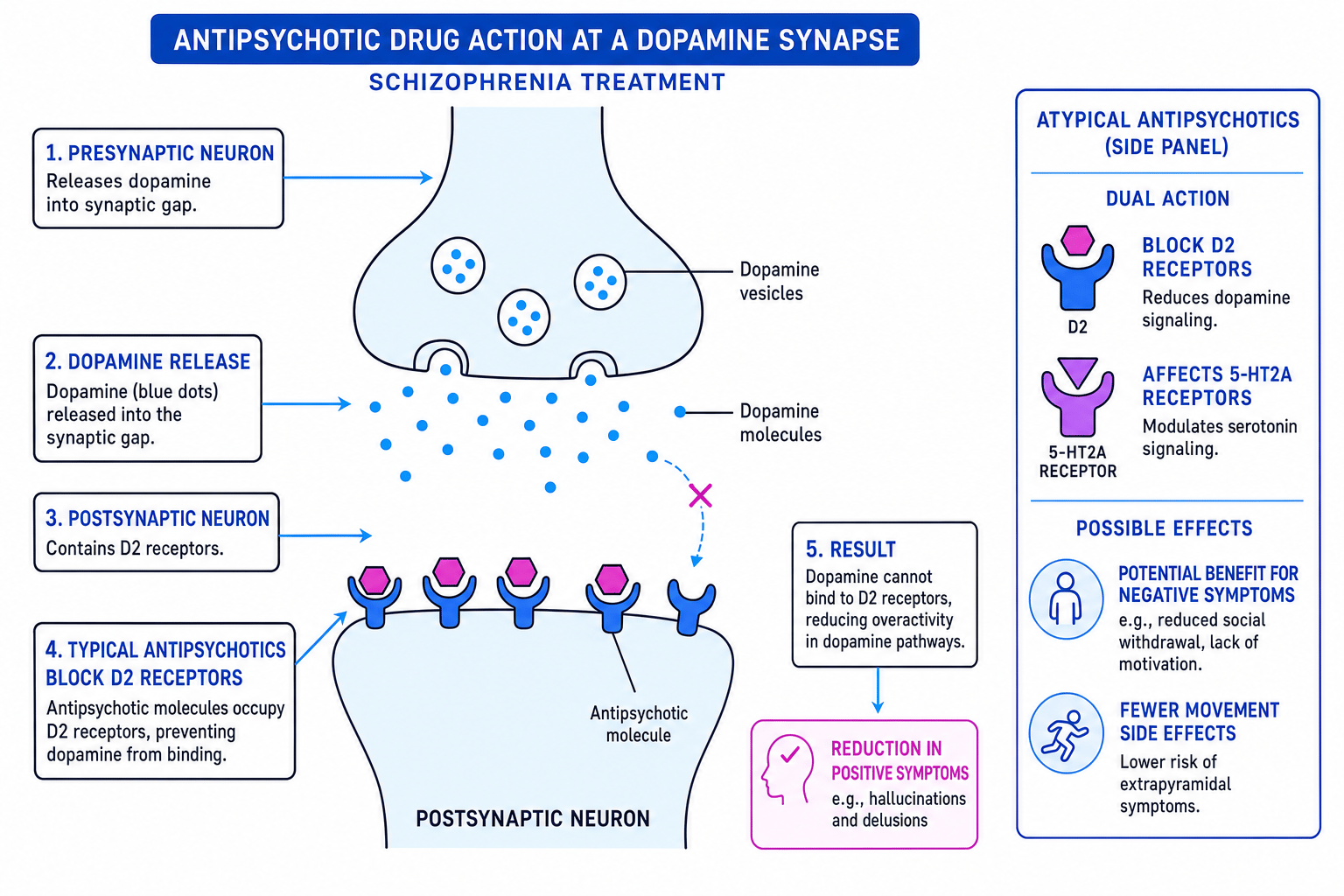
A synapse is the small gap between neurons. Dopamine is released from one neuron and binds to receptors on the next neuron. One important receptor type in schizophrenia treatment is the D2 receptor.
The dopamine hypothesis suggests that some symptoms of schizophrenia are linked to abnormal dopamine activity. Overactivity in dopamine pathways, especially the mesolimbic pathway, is associated with positive symptoms such as hallucinations and delusions.
Positive and negative symptoms
Positive symptoms are additions to normal experience, such as hallucinations and delusions. Negative symptoms are reductions or losses of normal functioning, such as avolition, speech poverty and social withdrawal.
Drug therapy mainly works by reducing the effect of dopamine at receptors, especially D2 receptors.
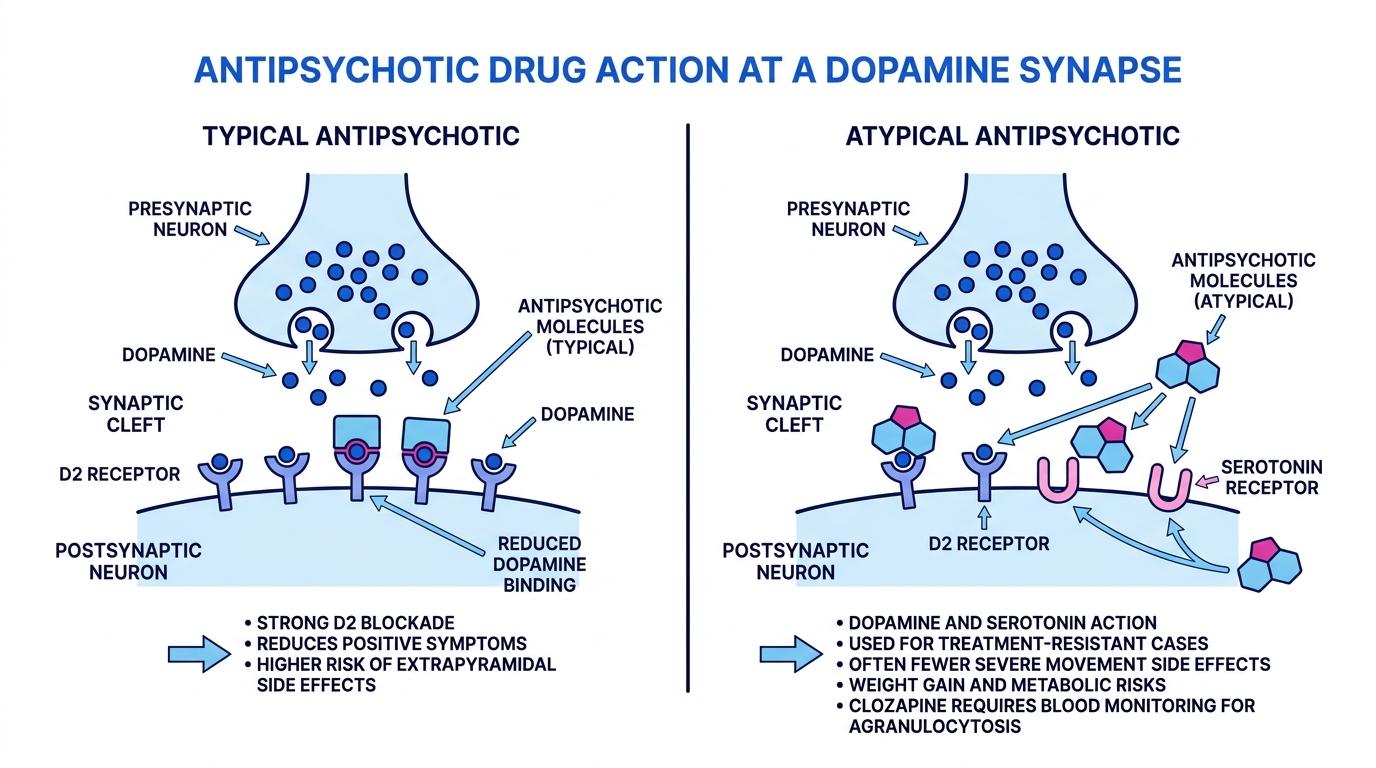
Typical antipsychotics
Typical antipsychotics are the older, first-generation antipsychotic drugs. They were developed in the 1950s and include chlorpromazine and haloperidol.
Their main action is as dopamine antagonists.
Antagonist
An antagonist is a substance that blocks a receptor, reducing the effect of the neurotransmitter that normally binds to it.
Typical antipsychotics strongly block D2 receptors. If dopamine cannot bind as effectively, dopamine activity is reduced. This tends to reduce positive symptoms, especially hallucinations and delusions.
Chlorpromazine
Chlorpromazine was one of the first antipsychotics used to treat schizophrenia. It can be taken as tablets, syrup or injection. It also has a sedative effect because it affects other neurotransmitter systems, such as histamine.
This sedation can be useful when a patient is very distressed or agitated, but it can also be a disadvantage because it may make the person tired, slowed down or less able to function normally.
Haloperidol
Haloperidol is another typical antipsychotic. It has a strong D2-blocking effect and is often associated with a higher risk of movement-related side effects.
Typical antipsychotics
Typical antipsychotics mainly reduce positive symptoms by blocking dopamine D2 receptors, but this strong dopamine blockade can also cause serious movement-related side effects.
Atypical antipsychotics
Atypical antipsychotics are newer, second-generation antipsychotics. They were developed to reduce psychotic symptoms while causing fewer severe movement side effects than typical antipsychotics.
Examples include clozapine and risperidone.
Atypical antipsychotics still affect dopamine, but they often act on other neurotransmitter systems too, especially serotonin. Serotonin is another neurotransmitter involved in mood, sleep and cognition.
Clozapine
Clozapine is often used for treatment-resistant schizophrenia, which means schizophrenia that has not responded well to other antipsychotic drugs.
Clozapine binds to dopamine receptors, but less strongly at D2 receptors than many typical antipsychotics. It also affects serotonin and other neurotransmitters. This may help with both positive and negative symptoms.
However, clozapine can cause a rare but dangerous blood condition called agranulocytosis.
Agranulocytosis
Agranulocytosis is a serious reduction in white blood cells, which makes the person more vulnerable to infection. People taking clozapine need regular blood monitoring.
Clozapine is also associated with weight gain and metabolic problems, but it has an important advantage: research suggests it can reduce suicidal behaviour in some people with schizophrenia.
Risperidone
Risperidone is another atypical antipsychotic. It blocks dopamine D2 receptors and also acts on serotonin receptors. It is usually less risky than clozapine in terms of blood disorders, but it can still cause side effects, including weight gain and movement problems, especially at higher doses.
Atypical does not mean side-effect free
Do not write that atypical antipsychotics have no side effects. A better evaluation point is that they often cause different side effects, such as weight gain and metabolic problems, and may cause fewer movement-related side effects than typical drugs.
Applying the difference between typical and atypical drugs
In AO2 questions, you may be given a short scenario and asked to apply your knowledge. The key is to link the person’s symptoms, treatment history and side effects to the correct type of drug.
Selecting a drug therapy from a patient profile
A patient has schizophrenia with severe hallucinations. They previously took haloperidol but stopped because of severe shaking and stiffness. Their psychiatrist is considering another medication.
-
The hallucinations are positive symptoms, so an antipsychotic drug is appropriate because antipsychotics are especially effective at reducing positive symptoms.
-
Haloperidol is a typical antipsychotic with strong D2 blockade, so the shaking and stiffness are likely to be extrapyramidal side effects caused by dopamine blockade in movement pathways.
-
An atypical antipsychotic may be considered because atypicals often have a lower risk of severe movement-related side effects than typical antipsychotics.
-
The answer should still be cautious: atypicals such as clozapine or risperidone have their own risks, so the psychiatrist would need to monitor side effects and discuss informed consent.
Evaluation: evidence for effectiveness
A major strength of drug therapy is that there is strong research support for antipsychotic drugs reducing symptoms and relapse.
Thornley et al. (2003) reviewed evidence on chlorpromazine and found that it was more effective than placebo in reducing symptoms and relapse. This supports the use of typical antipsychotics.
Leucht et al. (2013) carried out a large meta-analysis comparing antipsychotic drugs and found that antipsychotics were generally more effective than placebo. A meta-analysis combines findings from many studies, so it can provide a powerful overview of the evidence.
Meltzer (2012) argued that clozapine is particularly useful for treatment-resistant schizophrenia and may reduce suicide risk. This is important because it suggests atypical antipsychotics can have real-world benefits for patients who have not improved with other medication.
Using evidence in essays
For AO3, do not just name a study. Explain what it shows. For example: “Leucht et al. supports drug therapy because a large meta-analysis found antipsychotics were more effective than placebo, increasing confidence that the treatment has genuine clinical benefits.”
However, the evidence is not perfect. Many drug trials are randomised controlled trials, which is a strength because they compare a drug group with a placebo or another drug group. But side effects can make it obvious who is taking the real drug, weakening the double-blind procedure.
There may also be publication bias, where studies showing positive drug effects are more likely to be published than studies showing weak or negative effects. Some trials are funded by pharmaceutical companies, which may create a conflict of interest.
Evaluation: side effects
A major weakness of antipsychotic drug therapy is side effects.
Typical antipsychotics can cause extrapyramidal side effects, which are movement problems caused by dopamine disruption in motor pathways. These include:
- Parkinsonism, such as tremors, muscle stiffness and slowed movement.
- Akathisia, which is a distressing sense of restlessness.
- Dystonia, which involves muscle spasms.
- Tardive dyskinesia, which involves involuntary movements, often of the face or tongue, and can be long-lasting or irreversible.
A rare but life-threatening side effect is neuroleptic malignant syndrome, involving high fever, muscle rigidity and altered consciousness.
Serious side effects matter
Side effects are not just a minor inconvenience. They can reduce quality of life, lead people to stop taking medication, and create ethical concerns about whether the benefits outweigh the harms.
Atypical antipsychotics may reduce the risk of some movement-related effects, but they can cause other problems. Clozapine can cause agranulocytosis. Many atypicals are linked to weight gain, diabetes risk and cardiovascular problems.
Evaluation: ethical and social issues
Drug therapy raises ethical issues because people with schizophrenia may be vulnerable, especially during acute psychotic episodes.
In research trials, ethical considerations include informed consent, right to withdraw, protection from harm, confidentiality and debriefing. Placebo-controlled trials can be ethically sensitive if withholding active medication increases the risk of relapse or distress.
In clinical practice, consent is also important. Medication should ideally be a collaborative decision between patient and clinician. However, if a person is judged to be a serious risk to themselves or others, medication may sometimes be given under mental health legislation. This creates a tension between autonomy and protection from harm.
There is also a social concern that antipsychotics can be used as a “chemical cosh” — mainly to make patients easier to manage rather than to improve their wellbeing. This is a strong AO3 point if you link it carefully to ethics and quality of life.
Evaluation: drug therapy is useful but reductionist
Drug therapy is biologically reductionist because it focuses mainly on neurotransmitters, especially dopamine. This is useful because it leads to practical treatment, but schizophrenia is not only a dopamine disorder.
Psychological factors, family stress, trauma, cognitive biases and social disadvantage may also affect symptoms and relapse. Drug therapy may reduce hallucinations and delusions, but it does not directly teach coping strategies, challenge delusional beliefs or improve family communication.
For this reason, a strong conclusion is that drug therapy is often most effective as part of a combined treatment plan. For example, antipsychotics may reduce severe symptoms enough for the person to engage with CBTp or family therapy.
Balanced conclusion
Drug therapy is an effective biological treatment for many people with schizophrenia, especially for positive symptoms, but side effects, adherence problems and ethical concerns mean it is not a complete solution on its own.
In the exam
-
Clearly separate typical and atypical antipsychotics, using examples such as chlorpromazine, haloperidol, clozapine and risperidone.
-
For AO3, balance effectiveness evidence with limitations such as side effects, placebo issues, publication bias, adherence and ethics.
-
Link every evaluation point back to the question: explain whether it makes drug therapy more or less useful as a treatment for schizophrenia.
Check yourself
- How do typical antipsychotics reduce positive symptoms of schizophrenia?
- Why is clozapine useful for treatment-resistant schizophrenia, and what major risk must be monitored?
- What are two strong evaluation points you could use in an essay on drug therapy?