Welcome to the psychological explanations for obesity! While biological theories focus on genetics and neural mechanisms, psychological explanations look at how our thoughts and behaviours around food can unintentionally lead to weight gain.
What you'll learn:
- How attempting to restrict food intake can paradoxically lead to overeating (Restraint Theory).
- Why breaking a diet rule often triggers a total loss of control (Disinhibition).
- How biological urges and cognitive rules interact to cause binge eating (The Boundary Model).
- How to evaluate these theories using key studies and methodological criticisms.
Restraint Theory
Common sense suggests that going on a strict diet is the best way to lose weight. However, restraint theory, developed by Herman and Polivy (1975), suggests the exact opposite: trying to lose weight by placing strict cognitive limits on food intake can actually cause you to eat more.
Cognitive Restraint
Cognitive restraint refers to the conscious, rule-based restriction of food intake to control body weight. Instead of eating when hungry and stopping when full, a restrained eater eats according to mental rules (e.g., "I am only allowed 1,200 calories today" or "I cannot eat carbohydrates").
When someone becomes a restrained eater, they spend a significant amount of time thinking about food. They must constantly categorise foods into "good" and "bad" or track their calories. Because they are ignoring their natural physiological signals (hunger and fullness), they rely entirely on their willpower.
This creates a state of psychological preoccupation. The restrained eater is highly sensitive to food cues, which makes them vulnerable to losing control.
Disinhibition
If restraint theory explains the setup for obesity, disinhibition explains the trigger.
Disinhibition
Disinhibition is the sudden loss of control over eating behaviour that occurs when a restrained eater is exposed to a specific cue. Once the cognitive rules of the diet are temporarily forgotten or abandoned, the person overeats.
Because restrained eaters ignore their biological satiety (fullness) signals, their eating is entirely controlled by their mind. If that mental control slips, there is nothing left to stop them from eating.
Triggers for disinhibition can be internal or external:
- Internal cues: Emotional distress, anxiety, or low mood.
- External cues: The smell of baking, social situations, drinking alcohol, or being exposed to media images of food.
The most common trigger is simply breaking the diet slightly. If a restrained eater eats a single slice of cake, they feel they have crossed their cognitive limit. This triggers the "what the hell" effect (or all-or-nothing thinking). Because the rule is already broken, the diet is "ruined" for the day, so they disinhibit and eat everything in sight.
The Paradox of Dieting
Restraint and disinhibition work together to create a vicious cycle. Dieting (restraint) creates the psychological pressure, and a trigger causes the dam to burst (disinhibition), leading to binge eating and, ultimately, obesity.
The Boundary Model
Herman and Polivy (1984) developed the Boundary Model to tie restraint and disinhibition together. It explains how biological and cognitive factors interact in eating behaviour.
According to this model, eating is regulated along a continuum from hunger to satiety (fullness).
- At the bottom of the continuum is the biological hunger boundary. When we drop below this, we feel physical discomfort and are strongly motivated to eat.
- At the top is the biological satiety boundary. When we go above this, we feel uncomfortably full and stop eating.
- The gap between these two biological boundaries is called the Zone of Biological Indifference. In this zone, we are neither starving nor stuffed. We eat (or don't eat) based on social, cultural, and cognitive factors.
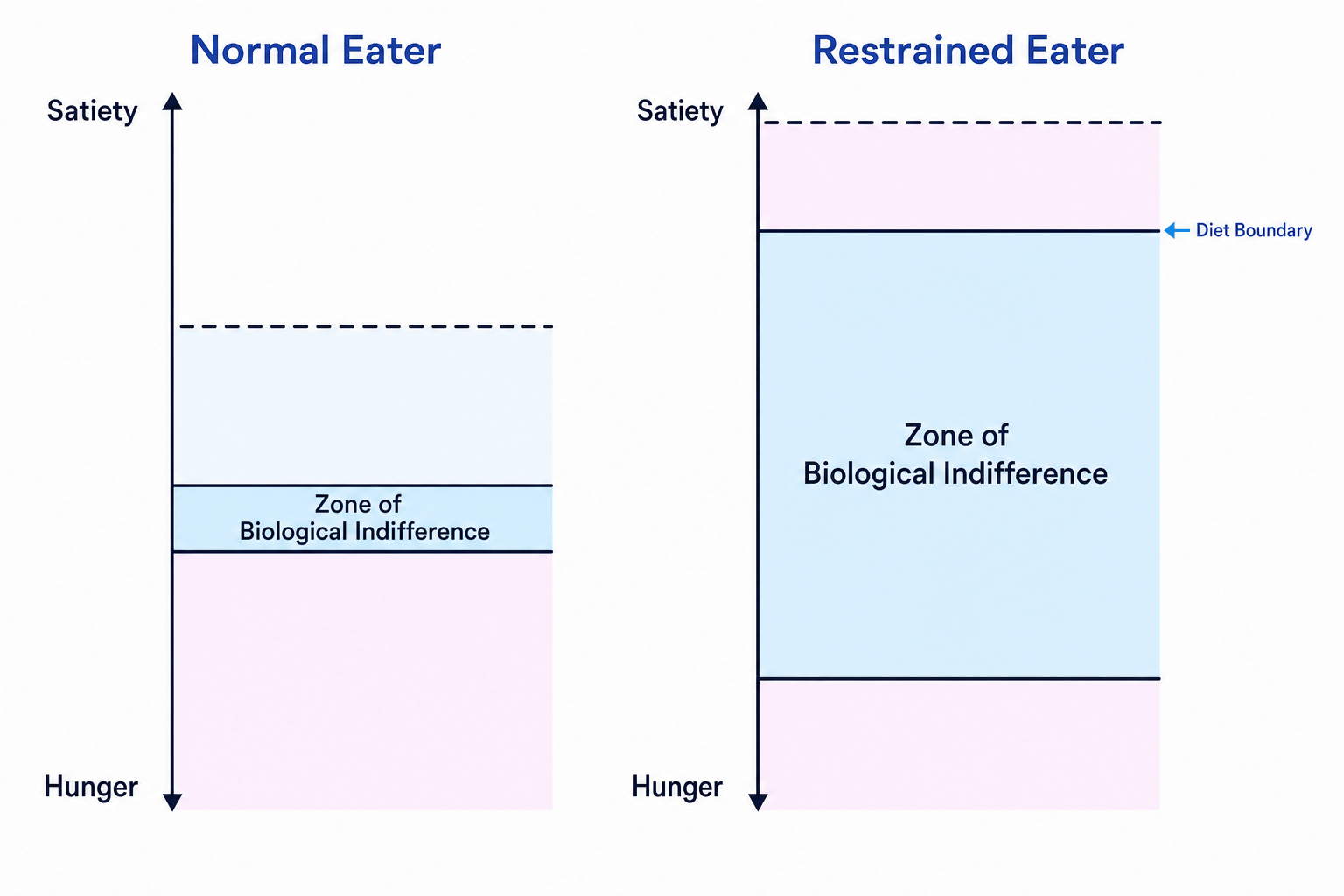
As the diagram shows, a restrained eater's boundaries look very different from a normal eater's:
- A wider zone of biological indifference: Because restrained eaters frequently ignore hunger and push past satiety during binges, their biological boundaries become stretched. It takes them longer to feel hungry and longer to feel full.
- The Cognitive Diet Boundary: Restrained eaters insert a self-imposed "diet boundary" inside their zone of biological indifference. This represents the maximum amount of food they permit themselves to eat.
Applying the Boundary Model to a diet violation
If an exam question asks you to explain why a restrained eater binges after a minor slip-up, you can walk through the mechanics of the Boundary Model step-by-step:
- Establish the starting state: Note that the restrained eater has a much wider Zone of Biological Indifference than a normal eater, meaning they require more food to hit their biological satiety boundary.
- Identify the cognitive limit: The eater stops eating when they hit their self-imposed cognitive Diet Boundary, which is set far below their biological fullness level.
- Trigger disinhibition (the preload): If the individual consumes a high-calorie food (a "preload"), they cross their cognitive Diet Boundary.
- Determine the behavioural shift: Because the cognitive rule has been broken, the "what the hell" effect takes over. The individual abandons cognitive control and reverts to biological control.
- Trace the outcome: The person will now continue eating until they reach their biological Satiety Boundary. Because this boundary is abnormally high in restrained eaters, the resulting behaviour is a massive binge, leading to weight gain.
Evaluating Psychological Explanations (AO3)
When evaluating these theories, you need to look at both the supporting research and the theoretical limitations.
Strengths and Supporting Evidence
Experimental support: Wardle and Beales (1988) provided strong evidence for restraint theory. They randomly assigned 27 obese women to one of three groups: a diet group (restraint), an exercise group, and a non-treatment control group. Over seven weeks, the women's food intake was assessed in laboratory conditions. In week four, all participants were given a "preload" (a high-calorie snack) before a taste test. The women in the diet group ate significantly more in the taste test than the other two groups. This clearly demonstrates that cognitive restraint makes individuals vulnerable to disinhibition and overeating.
Support from cognitive psychology: The failure of cognitive restraint can be explained by Wegner's theory of ironic processes of mental control. Wegner found that when you actively try not to think about something (like a white bear), you actually think about it more. By suppressing thoughts of food, restrained eaters make food more salient in their minds, increasing the likelihood of disinhibition.
Weaknesses and Limitations
Fails to distinguish between types of restraint: A major limitation of restraint theory is that it treats all dieting as identical. Researchers later identified two distinct types of restraint:
- Rigid restraint: An all-or-nothing approach to eating (which leads to the "what the hell" effect and obesity).
- Flexible restraint: A looser approach where individuals allow for occasional treats without feeling they have ruined their diet. Research suggests that flexible restraint often leads to successful weight loss, contradicting Herman and Polivy's blanket claim that restraint always causes weight gain.
Confusing the theories
Be careful not to treat Restraint Theory, Disinhibition, and the Boundary Model as three completely separate, competing theories. They are highly integrated. Restraint Theory outlines the problem, Disinhibition explains the behavioural trigger, and the Boundary Model maps out the mechanics visually. Use them together in an essay!
Cannot explain all eating disorders: Restraint theory struggles to explain anorexia nervosa. Anorexic individuals exhibit extreme cognitive restraint, yet this does not lead to disinhibition and overeating. If restraint universally leads to bingeing, anorexia would not exist in its restrictive form.
Methodological issues: Much of the research into these psychological explanations relies on self-report measures, such as the Restraint Scale. These questionnaires are highly vulnerable to social desirability bias. Overweight individuals might under-report their calorie intake or over-report their dietary restraint to appear as though they are "trying" to lose weight, which damages the validity of the data.
In the exam
- Be precise with terminology: Don't just say "they get hungry". Use terms like Zone of Biological Indifference, Cognitive Diet Boundary, and Biological Satiety Boundary.
- Link the theory to obesity: A common mistake in AO1 is explaining the boundary model without concluding why it causes obesity. Always explicitly state that because the cognitive boundary is broken, eating continues to an artificially high biological satiety level, causing a calorie surplus.
- Use Wardle and Beales (1988) effectively: When using this study for AO3, emphasise that it was an experimental design (with random allocation). This allows us to infer a cause-and-effect relationship between dietary restraint and binge eating.
Check yourself
- What is the difference between a biological boundary and a cognitive boundary in Herman and Polivy's model?
- How does the Zone of Biological Indifference differ between a normal eater and a restrained eater?
- What is the "what the hell" effect, and how does it relate to disinhibition?
- Why might relying on questionnaires (like the Restraint Scale) reduce the validity of research into obesity?
