What you'll learn
- How the body responds to a stressor using fast and slow biological systems.
- The difference between the sympathomedullary pathway and the HPA axis.
- How cortisol helps you cope short-term but may harm health if stress is prolonged.
- How to describe and evaluate general adaptation syndrome for AO1 and AO3 essays.
Starting point: what is a stress response?
A stressor is anything a person perceives as a demand, threat, or pressure. It could be physical, such as pain or illness, or psychological, such as exams, relationship conflict, or public speaking.
A stress response is the body’s coordinated reaction to a stressor. Its job is to help you cope by mobilising energy, increasing alertness, and preparing action.
Stress response
A stress response is a set of physiological changes triggered when the brain detects a threat or demand, especially through the autonomic nervous system and the endocrine system.
Two body systems matter most here:
- The autonomic nervous system is the part of the nervous system that controls involuntary functions, such as heart rate, breathing, digestion, and sweating.
- The endocrine system is a set of glands that release hormones, which are chemical messengers carried in the blood.
The key brain area is the hypothalamus, a small region of the brain that coordinates stress responses. The key glands are the adrenal glands, which sit above the kidneys. Each adrenal gland has two important parts: the inner adrenal medulla and the outer adrenal cortex.
Two routes, two speeds
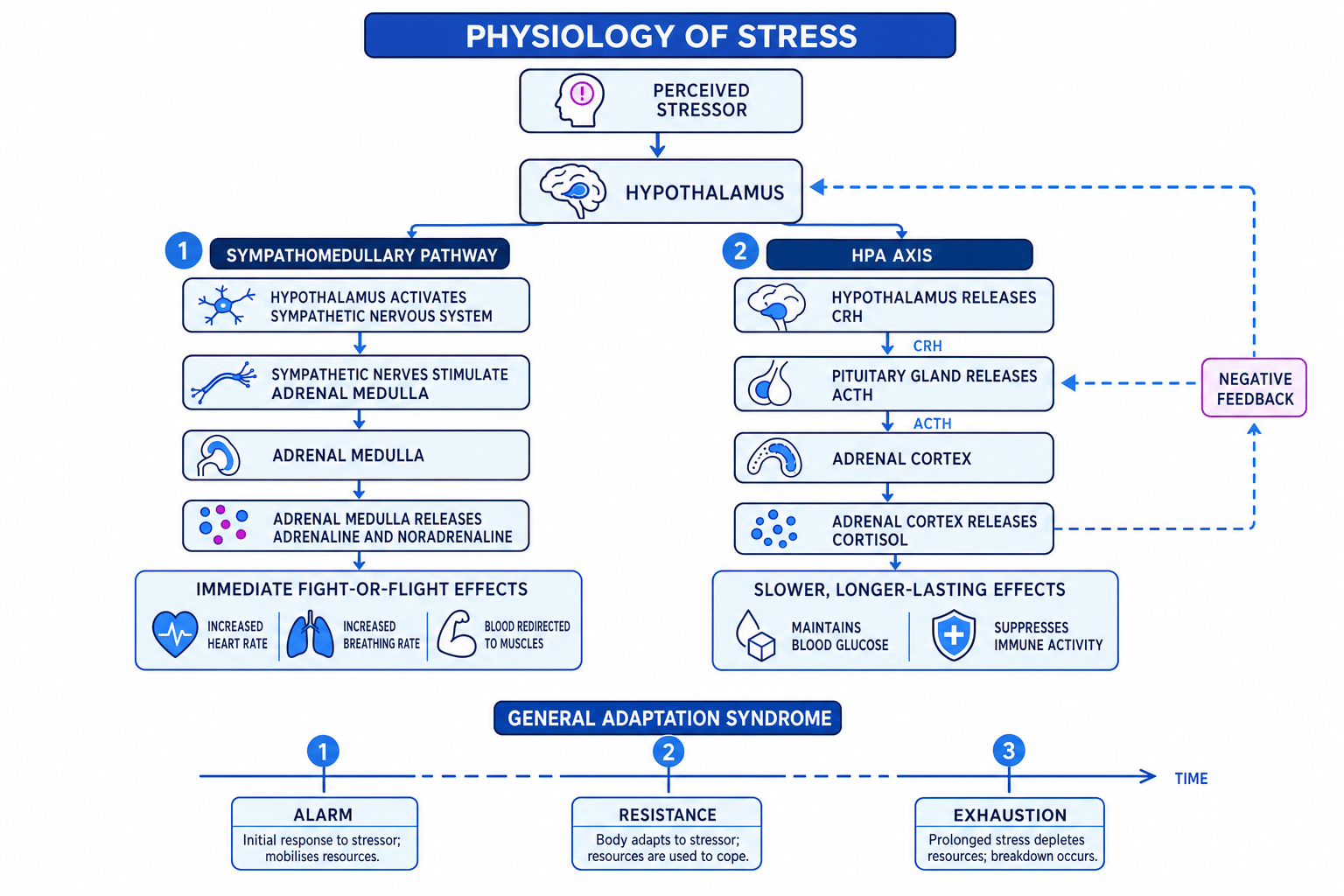
The stress response has a fast route for immediate action, called the sympathomedullary pathway, and a slower route for sustained stress, called the HPA axis.
The sympathomedullary pathway: the fast alarm system
The sympathomedullary pathway, often shortened to SAM pathway, is the body’s rapid response to acute stress. “Sympatho” refers to the sympathetic branch of the autonomic nervous system, and “medullary” refers to the adrenal medulla.
AO1: what happens?
When a stressor is perceived, the hypothalamus activates the sympathetic nervous system. Sympathetic nerves then stimulate the adrenal medulla. The adrenal medulla releases the hormones adrenaline and noradrenaline into the bloodstream.
These hormones produce the classic fight-or-flight response, which prepares the body to confront danger or escape from it. Typical effects include:
- increased heart rate, so oxygen and glucose reach muscles faster
- increased breathing rate, so more oxygen enters the blood
- pupils dilating, improving visual alertness
- digestion being reduced, because energy is diverted away from non-urgent functions
- blood being redirected towards large skeletal muscles
Once the threat passes, the parasympathetic branch of the autonomic nervous system helps return the body to a calmer resting state.
Adrenal medulla versus adrenal cortex
Do not mix up the two adrenal regions: the adrenal medulla releases adrenaline and noradrenaline in the fast SAM pathway, while the adrenal cortex releases cortisol in the slower HPA axis.
The HPA axis: the slower sustained system
The hypothalamic-pituitary-adrenal axis, usually called the HPA axis, is a slower hormonal response that is especially important when stress continues for longer.
The pituitary gland is a small endocrine gland beneath the brain. It acts like a hormonal relay station, receiving signals from the hypothalamus and sending hormonal instructions to other glands.
AO1: what happens?
First, the hypothalamus releases CRH, which stands for corticotropin-releasing hormone. CRH travels to the pituitary gland.
Next, the pituitary gland releases ACTH, which stands for adrenocorticotropic hormone. ACTH travels in the bloodstream to the adrenal cortex.
Finally, the adrenal cortex releases cortisol, a hormone involved in maintaining energy supply during stress.
Cortisol
Cortisol is a stress hormone released by the adrenal cortex that helps maintain blood glucose, supports blood pressure, and can suppress immune activity during prolonged stress.
The HPA axis is controlled partly by negative feedback. Negative feedback means the output of a system reduces further activity in that system. When cortisol levels are high enough, cortisol signals back to the hypothalamus and pituitary gland to reduce CRH and ACTH release.
Remember the order
For the HPA axis, think: Hypothalamus → Pituitary → Adrenal cortex → Cortisol. The hormone sequence is CRH → ACTH → cortisol.
Choosing between SAM and HPA
A student nearly steps into the road and jumps back with a racing heart. Later, during several weeks of exams, they feel constantly tense and keep getting minor illnesses.
- The sudden road incident is immediate and short-lived, so the fast SAM pathway best explains the racing heart and rapid arousal.
- The relevant adrenal region for the road incident is the adrenal medulla, because it releases adrenaline and noradrenaline for fight-or-flight effects.
- The exam period is prolonged, so the HPA axis becomes more relevant because it supports a sustained response over time.
- The repeated minor illnesses can be linked to prolonged cortisol because cortisol can suppress aspects of immune functioning when stress continues.
The role of cortisol
Cortisol is not “bad” in itself. In the short term, it is adaptive because it helps keep energy available. For example, cortisol supports the release of glucose into the blood, so the body can keep functioning under pressure.
Cortisol also helps regulate inflammation. This can be useful because inflammation uses energy and can interfere with immediate coping. However, if cortisol remains high for a long time, it may weaken immune functioning, disrupt sleep, affect mood, and contribute to physical illness.
This is why psychologists distinguish between acute stress, which is short-term, and chronic stress, which is long-term or repeated. Acute stress can be useful. Chronic stress is more likely to be damaging.
Cortisol is not only harmful
Avoid writing that cortisol simply “causes illness”. A better answer is that cortisol is useful for short-term coping, but prolonged or poorly regulated cortisol can increase vulnerability to illness.
General adaptation syndrome
General adaptation syndrome, or GAS, is Hans Selye’s model of the body’s response to stress. Selye (1936) developed the idea after animal research with rats exposed to physical stressors such as extreme temperature, electric shock, and forced exercise.
General adaptation syndrome
General adaptation syndrome is Selye’s three-stage model of physiological response to stress: alarm, resistance, and exhaustion.
Stage 1: alarm
The alarm stage is the initial reaction to a stressor. The body detects a threat and mobilises resources. The SAM pathway is especially important here because adrenaline and noradrenaline prepare the body for immediate action.
Selye described an initial “shock” phase, where the body’s resistance drops, followed by “countershock”, where the body begins to defend itself.
Stage 2: resistance
The resistance stage occurs if the stressor continues. The body appears to cope, but it is using energy to maintain this coping. The HPA axis and cortisol are particularly important because they help sustain blood glucose and keep the body alert.
In everyday terms, this might look like someone “getting through” weeks of pressure, but feeling tense, tired, or run down.
Stage 3: exhaustion
The exhaustion stage occurs when stress continues for too long and the body’s resources become depleted. At this point, the person may become more vulnerable to illness, fatigue, burnout, or stress-related disorders.
Applying general adaptation syndrome
A carer experiences panic and sleeplessness when a relative first becomes ill. For months, they continue managing work and care duties, but feel constantly tense. Eventually, they become exhausted and repeatedly unwell.
- The initial panic and sleeplessness fit the alarm stage, because the body is reacting to a new stressor and mobilising emergency resources.
- The months of continued functioning fit the resistance stage, because the person is coping but using sustained physiological resources.
- The later exhaustion and repeated illness fit the exhaustion stage, because prolonged stress has increased vulnerability to breakdown.
- The biological explanation can link this to the HPA axis, as prolonged cortisol may suppress immune functioning and disrupt recovery.
Exhaustion does not mean no stress response
In GAS, exhaustion does not mean the body simply stops responding. It means the body can no longer maintain effective adaptation, so vulnerability to illness and breakdown increases.
AO3: evaluating the physiology of stress
Strength: scientific and biological
A strength of physiological explanations is that they are scientific and measurable. Hormones such as cortisol can be measured using saliva, blood, or urine samples. Heart rate and blood pressure can also be recorded objectively. This gives stress research a strong biological basis.
Physiological knowledge also has real-world applications. Understanding cortisol helps explain why chronic stress may affect illness, sleep, and recovery. It also supports interventions such as stress management, workplace wellbeing programmes, and relaxation techniques designed to reduce prolonged arousal.
Limitation: Selye’s research used animals
Selye’s work was important because it showed a consistent biological pattern under stress. However, much of it was based on rats exposed to severe physical stressors. This raises problems when applying the findings to humans, because human stress often involves thoughts, social situations, and personal interpretation.
There are also ethical concerns. Selye’s rats experienced significant harm, and modern animal research would require careful justification, minimising suffering, humane endpoints, and consideration of alternatives. Because animals cannot consent or withdraw, researchers have a special duty to protect welfare.
Limitation: stress responses are not always “general”
Selye argued that stress produces a non-specific bodily response. However, later researchers challenged this. Mason (1975) argued that different stressors can produce different hormonal patterns, depending on psychological factors such as fear, uncertainty, and controllability.
This matters for AO3 because it suggests GAS may be too simplistic. The body does not respond in exactly the same way to every stressor.
Limitation: fight-or-flight may be incomplete
The SAM pathway is often described as fight-or-flight, but this may not cover all human stress responses. Taylor et al. (2000) proposed tend-and-befriend, arguing that under stress some people, especially women in some contexts, may protect others and seek social support rather than fight or flee.
This does not mean fight-or-flight is wrong. It means it is only part of the picture. Human stress responses are shaped by biology, gender, social support, learning, and culture.
Methodological issue: measuring cortisol is tricky
Cortisol changes naturally across the day and can be affected by sleep, caffeine, illness, exercise, medication, and individual differences. This means researchers must control timing and confounding variables carefully.
In human stress studies, ethical safeguards are also important: informed consent, the right to withdraw, protection from harm, confidentiality of biological data, and a full debrief if stress has been induced.
In the exam
- For AO1, keep the pathways separate: SAM = sympathetic nervous system + adrenal medulla + adrenaline/noradrenaline; HPA = CRH + ACTH + adrenal cortex + cortisol.
- For AO2, use timing: sudden threat usually points to SAM, while prolonged pressure usually points to the HPA axis and cortisol.
- For AO3, evaluate with evidence and limitations: Selye’s animal research, the oversimplification of a “general” response, ethical issues, and real-world applications.
Check yourself
- What is the difference between the adrenal medulla and the adrenal cortex?
- How does negative feedback work in the HPA axis?
- Why might general adaptation syndrome be useful but too simplistic?

