What you'll learn
- How genetic explanations suggest some people inherit a higher vulnerability to obesity.
- How neural explanations focus on the hypothalamus, hormones, and reward pathways in the brain.
- How to apply these explanations to real-life eating behaviour scenarios.
- How to evaluate biological explanations using evidence, limitations, and exam-ready AO3 points.
Starting point: what is obesity?
Obesity is usually defined as having an excessive amount of body fat that may increase health risks. In medical contexts, it is often identified using body mass index, known as BMI, where a BMI of 30 or above is typically classed as obese.
Obesity
Obesity is a condition involving excessive body fat, often linked to increased risk of health problems such as type 2 diabetes, cardiovascular disease, and joint problems.
For A-Level Psychology, you do not need to treat obesity as simply “lack of willpower”. Biological explanations argue that eating behaviour is influenced by factors such as genes, brain mechanisms, hormones, and neurotransmitters.
The biological approach
Biological explanations suggest that obesity can result from inherited vulnerabilities and brain-based mechanisms that affect hunger, satiety, reward, and energy regulation.
The energy balance idea
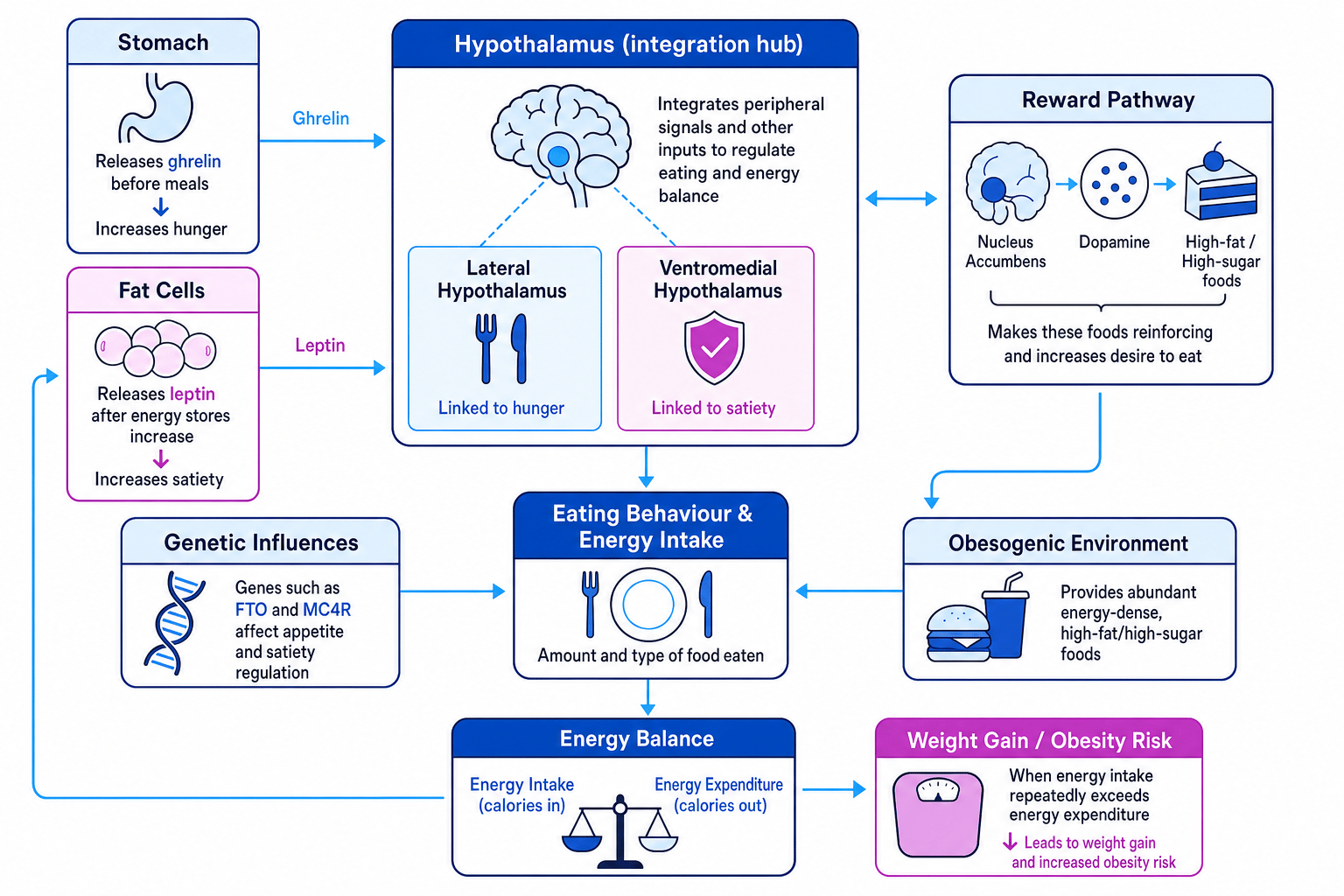
At the simplest level, weight gain occurs when energy intake repeatedly exceeds energy expenditure. However, the biological approach asks a deeper question: why might some people be more likely to overeat, feel less full, or find high-calorie foods especially rewarding?
That is where genetic and neural explanations become important.
Genetic explanations for obesity
Genes and inherited vulnerability
A gene is a section of DNA that influences a characteristic. Different versions of a gene are called alleles. Genetic explanations argue that some people inherit alleles that make obesity more likely, for example by affecting appetite, satiety, metabolism, or food reward.
Genetic explanation
A genetic explanation of obesity claims that inherited biological factors increase a person’s vulnerability to gaining weight, especially when combined with an environment where high-calorie food is easily available.
This does not mean there is one single “obesity gene”. Obesity is usually polygenic, meaning many genes each contribute a small amount to risk.
Polygenic
A characteristic is polygenic when it is influenced by many genes rather than one gene alone.
Heritability
Researchers often discuss obesity in terms of heritability. Heritability refers to the extent to which individual differences in a trait, within a population, are associated with genetic differences.
Heritability
Heritability is an estimate of how much variation in a trait within a group can be explained by genetic variation.
For obesity, heritability estimates are often quite high, sometimes around 40–70%, depending on the sample and method used. This suggests genes matter, but it does not mean obesity is inevitable.
Thinking heritability means destiny
A high heritability estimate does not mean a person is “doomed” to become obese. Genes create vulnerability; environment and behaviour still influence whether that vulnerability is expressed.
Evidence from twin and adoption studies
Twin studies compare monozygotic twins, who share 100% of their genes, with dizygotic twins, who share around 50% of their genes. If identical twins are more similar in body weight than non-identical twins, this supports a genetic role.
Stunkard et al. (1986) studied Danish adoptees and found that their body weight was more strongly related to their biological parents than their adoptive parents. This suggests genetic factors may be more important than the shared family environment.
Bouchard et al. (1990) carried out an overfeeding study with identical male twins. Participants were overfed for several weeks. Weight gain varied between different twin pairs, but was more similar within each twin pair. This suggests genetic factors may influence how bodies respond to overeating.
Applying a genetic explanation
A student says: “My brother and I eat similar meals, but he gains weight much more easily than I do.”
- Identify the relevant biological idea: the two siblings may differ genetically in appetite regulation, satiety, metabolism, or fat storage.
- Link this to obesity risk: if one sibling feels less full after eating or stores energy more efficiently, they may be more likely to gain weight over time.
- Avoid genetic determinism: the explanation should say genes create a vulnerability, not that the brother has no control over his eating behaviour.
Specific genes: FTO and MC4R
One of the best-known genes linked to obesity is the FTO gene, sometimes called the fat mass and obesity-associated gene. Variants of this gene have been associated with increased appetite and reduced satiety.
Frayling et al. (2007) found that people with certain FTO variants had higher average BMI and a greater risk of obesity. Wardle et al. (2008) found that children with the higher-risk FTO variant showed reduced satiety, meaning they were less likely to feel full after eating.
Another important gene is MC4R, which is involved in regulating appetite. Rare mutations in MC4R can lead to intense hunger, known as hyperphagia, and severe early-onset obesity.
Hyperphagia
Hyperphagia means excessive hunger or abnormally increased eating.
The thrifty gene hypothesis
The thrifty gene hypothesis, proposed by Neel (1962), suggests that genes promoting efficient fat storage may have been adaptive in ancestral environments where food shortages were common. In modern societies, where high-calorie food is widely available, these same genes may increase obesity risk.
Genes and environment interact
Genetic vulnerability is most likely to lead to obesity in an obesogenic environment: an environment that encourages overeating and physical inactivity.
Evaluation of genetic explanations
Strength: supporting evidence from family, twin, and adoption studies
Genetic explanations are supported by adoption and twin studies such as Stunkard et al. (1986) and Bouchard et al. (1990). These studies are useful because they help separate genetic influences from environmental ones.
A key strength of adoption research is that adoptees share genes with biological parents but not usually their day-to-day eating environment. If body weight is more similar to biological parents, this supports a genetic explanation.
Limitation: genes cannot explain the rapid rise in obesity
Obesity rates have increased rapidly in many countries over recent decades. Human genes have not changed dramatically in that time. This suggests that environmental factors, such as cheap high-calorie food, larger portion sizes, and reduced physical activity, must also be important.
Good AO3 phrase
A balanced evaluation is: “Genes may explain individual vulnerability, but environmental change helps explain why obesity rates have risen so quickly.”
Limitation: reductionism
Genetic explanations can be criticised as biologically reductionist. This means they may oversimplify obesity by reducing it to genes and ignoring psychological, social, and cultural influences.
For example, emotional eating, stress, food advertising, income, family habits, and cultural attitudes to body size may all affect eating behaviour.
Ethical issues in genetic research
Research involving genetic information raises issues of confidentiality, informed consent, and possible psychological harm. Participants should understand how their genetic data will be used and should be protected from stigma or discrimination.
Neural explanations for obesity
What does “neural” mean?
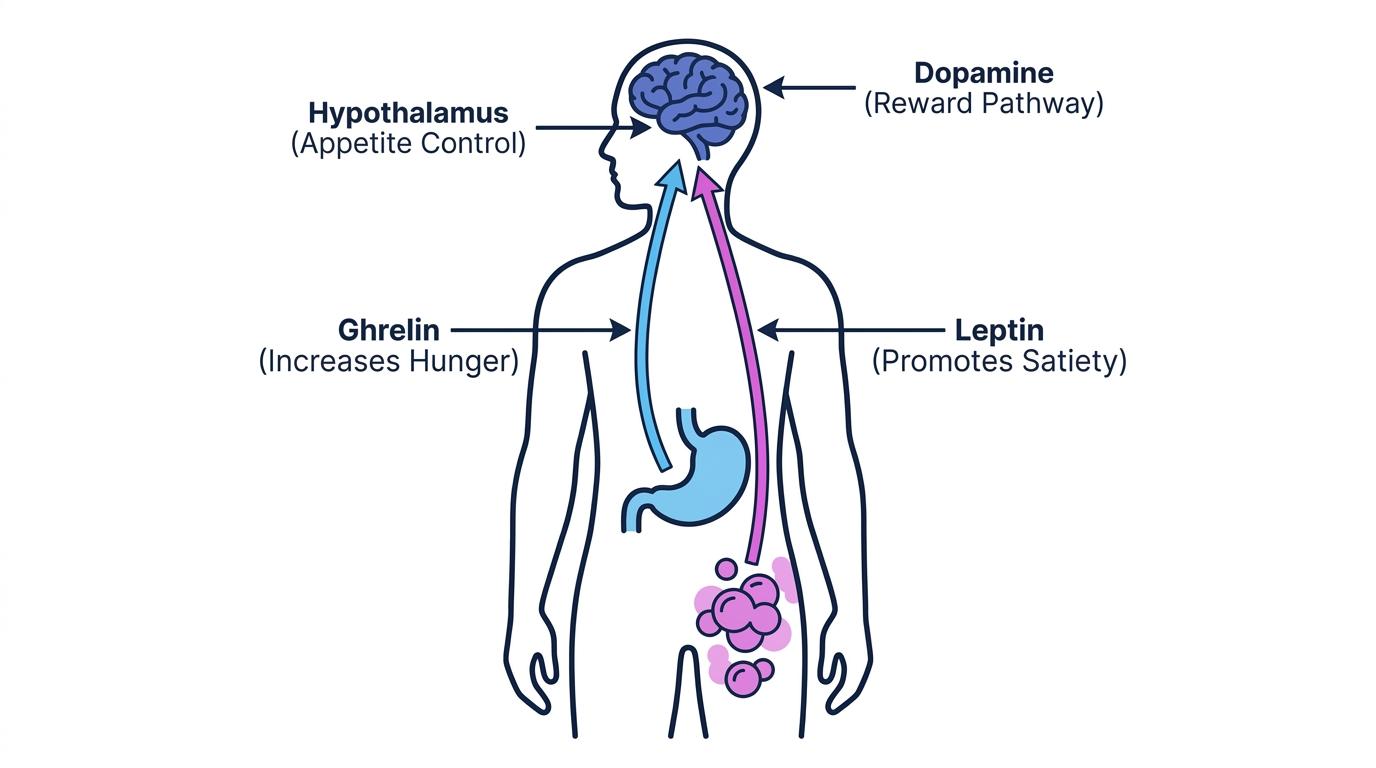
A neural explanation focuses on the brain and nervous system. In obesity, the main neural areas include the hypothalamus, which helps regulate hunger and satiety, and the brain’s reward system, which influences motivation to eat pleasurable foods.
Neural explanation
A neural explanation of obesity explains weight gain in terms of brain structures, brain pathways, neurotransmitters, and hormone signals that influence eating behaviour.
The hypothalamus: hunger and satiety
The hypothalamus is a small brain structure involved in homeostasis, which means keeping the body’s internal conditions stable. It helps regulate hunger, fullness, body temperature, and other bodily processes.
Two areas are especially important:
- The lateral hypothalamus, often linked to hunger.
- The ventromedial hypothalamus, often linked to satiety, or feeling full.
Satiety
Satiety is the feeling of fullness that reduces motivation to keep eating.
Classic animal studies found that damage to the ventromedial hypothalamus could lead to overeating and weight gain, while damage to the lateral hypothalamus could reduce eating. For example, Hetherington and Ranson (1942) found that lesions to the ventromedial hypothalamus in rats led to overeating and obesity.
However, modern research shows the system is more complex than a simple “hunger centre” and “satiety centre”. Other hypothalamic areas, including the arcuate nucleus, also integrate signals from hormones and nutrients.
Oversimplifying the hypothalamus
Do not write as if the lateral hypothalamus is the only hunger mechanism and the ventromedial hypothalamus is the only satiety mechanism. They are important, but eating behaviour is controlled by a wider network.
Hormonal signals: leptin and ghrelin
Although hormones are not neurons, they affect neural systems, especially the hypothalamus.
Leptin is released by fat cells. Higher fat stores usually lead to higher leptin levels, which should signal to the brain that the body has enough energy stored.
Ghrelin is released mainly by the stomach and tends to increase hunger before meals.
Leptin and ghrelin
Leptin is a hormone released by fat cells that usually promotes satiety. Ghrelin is a hormone released mainly by the stomach that increases hunger.
In some cases of obesity, the issue may be leptin resistance. This means the body produces leptin, but the brain does not respond to it properly, so satiety signals are weakened.
The reward pathway and dopamine
Eating is not only about biological need. It is also rewarding. High-fat and high-sugar foods can activate the brain’s reward system, including areas such as the nucleus accumbens.
A key neurotransmitter in reward is dopamine.
Dopamine
Dopamine is a neurotransmitter involved in reward, motivation, and reinforcement.
If eating highly palatable food produces a strong reward response, the person may be more likely to seek that food again. Over time, this can contribute to overeating.
Wang et al. (2001) used PET scans and found that obese individuals had lower dopamine D2 receptor availability than controls, and this was negatively correlated with BMI. One interpretation is that some individuals may overeat to compensate for a less sensitive reward system. However, it is difficult to know whether altered dopamine functioning is a cause or consequence of obesity.
Explaining overeating using neural mechanisms
A person says they keep eating sweet foods even when they are not physically hungry.
- Separate hunger from reward: they may not need food for energy, but sweet foods may still activate reward pathways.
- Link the reward pathway to behaviour: dopamine activity in areas such as the nucleus accumbens can reinforce eating, making the person more likely to repeat it.
- Add hypothalamic control: if satiety signals such as leptin are weak or resisted, the brain may be less effective at stopping eating.
- Reach a balanced conclusion: neural mechanisms can explain the pull of high-calorie foods, but environment and learning also matter.
Evaluation of neural explanations
Strength: scientific methods and biological evidence
Neural explanations are supported by controlled animal studies, brain scanning research, and hormone research. For example, lesion studies helped identify hypothalamic involvement, while PET scans have linked obesity with dopamine receptor differences.
This gives the explanation scientific credibility because it is based on measurable biological processes.
Limitation: animal research may not generalise to humans
Early hypothalamus research often used animals such as rats. This creates a problem of extrapolation, meaning findings from animals may not fully apply to human eating behaviour.
Human eating is influenced by cognition, culture, mood, social norms, and conscious restraint. Rats do not experience dieting culture, food advertising, or emotional eating in the same way humans do.
Limitation: cause and effect problems
Brain differences found in obese individuals do not automatically prove that those differences caused obesity. For example, reduced dopamine receptor availability could make overeating more likely, but overeating may also alter dopamine functioning over time.
Correlation is not causation
If a study finds a relationship between brain activity and obesity, be careful: it does not always show which variable caused the other.
Ethical issues in neural research
Brain scanning studies usually pose low physical risk, but researchers still need informed consent, confidentiality, and protection from harm. Participants should not be made to feel blamed or shamed for their weight.
Animal lesion studies raise more serious ethical issues because they may involve brain damage, distress, or death. Researchers must justify the scientific value and minimise harm.
Putting genetic and neural explanations together
The strongest answer usually treats genetic and neural factors as interacting rather than competing.
For example, a person may inherit FTO variants that reduce satiety. This may affect how their hypothalamus responds to fullness signals. If they also live in an obesogenic environment with constant access to high-calorie foods, reward pathways may make overeating more likely.
Best overall view
Obesity is best explained using an interactionist approach: genes may influence appetite and neural sensitivity, while the environment affects how strongly those vulnerabilities are expressed.
AO2: applying the explanation to a scenario
If an exam scenario describes someone who says they are “always hungry”, struggles to feel full, and has several obese biological relatives, you could apply both explanations.
You might say that genetic factors could influence satiety regulation, perhaps through genes such as FTO or MC4R. Neural mechanisms may also be involved because the hypothalamus integrates hunger and satiety signals, while dopamine reward pathways may reinforce eating high-calorie foods.
The best AO2 answers make clear links to the exact details in the scenario rather than simply describing the theory.
AO3: overall strengths and weaknesses
Biological explanations are useful because they reduce blame and show that obesity is not simply a moral failure. They have also contributed to treatments targeting appetite systems, such as drugs that influence satiety pathways.
However, biological explanations can become too deterministic if they ignore personal, social, and economic factors. They also struggle to explain why obesity rates vary between cultures and have risen quickly over time. A strong essay should therefore combine biological vulnerability with environmental triggers.
In the exam
- For AO1, clearly separate genetic explanations from neural explanations, using terms such as FTO, MC4R, hypothalamus, leptin, ghrelin, dopamine, and reward pathway.
- For AO2, link the explanation directly to the scenario: hunger, lack of satiety, family history, cravings, or overeating high-calorie foods.
- For AO3, balance evidence with limitations: use twin/adoption studies, brain research, reductionism, cause-and-effect issues, animal research problems, ethics, and gene-environment interaction.
Check yourself
- How do FTO and MC4R genes help explain vulnerability to obesity?
- Why is the hypothalamus important in hunger and satiety?
- What is one strength and one limitation of using biological explanations for obesity?