What you'll learn
- How family systems theory explains anorexia nervosa through enmeshment, autonomy and control.
- How social learning theory explains anorexia nervosa through modelling, reinforcement and media influences.
- How cognitive theory explains anorexia nervosa through distortions and irrational beliefs.
- How to build AO1, AO2 and AO3 points for AQA essay-style answers.
Starting point: what is anorexia nervosa?
Anorexia nervosa
Anorexia nervosa (AN) is an eating disorder involving severe restriction of food intake, significantly low body weight, intense fear of gaining weight, and disturbance in how body shape or weight is experienced.
A psychological explanation focuses on mental processes, learning, relationships and social influences. It does not mean AN is “not real” or “just a choice”. AN is serious, risky and usually best understood as multi-factorial, meaning several causes may interact.
For essays, think in three layers: AO1 means description, AO2 means applying the explanation to a person or scenario, and AO3 means evaluation.
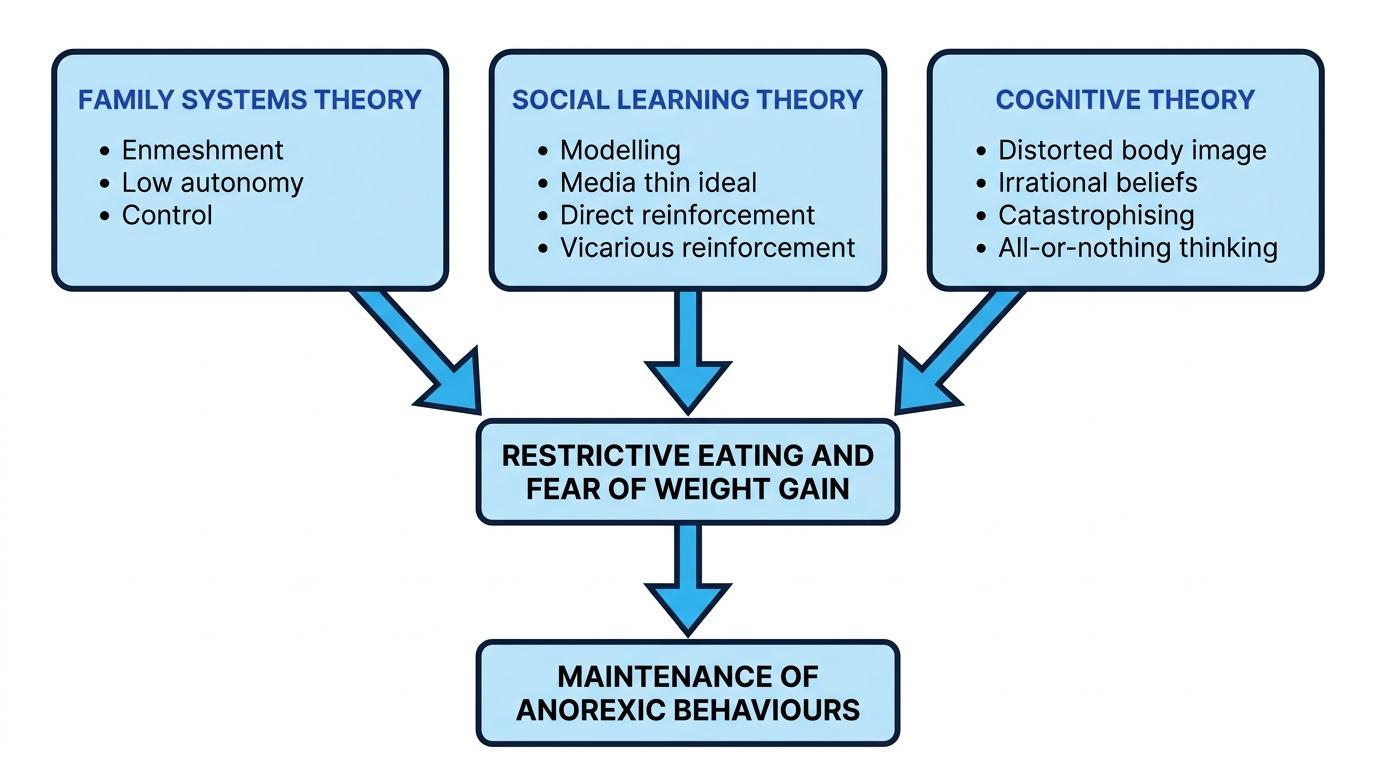
This overview shows the three explanations you need for this sub-topic and how they may maintain restrictive eating.
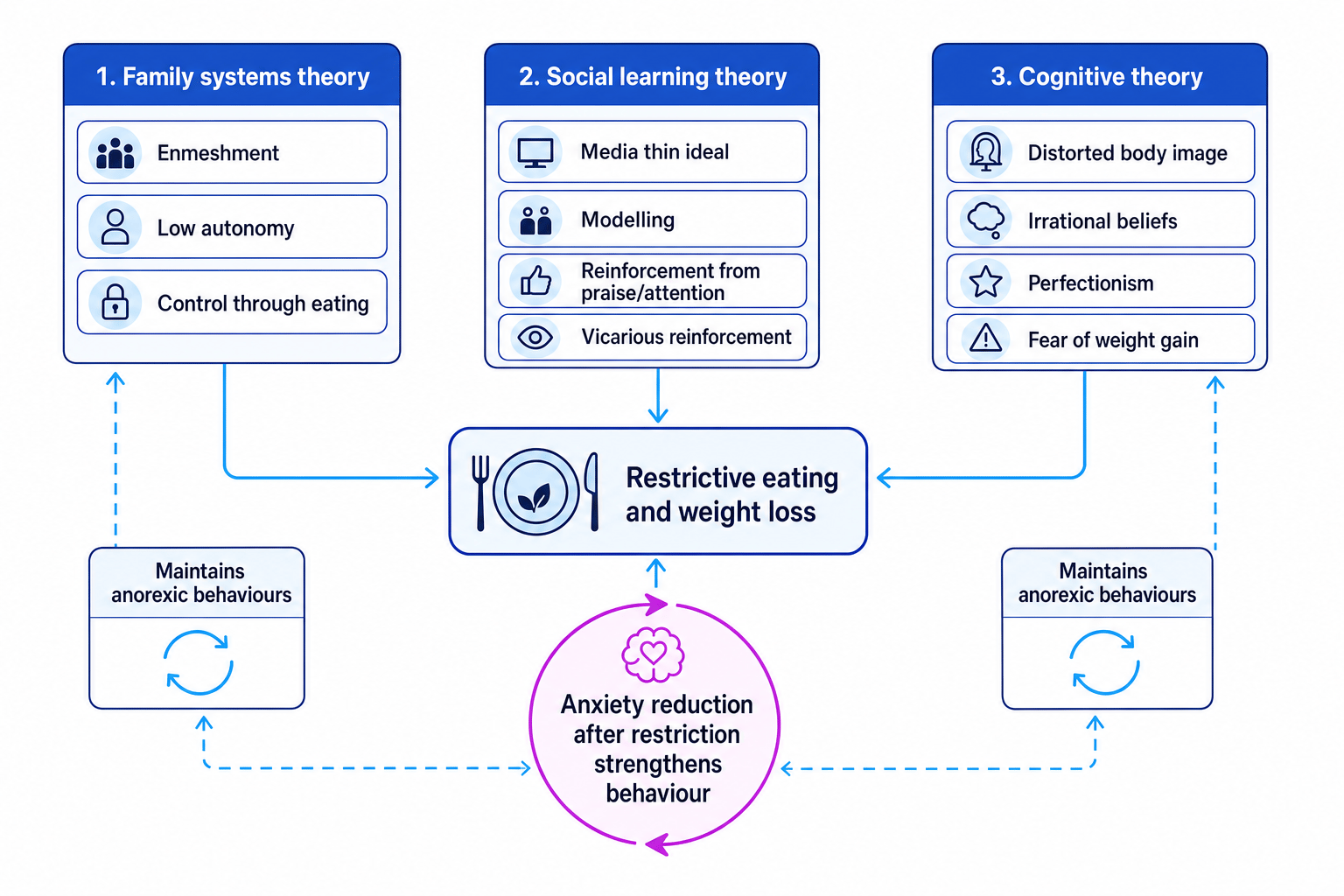
Big picture
The three psychological explanations are not rivals in a simple “one must be correct” way. A student may argue that family dynamics, social reinforcement and distorted thinking can interact to increase vulnerability to AN and maintain it over time.
Family systems theory
AO1: the explanation
Family systems theory
Family systems theory sees the family as an emotional system where each person’s behaviour affects everyone else. AN may develop or be maintained because it serves a function within the family system.
The classic version comes from Minuchin et al. (1978), who described some families of people with eating disorders as psychosomatic families. These families may show patterns such as over-involvement, conflict avoidance and rigidity.
The AQA specification focuses especially on enmeshment, autonomy and control.
Key family systems terms
- Enmeshment means family boundaries are blurred, so members are highly involved in each other’s lives and privacy is limited.
- Autonomy means independence: the ability to make your own choices and develop a separate identity.
- Control means feeling able to influence what happens to you. In AN, eating and weight may become areas where the person feels unusually powerful or in charge.
In an enmeshed family, a young person may feel watched, managed or unable to separate from parents. Restricting food can become a way to create independence: “You can control many things, but you cannot make me eat.” The eating problem may also draw family attention away from other conflicts.
Applying family systems theory
A 15-year-old, Leila, says her parents check her homework, friendships and phone daily. She feels she has no privacy. She then begins refusing family meals.
- The family pattern suggests low autonomy because Leila has limited independence over ordinary teenage choices.
- Her food refusal can be interpreted as an attempt to gain control, because eating is one area where others cannot fully force compliance.
- If the family focuses on Leila’s eating rather than discussing wider tensions, the symptom may help maintain the family system by avoiding conflict.
AO3: evaluation
One strength is that family systems theory has useful real-world applications. Family-based interventions, such as the Maudsley approach, involve parents in supporting weight restoration and reducing unhelpful family patterns. This suggests family context can matter, especially for adolescents.
However, there is a major cause-and-effect problem. Families may become overprotective and anxious because the young person has AN, not because those family patterns caused AN. Much evidence is correlational or based on clinical observations, so it cannot prove causation.
Don’t blame the family
Family systems theory describes interaction patterns; it should not be written as “parents cause anorexia”. That is too simplistic and ethically insensitive.
Ethically, research with families affected by AN must protect vulnerable participants. Researchers need informed consent, confidentiality, a clear right to withdraw, careful debriefing and protection from harm, especially because discussing family conflict may create distress or guilt.
Social learning theory
AO1: the explanation
Social learning theory
Social learning theory (SLT) argues that people learn behaviours and attitudes by observing others, especially attractive, high-status or similar models.
SLT was developed by Bandura (1977). In this topic, it explains how a young person may learn body dissatisfaction, dieting or restrictive eating by observing peers, family members, celebrities or influencers.
Modelling and reinforcement
- Modelling means observing and imitating another person’s behaviour.
- Reinforcement means a consequence that makes behaviour more likely to happen again.
- Vicarious reinforcement means seeing someone else rewarded for a behaviour, making you more likely to copy it.
The media can provide repeated models of a “thin ideal”. If thin celebrities receive admiration, attention and success, a young person may learn that thinness is desirable. Direct reinforcement can also occur: compliments, likes, approval or attention after weight loss may strengthen restrictive behaviour.
Research often used here includes Becker et al. (2002), who studied adolescents in Fiji after television became more available. Reports of dieting and body dissatisfaction increased, supporting the idea that media exposure can influence eating attitudes.
Identifying modelling and reinforcement
Noah follows fitness influencers who post “before and after” weight-loss photos. When Noah skips lunch and loses weight, friends praise him and his posts receive more likes.
- The influencers act as models because Noah observes their eating and body ideals.
- The likes and compliments are direct reinforcement because they reward Noah’s weight loss.
- If Noah sees influencers praised for being very thin, this is vicarious reinforcement, making restriction seem socially valuable.
AO3: evaluation
A strength is that SLT explains why cultural change and peer/media environments can matter. Becker et al.’s Fiji research is useful because it examined a real-world shift in media exposure rather than only using artificial lab materials.
However, media exposure is extremely common, while AN is relatively rare. This means SLT alone cannot explain why only some people develop AN. Individual factors such as perfectionism, anxiety, genetics or family context may affect vulnerability.
A further weakness is that much media research relies on self-report, where participants may not accurately remember or may answer in socially desirable ways. There is also a direction-of-effect issue: people already worried about weight may actively seek thin-ideal content.
Ethically, studies on media and eating attitudes need particular care with adolescents. Researchers should gain consent, maintain confidentiality, allow withdrawal, debrief participants and avoid increasing body dissatisfaction through harmful images or questions.
Evaluation shortcut
For SLT, a strong AO3 line is: media and peers may help explain the spread and maintenance of thin ideals, but they do not fully explain individual vulnerability.
Cognitive theory
AO1: the explanation
Cognitive theory
Cognitive theory explains AN through faulty thinking patterns, such as distorted body image, irrational beliefs and biased interpretations of food, weight and control.
A cognitive distortion is a biased or inaccurate way of thinking. In AN, common distortions include:
- All-or-nothing thinking: “If I eat one biscuit, I have failed completely.”
- Catastrophising: “If I gain weight, everyone will reject me.”
- Selective attention: focusing only on perceived flaws.
- Overgeneralisation: turning one event into a global rule, such as “I felt full once, so eating is dangerous.”
Irrational beliefs
Irrational beliefs are rigid, unrealistic beliefs that are not well supported by evidence, such as “My worth depends entirely on being thin.”
Cognitive explanations often link AN to distorted body image, where the person may overestimate body size or feel “fat” despite being underweight. Fairburn, Shafran and Cooper (1999) argued that over-evaluation of shape, weight and eating control is central to eating disorders.
Restriction can also reduce anxiety in the short term. This relief strengthens the behaviour, so the person becomes trapped in a cycle: fear of weight gain → restriction → temporary relief → stronger belief that restriction is necessary.
Tracing a cognitive maintenance cycle
Amira thinks, “If I eat breakfast, I will gain weight and lose control.” She skips breakfast and feels calmer for a few hours.
- The thought contains catastrophising because Amira predicts an extreme negative outcome from one meal.
- The belief is irrational because one breakfast cannot logically determine her entire weight or self-control.
- Skipping breakfast reduces anxiety temporarily, so the behaviour is maintained even though it keeps the disorder going.
AO3: evaluation
A strength is that cognitive theory explains the inner experience of AN well. It accounts for why someone may continue restricting even when others can see the behaviour is dangerous. It has also led to practical treatments, especially cognitive behavioural therapy, which targets distorted thoughts and unhelpful behaviours.
There is supporting evidence that people with AN often show body image distortion and high perfectionism. However, the causal direction is difficult. Starvation itself can affect thinking, mood and obsessionality, so some cognitive distortions may be consequences of AN rather than original causes.
Another limitation is that cognitive explanations can be individualistic. They may underplay wider cultural pressures, family dynamics and biological vulnerability. A balanced essay should therefore avoid presenting cognitive theory as a complete explanation on its own.
Ethically, cognitive research often asks vulnerable participants about weight, food and self-worth. Researchers must avoid triggering distress, ensure confidentiality, gain informed consent, offer the right to withdraw and provide debriefing or support information.
Best synthesis
A strong A-Level answer can argue that cognitive distortions may be the closest maintaining mechanism, while family systems and social learning help explain where some beliefs and pressures come from.
Comparing the explanations
Family systems theory focuses on relationships. Social learning theory focuses on observed behaviour and rewards. Cognitive theory focuses on beliefs and interpretations.
In an essay, you can combine them. For example, a person might grow up in an enmeshed family where eating becomes a form of control, observe media models who are rewarded for thinness, and then develop irrational beliefs such as “I am only acceptable if I am thin.”
Writing three separate mini-essays
Try not to simply describe each explanation and stop. The best answers compare them, evaluate evidence, and show how they may interact.
Quick essay structure
For a 16-mark answer, you could organise it like this:
- AO1 paragraph on family systems theory: enmeshment, autonomy and control.
- AO1 paragraph on SLT: modelling, reinforcement and media.
- AO1 paragraph on cognitive theory: distortions and irrational beliefs.
- AO3 paragraphs evaluating evidence, causality, methodology, ethics and applications.
- Mini-conclusion: AN is likely multi-factorial, so no single psychological explanation is sufficient.
In the exam
- Define the explanation first, then use the required terms: enmeshment, autonomy, control, modelling, reinforcement, media, distortions and irrational beliefs.
- For AO3, include at least one issue of causality: does the factor cause AN, or is it a consequence of AN?
- Use research carefully: name the researcher and year where possible, then explain how the evidence supports or challenges the theory.
Check yourself
- How could enmeshment and low autonomy make eating feel like an area of control?
- What is the difference between direct reinforcement and vicarious reinforcement in SLT?
- Give one example of a cognitive distortion that might maintain anorexic behaviour.