What you'll learn
- How genetic explanations suggest anorexia nervosa can run in families.
- How neural explanations focus on brain systems, neurotransmitters, hunger, reward and anxiety.
- How to evaluate biological explanations using evidence, causality issues and methodological limitations.
- How to apply these explanations to scenario-based AO2 questions.
Starting point: what is anorexia nervosa?
Anorexia nervosa is an eating disorder involving severe restriction of food intake, very low body weight, intense fear of gaining weight, and disturbance in how body shape or weight is experienced.
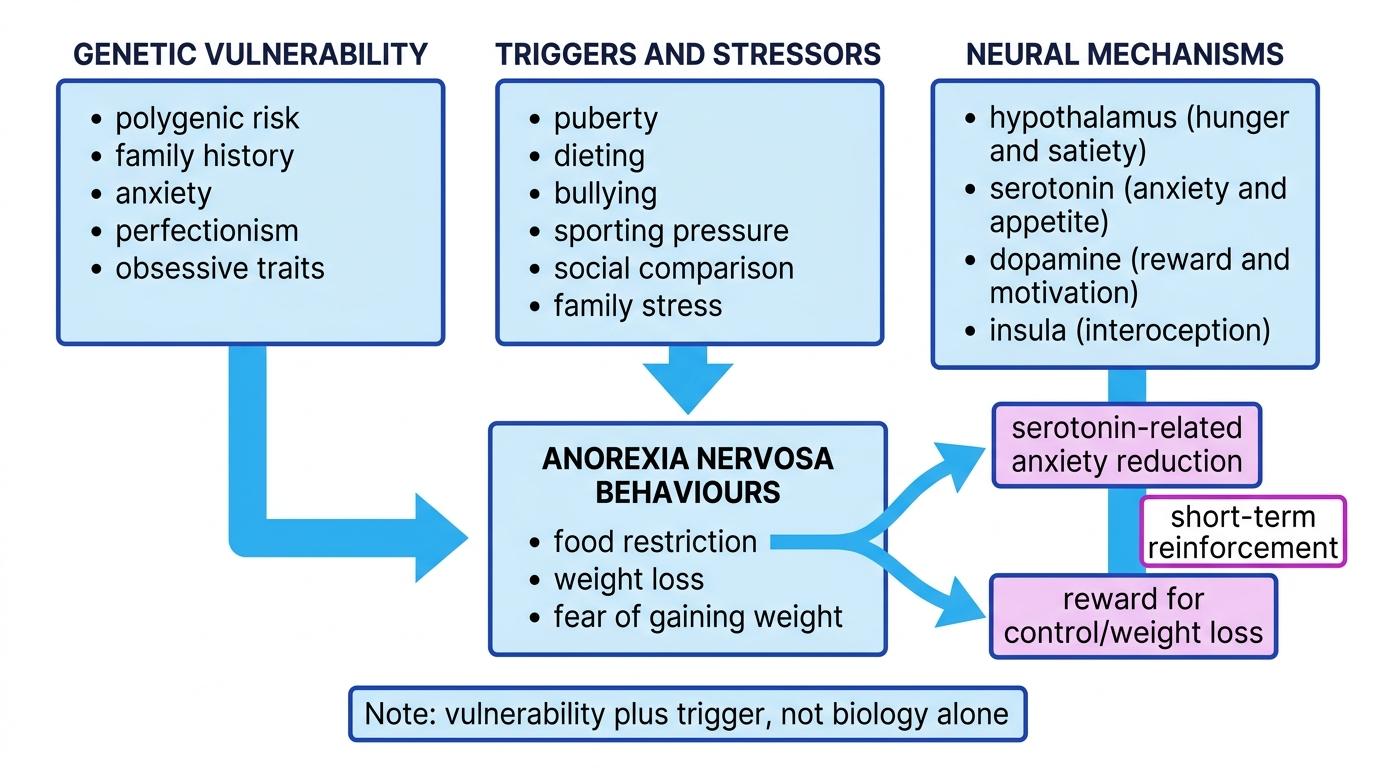
A biological explanation does not mean “biology is the only cause”. It means we are looking at how genes, brain systems and neurochemistry may increase vulnerability.
Biological explanation
A biological explanation argues that behaviour is influenced by physical processes, such as genes, brain structures, neurotransmitters and hormones.
For anorexia nervosa, the AQA specification focuses on two biological explanations:
- Genetic explanations
- Neural explanations
The main biological idea
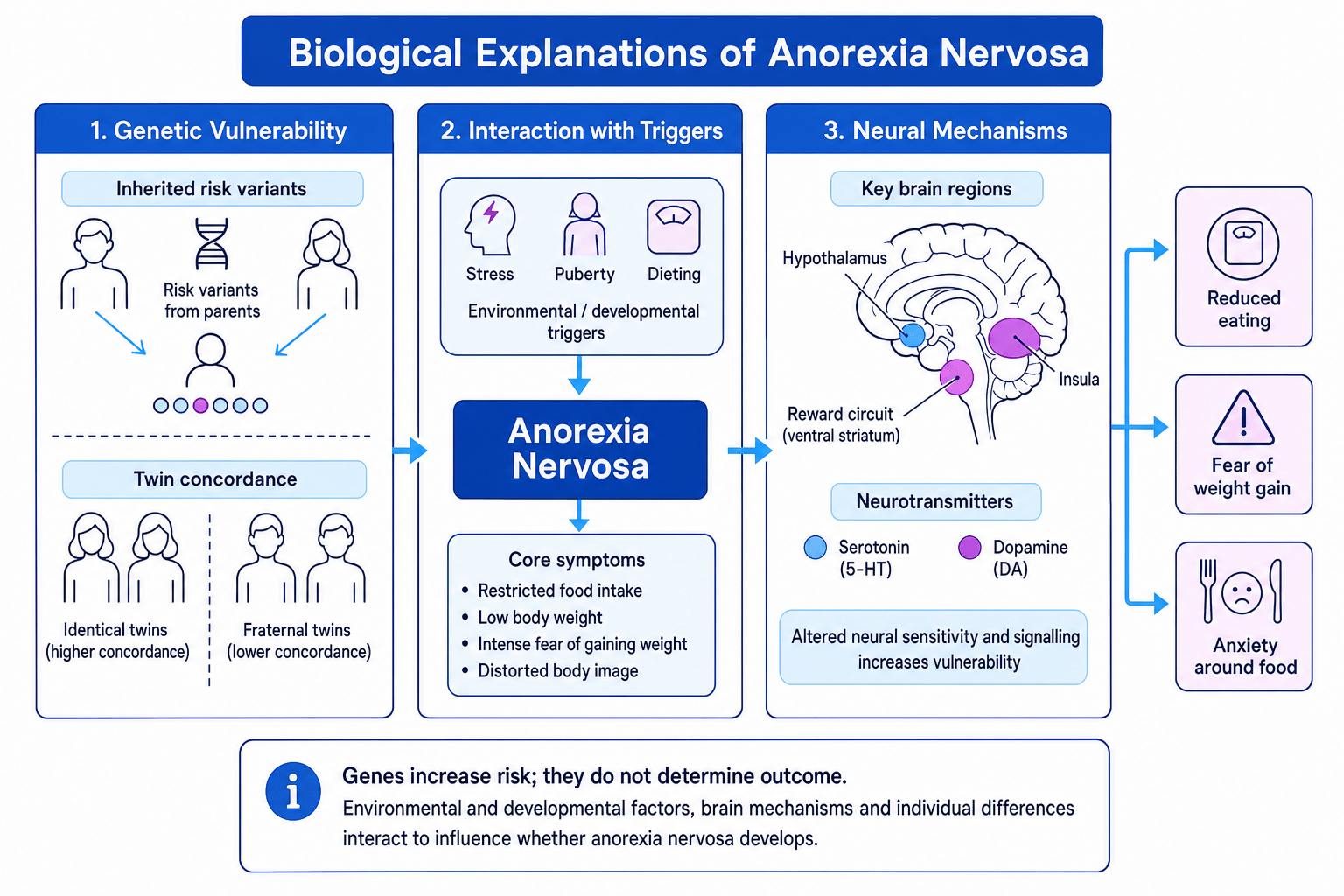
Biological factors may make anorexia nervosa more likely, but they do not make it inevitable. The best answers usually explain vulnerability plus triggers, rather than claiming a single biological cause.
Genetic explanations
Genes and inherited vulnerability
A gene is a section of DNA that influences a characteristic, such as aspects of brain development, metabolism or temperament. A genetic explanation of anorexia nervosa argues that some people inherit biological risk factors that make them more vulnerable to developing the disorder.
This does not mean there is one “anorexia gene”. Most psychologists see anorexia nervosa as polygenic, meaning many genes each make a small contribution to risk.
Polygenic
A behaviour or disorder is polygenic when it is influenced by many genes rather than one single gene.
These genes may influence traits associated with anorexia nervosa, such as:
- high anxiety
- perfectionism
- obsessive thinking
- sensitivity to reward and punishment
- appetite and metabolism
Family studies
A family study compares rates of a disorder among biological relatives. If anorexia nervosa is more common among relatives of people with the disorder, this suggests a possible genetic contribution.
For example, Strober et al. (2000) found that first-degree relatives of people with anorexia nervosa were much more likely to develop anorexia nervosa than relatives of people without the disorder.
First-degree relative
A first-degree relative is a close biological relative, such as a parent, sibling or child, who shares about half of their genes with the individual.
Family studies are useful because they show anorexia nervosa can cluster in families. However, families share environments too: diet culture, parenting style, stress, attitudes to food and weight may all be similar within families.
Genes are not the same as family influence
Do not write “it runs in families, therefore it is genetic” as if that proves the explanation. Family members share both genes and environment, so family studies alone cannot separate the two.
Twin studies
Twin studies are especially important in genetic explanations.
Monozygotic twins are identical twins who share 100% of their genes. Dizygotic twins are non-identical twins who share about 50% of their genes, like ordinary siblings.
Concordance rate
A concordance rate is the percentage chance that both members of a pair share the same characteristic or disorder.
If anorexia nervosa has a genetic component, we would expect higher concordance rates in monozygotic twins than dizygotic twins.
Holland et al. (1988) found higher concordance for anorexia nervosa in monozygotic twins than dizygotic twins. This supports the idea that genetic similarity is associated with increased risk.
Modern genetic evidence
More recent research uses genome-wide association studies, often shortened to GWAS. These scan the DNA of very large samples to identify genetic variations associated with a condition.
Watson et al. (2019) found genetic links between anorexia nervosa and both psychiatric factors, such as anxiety and obsessive-compulsive traits, and metabolic factors, such as body weight regulation. This is important because it suggests anorexia nervosa is not only about attitudes to body image; biological regulation of appetite and metabolism may also matter.
AO1 summary: genetic explanation
Genetic explanations argue that inherited biological factors increase vulnerability to anorexia nervosa. Evidence comes from family studies, twin studies and modern genetic research, but genes are best seen as risk factors rather than direct causes.
Evaluating genetic explanations
Strength: research support
Twin and family studies generally show that anorexia nervosa is more common among close biological relatives. Higher concordance in identical twins than non-identical twins supports a genetic contribution.
This gives the explanation scientific credibility because it is based on measurable biological relationships.
Limitation: shared environment problem
Even identical twins do not only share genes. They may also be treated more similarly, attend the same school, experience similar family pressures and be exposed to similar attitudes about dieting.
This means higher concordance in identical twins could partly reflect a more similar environment, not just genetics.
Limitation: concordance is not 100%
If anorexia nervosa were entirely genetic, identical twins would always both develop it. They do not. This shows that environmental and psychological factors also matter.
A more balanced explanation is the diathesis-stress model.
Diathesis-stress model
The diathesis-stress model suggests a person may inherit a vulnerability, called a diathesis, but the disorder develops only when environmental stressors trigger that vulnerability.
For anorexia nervosa, possible triggers could include puberty, bullying, dieting, sporting pressure, trauma, social media comparison, or family stress.
Neural explanations
What does “neural” mean?
A neural explanation focuses on the brain and nervous system. In anorexia nervosa, researchers are especially interested in:
- brain areas involved in hunger and satiety
- reward systems
- anxiety circuits
- neurotransmitters such as serotonin and dopamine
Neurotransmitter
A neurotransmitter is a chemical messenger that carries signals between neurons in the brain and nervous system.
The hypothalamus: hunger and satiety
The hypothalamus is a brain area involved in basic survival functions, including hunger, thirst, temperature regulation and hormone control.
In eating behaviour, the hypothalamus helps regulate:
- hunger signals
- fullness or satiety
- energy balance
Some neural explanations suggest anorexia nervosa may involve disrupted hunger and satiety signalling. A person may not respond to hunger in the usual way, or the brain may process food-related signals as threatening rather than rewarding.
Satiety
Satiety means the feeling of fullness after eating.
Serotonin: anxiety, mood and appetite
Serotonin, also called 5-HT, is a neurotransmitter involved in mood, anxiety, impulse control and appetite.
Some research suggests people with anorexia nervosa may have abnormalities in serotonin functioning. One idea is that high serotonin activity may be linked to anxiety and obsessive thinking. Food restriction may temporarily reduce serotonin activity, which could make restriction feel anxiety-reducing in the short term.
This could help explain why some people with anorexia nervosa feel calmer or more in control when restricting food, even though the behaviour is physically harmful.
Serotonin and restriction
A neural explanation can link food restriction to anxiety reduction: if restriction temporarily reduces uncomfortable serotonin-related anxiety, the behaviour may be reinforced.
Dopamine: reward and motivation
Dopamine is a neurotransmitter involved in reward, pleasure, motivation and learning.
In many people, eating is rewarding. In anorexia nervosa, the reward system may work differently. Food may produce anxiety rather than pleasure, while weight loss, control or restraint may become unusually rewarding.
Brain-imaging research has linked anorexia nervosa to differences in the striatum, an area involved in reward learning. This may help explain why behaviours such as calorie restriction or excessive exercise can become persistent.
Reward system
The reward system is a network of brain areas involved in motivation, pleasure and learning from rewarding experiences.
The insula: body awareness
The insula is a brain region involved in interoception, which means awareness of internal bodily states such as hunger, fullness, nausea and heartbeat.
If the insula processes body signals unusually, this could contribute to distorted experiences of hunger, fullness or body size in anorexia nervosa.
Interoception
Interoception is the ability to sense internal bodily states, such as hunger, fullness, thirst and heartbeat.
Applying the biological explanation
Applying biological explanations to a case
A student is asked to explain why Maya may have developed anorexia nervosa. Maya’s older sister had anorexia nervosa, Maya became very anxious during puberty, and she says that skipping meals makes her feel “calm and in control”.
-
The family history can be linked to a genetic vulnerability: Maya may have inherited risk factors associated with anxiety, perfectionism or appetite regulation.
-
Puberty can be identified as a trigger in a diathesis-stress explanation: the inherited vulnerability may not lead to anorexia nervosa unless combined with developmental or environmental stress.
-
Maya feeling calmer when skipping meals can be linked to a neural explanation: restriction may temporarily reduce anxiety, possibly involving serotonin systems, which reinforces the behaviour.
-
A balanced conclusion would avoid determinism: Maya’s biology may increase risk, but it does not fully explain the disorder without considering psychological and social factors.
Evaluating neural explanations
Strength: objective biological evidence
Neural explanations are supported by brain-imaging and neurochemical research. For example, studies using PET and fMRI scans have found differences in reward processing and neurotransmitter activity in people with anorexia nervosa or those recovered from it.
This is a strength because brain scans and biological measures can be more objective than self-report questionnaires.
Limitation: cause and effect problem
A major issue is whether neural differences cause anorexia nervosa or are caused by it.
Starvation itself changes the brain. It can affect mood, concentration, hormone levels, reward processing and neurotransmitter functioning. Therefore, if researchers find unusual serotonin or dopamine activity in people with anorexia nervosa, this may be an effect of long-term restriction rather than the original cause.
Do not assume brain difference means brain cause
If a study finds a neural difference in people with anorexia nervosa, that does not automatically prove the difference caused the disorder. It may be a consequence of starvation.
Strength: real-world applications
Biological explanations can reduce blame. If anorexia nervosa is partly influenced by genes and brain systems, families and patients may be less likely to see it as “attention-seeking” or “just a choice”.
They may also help develop treatments. For example, understanding anxiety and reward systems can support combined approaches involving nutritional restoration, psychological therapy and sometimes medication.
Limitation: medication is not a complete treatment
If neurotransmitter imbalance were the whole explanation, drug treatments would be expected to be highly effective. However, medication alone is usually not sufficient for anorexia nervosa, especially when the person is severely underweight.
This weakens a purely neural explanation and suggests that biological treatments need to be combined with psychological and social interventions.
Ethical issues in biological research
Research into anorexia nervosa often involves vulnerable participants, especially if they are severely underweight or distressed.
Ethical issues include:
- informed consent, especially where medical risk is high
- protection from harm, because discussing weight, food or symptoms may increase distress
- confidentiality, because eating disorder diagnoses are sensitive
- right to withdraw, particularly in brain-imaging or clinical studies
- debriefing, so participants understand the purpose of the research and can access support
Evaluation shortcut
For AO3, a strong biological evaluation often uses the phrase: “This supports a vulnerability explanation, but not a complete causal explanation.”
Putting it together for essays
For a 16-mark essay, you could structure your answer like this:
AO1: describe
- Define anorexia nervosa briefly.
- Explain the genetic explanation using family and twin studies.
- Explain neural mechanisms such as serotonin, dopamine, hypothalamus, reward systems or the insula.
AO3: evaluate
Use three or four developed points, such as:
- Twin and family evidence supports genetic influence.
- Family and twin studies struggle to separate genes from shared environment.
- Neural evidence is scientific and objective.
- Cause and effect is unclear because starvation changes brain functioning.
- Biological explanations are useful but reductionist if they ignore culture, cognition and family factors.
- Ethical care is needed because participants are vulnerable.
In the exam
-
Use the word vulnerability rather than claiming genes or neurotransmitters directly “cause” anorexia nervosa.
-
For genetic AO3, compare monozygotic and dizygotic twin concordance, then mention the shared environment problem.
-
For neural AO3, always consider cause and effect: abnormal brain activity could be a cause, a consequence, or both.
Check yourself
-
Why do twin studies support a genetic explanation of anorexia nervosa?
-
How might serotonin and dopamine be involved in anorexia nervosa?
-
Why is it risky to conclude that neural differences definitely cause anorexia nervosa?