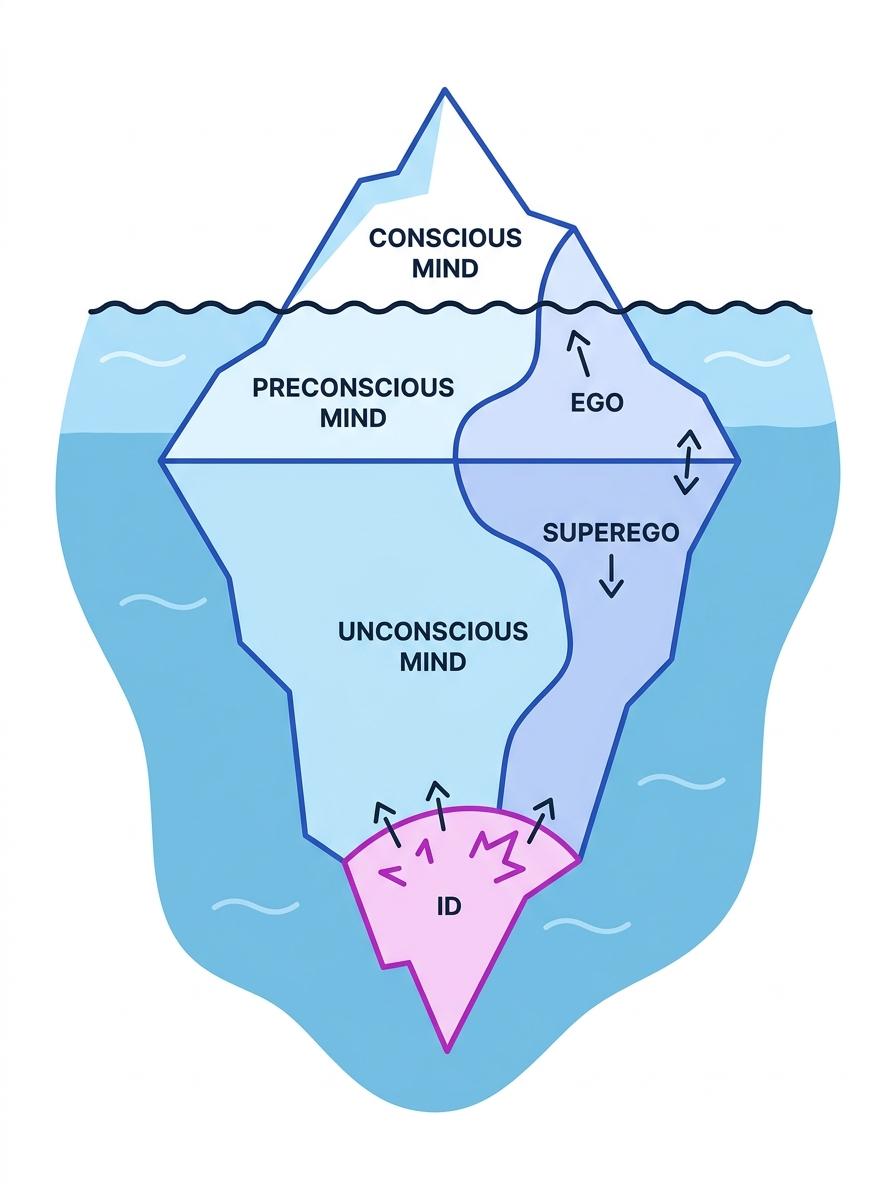
The psychodynamic approach, pioneered by Sigmund Freud at the turn of the twentieth century, completely changed how psychologists viewed the human mind. Instead of focusing solely on conscious thoughts and observable actions, Freud argued that our behaviour is largely driven by powerful, hidden forces within our unconscious.
What you'll learn
- How the mind is structured like an iceberg, dividing thoughts into conscious, preconscious, and unconscious levels.
- The tripartite structure of personality: the competing forces of the Id, Ego, and Superego.
- How the Ego deploys unconscious defence mechanisms (repression, denial, and displacement) to protect itself from anxiety.
- The five psychosexual stages of development and how fixating on them impacts adult personality.
The Role of the Unconscious Mind
Before Freud, psychology focused almost exclusively on conscious experience. Freud challenged this by suggesting that the conscious mind is only the "tip of the iceberg."
The Unconscious Mind
The unconscious mind is the vast, hidden part of our mind that we are completely unaware of. It contains repressed memories, biological drives, and instincts that actively direct and influence our everyday behaviour.
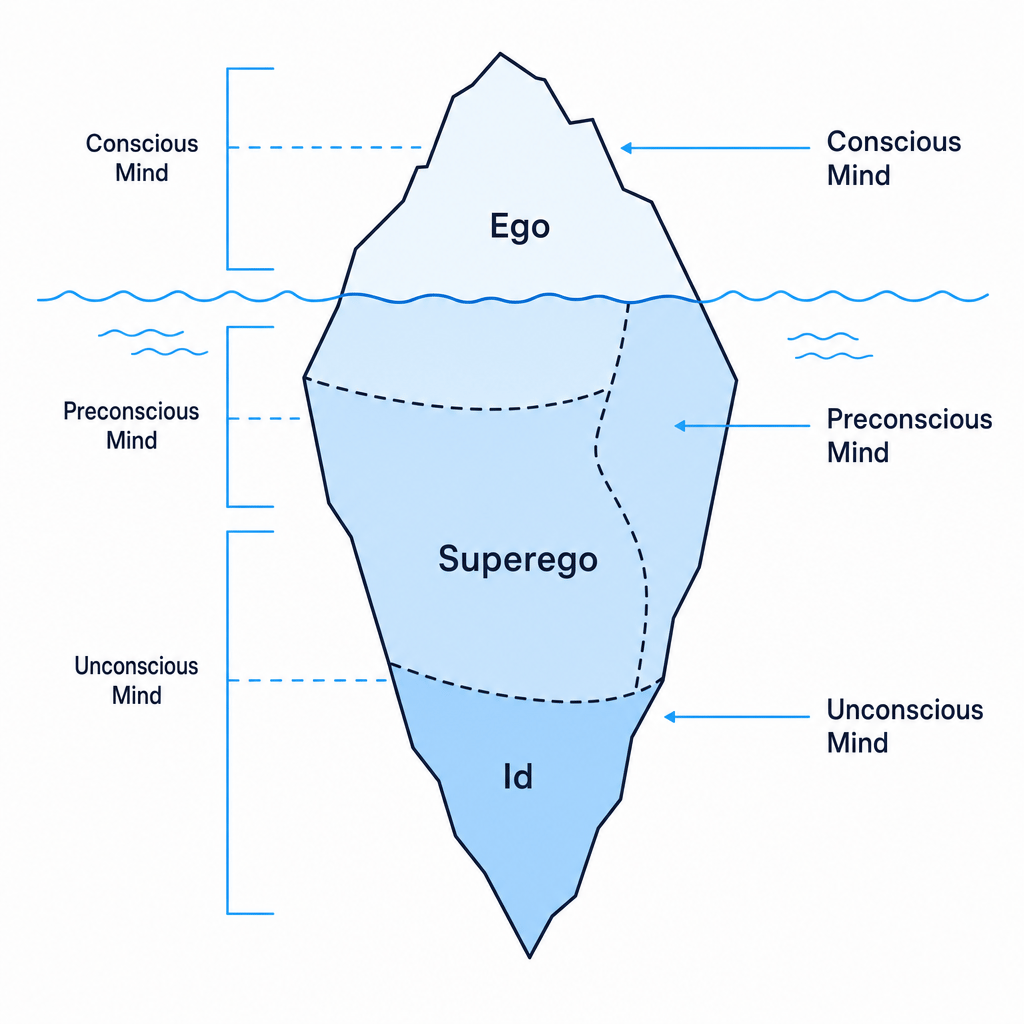
Freud divided the mind into three distinct levels of awareness:
- The Conscious Mind: The thoughts, feelings, and perceptions that we are currently aware of at any given moment.
- The Preconscious Mind: A mental waiting room containing memories and thoughts that are not currently in our conscious awareness, but which we can access easily if we try (such as your phone number or what you had for breakfast).
- The Unconscious Mind: The deepest, inaccessible layer. It acts as a storage facility for disturbing, traumatic, or unacceptable memories that have been actively pushed out of conscious awareness to protect us from extreme anxiety.
Accessing the Unconscious
Because the unconscious is kept hidden, Freud believed it could only be accessed indirectly. He used techniques such as:
- Free association: Encouraging patients to say whatever comes into their head without filtering it, hoping unconscious thoughts would slip out.
- Dream analysis: Interpreting the symbolic meaning of dreams, which Freud called the "royal road to the unconscious."
- "Freudian slips": Accidental verbal slip-ups (parapraxes) where the unconscious accidentally reveals its true desires (e.g., calling your teacher "Mum").
The Structure of Personality (Tripartite Model)
Freud described the personality as a dynamic, three-part system. These three components are constantly competing for control of our behaviour.
The Tripartite Personality
Your personality is not a single entity. It is a battleground between your basic animal instincts (the Id) and your moral conscience (the Superego), with your conscious self (the Ego) caught in the middle trying to keep the peace.
1. The Id (The Instinctive Self)
- Principle: Operates on the pleasure principle.
- Development: Present at birth.
- Characteristics: The Id is entirely selfish, irrational, and demanding. It represents our primal, biological urges (such as hunger, aggression, and sex) and demands immediate gratification. It is completely unconscious.
2. The Ego (The Realistic Self)
- Principle: Operates on the reality principle.
- Development: Formed around the age of two.
- Characteristics: The Ego is the conscious, rational part of the mind. It acts as a mediator, trying to satisfy the unrealistic demands of the Id in a socially acceptable and realistic way.
3. The Superego (The Moral Self)
- Principle: Operates on the morality principle.
- Development: Formed around the age of five (at the end of the phallic stage).
- Characteristics: The Superego represents our internalized moral standards, learned from parents and society. It represents the "ideal self" and punishes the Ego with feelings of guilt when we do something wrong, while rewarding us with pride when we behave well.
The Rider and the Wild Horse
Imagine a rider on a wild horse. The horse represents the Id—it is incredibly powerful and wants to run wherever it pleases. The rider represents the Ego, trying to guide and control the horse to prevent it from running off a cliff. Meanwhile, a back-seat driving instructor stands on the path representing the Superego, constantly shouting out rules and criticizing the rider's steering.
Defence Mechanisms
Because the Ego is constantly caught in a tug-of-war between the chaotic desires of the Id and the strict morals of the Superego, it experiences intense inner conflict and anxiety.
To cope with this pressure, the Ego utilizes defence mechanisms. These are unconscious mental strategies that distort reality so that the Ego can protect itself from being overwhelmed by anxiety.
The AQA specification requires you to know three specific defence mechanisms:
| Defence Mechanism | Definition | Example |
|---|---|---|
| Repression | Forcing a distressing, threatening, or traumatic memory out of the conscious mind and deep into the unconscious so it is "forgotten." | A person who was severely bullied as a child has no conscious memory of the events, though it still affects their relationships. |
| Denial | Completely refusing to acknowledge or accept some painful aspect of objective reality. | A heavy smoker refuses to accept that smoking is damaging their health, insisting they "feel perfectly fine." |
| Displacement | Transferring intense feelings (usually anger or frustration) from their true, threatening target onto a substitute, safer target. | After being yelled at by their boss, a worker goes home and angrily kicks the family dog or shouts at their partner. |
Confusing Repression and Suppression
Students often mix up repression and suppression. Repression is entirely unconscious—the Ego buries the memory automatically, and the person genuinely has no awareness of it. Suppression is a conscious decision to try and stop thinking about something distressing. Make sure you emphasize the unconscious nature of repression in your exam answers!
Let's look at how to apply these concepts to an A-Level AO2 scenario question.
Applying Defence Mechanisms to Scenarios
Scenario: Sasha fails her driving test for the third time. When her friends ask her about it, she laughs and says the examiner made a mistake, and that she is actually an excellent driver. Later that evening, she gets into a furious argument with her younger brother because he left his shoes in the hallway.
Identify and explain two defence mechanisms that Sasha is displaying in this scenario.
-
Step 1: Identify the first defence mechanism by matching the behavior to the definitions.
Sasha refuses to accept the reality of her failure, claiming she is an excellent driver and that the test result was just an examiner's error. This matches the definition of Denial. -
Step 2: Apply Denial directly to the scenario's details.
Explain that Sasha is using denial because her Ego cannot cope with the feelings of failure and low self-esteem associated with failing the driving test. By denying the reality of the situation, she protects her self-image. -
Step 3: Identify the second defence mechanism by matching the behavior to the definitions.
Sasha reacts with intense anger toward her younger brother over a very minor issue (shoes in the hallway). The anger is disproportionate and actually stems from her failed driving test. This matches the definition of Displacement. -
Step 4: Apply Displacement directly to the scenario's details.
Explain that Sasha cannot safely express her anger at the driving examiner (who is a threatening figure of authority). Instead, her Ego unconsciously redirects (displaces) this hostile frustration onto her younger brother, who is a much safer, less threatening target.
Psychosexual Stages of Development
Freud claimed that personality development occurs during childhood through five distinct psychosexual stages.
At each stage, the Id's pleasure-seeking energies (the libido) focus on a different area of the body (an erogenous zone). Each stage presents a conflict that the child must resolve. If a child experiences too much frustration (under-gratification) or too much pleasure (over-gratification) at a stage, they become fixated.
Fixation
Fixation occurs when a child becomes emotionally stuck in a psychosexual stage because their developmental needs were unresolved. This fixation carries forward into adulthood, heavily shaping their adult personality and behavior.
The five stages are:
1. The Oral Stage (0 to 1 year)
- Focus of Pleasure: The mouth (sucking, biting, chewing, breastfeeding).
- Conflict/Key Event: Weaning off breast or bottle milk.
- Adult Fixation Traits: If fixated, the adult may develop an "oral fixation," leading to habits like smoking, nail-biting, overeating, or becoming sarcastic and verbally critical (referred to as "oral sadistic").
2. The Anal Stage (1 to 3 years)
- Focus of Pleasure: The anus (holding in and expelling faeces).
- Conflict/Key Event: Toilet training.
- Adult Fixation Traits:
- Anal-retentive: If parents are too strict with toilet training, the child holds back faeces. As an adult, they become obsessively neat, perfectionist, stingy, and controlling.
- Anal-expulsive: If parents are too lenient, the child expels faeces anywhere. As an adult, they become messy, disorganized, and rebellious.
3. The Phallic Stage (3 to 6 years)
- Focus of Pleasure: The genital area.
- Conflict/Key Event: The child experiences deep, unconscious conflicts:
- Oedipus Complex (Boys): A boy develops incestuous feelings for his mother and views his father as a rival. He experiences castration anxiety (fear that his father will castrate him if he finds out). To resolve this anxiety, the boy represses his feelings, identifies with his father, and internalizes his father's gender roles and moral values (forming the Superego).
- Electra Complex (Girls): A girl experiences penis envy, blaming her mother for her lack of a penis. She eventually converts this desire into a wish to have a baby, represses her hostility, identifies with her mother, and internalizes her mother's values.
- Adult Fixation Traits: Phallic personality types are self-obsessed, narcissistic, reckless, or struggle with authority and relationships.
4. The Latency Stage (6 to puberty)
- Focus of Pleasure: No specific erogenous zone.
- Conflict/Key Event: Earlier conflicts are repressed. Libidinal energy is redirected into developing social skills, friendships, hobbies, and schoolwork.
5. The Genital Stage (Puberty onwards)
- Focus of Pleasure: The genitals, but directed outward toward healthy, consensual sexual relationships with others.
- Conflict/Key Event: Establishing a balance between different areas of life (love and work).
- Adult Fixation Traits: If earlier stages were completed successfully, the individual is now a well-adjusted, warm, caring adult.
Remembering the Order of Stages
Use this simple, classic mnemonic to remember the order of the five stages from first to last:
Old Angry People Like Gardening
(Oral →\rightarrow→ Anal →\rightarrow→ Phallic →\rightarrow→ Latency →\rightarrow→ Genital)
Evaluation of the Psychodynamic Approach (AO3)
When writing an essay on the psychodynamic approach, you need to weigh up its revolutionary contributions against its profound scientific shortcomings.
Strengths
-
Immense Explanatory Power: Despite its controversial ideas, the psychodynamic approach was highly influential in the first half of the twentieth century. It successfully explained a wide range of psychological phenomena, including personality development, abnormal behaviour, and gender identity. Furthermore, it drew vital attention to the connection between childhood experiences and adult mental health, a link that is universally accepted today.
-
Real-World Application (Psychoanalysis): Freud designed psychoanalysis, the first form of "talking therapy." By using techniques like dream analysis and free association, psychoanalysis aimed to bring repressed unconscious conflicts into the conscious mind, allowing patients to resolve them. This laid the foundations for modern counseling and psychotherapy, which still help millions of people today.
Therapy Suitability
While psychoanalysis is a major strength, it is widely considered unsuitable—and even harmful—for patients suffering from severe mental disorders like schizophrenia. These patients may lose touch with reality and cannot engage in the deep reflection required for psychoanalysis.
Weaknesses
-
Unfalsifiable Concepts (Lack of Scientific Rigour): The philosopher of science Karl Popper argued that the psychodynamic approach is a pseudoscience because it cannot be falsified (proven wrong). Many of Freud's key concepts—such as the Id, Ego, Superego, and repressed memories—exist entirely in the unconscious mind. Because we cannot observe or measure the unconscious, these concepts cannot be empirically tested. If a theory cannot be tested scientifically, it lacks empirical validity.
-
Flawed Methodology (Case Studies): Freud constructed his theories using intensive case studies of single individuals, such as Little Hans (a young boy with a phobia of horses, which Freud claimed was castration anxiety stemming from his Oedipus complex).
- The issue: You cannot generalize findings from one unique, emotionally disturbed individual to the entire human population.
- Subjectivity: Freud's interpretations were highly subjective. It is highly likely that he interpreted Hans's behavior to fit his pre-existing theories, rather than objectively observing the child.
-
Psychic Determinism: The psychodynamic approach is highly deterministic. It suggests that all human behaviour is completely dictated by unconscious conflicts originating in childhood. This leaves absolutely no room for free will; even a simple slip of the tongue is treated as a meaningful unconscious message rather than an accident. This view can be discouraging, as it implies we have very little conscious control over our actions.
In the exam
- Be prepared for scenarios: The examiners love to use short vignettes containing characters behaving strangely or aggressively. You must link their behaviour directly to either the tripartite personality (e.g., "The Id is driving him to steal because...") or defence mechanisms (e.g., "She is displacing her anger...").
- Clearly define your terms: In 12- or 16-mark essay questions, start your AO1 section by clearly defining the unconscious mind and the three parts of the personality. Do not jump straight to the psychosexual stages.
- Use Karl Popper for AO3: When evaluating, explicitly use the term falsifiability. Explain why the unconscious cannot be falsified (we cannot design an experiment to observe a concept that is by definition unobservable). This is an excellent way to secure high-band marks for scientific evaluation.
- Be objective with the phallic stage: When describing the Oedipus or Electra complexes, write about them neutrally as historical psychological theories. Do not express personal disbelief; focus purely on explaining the steps of the theory and then critiquing its scientific validity in your AO3.
Check yourself
- Can you explain the difference between the conscious, preconscious, and unconscious mind using the iceberg metaphor?
- How does the Ego resolve the tension between the pleasure-seeking Id and the moralizing Superego?
- A person who has just been diagnosed with a terminal illness insists that the lab results are incorrect and plans a holiday for next year. Which defence mechanism is this, and why?
- What are the five psychosexual stages, and what specific adult personality traits might result from an "anal-retentive" fixation?