What you'll learn
- How genotype, phenotype and evolution explain genetic influences on behaviour.
- How brain structures, the nervous system and neurochemistry affect thoughts, emotions and actions.
- What cognitive neuroscience is and how it studies mental processes biologically.
- How to evaluate the biological approach for AO3: evidence, applications, reductionism, determinism and ethics.
The big idea: behaviour has biological roots
Biological approach
The biological approach explains behaviour in terms of physical processes in the body, especially genes, brain structures, nervous-system activity, hormones and neurotransmitters.
The biological approach assumes that what you think, feel and do is linked to the body. For example, anxiety might be explained through inherited vulnerability, activity in the amygdala, and neurotransmitters such as serotonin.
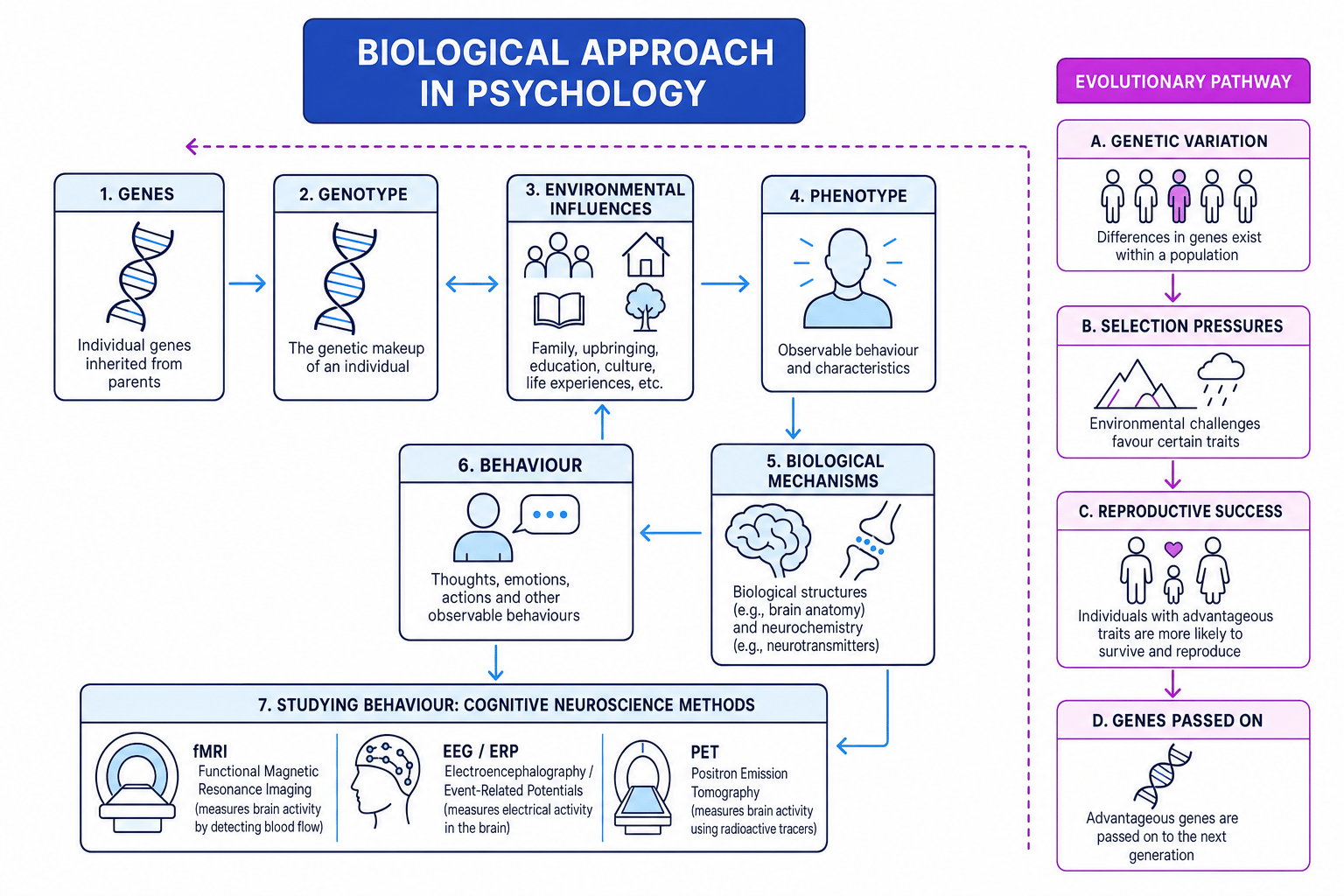
The diagram below shows how the main parts of the biological approach fit together.
Core assumption
Biology influences behaviour, but it rarely determines behaviour completely. A strong answer usually explains interaction: genes, brain systems and environment work together.
The genetic basis of behaviour
Genes, genotype and phenotype
A gene is a section of DNA inherited from biological parents. Genes help build proteins, which influence the development and functioning of the body, including the brain.
Genotype and phenotype
- Genotype means a person’s genetic make-up: the genes they inherit.
- Phenotype means the observable characteristics produced by the interaction between genotype and environment. In psychology, this can include behaviours, abilities, emotional tendencies and symptoms.
A person may inherit a genetic vulnerability for a behaviour, but whether that vulnerability becomes visible depends on environmental factors such as upbringing, stress, education, relationships and culture.
A useful term here is polygenic, meaning that most psychological characteristics are influenced by many genes, not one single “behaviour gene”.
Separating inherited risk from lived experience
Suppose identical twins show a higher concordance rate for anxiety than non-identical twins, but many identical twin pairs still differ in whether they develop anxiety.
-
Identical twins share 100% of their genes, while non-identical twins share about 50%, so higher concordance in identical twins suggests a genetic contribution.
-
If identical twins are not always the same for anxiety, genes cannot be the whole explanation. Their different experiences must also matter.
-
The best conclusion is that the genotype may create a vulnerability, while the phenotype depends on how that vulnerability interacts with the environment.
Evidence and evaluation of genetic explanations
Twin, family and adoption studies are often used to estimate genetic influence. For example, Gottesman (1991) found higher concordance for schizophrenia in identical twins than non-identical twins, supporting a genetic role. Caspi et al. (2003) found that a version of the 5-HTT serotonin transporter gene was linked to depression mainly when people had also experienced stressful life events — a clear gene-environment interaction.
These studies strengthen the biological approach because they show that behaviour has measurable biological influences. However, twin studies can be criticised because identical twins may be treated more similarly than non-identical twins, so higher concordance might partly reflect environment, not just genes.
Ethically, genetic research is sensitive. Researchers need informed consent, minimal deception, a clear right to withdraw, protection from distress or stigma, confidentiality of genetic data, and a debrief explaining what the findings can and cannot show.
Biological does not mean unchangeable
Do not write as if genes fix behaviour permanently. Biological influences are often predispositions, and environments can alter behaviour, development and even gene expression.
Evolution and behaviour
Evolution and natural selection
Evolution is the gradual change in inherited characteristics across generations. Natural selection means that traits increasing survival or reproductive success are more likely to be passed on.
The evolutionary explanation says some behaviours exist because they were adaptive for ancestors. For example, fear responses may have helped humans avoid danger, and attachment behaviours may have kept infants close to caregivers, increasing survival. Bowlby (1969) used an evolutionary argument when explaining attachment as an adaptive system.
Evolutionary explanations usually follow this logic:
- There is genetic variation in a population.
- Some traits are better suited to the environment.
- Individuals with those traits are more likely to survive and reproduce.
- Their genes become more common in future generations.
AO3 point: evolutionary explanations can be useful because they explain why some behaviours appear widespread across cultures. However, they are often difficult to test directly because ancestral environments cannot be recreated. This means some evolutionary explanations risk becoming “just-so stories” — plausible after the event, but hard to falsify.
Evaluating evolution
A strong AO3 point is: evolutionary explanations may explain origins, but they do not mean a behaviour is inevitable, desirable or morally acceptable today.
Biological structures and behaviour
Biological structures are physical parts of the body that influence behaviour. In psychology, the main focus is usually the brain and nervous system.
The central nervous system is the brain and spinal cord. The brain contains specialised areas linked to different functions. Localisation of function means that particular brain areas are associated with particular behaviours or mental processes.
Examples include:
- The amygdala, linked with fear and emotional processing.
- The hippocampus, linked with memory and spatial navigation.
- The prefrontal cortex, linked with planning, decision-making and impulse control.
- Broca’s area, linked with speech production.
- Wernicke’s area, linked with language comprehension.
Maguire et al. (2000) used MRI scans and found that London taxi drivers had larger posterior hippocampi than controls, supporting a link between brain structure and spatial memory. Raine et al. (1997) used PET scans and found differences in prefrontal and limbic activity in murderers pleading not guilty by reason of insanity compared with controls, suggesting possible biological links with aggression and impulse control.
Using evidence from a brain scan
Imagine a study finds that expert navigators have greater activity in the hippocampus during a route-planning task.
-
The behaviour being studied is spatial navigation, so the hippocampus is a relevant structure because it is linked with spatial memory.
-
Increased hippocampal activity during the task supports the idea that this brain area contributes to navigation.
-
If the study is correlational, you should avoid saying the hippocampus “caused” the skill. It might be that navigation training changed the brain, or that people with stronger hippocampal functioning became better navigators.
Scanning studies provide objective, scientific evidence, which is a strength. However, they can be correlational and may oversimplify behaviour by focusing on one brain area when real behaviour involves networks of regions working together.
Ethically, brain-scanning and forensic research require informed consent, the right to withdraw, confidentiality, protection from harm such as anxiety in scanners, careful debriefing, and caution about socially sensitive conclusions — especially if findings could stigmatise people as “biologically criminal”.
Neurochemistry: chemical messages in the brain
Neurochemistry refers to the role of chemical substances in the nervous system. The key idea is that neurons communicate using neurotransmitters.
Neurotransmitter
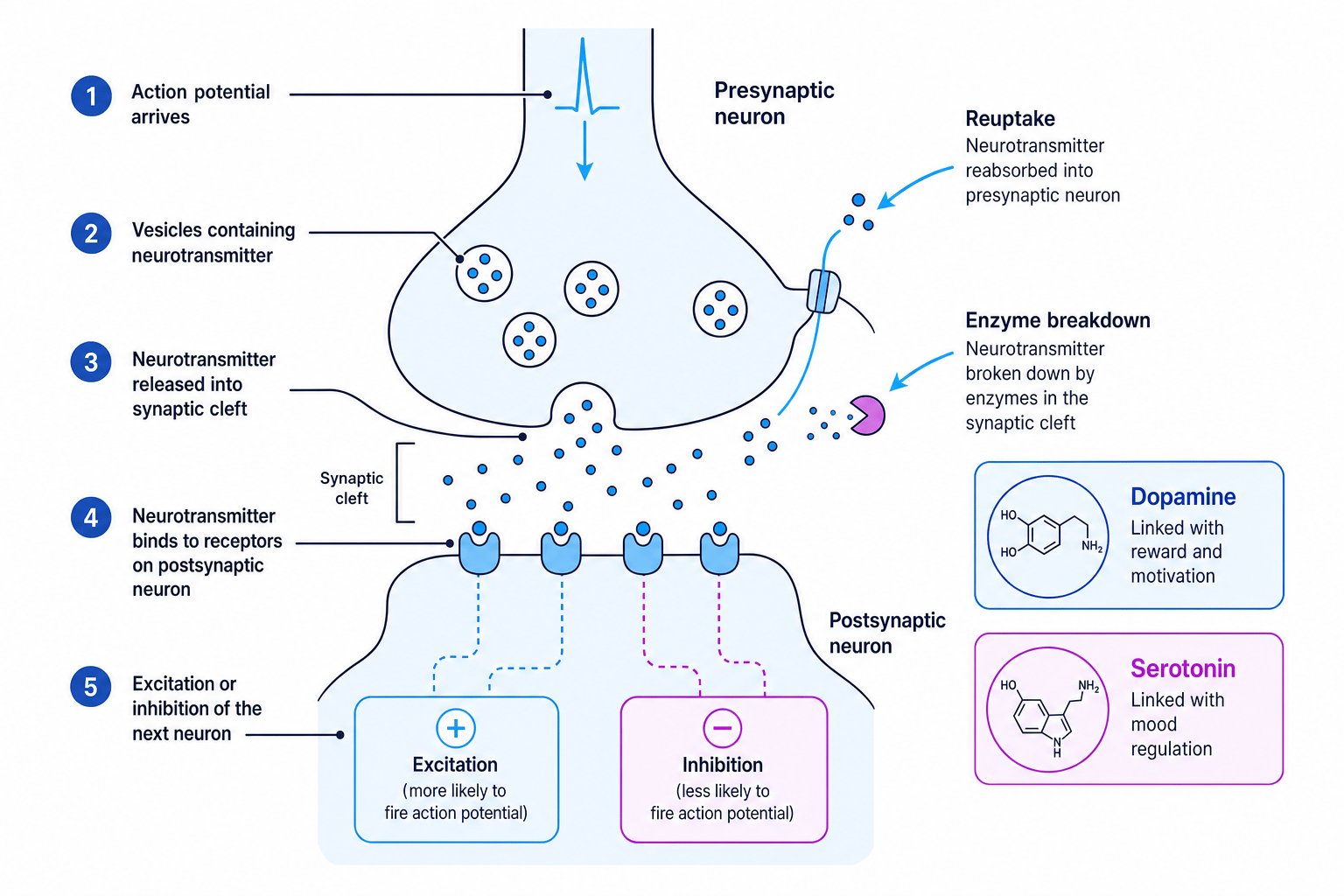
A neurotransmitter is a chemical messenger released by one neuron that crosses the synaptic gap and affects the activity of another neuron.
The synapse is the tiny gap between neurons. Neurotransmitters can make the next neuron more likely to fire, called excitation, or less likely to fire, called inhibition.
Examples include:
- Dopamine, linked with reward, motivation and movement.
- Serotonin, linked with mood regulation.
- Adrenaline, a hormone involved in arousal and the fight-or-flight response.
- Cortisol, a hormone involved in stress.
Linking serotonin to behaviour and treatment
Suppose a person with depression is prescribed an SSRI, a drug that reduces serotonin reuptake.
-
If reuptake is reduced, serotonin remains available in the synapse for longer.
-
More available serotonin may increase signalling in pathways involved in mood regulation.
-
If symptoms improve, this supports serotonin being involved in depression, but it does not prove depression is caused only by low serotonin. Placebo effects, thoughts, relationships and life events may also contribute.
Drug therapies are a major real-world application of the biological approach. Antidepressants and antipsychotics are based on changing neurotransmitter activity. This supports the value of biological explanations.
However, not everyone responds to drug treatment, and side effects can be significant. Also, if a drug changes behaviour, that does not automatically prove the original cause was purely chemical.
Cognitive neuroscience
Cognitive neuroscience
Cognitive neuroscience is the scientific study of how biological structures and processes, especially brain activity, are linked to cognitive processes such as memory, attention, language and decision-making.
“Cognitive” means mental processes; “neuroscience” means the study of the nervous system. Cognitive neuroscience combines cognitive psychology with biological methods.
Common methods include:
- fMRI, which detects changes in blood flow linked to brain activity. It has good spatial resolution but is expensive and can lack ecological validity.
- EEG, which records electrical activity from the scalp. It has excellent temporal resolution but weaker spatial resolution.
- ERPs, which are averaged EEG responses to specific stimuli, useful for studying attention and perception.
- PET, which uses radioactive tracers to measure brain activity, but is more invasive.
- Lesion studies, which study behavioural changes after brain damage.
Cognitive neuroscience has helped map functions such as memory, language and emotion, and has applications in neurosurgery, brain-injury rehabilitation and understanding disorders.
Reverse inference
Do not assume that activity in a brain area proves a specific mental process is happening. The same area can be involved in several tasks, so brain scans need careful interpretation.
Overall evaluation of the biological approach
A major strength is that the biological approach is scientific. It often uses objective methods such as scans, genetic testing and controlled drug trials. This improves reliability and makes psychology closer to the natural sciences.
Another strength is practical application. Biological explanations have led to drug treatments, brain-imaging techniques and better understanding of neurological conditions.
A key limitation is biological reductionism, which means explaining complex behaviour at a lower biological level while ignoring thoughts, emotions, learning and culture. For example, explaining aggression only through genes or brain activity may miss social learning, cognition and situational triggers.
The approach can also be deterministic if it suggests people have little control over behaviour because of biology. A more balanced view is interactionist: biology creates possibilities and constraints, while experience shapes how they develop.
In the exam
-
Define key terms early: genotype, phenotype, neurotransmitter, evolution and cognitive neuroscience.
-
For AO2, translate the scenario into biology: is it about inherited vulnerability, a brain area, neurochemistry or an adaptive behaviour?
-
For AO3, balance evidence and applications against reductionism, determinism, causality problems, methodological limits and ethical issues.
Check yourself
- What is the difference between genotype and phenotype, and why is phenotype not just genes?
- How can neurotransmitter evidence support a biological explanation without proving causation?
- What is one strength and one limitation of cognitive neuroscience?
