What you'll learn
- How humanistic psychology differs from behaviourist, biological and psychodynamic approaches.
- What psychologists mean by free will, self-actualisation and Maslow’s hierarchy of needs.
- How congruence and conditions of worth explain psychological discomfort.
- How to evaluate the approach for AQA essays using AO1, AO2 and AO3.
The big picture: the “third force” in psychology
Humanistic psychology developed in the mid-20th century, especially through the work of Abraham Maslow and Carl Rogers. It is often called the third force because it was presented as an alternative to two dominant approaches at the time: behaviourism and the psychodynamic approach.
Behaviourism focused on learning from the environment. The psychodynamic approach focused on unconscious conflict. Humanistic psychologists argued that both approaches were too negative or too deterministic. They wanted psychology to study the whole person, personal meaning and human potential.
Humanistic psychology
Humanistic psychology is an approach that sees people as active, conscious beings who strive for personal growth, fulfilment and psychological health.
Two important background ideas are holism and the idiographic approach. Holism means understanding a person as a whole rather than reducing them to parts, such as genes, hormones or stimulus-response links. An idiographic approach studies the individual’s unique personal experience rather than only looking for general laws that apply to everyone.
Core assumption
Humanistic psychology is optimistic: it assumes people are motivated to grow, make choices and move towards becoming the best version of themselves.
Free will
Free will
Free will is the idea that people can make conscious choices and are not completely controlled by biology, childhood experiences or environmental rewards and punishments.
Humanistic psychologists do not usually claim that you have unlimited freedom. Your choices can be affected by poverty, family expectations, trauma, culture and biology. However, they argue that people still have some capacity to choose how they respond to their situation.
This contrasts with determinism, which is the view that behaviour is caused by forces outside a person’s conscious control. For example, biological psychologists may explain behaviour through genes or brain chemistry, while behaviourists may explain behaviour through reinforcement and punishment.
Explaining behaviour using free will
A student, Sam, has always been pushed by his family to study law, but he decides to apply for a music course because it feels more meaningful to him.
- The humanistic explanation focuses on Sam as an active decision-maker, not simply as someone controlled by family pressure.
- Sam’s choice is linked to his subjective experience: music feels personally meaningful and connected to who he wants to become.
- The behaviour can be explained as movement towards personal growth, even though Sam is still affected by social expectations and possible consequences.
Free will is not the same as no influences
Do not write that humanistic psychologists believe people are totally free from all influences. A stronger answer says they emphasise personal agency within real-life constraints.
Evaluating free will
A strength is that free will gives a more positive and respectful view of human beings. It fits well with counselling because it encourages people to see themselves as capable of change.
A limitation is that free will is difficult to test scientifically. If someone says, “I chose freely,” it is hard to prove whether the choice was genuinely free or shaped by unconscious, biological or environmental causes. This reduces the scientific credibility of the approach.
Self-actualisation and Maslow’s hierarchy of needs
Self-actualisation
Self-actualisation is the desire to fulfil your potential and become the best version of yourself.
Maslow (1943) proposed that human motivation can be organised into a hierarchy of needs. A need is something a person is motivated to obtain because it is important for survival, security, belonging, self-worth or growth.
Maslow argued that lower needs usually have to be sufficiently satisfied before higher needs become the main focus. For example, someone who is hungry and unsafe is less likely to focus on creativity, personal fulfilment or moral development.
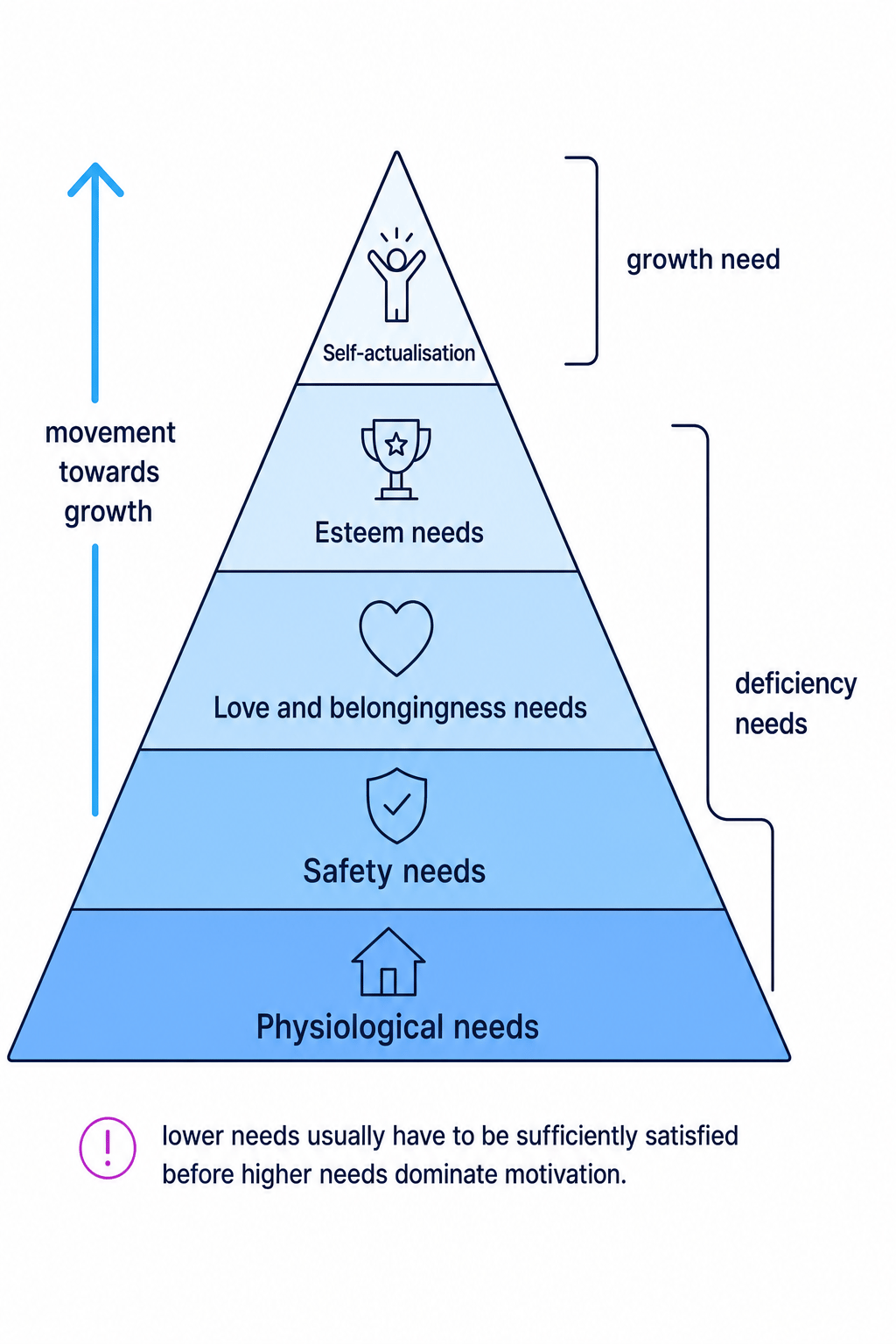
The five levels are:
- Physiological needs — basic survival needs, such as food, water and sleep.
- Safety needs — protection, stability and freedom from danger.
- Love and belongingness needs — friendship, family, intimacy and social connection.
- Esteem needs — respect, achievement, confidence and feeling valued.
- Self-actualisation — growth, creativity, meaning and fulfilling potential.
The bottom four levels are often called deficiency needs because they involve something missing. Self-actualisation is a growth need because it involves developing, rather than simply removing a deficit.
Applying Maslow’s hierarchy
Leah wants to become a writer, but she is sleeping badly, worried about money and feels isolated at college.
- Her writing goal is linked to self-actualisation because it involves creativity and fulfilling potential.
- Her sleep and money worries suggest unsatisfied physiological and safety needs, while isolation suggests unmet belongingness needs.
- Maslow’s theory predicts these lower needs may dominate Leah’s motivation, making it harder for her to focus on personal growth until they are sufficiently supported.
Essay shortcut
For Maslow, remember: survival first, growth later — but do not describe the hierarchy as completely rigid.
Evaluating Maslow’s theory
A strength is that the hierarchy has useful real-world applications. In education, for example, it suggests students need safety, belonging and confidence before they can fully focus on learning and personal development.
A limitation is that Maslow’s evidence was not very scientific by modern standards. He based some ideas on biographical analysis of people he considered self-actualised, such as historical figures. This is subjective because Maslow decided who counted as self-actualised.
Another limitation is cultural bias, which means a theory may reflect the values of one culture more than others. Self-actualisation can sound very individualistic, focusing on personal fulfilment. In more collectivist cultures, where group harmony and family duty are emphasised, the highest form of fulfilment may not be individual achievement.
Rogers: the self, congruence and psychological discomfort
Carl Rogers (1951, 1959) focused on the self. In humanistic psychology, the self means your personal understanding of who you are.
Self-concept
Self-concept is the way you see and describe yourself, including your beliefs about your abilities, personality and worth.
Rogers also described the ideal self, which means the person you would like to be. Your ideal self might include being confident, kind, successful, attractive, independent or respected.
Congruence
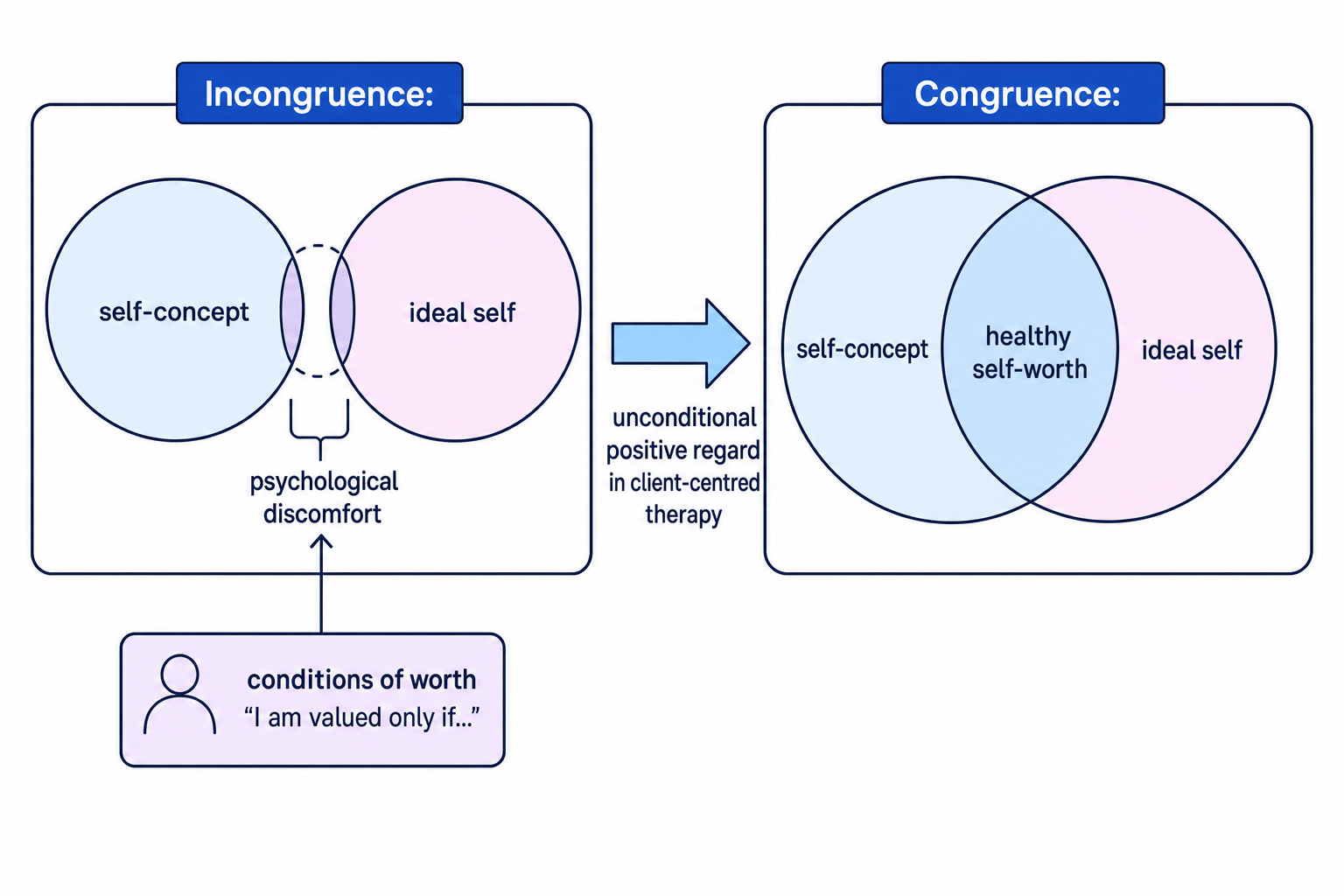
Congruence is when your self-concept and ideal self are closely matched.
When there is a large gap between the self-concept and ideal self, Rogers called this incongruence. Incongruence can lead to anxiety, low self-esteem and psychological discomfort because the person feels they are not living as their “true” or valued self.
Identifying incongruence
Aisha sees herself as awkward and unlikable, but her ideal self is confident, popular and socially relaxed.
- Compare Aisha’s self-concept with her ideal self: the two descriptions are very different.
- This large gap suggests incongruence because who she thinks she is does not match who she wants to be.
- A humanistic explanation would link her distress to this mismatch, rather than only to faulty thinking, biology or reinforcement history.
Mixing up self-concept and ideal self
Your self-concept is how you see yourself now. Your ideal self is how you would like to be. Congruence is about the match between them.
Conditions of worth
Conditions of worth
Conditions of worth are expectations a person feels they must meet in order to be loved, accepted or valued.
Rogers argued that children need unconditional positive regard, which means being accepted and valued without having to meet strict conditions. If love and approval are conditional, the child may learn: “I am only worthwhile if I achieve,” or “I am only lovable if I behave exactly as others want.”
These conditions can become internalised. This means the person takes external expectations into their own self-concept. Over time, they may deny their genuine feelings and chase an ideal self created by other people’s approval.
Tracing conditions of worth to incongruence
Ben’s parents praise him warmly when he gets top grades but become cold and disappointed when he gets anything lower.
- The approval is conditional because Ben feels valued only when he achieves highly.
- Ben may internalise the condition of worth: “I am worthwhile only if I am academically perfect.”
- If Ben’s real self-concept includes normal mistakes and limits, but his ideal self requires perfection, this creates incongruence and may lower his self-worth.
Rogers in one sentence
Psychological problems can develop when conditions of worth create a gap between who you really feel you are and who you believe you must be to gain acceptance.
Influence on counselling psychology
Rogers developed client-centred therapy, also called person-centred therapy. This is a form of counselling where the therapist provides empathy, genuineness and unconditional positive regard. It is non-directive, meaning the therapist does not simply tell the client what to do. Instead, the client is supported to explore feelings and move towards greater congruence.
This has clear ethical strengths. The approach respects the client’s autonomy, avoids deception, values confidentiality and aims to protect the client from harm. In therapy research, psychologists must still gain informed consent, allow the right to withdraw, maintain confidentiality and debrief participants where appropriate.
AO3: strengths and limitations of the humanistic approach
A major strength is its positive view of human nature. It focuses on growth, meaning and change rather than only abnormality or control. This makes it valuable in counselling, education and workplace psychology.
Another strength is that it takes subjective experience seriously. This is useful because two people can experience the same event very differently. Humanistic psychology helps explain why personal meaning matters.
However, a major limitation is that some concepts are difficult to operationalise, which means turning them into measurable variables. Ideas such as self-actualisation and congruence are meaningful, but they are not as easy to measure objectively as reaction times or hormone levels.
The approach can also be criticised as less scientific than biological or behaviourist approaches. It often uses interviews, case studies and personal accounts, which produce rich detail but may be affected by researcher interpretation and self-report bias.
Evaluation balance
Do not evaluate humanistic psychology only by saying “it is not scientific”. Add balance: its less scientific methods are partly because it is trying to study personal meaning, which may be lost in highly controlled experiments.
In the exam
- For AO1, define the key terms clearly: free will, self-actualisation, hierarchy of needs, congruence and conditions of worth.
- For AO2, apply the theory to the person’s subjective experience: ask what they want, how they see themselves and what conditions of worth may affect them.
- For AO3, balance strengths such as counselling applications and optimism against limitations such as poor testability, cultural bias and weak evidence for a fixed hierarchy.
Check yourself
- How does humanistic psychology differ from a deterministic approach?
- Why might conditions of worth lead to incongruence?
- Give one strength and one limitation of Maslow’s hierarchy of needs.
