What you'll learn
- What AQA means by the implications of psychological research for the economy.
- How psychological research can affect work, healthcare, childcare, education and justice.
- How to build strong AO2 application chains from a scenario to an economic outcome.
- How to evaluate economic claims using methodology, ethics and real-world limitations.
Starting point: what is “the economy”?
In this topic, the economy is not just banks, business or government budgets. It includes how society uses money, time, labour, services and resources.
Psychology affects the economy because psychological research can change how people are treated, educated, employed, supported, managed or rehabilitated.
Economic implication
An economic implication is a likely consequence for money, jobs, productivity, public spending, tax revenue, service use or long-term human development.
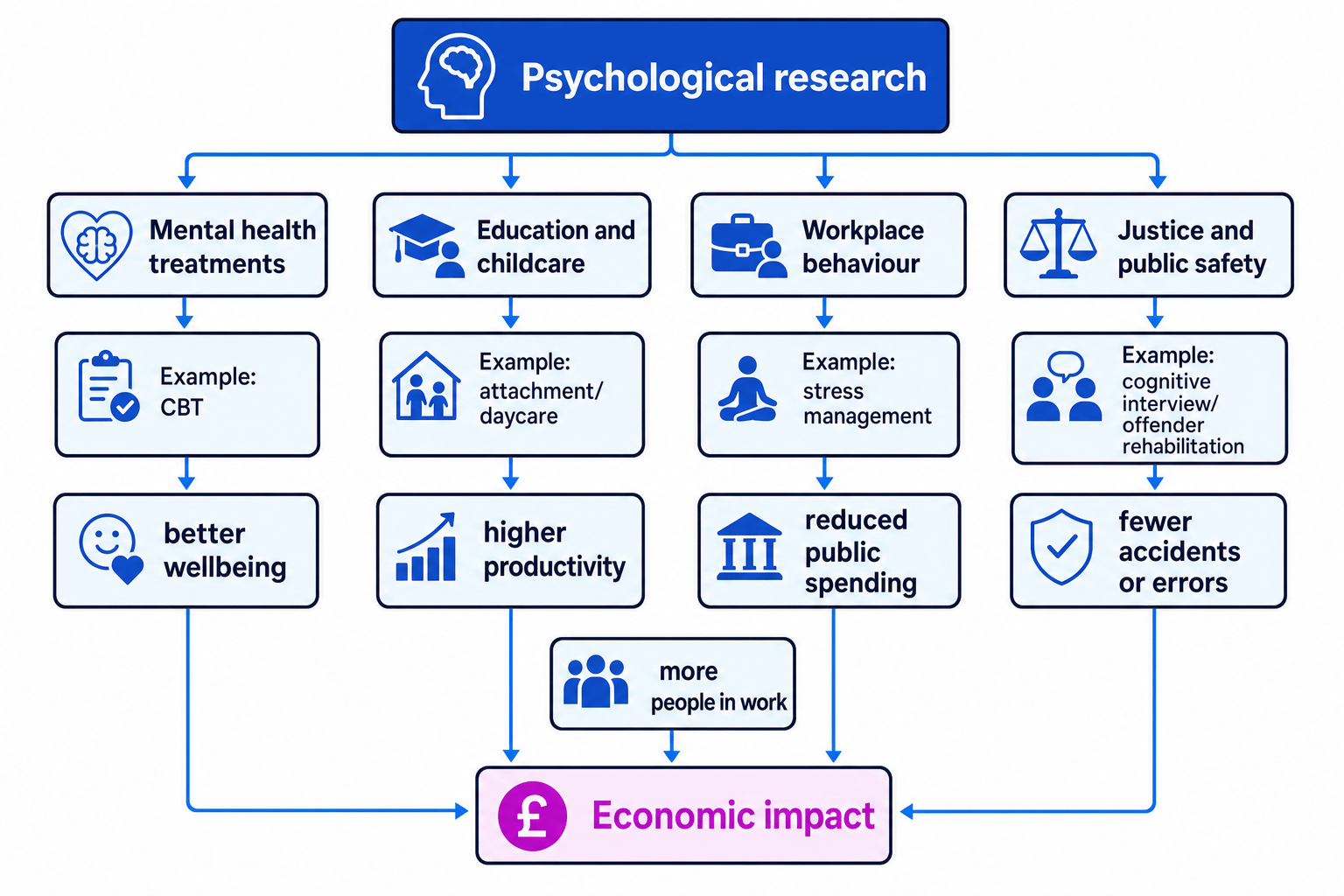
For example, research into depression might lead to better therapy. If that helps people return to work, it may reduce sickness absence and increase productivity. But the therapy also costs money to provide, so you need a balanced answer.
The core chain
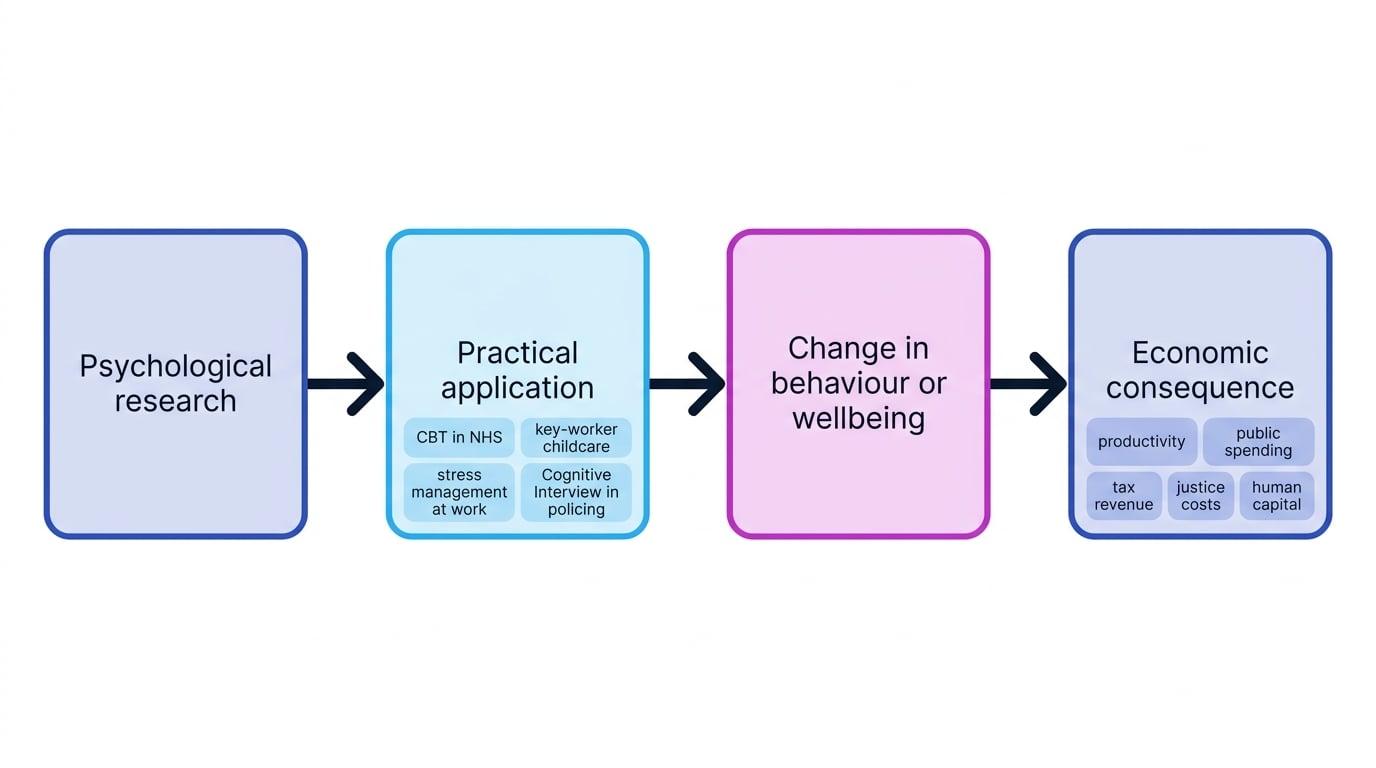
Strong answers usually follow this chain: psychological research → practical application → change in behaviour or wellbeing → economic consequence.
Why this belongs under scientific processes
AQA places this issue under scientific processes because it asks you to think about what happens when psychological evidence is used outside the laboratory.
Psychological research may influence:
- Policy: decisions made by governments, schools, the NHS, police or courts.
- Interventions: practical actions designed to improve outcomes, such as therapy or training.
- Workplace practice: how organisations support, select, train and manage staff.
- Public spending: money spent on healthcare, education, social care, policing and prisons.
However, scientific evidence must be reliable before it is used to justify expensive decisions. A finding that is statistically significant at p<0.05p < 0.05p<0.05 may still be too small, too artificial or too limited to be worth implementing widely.
Effect size
An effect size tells you the practical size of a finding. This matters because a tiny effect can be statistically significant but have little real economic value.
Mental health, work and public spending
One major economic implication of psychology is through mental health treatment.
Psychological research into disorders such as depression, anxiety, phobias and obsessive-compulsive disorder has informed therapies such as cognitive behavioural therapy, usually shortened to CBT. CBT is a talking therapy that helps people identify unhelpful thoughts and behaviours, then replace them with more realistic thinking patterns and coping strategies.
Mental health problems can affect the economy through:
- Absenteeism: time away from work due to illness.
- Presenteeism: being at work but functioning poorly because of distress or ill health.
- Increased use of NHS services.
- Increased welfare or sickness benefit claims.
- Reduced tax revenue if people cannot work.
So, if psychological treatment improves functioning, it may have economic benefits.
Linking CBT to economic impact
A local NHS service increases access to CBT for adults with anxiety disorders.
-
Identify the psychological application: CBT is based on research showing that anxiety can be maintained by negative interpretations, avoidance and safety behaviours.
-
Link the application to behaviour: if CBT reduces avoidance, some patients may be able to attend work more consistently or return after sickness absence.
-
Link behaviour to the economy: this could reduce benefit claims, reduce pressure on health services and increase workplace productivity.
-
Add balance: CBT requires trained therapists, appointments and funding, and it does not work equally well for everyone, so the economic benefit is not automatic.
AO3 evaluation
A strength is that mental health research has clear real-world application. Treatments can improve quality of life and may reduce long-term costs to employers, the NHS and the welfare system.
However, economic claims can be overstated. Waiting lists, unequal access, relapse and individual differences mean not everyone benefits. There is also an ethical issue: people should not be valued only by how economically “productive” they are.
Only saying “it saves money”
Do not just write that psychology “helps the economy”. Explain how: for example, through reduced absence, improved functioning, fewer repeat appointments, lower staff turnover or reduced public spending.
Attachment, childcare and education
Research into attachment also has economic implications.
Attachment
An attachment is an emotional bond between an infant and caregiver, usually involving comfort-seeking, distress on separation and pleasure on reunion.
Bowlby’s monotropic theory, developed in Bowlby (1969), argued that infants have an important early bond with one main caregiver. Ainsworth (1978) used the Strange Situation to classify attachment types, such as secure and insecure attachment. Later research, such as Schaffer and Emerson (1964), showed that many infants form multiple attachments, not just one bond.
This research has influenced childcare practice, including:
- key-worker systems in nurseries;
- stable caregiving in foster care and adoption;
- early intervention for families under stress;
- guidance on sensitive, responsive caregiving.
The economic implications can be positive. High-quality childcare may allow parents to work or study, increasing household income and labour-force participation. Good early care may also support later social and educational development, contributing to human capital, which means the skills, health and abilities people bring to society and work.
AO3 evaluation
A strength is that attachment research has influenced practical childcare standards. For example, nurseries often aim to provide consistent caregivers, which may support children emotionally while also allowing parents to remain economically active.
But there are limitations. Bowlby’s ideas were sometimes interpreted in a way that placed responsibility mainly on mothers, which may have discouraged maternal employment and reinforced gender roles. Evidence also suggests that the quality of care matters more than simply whether a child attends daycare.
Ethically, attachment research must avoid blaming parents. Studies involving separation, such as Ainsworth’s Strange Situation, require parental consent, protection from excessive distress and careful debriefing.
Good attachment evaluation
A balanced answer can say: attachment research helped improve childcare, but oversimplified interpretations may have had negative social and economic effects, especially for women’s employment.
Workplace behaviour and productivity
Psychological research is also used in organisations. Occupational psychology is the application of psychological knowledge to work, including stress, motivation, leadership, selection, training and teamwork.
One important area is workplace stress. Stress occurs when a person perceives that demands exceed their ability to cope. Research such as Marmot et al. (1997), from the Whitehall II study, linked low job control with poorer health outcomes among civil servants.
Economic implications include:
- reduced sickness absence if stress is managed well;
- lower staff turnover, saving recruitment and training costs;
- fewer errors and accidents;
- improved motivation and productivity;
- better leadership and team performance.
For example, if a workplace redesign gives employees more control over workload, this may reduce stress-related illness and improve efficiency.
AO3 evaluation
A strength is that workplace outcomes are often measurable: organisations can track absence rates, turnover, accidents and productivity before and after an intervention.
However, workplace research is often correlational. This means it can show a relationship, such as low control being linked to illness, but cannot always prove cause and effect. There are also ethical issues around employee data: staff must be treated confidentially and should not feel forced to disclose mental health difficulties.
The justice system and public safety
Psychological research into memory, interviewing and offending can also affect the economy.
Loftus and Palmer (1974) showed that leading questions can distort eyewitness testimony. Their research helped demonstrate that memory is not a perfect recording of events. This has implications for police interviewing and courtroom evidence.
The Cognitive Interview, associated with Geiselman et al. (1985), uses techniques such as context reinstatement and reporting everything to improve eyewitness recall. If police interviews become more accurate, investigations may become more efficient and miscarriages of justice may be reduced.
Applying eyewitness research to policing
A police force trains officers to avoid leading questions and use Cognitive Interview techniques.
-
Link to research: Loftus and Palmer showed that wording can influence memory reports, while Cognitive Interview research suggests recall can be improved through structured retrieval cues.
-
Apply to practice: officers may ask more open questions and encourage witnesses to reinstate the context of the event.
-
Explain economic impact: better-quality evidence could reduce wasted investigation time, appeals, retrials and the cost of imprisoning the wrong person.
-
Evaluate realistically: training takes time and money, and eyewitness memory can still be affected by anxiety, delay and post-event discussion.
Forensic psychology can also influence the economy through offender rehabilitation. Programmes based on CBT, anger management or social skills training aim to reduce reoffending. If effective, they may reduce prison costs, court costs and the economic impact of crime on victims and communities.
AO3 evaluation
There are clear real-world benefits if psychological research improves justice. However, lab studies of memory may lack ecological validity because watching a film of a car crash is not the same as witnessing a real crime. Loftus and Palmer also involved ethical issues such as deception about the full aim and possible distress from crash footage, so consent, right to withdraw and debriefing matter.
How to evaluate economic claims
When you see this topic in an exam, avoid treating economic impact as automatically positive. Ask whether the evidence really supports the claim.
Useful AO3 points include:
- Causality: did the psychological application cause the economic outcome, or are other factors involved?
- Cost-benefit: are the savings greater than the cost of training, therapy or policy change?
- Time scale: some interventions cost money now but may save money years later.
- Generalisability: findings from one group, culture or laboratory task may not apply to national policy.
- Ethics: economic benefits do not justify ignoring consent, confidentiality, protection from harm or equality.
- Opportunity cost: money spent on one psychological intervention cannot be spent on another service.
Balanced conclusion
Psychological research can benefit the economy, but only when findings are reliable, ethically applied and cost-effective in the real world.
In the exam
-
Start with the chain: research finding → application → behaviour/wellbeing change → economic implication.
-
Use at least one named example, such as CBT, attachment research, workplace stress research, Loftus and Palmer (1974), or the Cognitive Interview.
-
Evaluate with balance: mention costs, methodological limits, ethics and the danger of overclaiming.
-
Keep the focus on the economy: refer to productivity, public spending, employment, healthcare, justice costs or long-term human capital.
Check yourself
-
How could CBT for anxiety have both direct and indirect economic implications?
-
Why might attachment research have produced both positive and negative economic effects?
-
What AO3 points would weaken the claim that eyewitness research always saves the justice system money?