What you'll learn
- What a parasocial relationship is and how it differs from an ordinary social relationship.
- The three levels of parasocial relationships: entertainment-social, intense-personal, and borderline-pathological.
- How the absorption-addiction model explains increasingly intense celebrity worship.
- How the attachment theory explanation links parasocial relationships to early attachment experiences.
The basic idea: a one-sided relationship
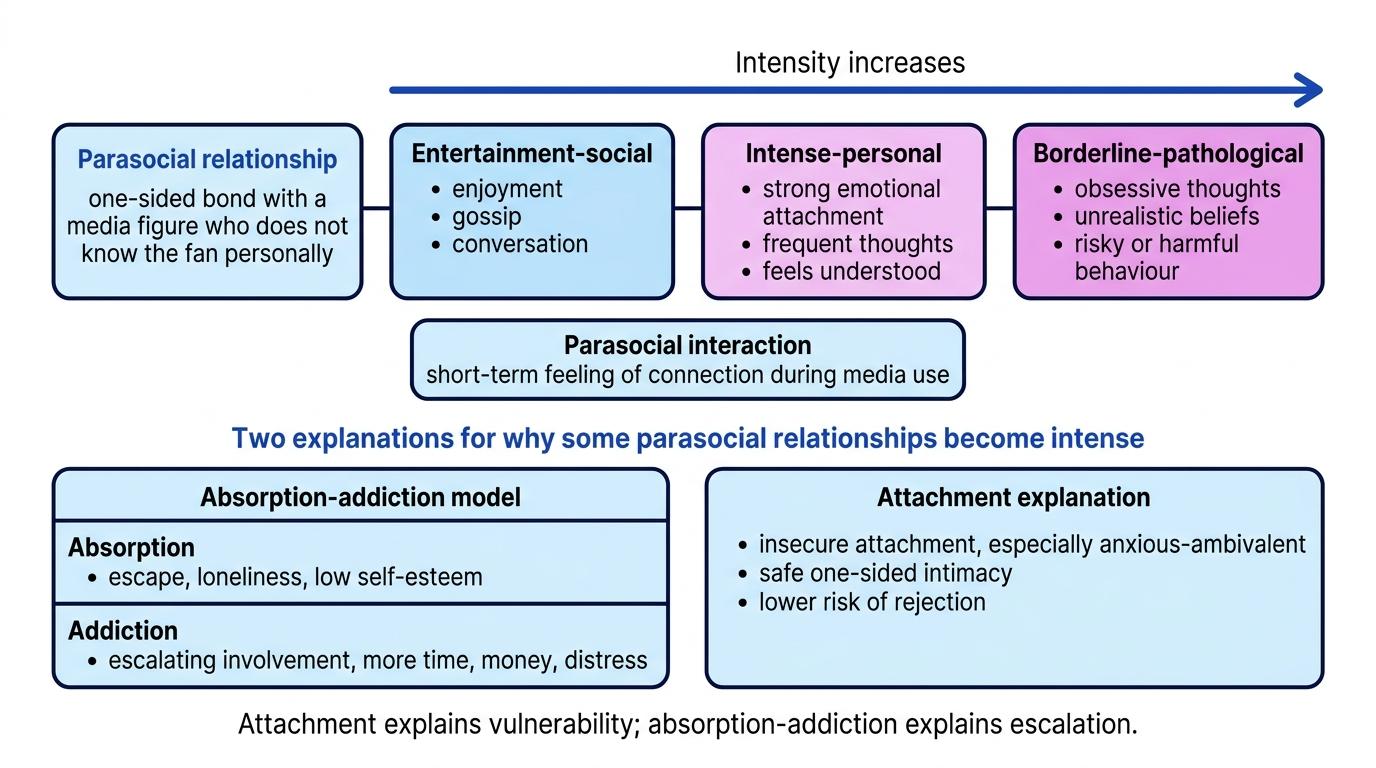
A parasocial relationship is a one-sided relationship that a person forms with a media figure, celebrity, influencer, fictional character, sportsperson, musician, or public personality.
The fan may feel that they “know” the celebrity, care about their life, and experience comfort from them. However, the celebrity does not genuinely know the fan as an individual, so the relationship is not reciprocal.
Parasocial relationship
A parasocial relationship is a one-sided psychological relationship in which a person feels emotionally connected to a media figure who does not know them personally.
This matters for A-Level because parasocial relationships sit within the wider Relationships topic: they look like social bonds, but they lack key features of ordinary relationships such as genuine reciprocity, meaning mutual give-and-take between two people.
Parasocial interaction vs parasocial relationship
A parasocial interaction is a short-term feeling of connection during media use, such as feeling that a YouTuber is speaking directly to you.
A parasocial relationship is longer-lasting. It continues beyond one viewing or one post, and becomes part of how the fan thinks, feels, or behaves over time.
The core difference
In a normal relationship, both people know and respond to each other. In a parasocial relationship, the fan feels close to the celebrity, but the celebrity does not truly share that bond.
Levels of parasocial relationships
Psychologists such as Giles and Maltby (2006) describe parasocial relationships as varying in intensity. Not every fan is “obsessed”; many parasocial relationships are mild, enjoyable, and socially normal.
A useful way to learn this is as a continuum from low intensity to high intensity.
Level 1: entertainment-social
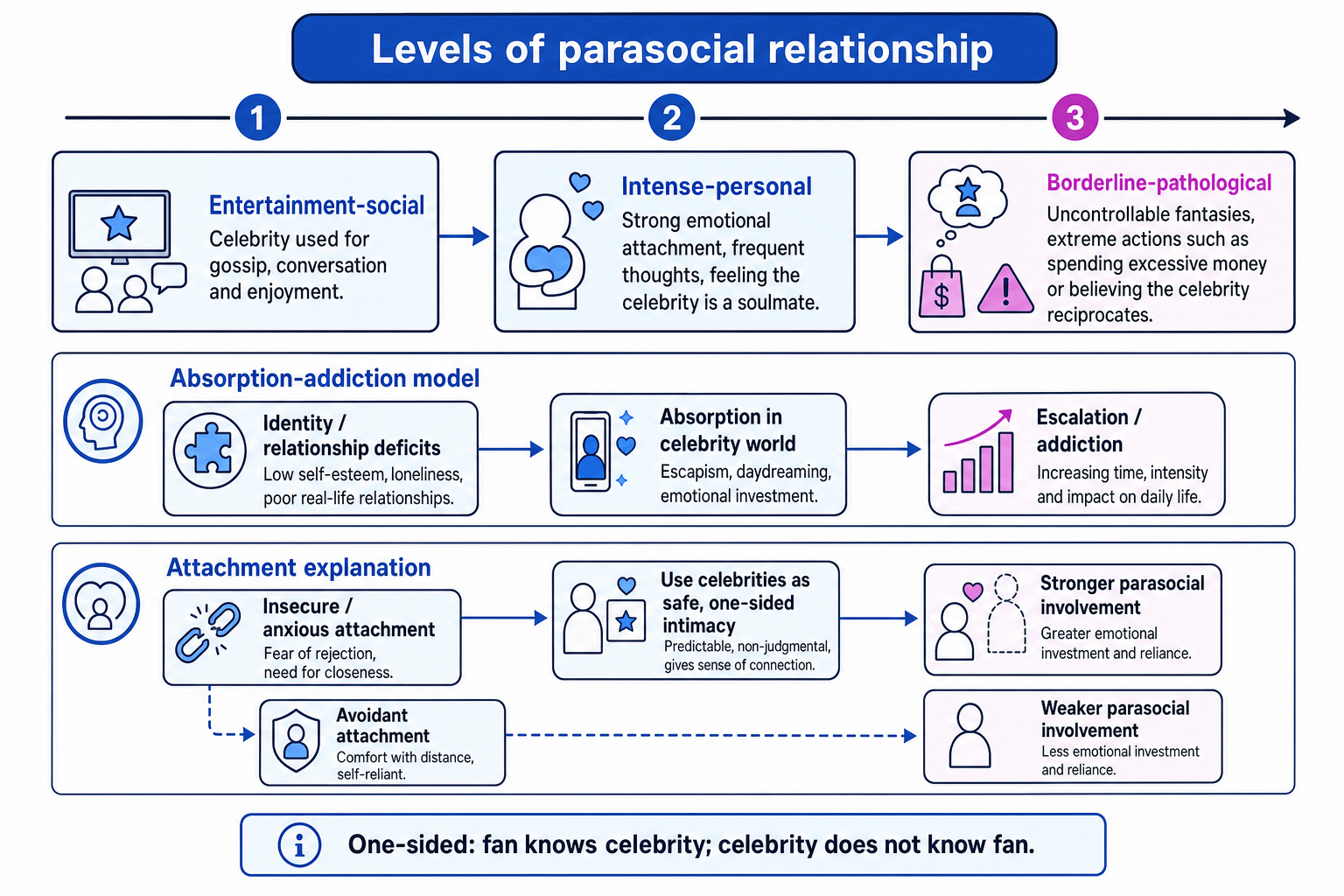
At the entertainment-social level, the celebrity is mainly a source of entertainment and conversation.
For example, someone might follow a singer because they enjoy their music, watch interviews, or talk about them with friends. The interest is not usually harmful or extreme.
Entertainment-social level
The entertainment-social level is the mildest form of parasocial relationship, where interest in a celebrity is mainly for enjoyment, gossip, and social conversation.
Level 2: intense-personal
At the intense-personal level, the fan develops stronger emotional feelings. They may think about the celebrity often, feel that the celebrity is especially important to them, or believe the celebrity understands them.
This level can involve more emotional dependency. The celebrity may feel like a “soulmate” or a central part of the person’s identity.
Intense-personal level
The intense-personal level involves a deeper emotional attachment to a celebrity, where the fan has frequent thoughts and strong personal feelings about them.
Level 3: borderline-pathological
At the borderline-pathological level, the relationship becomes extreme and may involve uncontrollable fantasies or risky behaviour.
For example, a person might spend excessive money trying to get close to the celebrity, believe the celebrity secretly loves them, or say they would do something illegal if the celebrity asked.
Borderline-pathological level
The borderline-pathological level is the most extreme form, involving obsessive thoughts, unrealistic beliefs, or behaviour that may be harmful or socially unacceptable.
Classifying the level of a parasocial relationship
Mia watches every interview with her favourite actor, talks about him with friends, and enjoys following his career. Recently, she has started saying he is the only person who truly understands her. She spends hours imagining conversations with him and says she would “do anything” to meet him.
-
The early behaviour fits the entertainment-social level because Mia uses the actor for enjoyment and conversation with friends.
-
Her belief that he is the only person who understands her suggests the intense-personal level because she is giving the relationship strong emotional meaning.
-
The phrase “do anything” might suggest movement towards the borderline-pathological level, but you would need clearer evidence of extreme or harmful behaviour before confidently labelling it that way.
Assuming all fans are pathological
Do not write as if parasocial relationships are automatically abnormal. Most are mild and can be enjoyable, socially useful, and harmless.
Evaluating the levels
A strength of the levels approach is that it avoids oversimplifying fandom. It recognises that liking a celebrity is not the same as having an extreme obsession.
Research support comes from Giles and Maltby (2006), who studied adolescents using measures such as the Celebrity Attitude Scale, a questionnaire used to assess levels of celebrity worship. They found that most celebrity interest was entertainment-social, while more intense forms were linked to personality factors and poorer psychological adjustment.
However, the evidence is often correlational, meaning researchers measure variables as they naturally occur rather than manipulating one variable to see its effect. This means we cannot be sure whether intense parasocial relationships cause poorer wellbeing, or whether people with poorer wellbeing are more likely to develop intense parasocial relationships.
There are also issues with self-report methods, where participants answer questionnaires about themselves. People may exaggerate, misunderstand items, or give socially desirable answers.
Ethically, studies in this area should ensure informed consent, confidentiality, the right to withdraw, and protection from harm, especially because questions about loneliness, obsession, and mental health can be sensitive.
The absorption-addiction model
The absorption-addiction model was proposed by McCutcheon et al. (2002) to explain why some parasocial relationships become very intense.
Absorption-addiction model
The absorption-addiction model explains parasocial relationships as developing when people become absorbed in a celebrity’s life to compensate for personal difficulties, and then need increasing involvement to maintain that emotional satisfaction.
Absorption
Absorption means becoming deeply focused on the celebrity and their world. The person may use the celebrity to escape from stress, loneliness, low self-esteem, or problems with identity.
The model suggests that people who have difficulties in their real-life relationships or personal identity may turn to celebrities because the relationship feels safe, exciting, and controllable.
Addiction
Addiction means the person needs more and more involvement to get the same emotional reward. This does not necessarily mean substance addiction; it refers to an escalating psychological dependence.
For example, a fan might move from watching interviews, to constantly checking updates, to spending large amounts of money, to believing they have a special connection with the celebrity.
Absorption then escalation
The model argues that parasocial relationships may begin as emotional escape, but can become more intense if the person needs increasing contact, fantasy, or involvement to feel fulfilled.
Applying the absorption-addiction model
Jay feels lonely after moving schools and spends more time watching a streamer who seems funny and comforting. Over time, Jay checks the streamer’s posts during lessons, becomes distressed when there are no updates, and spends money he cannot afford on donations.
-
Jay’s loneliness and difficult adjustment suggest a possible deficit in real-life social support, which the model sees as a reason for turning towards a celebrity or media figure.
-
His repeated watching and emotional comfort show absorption, because attention and emotional energy are increasingly focused on the streamer.
-
The distress, loss of control, and unaffordable spending suggest addiction-like escalation, because the behaviour is becoming harder to control and is interfering with daily life.
Evaluating the absorption-addiction model
A strength is that the model explains why parasocial relationships differ in intensity. It can account for the movement from harmless interest to more extreme forms of celebrity worship.
There is some research support. For example, Maltby et al. (2005) found links between intense celebrity worship and poorer psychological wellbeing, such as anxiety and depression. This supports the idea that people may use celebrity attachment to manage emotional difficulties.
However, the model risks pathologising normal fandom. Many people follow celebrities intensely during certain periods without being addicted or psychologically unhealthy.
Another weakness is the cause-and-effect problem. If loneliness and celebrity worship are correlated, we cannot tell whether loneliness leads to celebrity worship, celebrity worship increases loneliness, or a third factor affects both.
Using addiction too literally
In this topic, “addiction” usually means escalating psychological dependence, not necessarily a diagnosed clinical addiction.
The attachment theory explanation
The attachment theory explanation applies ideas from Bowlby’s attachment theory to parasocial relationships.
Attachment
Attachment is a strong emotional bond between two people. In psychology, early attachment to a caregiver is thought to influence later expectations about relationships.
Bowlby argued that children develop an internal working model, which is a mental template for relationships. If early caregiving is reliable, a person may expect others to be trustworthy. If early caregiving is inconsistent or rejecting, the person may develop insecure expectations.
Ainsworth’s research, including Ainsworth et al. (1978), identified attachment types such as:
- Secure attachment: comfort with closeness and trust.
- Insecure-avoidant attachment: emotional distance and discomfort with dependence.
- Insecure-resistant, also called anxious-ambivalent attachment: anxiety about rejection and a strong need for closeness.
How attachment links to parasocial relationships
The attachment explanation argues that people with insecure attachment, especially anxious-ambivalent attachment, may be more likely to form intense parasocial relationships.
This is because celebrities can provide a sense of closeness without the same risk of rejection. The relationship feels emotionally safe because it is one-sided and controlled by the fan.
Avoidantly attached individuals may be less likely to develop intense parasocial relationships because they tend to avoid emotional closeness and dependency.
Safe one-sided intimacy
Parasocial relationships may appeal to anxiously attached people because they offer feelings of closeness without the uncertainty and rejection risk of real relationships.
Applying the attachment explanation
Leah says people often leave her, and she becomes very anxious if friends do not reply quickly. She follows a musician closely, says the musician “would never hurt me”, and feels calmer after watching their videos.
-
Leah’s fear that people will leave her suggests an anxious-ambivalent attachment pattern, because she wants closeness but worries about rejection.
-
The musician provides a predictable source of comfort, so the parasocial relationship may act as a safer substitute for uncertain real-life relationships.
-
Her statement that the musician “would never hurt me” shows why the one-sided nature matters: the celebrity cannot directly reject her in the way a real partner or friend might.
Evaluating the attachment explanation
A strength is that it links parasocial relationships to a well-established theory. Bowlby’s theory has been widely used to explain later friendships and romantic relationships, so applying it to celebrity bonds makes theoretical sense.
There is research support from Cole and Leets (1999), who found that people with anxious-ambivalent attachment were more likely to form parasocial bonds with TV personalities, while avoidant attachment was linked to weaker parasocial involvement.
However, evidence is mixed. Not all studies find a clear relationship between attachment type and celebrity worship. This suggests attachment may explain some parasocial relationships, but not all of them.
A methodological issue is that attachment is often measured using questionnaires, which may not accurately capture someone’s early attachment history. People may not remember childhood relationships clearly, or may answer in a way that protects their self-image.
Ethically, attachment research can involve sensitive personal material. Researchers must protect confidentiality, allow withdrawal, avoid unnecessary distress, and debrief participants if questions about childhood or emotional insecurity cause discomfort.
Comparing the two explanations
The absorption-addiction model focuses on personal deficits, emotional escape, and escalation. It is especially useful for explaining intense or borderline-pathological parasocial relationships.
The attachment explanation focuses on early relationship experiences and why some people seek safe, one-sided intimacy. It is especially useful for explaining individual differences in who becomes emotionally dependent on celebrities.
A strong exam answer can use both: attachment may explain why a person is vulnerable to seeking one-sided closeness, while absorption-addiction may explain how that bond escalates over time.
Essay comparison phrase
A useful comparison is: attachment theory explains the origin of vulnerability, whereas absorption-addiction explains the process of escalation.
AO2: applying to scenarios
When you are given a scenario, avoid simply naming a theory. Link details from the scenario to the explanation.
For example:
- Loneliness, low self-esteem, poor identity, or weak real-life relationships can support the absorption part of the absorption-addiction model.
- Increasing time, money, distress, or loss of control can support the addiction part.
- Fear of rejection, clinginess, or inconsistent early caregiving can support the attachment explanation.
- Ordinary gossip and enjoyment usually suggests entertainment-social, not pathology.
In the exam
-
Separate AO1 and AO3 clearly: describe the levels or theory first, then evaluate with evidence, methods, and alternative explanations.
-
Use scenario details for AO2: quote or paraphrase the person’s behaviour and link it to a specific level or mechanism, such as absorption or anxious attachment.
-
Avoid extreme language: parasocial relationships are not always unhealthy, so evaluate whether the evidence shows mild interest, emotional dependence, or genuinely harmful behaviour.
Check yourself
- What is the difference between entertainment-social and intense-personal parasocial involvement?
- How does the absorption-addiction model explain escalation?
- Why might anxious-ambivalent attachment make parasocial relationships more likely?