What you'll learn
- How chromosomes usually influence the development of biological sex.
- The roles of testosterone, oestrogen and oxytocin.
- How diversity in sex development (DSD) shows that sex development is not a simple XX/XY switch.
- How to evaluate this area for AO3, including evidence, ethics and real-world applications.
1. Sex, gender and DSD: start with the basics
In the Gender topic, you need to keep biological sex and gender separate. They often relate to each other, but they are not the same thing.
Biological sex and gender
Biological sex refers to physical characteristics such as chromosomes, gonads, hormones and reproductive anatomy. Gender refers to a person’s psychological sense of identity and the social/cultural expectations attached to being masculine, feminine, both or neither.
A gonad is a reproductive gland: typically testes or ovaries. A hormone is a chemical messenger released into the bloodstream that affects target tissues. A receptor is a specialised cell structure that responds to a particular hormone.
Diversity in sex development
Diversity in sex development (DSD) refers to variations in chromosomes, gonads, hormones, hormone receptors or reproductive anatomy. Older sources may use the phrase “disorders of sex development”, but “differences” or “diversity” is often preferred because it is less stigmatising.
The big idea
Biological sex develops through several interacting levels: chromosomes, genes, gonads, hormones, receptors and anatomy. DSDs are important because they show that chromosomes alone do not determine everything.
2. Chromosomes: the usual starting point
A chromosome is a thread-like structure in the cell nucleus that contains genes, which are sections of DNA carrying instructions for making proteins. Most humans have 23 pairs of chromosomes. One pair is the sex chromosomes.
Typical chromosomal patterns are:
| Chromosomal pattern | Usual pathway |
|---|---|
| XX | Female-typical development |
| XY | Male-typical development |
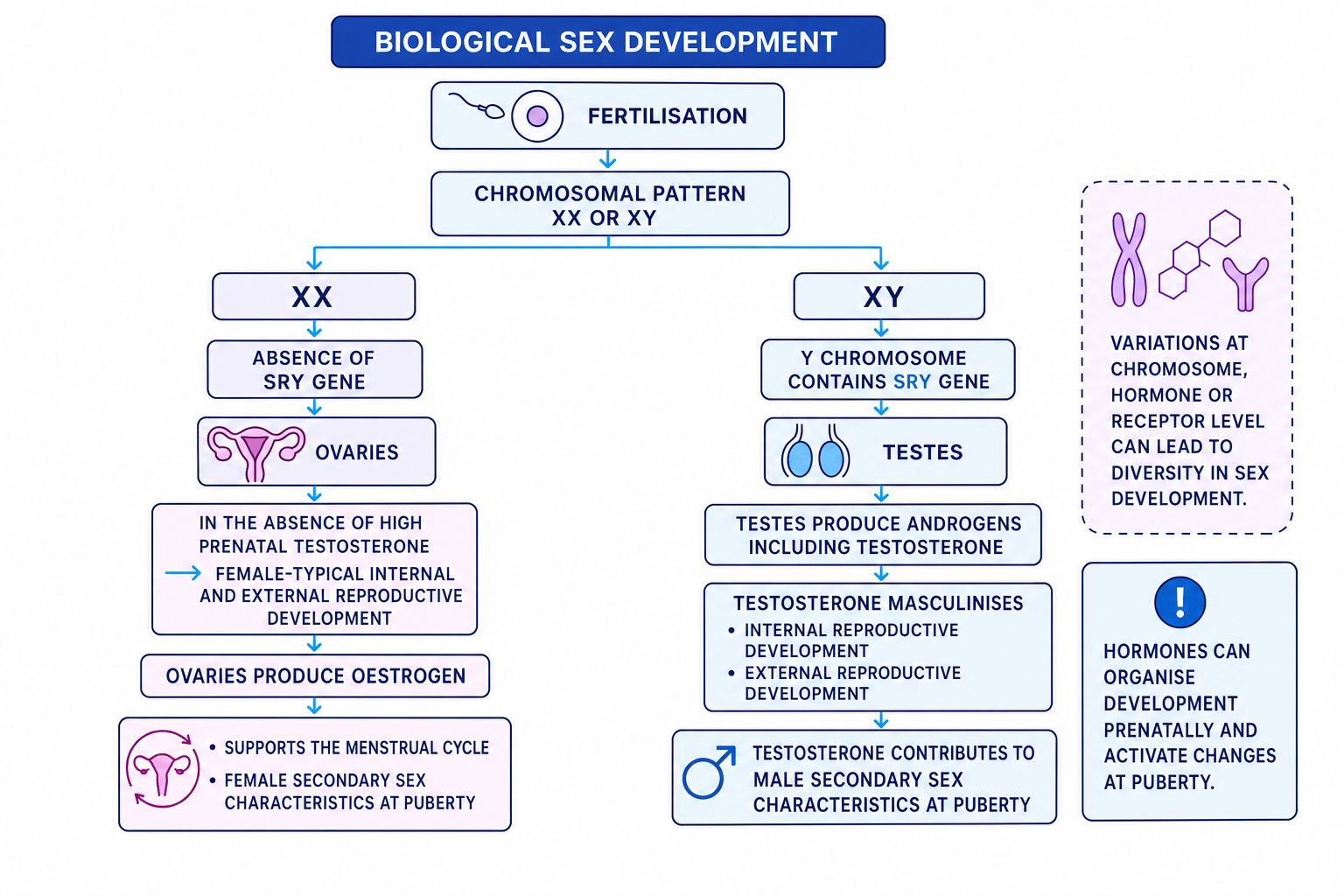
The egg cell usually contributes an X chromosome. The sperm cell contributes either an X or a Y chromosome. If the sperm contributes X, the typical pattern is XX. If it contributes Y, the typical pattern is XY.
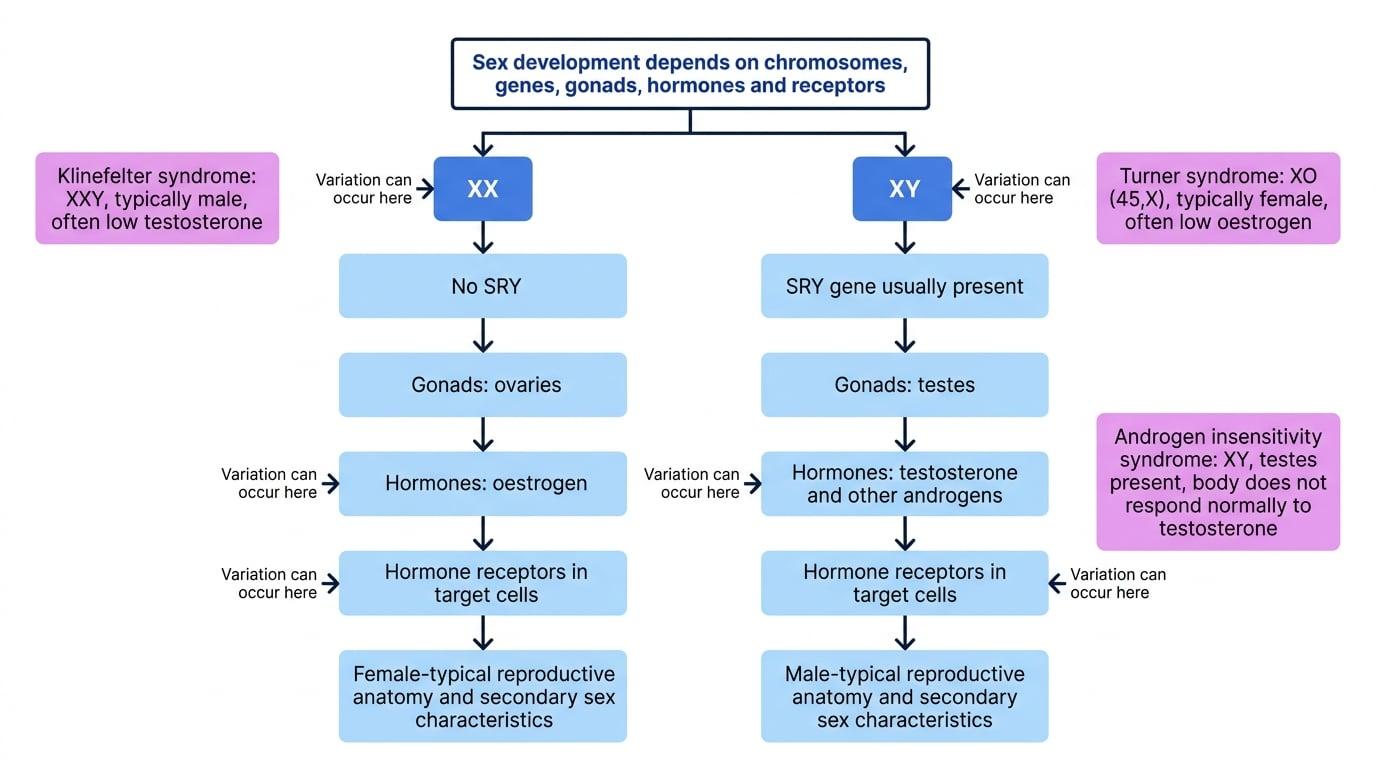
The Y chromosome usually contains the SRY gene. This gene helps trigger the development of testes. The testes then produce androgens, including testosterone.
This diagram shows the typical pathway, while also flagging where variation can occur.
Thinking XX and XY explain everything
Do not write as if XX automatically means “fully female” and XY automatically means “fully male” in every biological respect. AQA expects you to understand the role of hormones and DSD, so include chromosomes and hormone/receptor effects.
3. Hormones and biological sex
Testosterone
Testosterone is an androgen, meaning a hormone involved in male-typical sexual development. It is produced mainly by the testes, although all humans produce some testosterone.
Before birth, testosterone helps masculinise reproductive anatomy. At puberty, it contributes to secondary sex characteristics, which are physical features that develop at sexual maturity, such as facial hair, a deeper voice and increased muscle mass.
Testosterone is also often discussed in relation to some gender-related behaviours, such as aggression or spatial ability, but you should be careful: behaviour is influenced by biology, learning, culture and individual experience.
Oestrogen
Oestrogen is a hormone produced mainly by the ovaries, although again it is present in all humans. It is involved in the menstrual cycle and contributes to female-typical secondary sex characteristics at puberty, such as breast development and wider hips.
In typical development, the absence of high prenatal testosterone allows female-typical reproductive development. Oestrogen then becomes especially important at puberty and in reproductive functioning.
Oxytocin
Oxytocin is a hormone released by the pituitary gland, a small gland at the base of the brain. It plays an important role in childbirth, milk release during breastfeeding and social bonding.
In A-Level Psychology, oxytocin is sometimes linked to nurturing or bonding behaviours. However, avoid calling it simply “the female hormone” or “the love hormone”. It is found in all humans, and its effects depend on the situation.
Organisation versus activation
A useful distinction is that hormones can have organisational effects, shaping development before birth, and activational effects, triggering changes later, such as at puberty.
4. Applying the chromosome-hormone-receptor pathway
Sometimes exam scenarios give you details about chromosomes, hormones or anatomy and ask you to explain what is happening. The key is to reason through the pathway rather than just spotting one word.
Explaining androgen insensitivity
A person has an XY chromosomal pattern and internal testes, but develops female-typical external genitalia. Medical tests show that their cells do not respond properly to testosterone.
- The XY pattern suggests the Y chromosome probably contains the SRY gene, so testes are likely to develop.
- The testes can produce testosterone, but the person’s cells cannot respond normally because the androgen receptors are not working properly.
- If the body cannot respond to testosterone, male-typical external genital development does not occur in the usual way.
- The best explanation is androgen insensitivity syndrome, showing that chromosomes alone are not enough; hormone reception also matters.
5. Diversity in sex development
Androgen insensitivity syndrome
Androgen insensitivity syndrome (AIS) is a DSD in which a person has an XY chromosomal pattern but their body is partially or completely insensitive to androgens such as testosterone.
In complete AIS, the person is usually born with female-typical external genitalia and is often raised as female. They usually have testes inside the body rather than ovaries, and they do not have a uterus. At puberty, breast development may occur, but menstruation does not. Fertility is usually not possible.
In partial AIS, the body responds to some androgens, so reproductive anatomy may be more varied.
What AIS teaches us
AIS shows that testosterone only affects development if target cells can respond to it. The hormone signal and the receptor both matter.
Klinefelter’s syndrome
Klinefelter’s syndrome is a DSD involving an extra X chromosome, usually written as XXY. The person is typically biologically male because the Y chromosome usually triggers testes development, but the extra X chromosome affects testicular development and testosterone levels.
Common features can include reduced fertility, smaller testes, lower testosterone, less facial/body hair, breast tissue development, taller-than-average height and sometimes language or learning difficulties. There is wide individual variation, and many people are not diagnosed until adulthood.
Turner syndrome
Turner syndrome is a DSD in which a person has only one complete X chromosome, often written as XO or 45,X. The person is typically biologically female, but the ovaries may be underdeveloped, leading to low oestrogen and infertility.
Common features can include short stature, delayed puberty, lack of menstruation, heart or kidney differences and sometimes difficulties with spatial tasks. Intelligence is usually within the typical range, although specific learning needs may occur.
Mixing up Klinefelter’s and Turner syndrome
Klinefelter’s is usually XXY and typically male. Turner syndrome is usually XO and typically female. Remember: Klinefelter’s has an extra sex chromosome; Turner has a missing or incomplete sex chromosome.
Identifying a DSD pattern
A student reads about a person who has an XXY chromosomal pattern, low testosterone, reduced fertility and is typically male.
- The chromosomal pattern includes a Y chromosome, so the usual pathway is male-typical development.
- The extra X chromosome suggests disruption of typical testicular development, which fits the low testosterone and reduced fertility.
- Turner syndrome is unlikely because Turner syndrome involves one X chromosome and no Y chromosome.
- The most appropriate identification is Klinefelter’s syndrome.
6. AO3: evaluating chromosomes, hormones and DSD
Strength: biological evidence is clear and useful
DSDs provide strong evidence that biological sex is influenced by several biological systems. AIS shows the importance of hormone receptors. Klinefelter’s and Turner syndrome show that chromosome number can affect development. This supports a biological approach because differences in chromosomes or hormone response are linked to observable physical outcomes.
This knowledge also has real-world applications. It can improve diagnosis, hormone treatment, fertility counselling and psychological support. It also encourages more sensitive care for people with DSDs.
Limitation: biology is not destiny
A reductionist explanation breaks a complex behaviour or identity down into one level, such as genes or hormones. This can be useful scientifically, but it can oversimplify gender development.
For example, chromosomes and hormones may influence the body and some behaviours, but gender identity and gender roles are also shaped by family, culture, cognition and personal experience. Not everyone with the same DSD has the same identity, experiences or psychological outcomes.
Avoid biological determinism
Biological explanations are important, but avoid suggesting that chromosomes or hormones rigidly determine personality, gender identity or social behaviour. A balanced essay says biology is influential, not all-powerful.
Evidence from case studies: useful but limited
Some research uses unusual cases because DSDs are relatively rare. Case studies can provide rich detail, but they often involve small samples, making it difficult to generalise.
A famous case is David Reimer, discussed by Diamond and Sigmundson (1997). Reimer was biologically male but was raised as a girl after a medical accident in infancy. He later rejected the female identity and lived as male. This challenges the idea that social rearing alone can override biology.
However, this case involved serious ethical issues: informed consent was questionable, psychological harm occurred, and the child’s vulnerability was not adequately protected. It is therefore important evidence, but it must be handled sensitively.
Cross-cultural and hormone evidence
Imperato-McGinley et al. (1974) studied children in the Dominican Republic with a DSD affecting androgen development. Some individuals raised as girls experienced masculinisation at puberty and adopted male gender roles. This supports the idea that androgens can influence sex-typed development.
However, the research was culturally specific and involved a small, unusual sample. Social expectations in that community may also have influenced outcomes, so it is not purely evidence for biology.
Ethical issues in DSD research and treatment
Research into DSD involves sensitive medical and personal information. Researchers and clinicians must protect confidentiality, gain informed consent where possible, avoid deception, allow the right to withdraw and protect participants from psychological harm.
There are also ethical debates about early surgery on children with DSD. If surgery is not medically necessary, critics argue that the individual should be able to consent when older. Supporters may argue that early treatment can reduce distress or medical risk, but this must be weighed carefully against autonomy and long-term wellbeing.
In the exam
- For AO1, describe the full pathway: chromosomes → SRY/gonads → hormones → receptors → sex characteristics.
- For AO2, use scenario details carefully: XXY points to Klinefelter’s, XO points to Turner syndrome, and XY plus androgen receptor insensitivity points to AIS.
- For AO3, evaluate with balance: DSD evidence supports biology, but case studies are rare/small, ethics are sensitive, and gender development is not purely biological.
Check yourself
- Why does AIS show that chromosomes alone do not determine biological sex development?
- How would you distinguish Klinefelter’s syndrome from Turner syndrome in a scenario?
- What is one ethical issue in research or treatment involving DSD?