What you'll learn
- What makes a study an experiment in psychology.
- How to distinguish laboratory, field, natural and quasi-experiments.
- How to evaluate each type using control, validity, reliability and ethics.
- How to apply the method to unfamiliar scenario questions.
The basic logic of an experiment
Psychologists use the experimental method when they want to test whether one thing causes another. In A-Level Psychology, the core idea is simple: change or compare an independent variable, measure a dependent variable, and try to control other influences.
Experiment
An experiment is a research method used to investigate cause and effect by examining whether changes in an independent variable lead to changes in a dependent variable, while controlling other possible influences.
Independent and dependent variables
The independent variable (IV) is the factor that is changed, compared, or naturally varies between conditions. It is the possible “cause”.
The dependent variable (DV) is the behaviour or outcome measured by the researcher. It is the possible “effect”.
A condition is one level of the IV. For example, if participants hear either loud music or silence while revising, “loud music” and “silence” are the two conditions.
Operationalisation means defining variables clearly enough to measure or replicate them. “Memory” is vague; “number of words correctly recalled from a list of 20 after five minutes” is operationalised.
Identifying the IV and DV
A psychologist shows two groups the same film clip of a car accident. One group is asked, “How fast were the cars going when they smashed into each other?” The other is asked, “How fast were the cars going when they contacted each other?” This is similar to Loftus & Palmer (1974).
- Identify what differs between groups. The wording of the question changes: “smashed” versus “contacted”. This is the IV.
- Identify what is measured. Participants give a speed estimate. This is the DV.
- Operationalise the DV. A clear DV would be “estimated speed in miles per hour”.
- Consider control. If both groups see the same clip, in the same room, with the same instructions except for the verb, the researcher has reduced extraneous variables.
Loftus & Palmer (1974) is often treated as a laboratory experiment because the researchers manipulated the wording in a controlled setting. Ethically, participants gave consent to take part, but may not have known the exact aim because that could have affected their responses. They should therefore have been fully debriefed afterwards, with the right to withdraw their data.
Extraneous and confounding variables
An extraneous variable is any variable other than the IV that might affect the DV. A confounding variable is more serious: it changes systematically with the IV, so you cannot tell whether the IV or the confound caused the result.
For example, if one memory group is tested in the morning and another in the afternoon, time of day could become a confounding variable if it affects alertness.
Control supports causality
The more carefully a study controls extraneous variables, the more confidently you can argue that the IV caused the change in the DV.
Useful control methods include standardised procedures such as identical instructions, same materials and same time limits. Random allocation means assigning participants to conditions by chance, which helps spread participant differences evenly across groups.
The four types of experiment
The main types in AQA Psychology are laboratory experiments, field experiments, natural experiments and quasi-experiments. The key distinction is whether the researcher manipulates the IV, and where the study takes place.
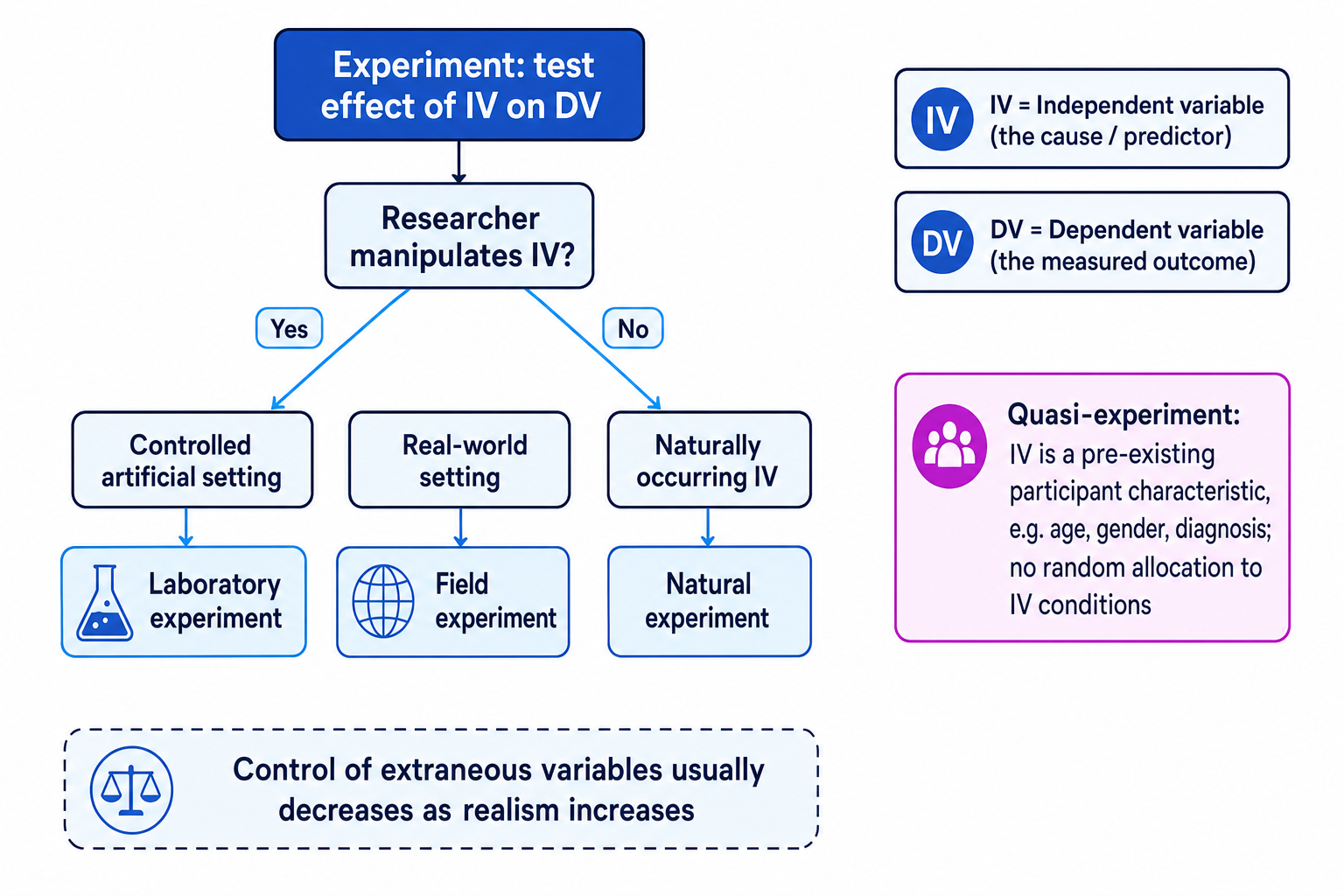
| Type | IV | Setting | Core strength | Core limitation |
|---|---|---|---|---|
| Laboratory experiment | Manipulated by researcher | Controlled/artificial | High control and replicability | May lack realism |
| Field experiment | Manipulated by researcher | Real-world setting | More natural behaviour | Less control |
| Natural experiment | Naturally occurring event or situation | Often real-world | Studies things that cannot be manipulated ethically | Weak control over allocation |
| Quasi-experiment | Pre-existing participant characteristic | Can be controlled or real-world | Useful for comparing natural groups | Causal conclusions are weaker |
Laboratory experiments
A laboratory experiment takes place in a controlled environment where the researcher manipulates the IV and measures the DV. “Laboratory” does not have to mean a science lab; it could be a classroom, office or online controlled setting.
Laboratory experiment
A laboratory experiment is an experiment conducted in a controlled setting where the researcher manipulates the IV and measures its effect on the DV.
AO1: What it looks like
A typical laboratory experiment might test whether anxiety affects recall. Participants could be randomly allocated to a “mild stress” condition or a “no stress” condition, then complete the same memory test.
AO3: Strengths
Laboratory experiments usually have high internal validity, meaning the study is good at showing whether the IV caused the DV. This is because the researcher can control extraneous variables.
They are also easy to replicate, meaning another researcher can repeat the procedure to check whether the same findings occur. This improves reliability, which means consistency of findings.
AO3: Weaknesses
The main weakness is lower ecological validity, meaning the findings may not generalise well to real-life settings. Participants may behave differently because the setting or task feels artificial.
Laboratory experiments can also suffer from demand characteristics, where participants guess the aim and change their behaviour.
Assuming controlled always means valid
High control improves internal validity, but it does not automatically mean the study reflects real-life behaviour. A tightly controlled memory task may still lack mundane realism if it feels nothing like everyday remembering.
Field experiments
A field experiment takes place in a natural, real-world setting, but the researcher still manipulates the IV.
Field experiment
A field experiment is an experiment conducted in a real-life setting where the researcher manipulates the IV and measures the DV.
For example, Bickman (1974) investigated obedience by having a confederate dressed in different uniforms give instructions to members of the public. The IV was the type of uniform, and the DV was whether people obeyed.
AO3: Strengths
Field experiments often have higher ecological validity than laboratory experiments because behaviour is measured in a real-world context. Participants may also be less likely to show demand characteristics if they do not realise they are in a study.
AO3: Weaknesses
The trade-off is reduced control. Noise, weather, time pressure, other people and individual differences may all affect the DV. This makes it harder to establish cause and effect.
There are also ethical issues. In many field experiments, participants may not give informed consent because telling them would change their behaviour. Researchers must consider protection from harm, confidentiality, debriefing where possible, and whether deception is justified.
Natural experiments
A natural experiment uses an IV that changes naturally, not because the researcher created it. The researcher takes advantage of a naturally occurring event or situation.
Natural experiment
A natural experiment investigates the effect of a naturally occurring IV on a DV. The researcher does not manipulate the IV directly.
For example, researchers might study the psychological effects of a natural disaster, a change in school policy, or early deprivation in children adopted from institutions. In Romanian orphan studies such as Rutter et al. (2011), researchers did not create deprivation; they studied children whose early experiences had already varied.
AO3: Strengths
Natural experiments are useful when it would be unethical or impossible to manipulate the IV. You could not ethically deprive children of care, expose people to trauma, or assign families to poverty. Natural experiments therefore allow psychologists to study important real-world issues.
They can also have strong external validity because the IV is a genuine life event rather than an artificial manipulation.
AO3: Weaknesses
The major weakness is lack of control. Participants are not randomly allocated by the researcher, so groups may differ in many ways before the study begins. This makes causal conclusions less certain.
Natural events may also be rare and difficult to replicate. Ethical care is especially important when studying vulnerable groups: researchers must protect participants from harm, gain appropriate consent, maintain confidentiality and avoid re-traumatisation.
Natural does not mean ethical automatically
A natural experiment may avoid creating harm, but it can still involve distressed or vulnerable participants. Ethical safeguards are still required.
Quasi-experiments
A quasi-experiment uses an IV based on a pre-existing participant characteristic, such as age, gender, diagnosis, brain damage, personality type or attachment style.
Quasi-experiment
A quasi-experiment compares groups based on a naturally occurring participant variable. The researcher does not randomly allocate participants to IV conditions.
For example, a psychologist might compare memory performance in people with depression and people without depression. The IV is diagnosis group, but the researcher has not created or manipulated depression.
AO3: Strengths
Quasi-experiments are useful because many important psychological variables cannot be manipulated. They can also be quite controlled if the testing procedure is standardised, especially in a laboratory-like setting.
AO3: Weaknesses
The key issue is weaker causal inference. If people with depression remember fewer positive words, the diagnosis may be linked with other factors such as sleep, medication, stress or social support. These could be confounding variables.
There are also ethical issues around confidentiality and stigma. If participants are grouped by diagnosis, ability or personal characteristics, researchers must handle labels sensitively and protect identities.
Natural vs quasi: the big exam trap
Natural and quasi-experiments both involve IVs that are not directly manipulated by the researcher. The difference is what kind of IV it is.
- In a natural experiment, the IV is usually an event or situation that occurs naturally, such as a disaster, law change or unusual life experience.
- In a quasi-experiment, the IV is a participant characteristic, such as age, gender or diagnosis.
Classifying the type of experiment
A psychologist compares problem-solving scores of bilingual and monolingual students. All students complete the same puzzles in a university testing room with the same time limit.
- Decide whether the researcher manipulated the IV. The researcher did not make students bilingual or monolingual; those groups already existed.
- Identify the type of IV. Language status is a pre-existing participant characteristic, so the IV is a participant variable.
- Choose the most precise label. This is a quasi-experiment, even though the testing room is controlled.
- Add an AO3 point. Causality is limited because bilingual and monolingual students may differ in other ways, such as education history or cultural background.
Fast classification check
Ask two questions: “Did the researcher manipulate the IV?” and “Is the IV a participant characteristic?” Your answers usually lead you to the correct type.
Comparing the types in evaluation
For AO3, think in terms of a trade-off.
Laboratory experiments usually offer the strongest control, so they are good for showing cause and effect. However, they may be artificial.
Field experiments improve realism, but reduce control and often raise consent or deception issues.
Natural experiments allow researchers to study important real-life events that cannot be manipulated, but the researcher has little control over who experiences the IV.
Quasi-experiments are valuable for studying natural group differences, but they are weaker for causal claims because participants cannot be randomly allocated to categories like age, gender or diagnosis.
Control and realism often pull in opposite directions
As realism increases, control often decreases. Strong exam answers explain this trade-off rather than simply saying one type is “better”.
In the exam
- Name the type and justify it using the IV. Say whether the IV was manipulated by the researcher, naturally occurring, or based on a participant characteristic.
- Use paired AO3 points. Link each strength to a consequence, such as “high control, therefore stronger internal validity”.
- Do not ignore ethics. Field and natural studies often raise consent, deception, harm, confidentiality and debriefing issues.
- Apply, don’t just define. Use details from the scenario, such as the setting, the group being compared, and what was measured.
Check yourself
- Why does a laboratory experiment usually have stronger internal validity than a field experiment?
- A researcher compares stress levels before and after a new national exam policy is introduced. Which type of experiment is this, and why?
- Why are causal conclusions weaker in quasi-experiments?
