What you'll learn
- What conformity means in social influence.
- The difference between compliance and internalisation.
- How informational social influence and normative social influence explain conformity.
- How group size, unanimity and task difficulty affected conformity in Asch’s research.
Starting point: social influence
Social influence is the process by which other people affect our behaviour, attitudes, or beliefs. It can be direct, such as friends pressuring you to do something, or indirect, such as copying what most people seem to be doing.
Majority influence is when a larger group influences the behaviour or beliefs of one or more individuals. Conformity is the main form of majority influence you need here.
Conformity
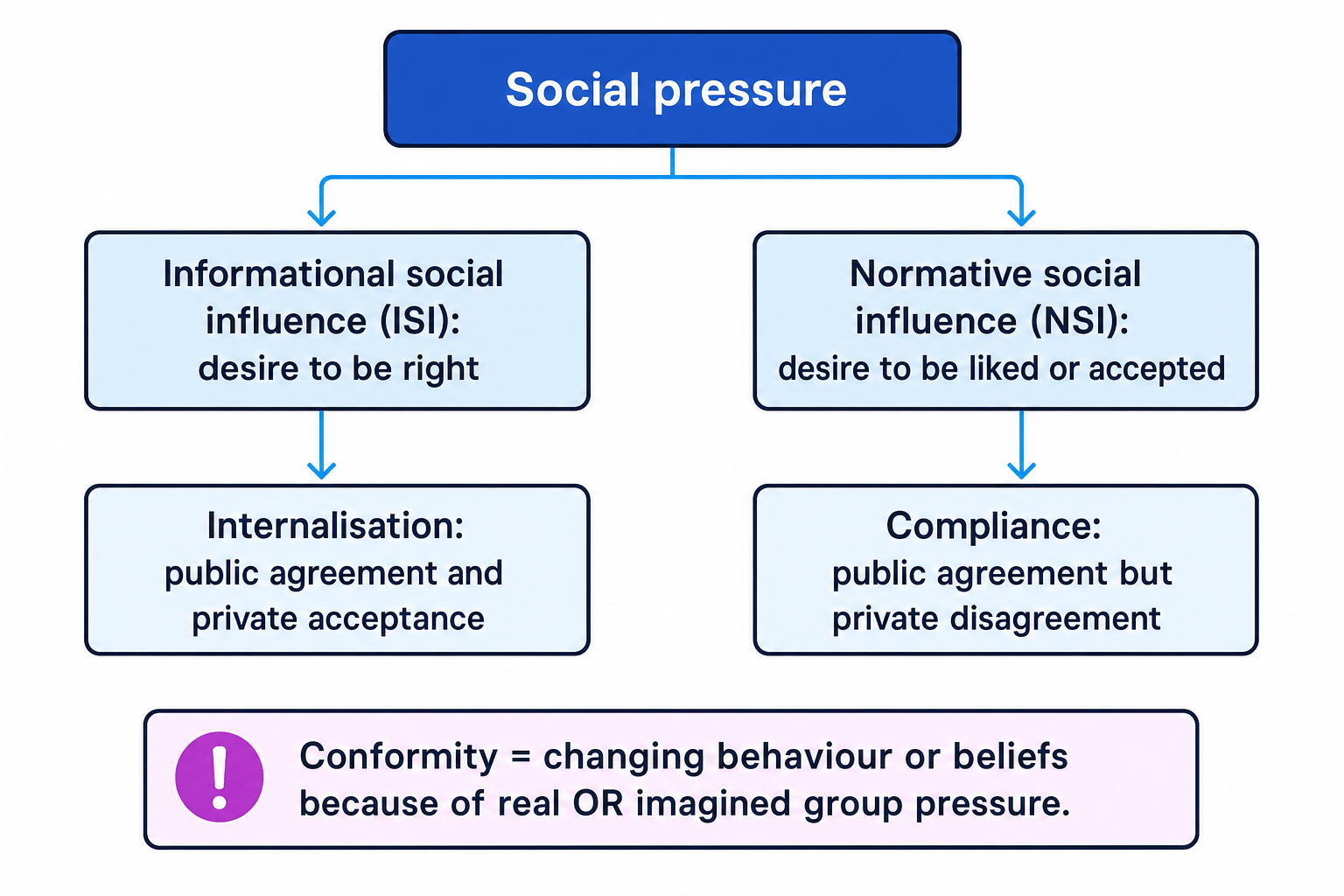
Conformity is a change in a person’s behaviour or beliefs because of real or imagined pressure from a group.
The key idea is that conformity can be public, private, or both. You might say something just to fit in, or you might genuinely come to believe the group is right.
Types of conformity
Compliance
Compliance
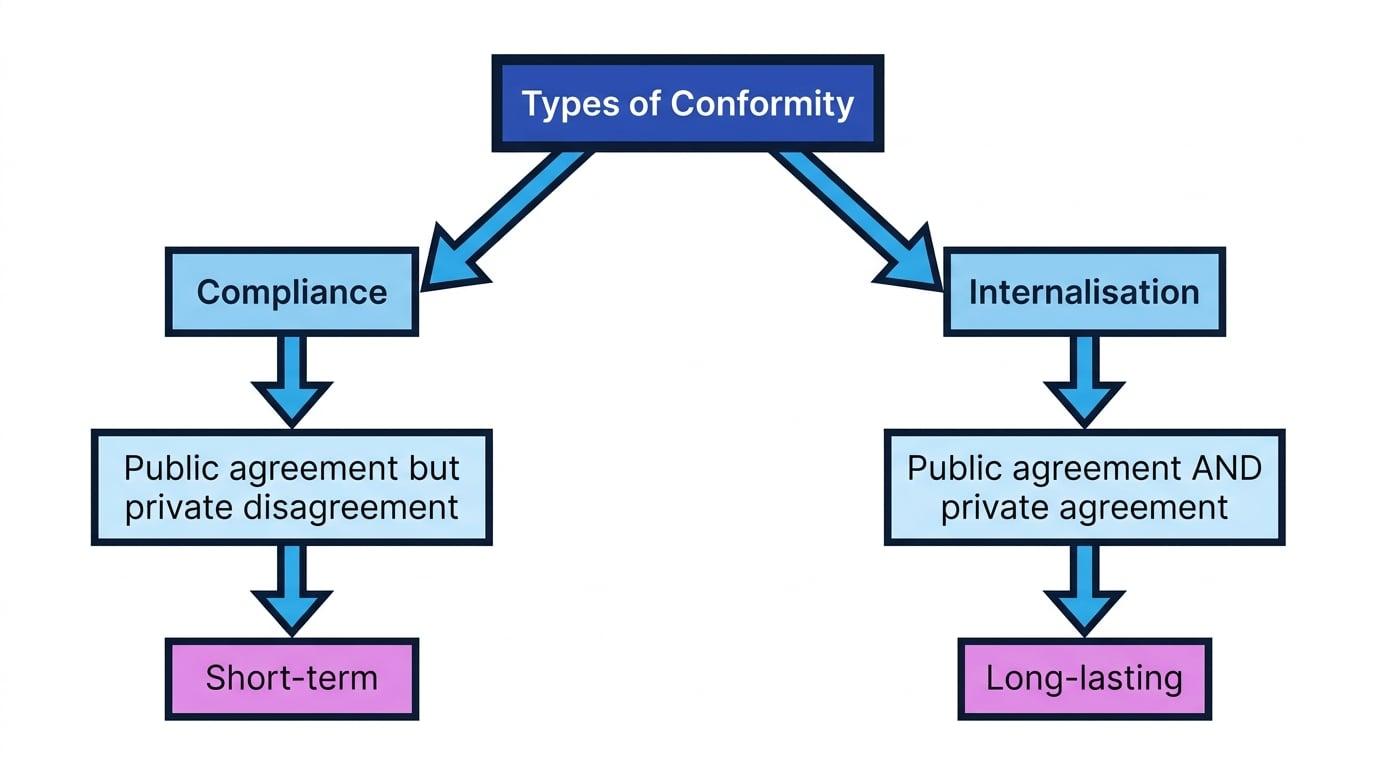
Compliance is a type of conformity where a person publicly agrees with the group but privately disagrees.
Compliance is usually fairly shallow and temporary. You change what you say or do because you want to avoid rejection, embarrassment, or conflict. Once the group pressure disappears, the behaviour may stop.
For example, you might laugh at a joke you do not find funny because everyone else is laughing.
Internalisation
Internalisation
Internalisation is a type of conformity where a person publicly agrees with the group and privately accepts the group’s view as correct.
Internalisation is deeper than compliance. The person has genuinely changed their belief, so the change is more likely to last even when the group is not present.
For example, if your friends explain why recycling matters and you become genuinely convinced, you may continue recycling even when nobody is watching.
| Type of conformity | Public behaviour | Private belief | Likely duration |
|---|---|---|---|
| Compliance | Agrees with group | Disagrees privately | Often temporary |
| Internalisation | Agrees with group | Accepts group view | Often longer-lasting |
Classifying public and private change
A student says she agrees with her friends that a film is “terrible”, but later tells her sibling she actually enjoyed it.
- Compare the student’s public behaviour with her private belief: publicly she agrees with the group, but privately she disagrees.
- Match this pattern to the definitions: public agreement plus private disagreement is compliance.
- Link the motive to the type: if she went along with the group to avoid standing out, this suggests normative social influence.
Mixing up compliance and internalisation
Do not define compliance as “agreeing with the group” on its own. The exam point is that compliance involves public agreement without private acceptance.
Explanations for conformity
An explanation tells us why a person conforms. The two explanations you need are informational social influence and normative social influence.
Informational social influence
Informational social influence
Informational social influence, or ISI, is conformity that happens because a person wants to be right and believes the group may have better information.
ISI is most likely when the situation is ambiguous, difficult, unfamiliar, or when the group seems expert. Because the person thinks the group is correct, ISI often leads to internalisation.
For example, if you are in a new school and everyone queues in a particular place, you may copy them because you assume they know the correct procedure.
Deciding whether ISI is operating
During a fire drill in an unfamiliar building, you follow a group of staff through a particular exit because you assume they know the safest route.
- Judge how clear the situation is: the building is unfamiliar, so the correct route is uncertain.
- Consider what the group seems to provide: the staff appear to have useful information about the building.
- Select the explanation: because you conform to be correct, this is best explained by informational social influence.
Normative social influence
Normative social influence
Normative social influence, or NSI, is conformity that happens because a person wants to be liked, accepted, or approved of by the group.
NSI is most likely when the group is important to you, when you fear rejection, or when your behaviour is visible to others. It usually leads to compliance, because you may not privately agree.
For example, you might wear a certain style of clothing because your friendship group does, even if you would not choose it alone.
Right versus liked
A quick way to separate the explanations: ISI is about wanting to be right, while NSI is about wanting to be liked or accepted.
Assuming only one explanation can apply
ISI and NSI can operate together. In a difficult situation, you may think the group is correct and worry about looking foolish if you disagree.
Research support for the explanations
There is support for ISI from Jenness (1932), who asked participants to estimate the number of beans in a jar. After discussing estimates in a group, participants often changed their private estimates towards the group estimate. This suggests people used the group as a source of information.
There is support for NSI from Asch’s interviews after his conformity study. Some participants said they knew the group was wrong but conformed to avoid standing out. This suggests public agreement can happen without private acceptance.
There are also individual differences. For example, people with a strong need for social approval may be more likely to conform through NSI. This means conformity is not explained only by the situation; personality and culture can matter too.
Asch (1956): investigating conformity
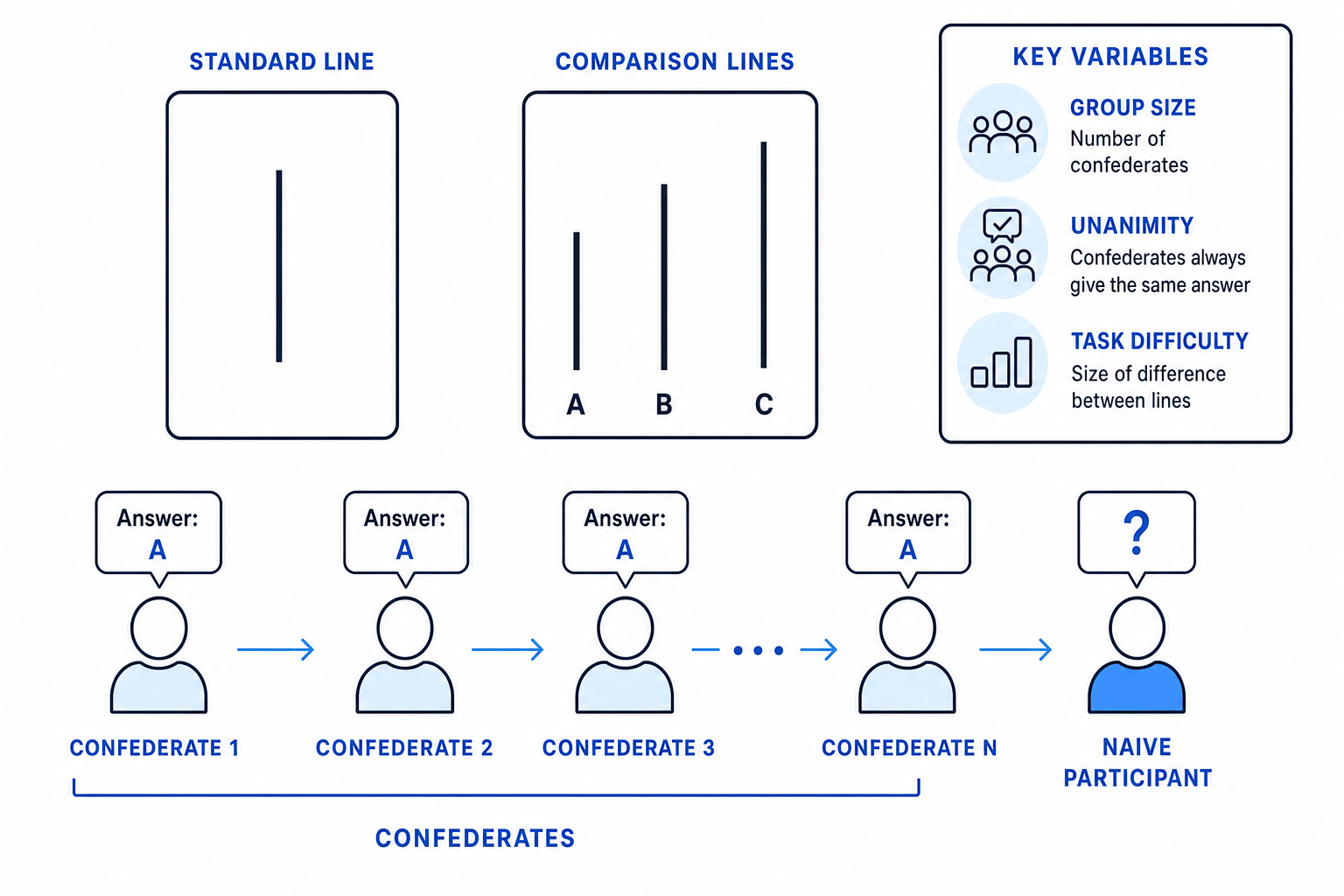
Solomon Asch (1956) studied conformity using a line judgement task. A confederate is a person who appears to be a real participant but is actually working for the researcher. A naive participant is the real participant who does not know the true aim of the study.
Participants were shown a standard line and three comparison lines. They had to say aloud which comparison line matched the standard line. The answer was obvious. On critical trials, the confederates deliberately gave the same wrong answer before the naive participant responded.
Baseline findings
In Asch’s original study, participants conformed on 36.8% of critical trials. About 75% conformed at least once, while 25% never conformed. In a control condition without confederates, mistakes were very rare, around 0.7%.
What Asch showed
Even when the answer was obvious, many participants gave a clearly wrong answer because of majority pressure.
Variables affecting conformity in Asch’s research
Group size
Group size means the number of people in the majority. Asch found that conformity increased as the majority grew, but only up to a point.
With one confederate, conformity was low, around 3%. With two confederates, it rose to about 13%. With three confederates, it rose to about 32%. After that, adding more confederates made little difference.
This suggests that majority pressure grows quickly at first, but there is a diminishing return once the group is already large enough to feel powerful.
Unanimity
Unanimity means complete agreement among the group. Asch found that when the majority was unanimous, conformity was higher.
If one confederate broke the majority by giving the correct answer, conformity dropped sharply, to about 5.5%. Even a dissenter giving a different wrong answer reduced conformity. This shows that having any break in the group’s agreement can reduce pressure.
Task difficulty
Task difficulty means how hard it is to judge the correct answer. Asch made the line judgement harder by making the comparison lines more similar.
When the task became more difficult, conformity increased. This supports informational social influence, because participants were less certain and were more likely to use the group as evidence.
Applying Asch’s variables
A student is in a group where four others give the same wrong answer on a difficult visual task. One person then disagrees with the group.
- Consider group size: four people create stronger majority pressure than one or two people, so this would tend to increase conformity.
- Consider task difficulty: because the visual task is difficult, the student may doubt their own judgement, increasing ISI.
- Consider unanimity: one person disagrees, so the majority is no longer unanimous; this reduces pressure and should lower conformity compared with a fully unanimous group.
Evaluating Asch’s research
A major strength is that Asch used a controlled laboratory procedure. By changing one variable at a time, such as group size or unanimity, he could investigate cause and effect more clearly. The task was also standardised, meaning participants experienced similar procedures.
However, the task has low ecological validity, meaning it may not reflect real-life situations very well. Judging line lengths is artificial and low-stakes. Real conformity often involves more meaningful decisions, such as peer pressure, workplace behaviour, or jury decisions.
There are also problems with the sample. Asch used American male students, so the research may be androcentric, meaning based mainly on male behaviour, and culturally limited. Bond and Smith (1996) found conformity was generally higher in collectivist cultures than individualist cultures, suggesting culture affects conformity.
There are issues with temporal validity, meaning findings may not apply equally across historical periods. Perrin and Spencer (1980) repeated an Asch-style study with British engineering students and found very little conformity. This may be because students were more confident in visual judgements, or because society had become less conformist since the 1950s.
Ethical considerations
Asch’s study involved deception, because participants were misled about the confederates and the true aim. This means fully informed consent was not possible. Participants may also have felt embarrassment or stress when disagreeing with a group, raising issues of protection from harm. However, the task was relatively mild, participants could be debriefed afterwards, and confidentiality could be maintained.
Why conformity matters in real life
Conformity can help groups function smoothly, such as following safety rules or shared classroom routines. But it can also be harmful, such as when people conform to bullying, discrimination, risky driving, or unhealthy peer norms.
Understanding NSI helps explain why people may go along with behaviour they privately dislike. Understanding ISI helps explain why people copy others in uncertain situations, such as emergencies or unfamiliar environments.
Evaluation shortcut
For Asch essays, aim to balance what the study showed with how far it applies to real life. Strong answers do not just list findings; they judge the research.
In the exam
- Define the key term first: for example, state whether you are discussing compliance, internalisation, ISI, or NSI.
- Use Asch’s findings precisely: include figures such as 36.8% baseline conformity, the effect of three confederates, and the drop when unanimity is broken.
- For evaluation, make the impact clear: explain why artificial tasks, cultural bias, temporal validity, or ethical issues affect how confidently we can generalise the findings.
Check yourself
- How can you tell the difference between compliance and internalisation in a scenario?
- Why does task difficulty support informational social influence?
- What happened to conformity when Asch broke unanimity?