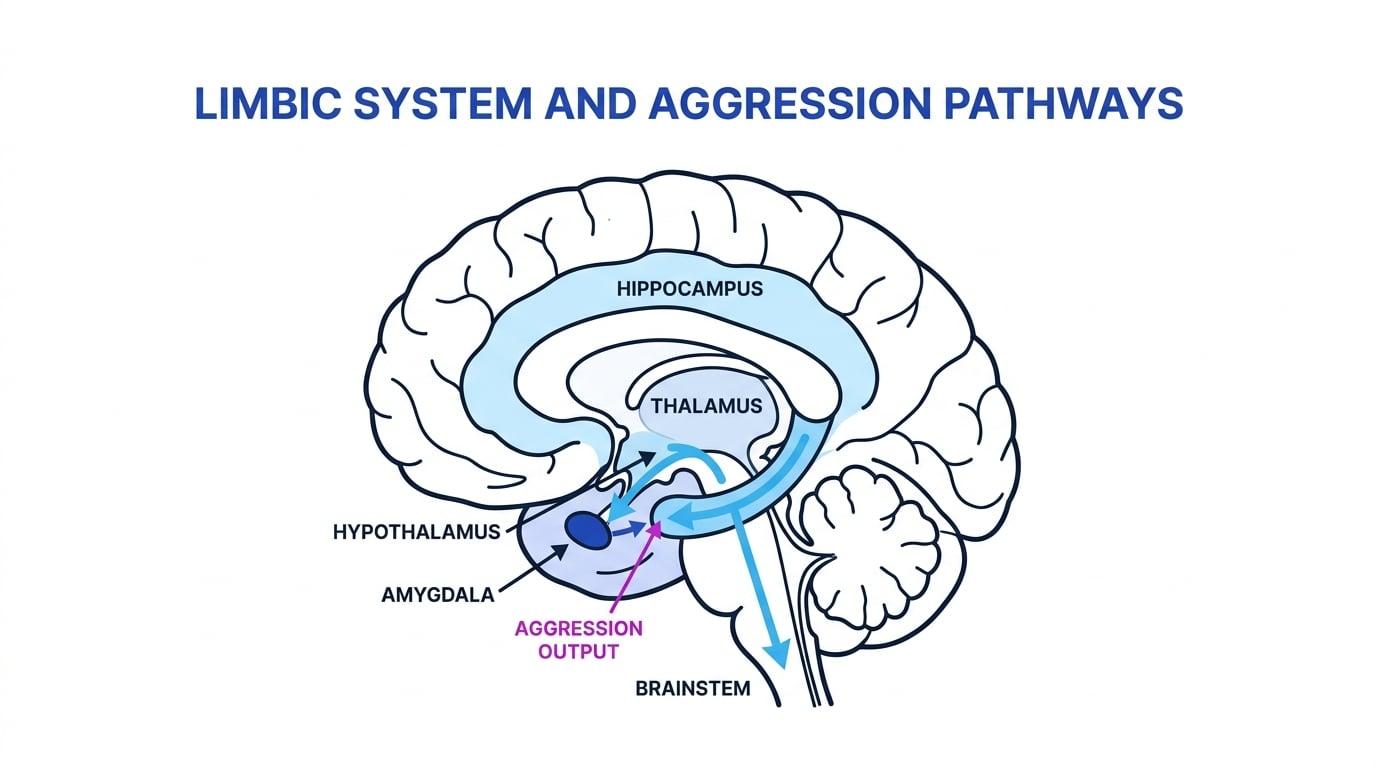
Welcome to the biological approach to aggression. Instead of looking at social learning or environmental triggers in isolation, we are diving deep into the body to see how our brain structure, neurochemistry, and DNA influence violent and aggressive behaviour.
What you'll learn:
- How the limbic system and the neurotransmitter serotonin (neural mechanisms) control our aggressive impulses.
- The role of the hormone testosterone in regulating social and aggressive behaviour.
- How the MAOA gene interacts with the environment to increase the risk of aggression.
1. Neural Mechanisms in Aggression
When we talk about neural mechanisms, we are referring to the physical structures of the brain and the neurotransmitters that send messages between them.
The Limbic System
The limbic system is a network of structures lying deep inside the brain, heavily involved in regulating our emotions and motivations. Two key structures are the hippocampus (involved in memory) and the amygdala.
Amygdala
An almond-shaped structure in the limbic system that acts as the brain's "threat-detection centre". It quickly evaluates sensory information and prompts an appropriate emotional response (like fear or aggression).
If the amygdala is highly stimulated, an organism responds with aggression. If it is damaged or removed, the organism becomes unusually tame.
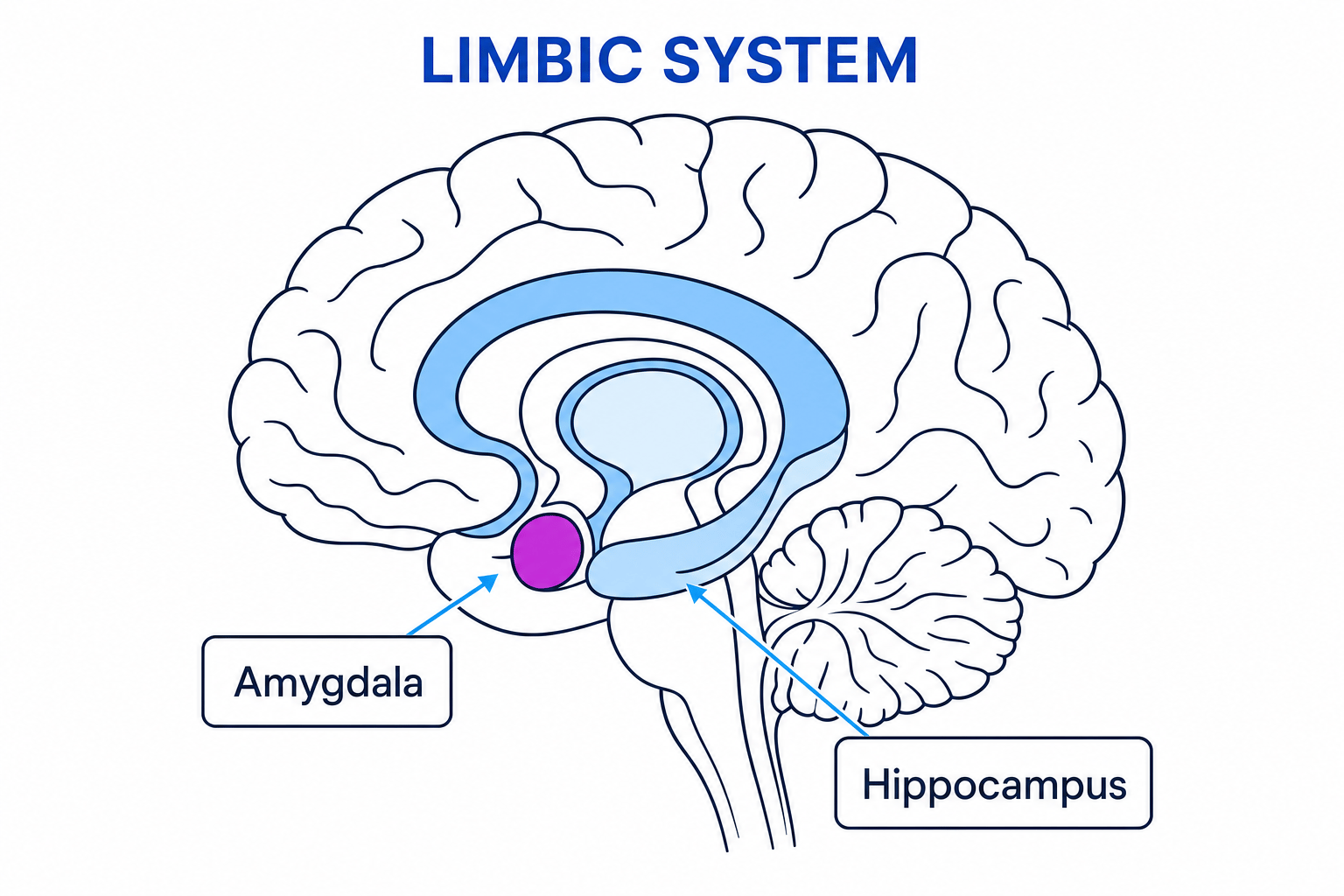
Evaluating the limbic system (AO3): A key strength of this explanation is the strong supporting evidence from human brain-scanning studies. Gospic et al. (2011) used fMRI scans on participants playing a laboratory game called the Ultimatum Game, which is designed to provoke frustration and social aggression. When participants were provoked by an unfair offer, the fMRI showed a fast and heightened response in the amygdala.
Serotonin
Serotonin is a neurotransmitter that has widespread inhibitory effects on the brain. In normal amounts, it slows down and calms neuronal activity.
When a person has normal levels of serotonin in the orbitofrontal cortex (the part of the brain involved in decision-making), they exhibit good self-control and can inhibit their aggressive impulses. However, low levels of serotonin remove this calming, inhibitory effect. The brain becomes less able to control the amygdala's firing, making the individual more impulsive and aggressive.
The Serotonin Deficiency Hypothesis
Decreased levels of the neurotransmitter serotonin disrupt the brain's ability to inhibit aggressive urges, leading to highly impulsive and reactive behaviour.
Evaluating serotonin (AO3):
- Supporting evidence: Raleigh et al. (1991) altered the diets of vervet monkeys to manipulate their serotonin levels. Monkeys fed diets high in tryptophan (which increases serotonin) showed decreased aggression, while those on low-tryptophan diets exhibited increased aggressive behaviour.
- Real-world application: If low serotonin leads to aggression, then drugs that raise serotonin levels (like SSRI antidepressants) should reduce it. Clinical trials have found that giving aggressive patients SSRIs significantly reduces their hostile behaviour, providing strong support for the neural explanation.
2. Hormonal Mechanisms in Aggression
Hormones are chemical messengers carried in the bloodstream. The hormone most reliably linked to aggression is testosterone.
Testosterone
Testosterone is an androgen (a male sex hormone), though it is present in both males and females. It is responsible for the development of masculine features and regulates social behaviour. Because males generally produce significantly more testosterone than females—and are statistically involved in more aggressive crimes—psychologists have long hypothesised a strong link between testosterone and aggression.
Evaluating testosterone (AO3):
- Supporting correlational evidence: Dabbs et al. (1995) measured testosterone in the saliva of adult male prisoners. They found that inmates who had committed violent crimes (like murder and rape) had significantly higher testosterone levels than those who had committed non-violent crimes (like theft).
- The Dual-Hormone Hypothesis: The link between testosterone and aggression is actually more complex than a simple direct cause. Carré and Mehta (2011) argue that high testosterone only leads to aggression when levels of cortisol (a stress hormone) are low. When cortisol is high, it blocks testosterone's influence. This means we cannot look at testosterone in isolation; we must consider how hormones interact.
Correlation vs. Causation
Be very careful when evaluating hormonal and neural mechanisms. Studies like Dabbs et al. are correlational. We cannot say for certain whether high testosterone causes aggressive behaviour, or whether engaging in aggressive, dominant behaviour causes an increase in testosterone.
3. Genetic Factors in Aggression
Is aggression inherited? Twin and adoption studies suggest that genetics play a significant role, but researchers have moved beyond just calculating heritability estimates; they have identified specific candidate genes.
The MAOA Gene
The most famous candidate gene for aggression is the MAOA gene (monoamine oxidase A).
The MAOA gene controls the production of an enzyme called monoamine oxidase A. This enzyme's job is to "mop up" neurotransmitters (including serotonin and dopamine) in the synapse after a nerve impulse has been transmitted, breaking them down so they can be recycled.
A specific variant of this gene, known as the MAOA-L (low-activity) variant, produces less of the enzyme. This leads to a build-up of neurotransmitters and abnormal serotonin metabolism, which in turn causes impulsive and aggressive behaviour. The media often calls MAOA-L the "warrior gene".
Supporting evidence for MAOA: Brunner et al. (1993) studied a large Dutch family where many of the male members had a history of extreme, unprovoked violence (including rape and attempted murder). Genetic analysis revealed that these exceptionally aggressive men all possessed the low-activity MAOA-L gene variant.
Gene-Environment Interaction (Diathesis-Stress)
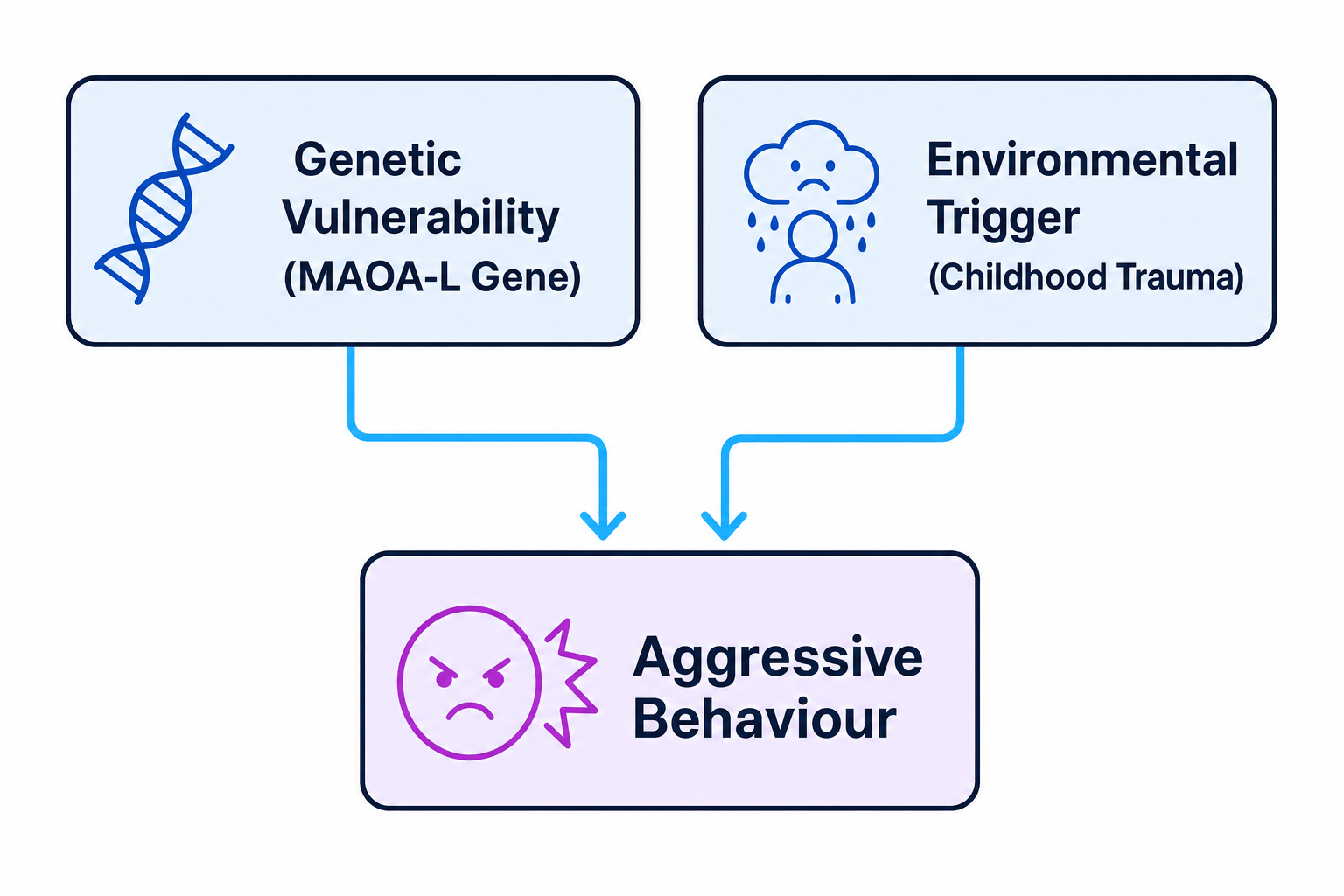
Crucially, possessing the MAOA-L gene does not automatically make someone aggressive. It requires an environmental trigger to be expressed. This is known as a gene-environment interaction, or the diathesis-stress model.
Caspi et al. (2002) conducted a landmark longitudinal study. They followed children from birth to adulthood, assessing both their MAOA gene variant and their childhood experiences.
- Children with the MAOA-L gene who had a normal, non-abusive childhood did not grow up to be unusually aggressive.
- However, children with the MAOA-L gene who also experienced severe childhood maltreatment were significantly more likely to engage in anti-social and violent behaviour as adults.
Biological Determinism
A common pitfall is writing that genes or hormones dictate our behaviour entirely (biological determinism). Remember to use Caspi's study to argue that biology only offers a vulnerability; the environment dictates whether that vulnerability becomes reality.
4. Applying Your Knowledge
In the exam, you may be given a short scenario (AO2) and asked to apply biological explanations to the behaviour described.
Applying biological mechanisms to a scenario
Scenario: Marcus is 191919 years old and has recently been arrested for fighting outside a pub. His lawyer argues that Marcus's behaviour is not entirely his fault. Medical records show Marcus has a highly reactive amygdala, and genetic tests confirm he carries the MAOA-L gene variant. Furthermore, Marcus's social worker notes he was neglected and physically abused as a young child.
Question: Use your knowledge of neural and genetic factors to explain Marcus's aggressive behaviour. (4 marks)
- Identify the neural factor and link to the scenario: Marcus's highly reactive amygdala acts as an oversensitive threat-detection system. When confronted outside the pub, his amygdala likely processed the situation as highly threatening, triggering an immediate aggressive response rather than a rational one.
- Identify the genetic vulnerability: Marcus possesses the MAOA-L gene variant, which results in lower levels of the MAOA enzyme. This disrupts normal serotonin processing in his brain, reducing his self-control and making him more prone to impulsivity.
- Apply the gene-environment interaction: The diathesis-stress model explains that the MAOA-L gene alone does not guarantee aggression. However, Marcus experienced childhood abuse (the environmental stressor).
- Synthesise the conclusion: The combination of his genetic vulnerability (MAOA-L) and early environmental trauma has interacted, causing his aggressive phenotype to be expressed in adulthood, leading to the pub fight.
In the exam
- Differentiate your terms: Never confuse "MAOA" (the gene/enzyme) with "amygdala" (the brain structure) or "serotonin" (the neurotransmitter). Be precise.
- Layer your AO3: When evaluating, do not just list studies. Use them to make a point. For example, "The role of serotonin is supported by Raleigh et al.'s monkey study... However, this relies on animal research, meaning we must be cautious when extrapolating these findings to complex human social aggression."
- Use the diathesis-stress model as your ultimate evaluation: It acts as an excellent concluding paragraph for any biological aggression essay. It elegantly resolves the Nature vs. Nurture debate by showing that both work together.
Check yourself
- Can you outline the role of the amygdala in processing threats?
- What happens to impulsive behaviour when serotonin levels drop in the orbitofrontal cortex?
- Why is it difficult to establish a direct cause-and-effect relationship between testosterone and aggression?
- According to Caspi et al. (2002), what environmental factor must be present for the MAOA-L gene to result in aggressive behaviour?