What you'll learn
- How drug therapy, stress inoculation therapy and biofeedback help people manage stress.
- How to apply each technique to realistic stress scenarios.
- How gender differences may affect coping, without overgeneralising.
- How social support buffers stress through instrumental, emotional and esteem support.
First: what does “coping” mean?
A stressor is anything that creates a demand on a person, such as exams, illness, workload or relationship conflict. The stress response is the body and mind’s reaction to that demand.
Coping
Coping means the thoughts and behaviours a person uses to manage the demands of a stressful situation and the emotions it creates.
Psychologists often distinguish between:
- Problem-focused coping: trying to change the stressor itself, such as making a revision timetable.
- Emotion-focused coping: trying to manage feelings caused by the stressor, such as relaxation, distraction or seeking reassurance.
Big picture
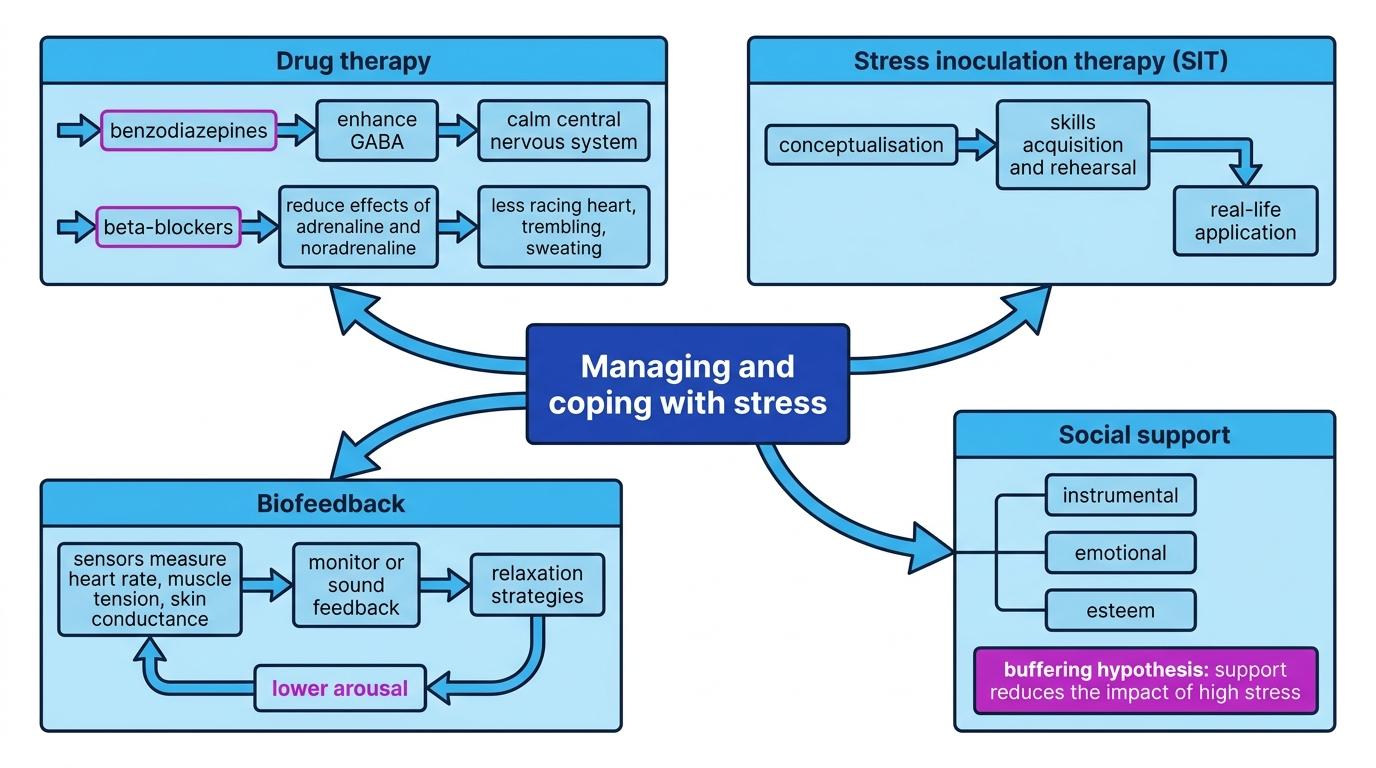
Stress management can target the body through drugs or biofeedback, the mind through cognitive therapy, or the social environment through support from others.
Here is the overall map of the main stress-management approaches in this topic.
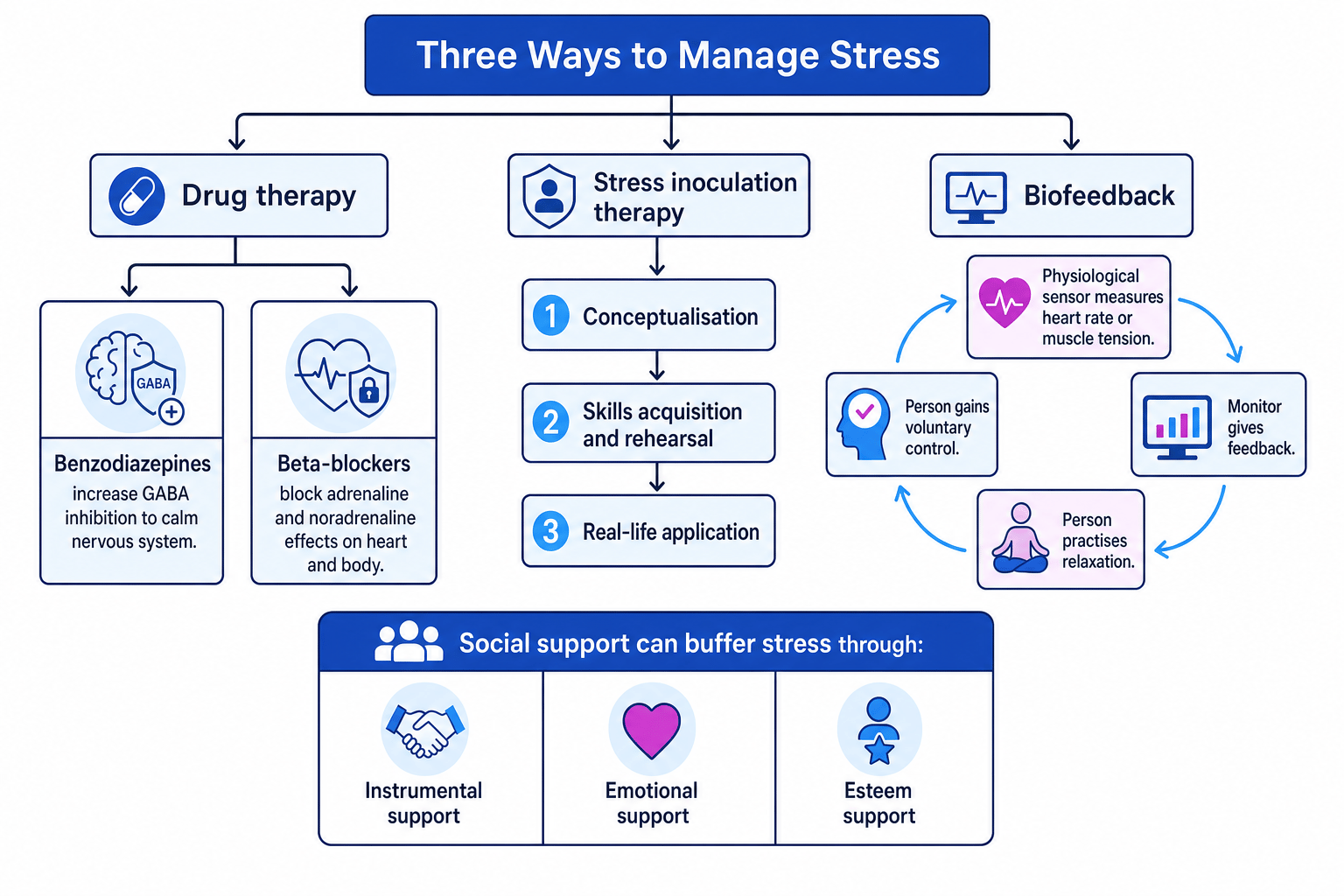
Drug therapy
Drug therapy
Drug therapy means using medication to reduce the physiological or psychological symptoms of stress, usually by changing neurotransmitter or hormone activity.
A neurotransmitter is a chemical messenger that carries signals between neurons. Two common drug approaches are benzodiazepines and beta-blockers.
Benzodiazepines
Benzodiazepines such as diazepam work by enhancing the effect of GABA, an inhibitory neurotransmitter. “Inhibitory” means it reduces neural activity. This calms the central nervous system, so the person may feel less anxious and physically tense.
Beta-blockers
Beta-blockers reduce the effects of adrenaline and noradrenaline on the body. They are especially useful for physical symptoms such as a racing heart, trembling hands and sweating, so they may be used for short-term performance stress.
Choosing a drug approach for a scenario
A student feels calm when revising but experiences shaking hands and a racing heart just before a piano performance.
- Identify the main symptoms: the stress is mainly physiological arousal, not constant anxious thinking.
- Match the drug to the symptom pattern: a beta-blocker would be more relevant because it reduces adrenaline-related bodily symptoms.
- Add evaluation: this may help performance in the short term, but it does not teach the student long-term coping skills.
AO3: evaluating drug therapy
Drug therapy is often fast-acting, which is useful when stress symptoms are severe. Placebo-controlled drug trials, such as research discussed by Kahn et al. (1986), suggest benzodiazepines can reduce anxiety symptoms more than placebo.
However, drugs mainly treat symptoms, not the source of stress. Benzodiazepines can also lead to tolerance, where larger doses are needed for the same effect, and dependence, where the person struggles to stop using them. Side effects may include drowsiness and reduced concentration.
Ethically, prescribing requires informed consent: the person should understand side effects, alternatives and withdrawal issues. In drug trials, researchers must protect participants from harm, monitor side effects, preserve confidentiality and allow withdrawal.
Drugs are not a full coping strategy
Do not write as if drug therapy “removes stress”. It usually reduces arousal or anxiety, but the original stressor may still remain.
Stress inoculation therapy
Stress inoculation therapy, often shortened to SIT, was developed by Meichenbaum (1977). It is a form of cognitive-behavioural therapy designed to prepare people for future stress.
Stress inoculation therapy
SIT is a psychological therapy that teaches people to understand their stress response, learn coping skills, and practise using those skills in increasingly stressful situations.
The word “inoculation” is like a vaccine: a person is exposed to manageable amounts of stress in therapy so they build resistance for real-life stressors.
The three stages of SIT
- Conceptualisation: the therapist helps the person identify their stressors, thoughts and coping patterns.
- Skills acquisition and rehearsal: the person learns coping skills such as relaxation, positive self-talk, cognitive restructuring and problem-solving.
- Real-life application: the person practises the skills in role plays, imagined stressors and then real situations.
Applying the three stages of SIT
A student panics before oral presentations and thinks, “Everyone will laugh at me.”
- In conceptualisation, the therapist links the student’s thought to the stress response: the belief “I will be humiliated” increases anxiety.
- In skills acquisition, the student practises breathing control and replaces the thought with a coping statement such as “I can focus on one point at a time.”
- In application, the student first rehearses with the therapist, then presents to a small group, and finally uses the skills in class.
AO3: evaluating SIT
SIT is a strength because it deals with the person’s appraisal of stress, not just physical symptoms. It can create long-term coping skills that transfer to new situations. Meichenbaum (1977) reported that SIT reduced anxiety in stressful performance situations, and Jay and Elliott (1990) found benefits for parents dealing with the stress of children’s medical treatment.
A limitation is that SIT takes time, effort and motivation. It may be less suitable when someone needs immediate symptom relief. It also depends on therapist skill, and it can be difficult to know which part of the therapy caused improvement.
Ethically, therapy research must be careful with vulnerable participants. Researchers need consent, confidentiality, the right to withdraw, and protection from harm if discussing distressing stressors.
Biofeedback
Biofeedback
Biofeedback is a technique where a person receives information about physiological activity, such as muscle tension or heart rate, and learns to control it.
A person may be connected to sensors measuring muscle tension, skin conductance, heart rate or brain activity. The information is shown as a sound, light or graph. The person then practises relaxation and learns which mental strategies reduce the stress response.
Biofeedback uses operant conditioning, which is learning through consequences. When the person sees the feedback improve, that improvement reinforces the relaxation strategy.
Explaining the biofeedback loop
A person with tension headaches watches a monitor showing high forehead muscle tension.
- The monitor identifies the target response: high muscle tension is linked to the headaches.
- The person tries relaxation strategies and compares the feedback after each attempt.
- When one strategy lowers muscle tension, the feedback reinforces it, so the person practises until control improves.
AO3: evaluating biofeedback
Biofeedback is non-drug-based and can increase a person’s sense of control. Budzynski et al. (1973) found biofeedback could help reduce tension headaches, and reviews such as Yucha and Montgomery (2008) support its usefulness for some stress-related conditions.
However, it may be hard to separate the effect of biofeedback from ordinary relaxation, therapist attention or placebo effects. It can also require specialist equipment and repeated practice, so it may not be accessible for everyone.
Biofeedback is not just measuring stress
The key point is not simply that the machine records heart rate or tension. The person must use the feedback to learn voluntary control.
Gender differences in coping with stress
Gender differences
Gender differences are average differences between men and women in behaviour, thoughts or emotions. They do not mean every man or every woman copes in the same way.
Research often suggests women are more likely to use social support and emotion-focused coping, while men are more likely to use problem-focused coping, direct action or avoidance. Tamres et al. (2002), in a meta-analysis, found women reported using many coping strategies more often, especially seeking social support.
Taylor et al. (2000) proposed the tend-and-befriend response. This suggests women may respond to stress by protecting others and forming social alliances, possibly linked to oxytocin. This contrasts with the classic fight-or-flight model, which focuses on aggression or escape.
Avoiding overgeneralisation about gender
A study finds women scored higher than men on support-seeking during exam stress.
- Treat the finding as a group average, not a rule about all individuals.
- Consider context: exam stress, age, culture and social expectations may influence the result.
- Evaluate the method: if coping was measured by self-report, social desirability may affect what people admit.
AO3: evaluating gender differences
A strength is that gender research has real-world applications. For example, if men are less likely to seek help, schools and workplaces can design support that feels more accessible.
However, gender differences can be exaggerated. Many studies rely on self-report questionnaires, which may reflect gender norms rather than actual coping. For instance, men may under-report emotional coping because it conflicts with masculine stereotypes. There are also cultural differences, and the type of stressor matters.
Avoid biological determinism
Do not explain gender differences only through hormones or evolution. Socialisation, culture, power, resources and the specific stressor all affect coping.
Social support
Social support
Social support is the help, comfort and reassurance people receive from others, which can reduce the impact of stress.
The AQA specification names three types:
- Instrumental support: practical help, such as money, childcare, transport or help with tasks.
- Emotional support: empathy, listening, warmth and reassurance.
- Esteem support: encouragement that boosts confidence and self-worth.
Remember the three support types
Instrumental = practical tools. Emotional = feelings. Esteem = confidence and self-worth.
How social support reduces stress
Cohen and Wills (1985) proposed the buffering hypothesis: social support protects people from the harmful effects of stress, especially when stress levels are high. Support can change how threatening a situation feels and increase available coping resources.
Kamarck et al. (1990) found that people showed lower physiological stress responses during a stressful task when they had a supportive friend present. Uchino et al. (1996) also reviewed evidence linking social support to better cardiovascular, endocrine and immune functioning.
Matching support to a stressor
A student is caring for a sick relative, falling behind on homework, and feeling like they are failing.
- The practical workload suggests instrumental support, such as help with transport or shared caregiving.
- The distress and pressure suggest emotional support, such as someone listening without judging.
- The belief “I am failing” suggests esteem support, such as reminding the student they are coping with a difficult situation.
AO3: evaluating social support
Social support has strong real-world value: support groups, mentoring and workplace peer schemes can reduce stress. It is also flexible because different types of support can be matched to different needs.
A limitation is that much research is correlational. People with good support may be healthier because support reduces stress, but healthier people may also find it easier to maintain relationships. Quality matters more than quantity: unwanted advice or criticism can increase stress.
Ethically, research on social support must protect confidentiality, especially when people discuss personal relationships, illness or mental health.
In the exam
- For AO1, describe the mechanism clearly: drugs affect physiology, SIT changes thinking and coping skills, biofeedback teaches control, and social support buffers stress.
- For AO2, apply the method to the exact symptoms or situation in the scenario rather than giving a generic description.
- For AO3, include evidence, limitations and ethics; avoid claiming one method is always best.
Check yourself
- How do benzodiazepines and beta-blockers reduce different aspects of the stress response?
- What happens in each of the three stages of stress inoculation therapy?
- How are instrumental, emotional and esteem support different?