What you'll learn
- How the hypothalamus helps regulate hunger and satiety.
- The roles of the hormones ghrelin and leptin in eating behaviour.
- Key research evidence, including animal lesion studies and hormone studies.
- How to evaluate neural and hormonal explanations for AQA essay answers.
The big picture: eating is regulated, not random
Eating behaviour is influenced by many factors: biology, learning, culture, mood, stress, social context and food availability. In this sub-topic, we focus on neural and hormonal mechanisms — the brain and chemical messengers that help control hunger and fullness.
A useful starting idea is homeostasis. This means the body tries to keep internal conditions within a healthy range. For eating, the body needs enough energy to function, but not so much that energy storage becomes excessive.
Homeostasis
Homeostasis is the body’s tendency to maintain a stable internal state, such as blood glucose level, body temperature or energy balance.
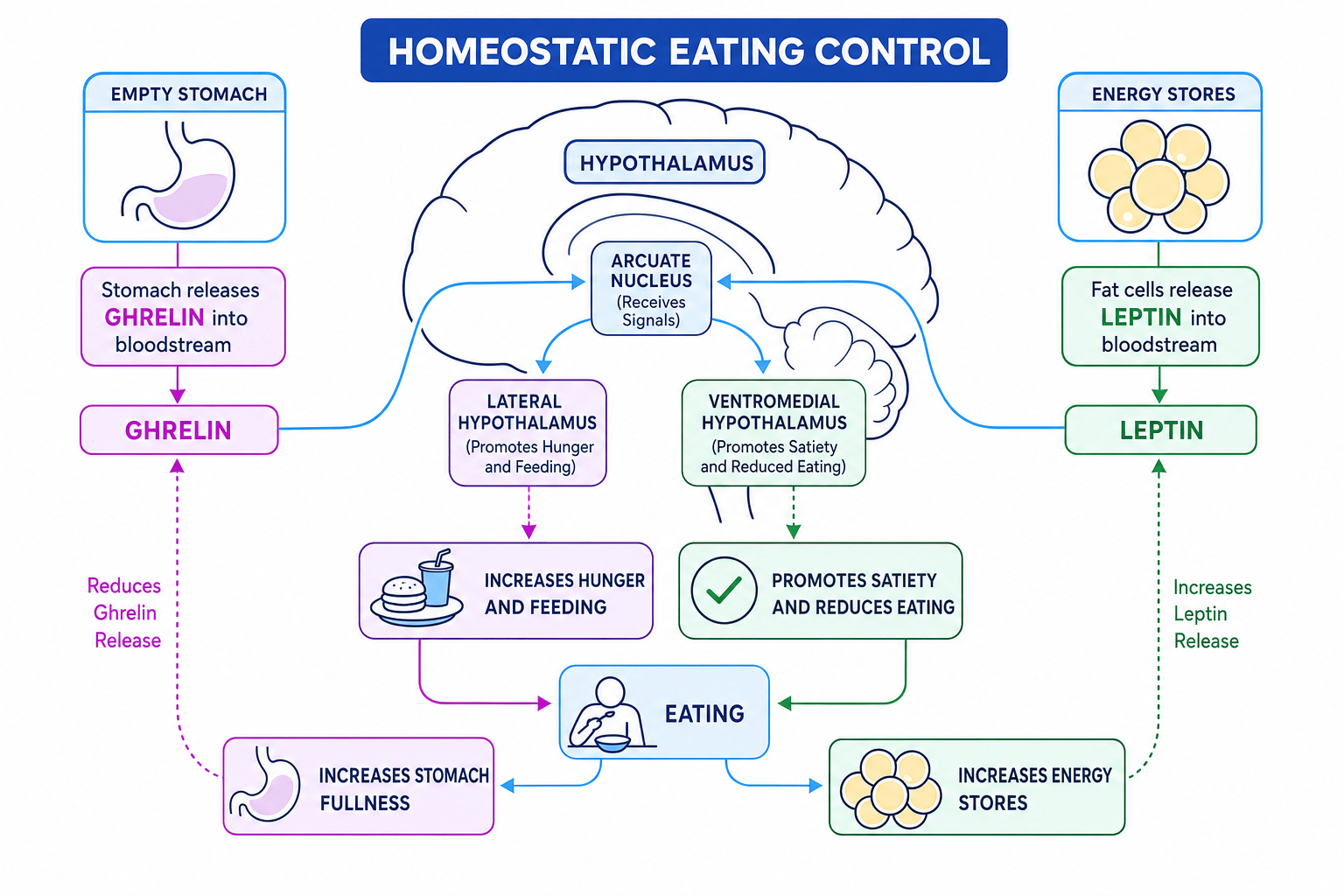
Eating is partly controlled by a feedback system. When energy is low, hunger signals increase. When enough food has been consumed and energy stores are sufficient, satiety signals increase.
Satiety
Satiety means the feeling of fullness or satisfaction after eating, which reduces the motivation to continue eating.
The key biological players you need for this specification are:
- the hypothalamus, a brain region involved in basic survival behaviours
- ghrelin, a hormone linked to hunger
- leptin, a hormone linked to satiety and long-term energy stores
The hypothalamus: the brain’s eating-control hub
Hypothalamus
The hypothalamus is a small structure at the base of the brain that helps regulate survival functions such as hunger, thirst, temperature, sleep and hormone release.
The hypothalamus receives signals from the body about energy levels and digestive state. It then helps influence whether eating is started, continued or stopped.
Older explanations often described two important hypothalamic areas:
Lateral hypothalamus: hunger and feeding
The lateral hypothalamus, often shortened to LH, has been linked with hunger and the initiation of feeding.
Early animal research found that damage to the LH could lead to aphagia, meaning a failure or refusal to eat. Anand and Brobeck (1951) found that lesions in the lateral hypothalamus of rats led to reduced eating.
Lesion
A lesion is an area of damage to tissue, often deliberately produced in animal research to investigate the function of a brain region.
Ventromedial hypothalamus: satiety and stopping eating
The ventromedial hypothalamus, often shortened to VMH, has been linked with satiety. Early research suggested it helps stop eating when enough food has been consumed.
Hetherington and Ranson (1942) found that rats with lesions in the VMH overate and became obese. This suggested the VMH may act as a “satiety centre”.
The classic dual-centre model
The classic model says the lateral hypothalamus starts eating, while the ventromedial hypothalamus helps stop eating. This is useful for AO1, but it is too simple as a full explanation.
The arcuate nucleus: a more modern view
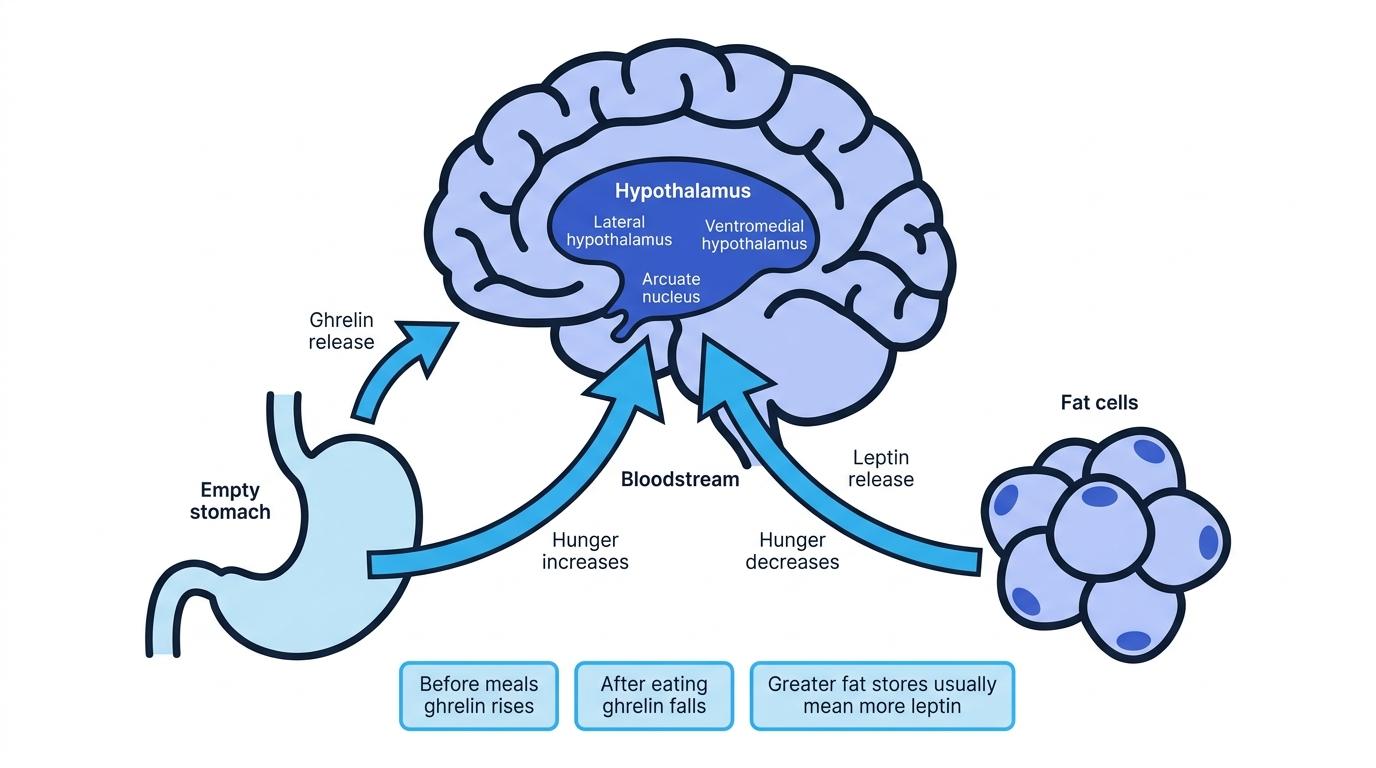
The hypothalamus is not just two simple “on/off” switches. A more detailed account focuses on the arcuate nucleus, an area of the hypothalamus that receives hormonal signals about hunger and energy stores.
Arcuate nucleus
The arcuate nucleus is a part of the hypothalamus that detects appetite-related hormones, including ghrelin and leptin, and helps coordinate hunger and satiety responses.
The arcuate nucleus contains different types of neurons, which are nerve cells. Some increase appetite, while others reduce it. This makes eating control more like a network than a single button.
Do not describe the hypothalamus as a simple hunger button
AQA students often write as if the LH “causes hunger” and the VMH “causes fullness” in a direct one-step way. Better answers explain that these areas are part of a wider regulatory system involving hormones, neural pathways and feedback from the body.
Ghrelin: the hunger hormone
Ghrelin
Ghrelin is a hormone mainly released by the stomach. It increases hunger and encourages eating, especially before meals.
When the stomach is empty, ghrelin levels tend to rise. Ghrelin travels through the bloodstream to the brain, where it can act on the hypothalamus, especially the arcuate nucleus. This increases activity in appetite-stimulating pathways.
Cummings et al. (2001) found that ghrelin levels rose before meals and fell after eating. This supports the idea that ghrelin is involved in meal initiation.
Wren et al. (2001) gave human participants ghrelin and found increased food intake at a buffet meal. This provides stronger evidence that ghrelin can have a causal effect on eating, not just a correlation with hunger.
AO2: applying ghrelin
If someone says, “I feel really hungry just before lunch, but the feeling fades after I eat,” ghrelin helps explain this. Before lunch, the empty stomach releases more ghrelin, which signals hunger to the hypothalamus. After eating, ghrelin levels fall, so hunger reduces.
Explaining a pre-meal hunger pattern
A student says: “I am always hungriest just before dinner, even if I was busy and not thinking about food. After dinner the hunger disappears quickly.” Use ghrelin and the hypothalamus to explain this.
- Identify the body state: before dinner, the stomach is relatively empty, so ghrelin release is likely to be higher.
- Link the hormone to the brain: ghrelin travels in the bloodstream and acts on the hypothalamus, particularly appetite-related pathways in the arcuate nucleus.
- Connect this to behaviour: increased hypothalamic hunger signalling makes eating more likely, so the student feels motivated to eat.
- Explain the change after eating: food in the stomach reduces ghrelin release, so the hunger signal weakens and the student feels less hungry.
Leptin: the satiety and energy-store hormone
Leptin
Leptin is a hormone released mainly by fat cells. It signals the level of stored energy to the brain and usually reduces hunger.
Leptin is linked more to long-term energy balance than to the start of a single meal. If fat stores increase, leptin levels generally rise. Leptin acts on the hypothalamus to reduce appetite and increase energy expenditure.
Research on mice has been important here. Zhang et al. (1994) identified the gene involved in producing leptin. Mice with a mutation affecting leptin production became severely obese, but leptin treatment reduced their eating and body weight.
Human evidence also supports leptin’s role, though in a more complicated way. Farooqi et al. (1999) studied children with congenital leptin deficiency, meaning they were born unable to produce normal leptin. Leptin treatment reduced excessive hunger and led to weight loss.
Ghrelin versus leptin
Ghrelin is mainly a short-term hunger signal from the stomach. Leptin is mainly a longer-term energy-store signal from fat cells.
Leptin resistance: why the explanation is not simple
If leptin reduces hunger, you might expect people with more body fat to eat less because they produce more leptin. However, many people with obesity have high leptin levels but continue to feel hunger and eat.
This is explained using leptin resistance.
Leptin resistance
Leptin resistance occurs when the brain becomes less responsive to leptin, so high leptin levels do not produce the expected reduction in hunger.
This matters for evaluation. It shows that leptin is not a simple “fullness chemical”. The effect depends on whether the brain responds normally to the hormone.
A simple way to remember the hormones
Ghrelin grows hunger. Leptin lowers hunger. Then add the detail: ghrelin comes mainly from the stomach, while leptin comes mainly from fat cells.
AO3: strengths of neural and hormonal explanations
Strong biological evidence
There is good evidence that the hypothalamus is involved in eating control. Lesion studies, such as Hetherington and Ranson (1942) and Anand and Brobeck (1951), show that damage to specific hypothalamic areas can produce major changes in feeding behaviour.
Hormone research also supports the explanation. Cummings et al. (2001) showed ghrelin changes around meals, while Wren et al. (2001) showed that giving ghrelin can increase food intake. This supports a causal role for ghrelin.
Real-world applications
Understanding hormones such as leptin and ghrelin has helped researchers develop treatments for eating and weight-related disorders. For example, leptin therapy can be highly effective for people with rare congenital leptin deficiency.
This gives the explanation practical value. It does not just describe eating behaviour; it can help guide medical intervention.
AO3: limitations and issues
Animal studies may not generalise fully to humans
Many early hypothalamus studies used rats. This allowed researchers to create lesions and observe changes in eating, but humans have more complex eating behaviour. Human eating is affected by social norms, emotions, dieting, culture, advertising and conscious decision-making.
So, animal studies are useful for identifying biological mechanisms, but they cannot fully explain human eating behaviour.
Lesion studies may lack precision
Gold (1973) argued that lesions to the VMH may also damage nearby neural pathways. This means overeating after VMH damage may not prove that the VMH alone is the satiety centre.
This weakens the classic dual-centre model because the observed behaviour may be due to wider damage rather than one exact structure.
Hormones interact with psychological and environmental factors
Ghrelin and leptin do not work in isolation. For example, someone may eat despite low hunger because food smells appealing, because they are stressed, or because others are eating. Equally, someone may restrict food intake despite hunger due to dieting or body-image concerns.
This means neural and hormonal explanations are biologically powerful but incomplete.
Forgetting non-biological influences
In essays, do not imply that eating is controlled only by the hypothalamus, ghrelin and leptin. A stronger answer says these mechanisms are important but interact with learning, cognition, mood and social context.
Ethical considerations in the research
Animal lesion studies raise ethical issues because they involve deliberate brain damage and possible suffering. Researchers must justify this through scientific value and follow strict animal welfare guidelines, including minimising harm and using the smallest appropriate number of animals.
Human hormone studies, such as ghrelin infusion research, require informed consent, protection from harm, confidentiality, right to withdraw and debriefing. Giving participants hormones could affect appetite and wellbeing, so screening and medical supervision are important.
Ethics strengthens AO3, but keep it relevant
Do not write a generic ethics paragraph that could apply to any study. Link the issue directly to the method used, such as brain lesions in animals or hormone administration in humans.
Putting it together for essays
For AO1, describe the system clearly:
- The hypothalamus regulates eating behaviour.
- The LH has been linked with hunger and feeding.
- The VMH has been linked with satiety.
- The arcuate nucleus receives hormone signals.
- Ghrelin is released by the stomach and increases hunger.
- Leptin is released by fat cells and usually reduces hunger.
For AO3, avoid simply listing studies. Use them to make arguments:
- Lesion studies support hypothalamic involvement.
- But lesion studies may damage nearby areas and are often animal studies.
- Ghrelin evidence is strong because infusion studies suggest causality.
- Leptin evidence is strong in rare deficiency cases, but leptin resistance complicates the explanation.
- Biological mechanisms cannot fully explain emotional, cultural or social eating.
In the exam
- Start with a clear AO1 chain: hormone or brain area → signal to hypothalamus → hunger or satiety → eating behaviour.
- Use named evidence accurately, such as Hetherington and Ranson (1942), Anand and Brobeck (1951), Cummings et al. (2001), Wren et al. (2001), Zhang et al. (1994) or Farooqi et al. (1999).
- For AO3, make each evaluation point do a job: say whether the evidence supports, weakens, complicates or limits the explanation.
Check yourself
- How do the roles of ghrelin and leptin differ?
- Why is the classic LH/VMH model considered too simple?
- What is one strength and one limitation of using animal lesion studies to explain human eating behaviour?