Cultural Influences
Culture is a macro-level social influence. Rozin argues that culture is the single most reliable predictor of food preference.
- Availability: We learn to prefer the foods that are readily available in our environment (e.g., seafood in coastal cultures, root vegetables in colder climates).
- Cultural rules: Cultures dictate what is acceptable to eat. For instance, eating offal (organs) is a delicacy in some cultures but considered disgusting in others. Spices are another great example; children in cultures that eat heavily spiced foods (e.g., traditional Indian or Mexican cuisine) learn to enjoy the "burn" of chilli, which is naturally aversive, because it is culturally normalised and celebrated.
Key Idea
Cultural vs Evolutionary
If the evolutionary approach were the only explanation, humans across the globe would eat the exact same things. Cultural influences explain the massive variation in global diets!
Evaluating the Learning Explanation (AO3)
Strengths:
- Real-world applications: Understanding social learning has led to practical interventions. For example, using "peer modelling" videos in schools (showing children enthusiastically eating vegetables) has successfully increased vegetable consumption among young children.
- Explains individual variation: Unlike the evolutionary approach, learning theories can explain why siblings raised in the same house might have different food preferences (due to different peer groups or unique classical conditioning experiences).
Weaknesses:
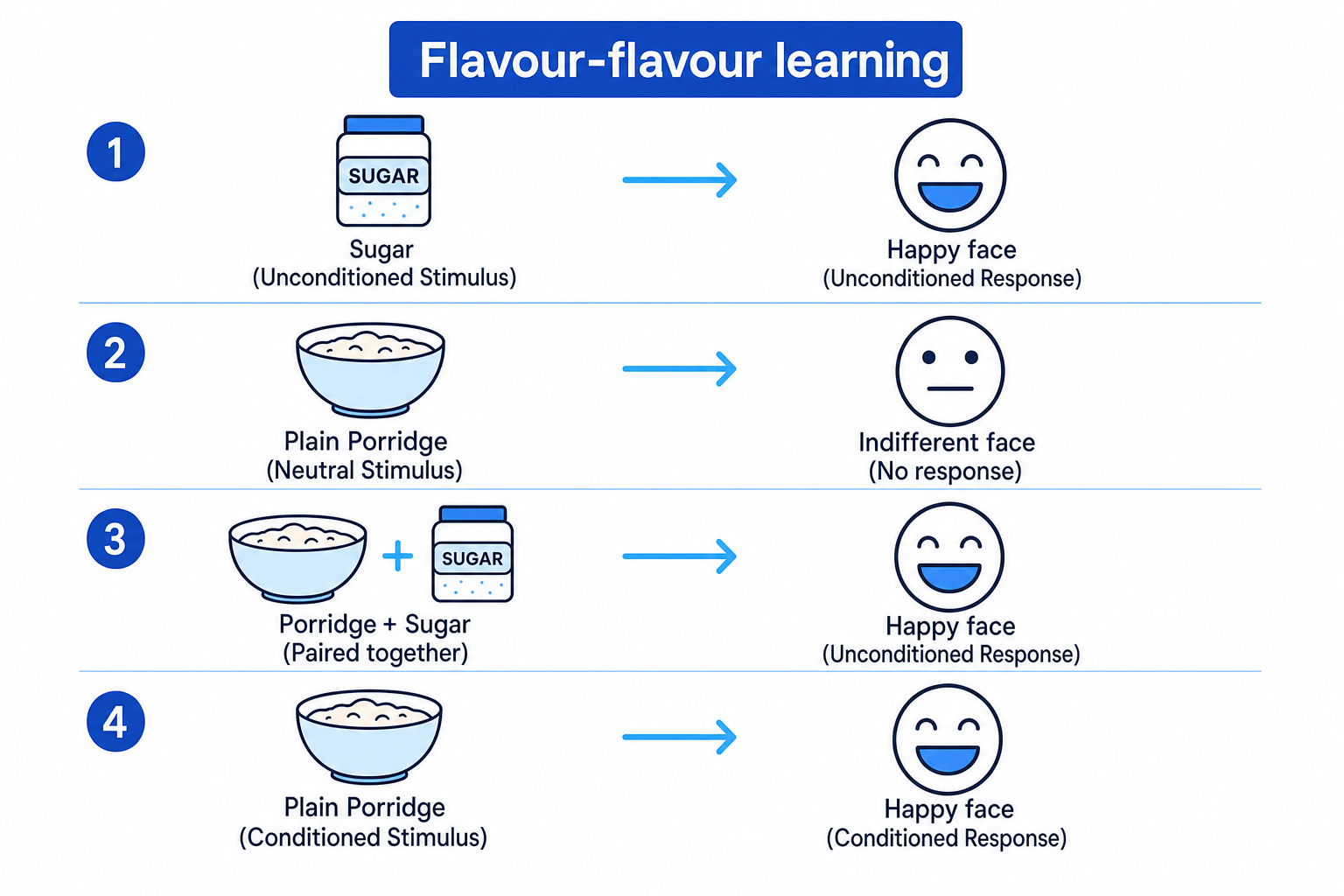
- Flavour-flavour learning is limited: Research by Baeyens et al. (1996) suggests that "mere exposure" (simply offering the new food repeatedly over time) is actually more effective at increasing food preferences than flavour-flavour learning. Sometimes, adding a sweet taste only makes the child like the sweet taste more, without transferring the liking to the actual food.
- Ignores biological factors: The learning approach on its own is reductionist if it ignores our innate biological hardwiring. For example, it is very difficult to socially condition a child to prefer an extremely bitter, toxic-tasting food without immense effort, showing that biology still sets the boundaries for what we can learn to like.
Tip
Integrating theories
The best answers in an essay will integrate these explanations. Evolution provides the baseline (we are born liking sweet and hating bitter), but learning and culture modify this baseline (we learn to like black coffee because of its cultural acceptance and the reinforcing effects of caffeine).
Exam technique
In the exam
- Ensure you can distinguish between neophobia (fear of new food) and taste aversion (avoiding a specific food after illness). They are distinct concepts!
- When applying SLT to a scenario, use the correct terminology: the child observes a model, imitates the behaviour, and experiences vicarious reinforcement if they see the model enjoying the food.
- For a 16-mark essay, try to structure your evaluation paragraphs as "However..." arguments. E.g., start with evolutionary strengths (Steiner's neonates), but counter it with the evolutionary mismatch in the modern day.
Self review
Check yourself
- Can you explain why a preference for sweet and fatty foods was adaptive in the EEA?
- What are the two unique features of taste aversion that demonstrate biological preparedness?
- How does "flavour-flavour learning" use classical conditioning to change food preferences?
- Provide one example of how culture can override our innate evolutionary food preferences.
