What you'll learn
- What psychologists mean by nature, nurture, heredity, and environment.
- Why the debate is about relative importance, not a simple “one or the other” choice.
- How the interactionist approach explains behaviour through genes and experience working together.
- How to evaluate the debate using research evidence, methods, ethics, and real-world implications.
The big question: what shapes behaviour?
The nature-nurture debate asks whether behaviour and psychological characteristics are mainly shaped by biological inheritance or by experience.
For example, if someone is highly anxious, is that because they inherited a biological vulnerability from their parents, because they had stressful life experiences, or because both worked together?
Nature-nurture debate
The nature-nurture debate is the argument about the relative importance of heredity and environment in determining behaviour and psychological characteristics.
The key phrase is relative importance. Modern psychologists rarely argue that a behaviour is entirely genetic or entirely environmental. The stronger answer is usually: genes and environment interact.
Avoid the either-or trap
Do not write as if nature and nurture are completely separate explanations. For most behaviours, the best answer is not “genes or environment”, but “how much does each contribute, and how do they interact?”
Nature: heredity and biological factors
Nature refers to biological influences on behaviour. This includes genes, brain structures, hormones, neurotransmitters, and biological maturation.
Heredity
Heredity is the passing on of genetic information from parents to offspring through genes.
A gene is a section of DNA that helps code for a particular characteristic. Your genotype is your genetic make-up. Your phenotype is the observable characteristic that results from the interaction between your genotype and your environment.
For example, someone may inherit a genetic vulnerability to depression, but whether they develop depression may depend on later stress, relationships, coping skills, and support.
Nativism
A nativist view argues that many characteristics are innate, meaning they are present from birth or develop as part of biological maturation.
In psychology, biological explanations of behaviour often lean towards nature. For example, explanations of aggression may focus on hormones such as testosterone, while explanations of schizophrenia may focus on inherited vulnerability and neurotransmitters such as dopamine.
Nature side of the debate
Nature explanations emphasise inherited biological factors and often argue that behaviour is strongly influenced by genes, brain chemistry, or evolutionary pressures.
Studying nature: twin and adoption research
Psychologists often use twin studies and adoption studies to estimate genetic influence.
Monozygotic twins are identical twins who share 100 percent of their genes. Dizygotic twins are non-identical twins who share about 50 percent of their genes, like ordinary siblings.
A concordance rate is the extent to which two people share the same characteristic or disorder. If identical twins have a much higher concordance rate than non-identical twins, this suggests a genetic influence.
Interpreting a twin-study finding
Imagine a study finds that schizophrenia has a concordance rate of 48 percent for monozygotic twins and 17 percent for dizygotic twins.
- Compare the two concordance rates: monozygotic twins show a much higher rate than dizygotic twins, even though both types may grow up in similar family environments.
- Infer genetic influence: because monozygotic twins share more genes, the higher concordance rate suggests heredity plays a role in schizophrenia.
- Avoid overclaiming: the monozygotic rate is not 100 percent, so schizophrenia cannot be explained by genes alone. Environmental triggers must also matter.
Twin and adoption studies can be useful because they allow psychologists to separate genetic similarity from environmental similarity. However, they are not perfect.
Identical twins may be treated more similarly than non-identical twins, so higher concordance might partly reflect a more similar environment. Adoption studies may also be affected by selective placement, where children are placed into adoptive families similar to their biological families.
Ethically, research into genetic risk must protect confidentiality, gain informed consent, and avoid causing unnecessary anxiety or stigma.
Nurture: environment and experience
Nurture refers to environmental influences on behaviour. This includes the prenatal environment before birth, parenting, peers, education, culture, life events, and learning experiences.
Environment
In the nature-nurture debate, environment means all non-genetic influences that may affect behaviour, including physical, social, cultural, and psychological experiences.
Empiricism and learning
An empiricist view argues that behaviour is mainly shaped by experience. This is closely linked to behaviourist explanations, where behaviour is learned through classical conditioning, operant conditioning, and social learning theory.
For example, a phobia may develop after a frightening experience, or aggression may be learned by observing and imitating aggressive role models.
Nurture explanations are also important in social and cultural psychology. For instance, attitudes, gender roles, conformity, and obedience can be shaped by social norms and expectations.
Nurture side of the debate
Nurture explanations emphasise experience, learning, social context, and culture as influences on behaviour.
Remember what counts as nurture
Nurture does not just mean “parenting”. It includes prenatal conditions, peer groups, school, media, culture, trauma, relationships, and opportunities.
The interactionist approach
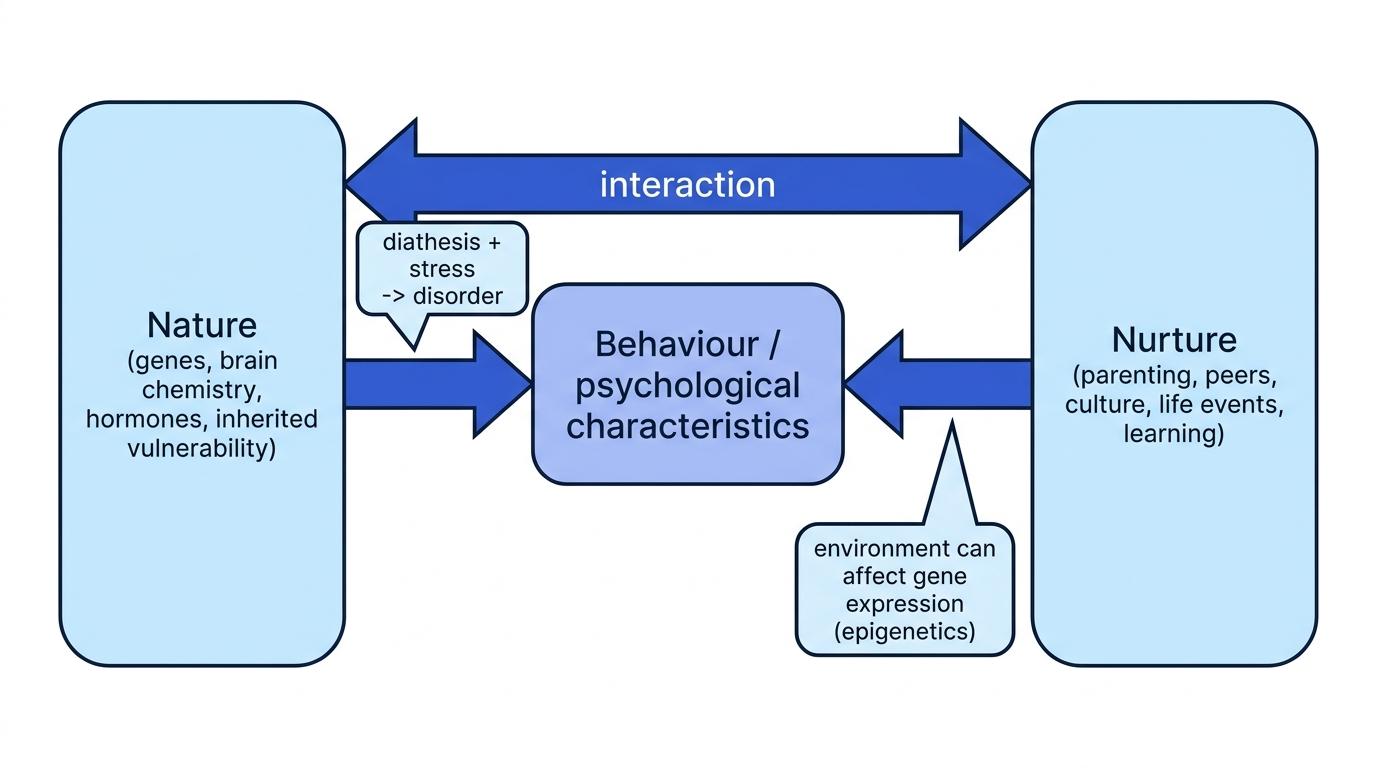
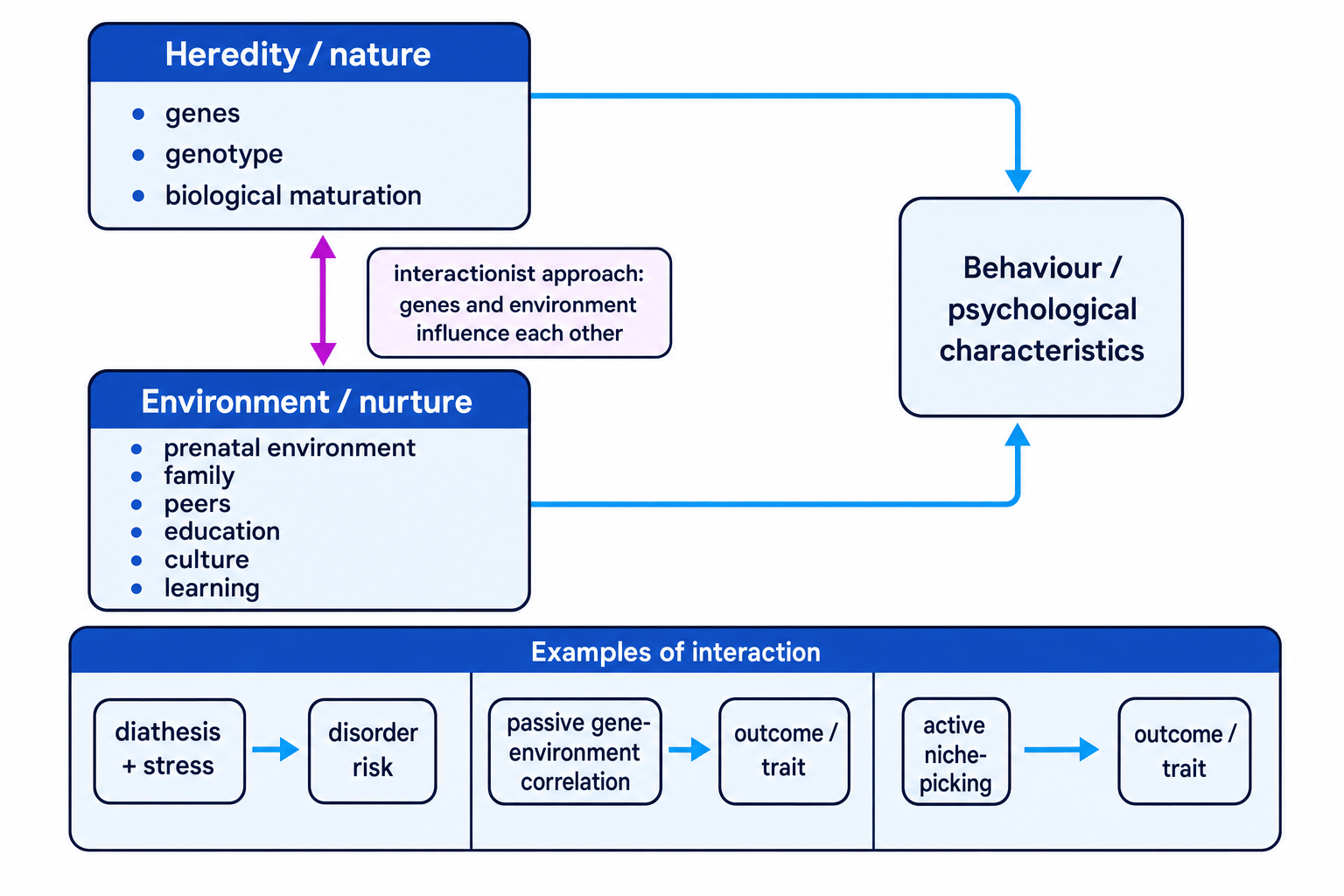
The interactionist approach argues that nature and nurture are not separate forces. Instead, genes and environment influence each other.
A person may inherit a vulnerability, but whether it becomes an actual behaviour or disorder may depend on environmental conditions. Equally, a person’s genetically influenced traits may affect the environments they experience.
The diagram below summarises the basic interactionist idea: heredity and environment both influence behaviour, and they can also shape each other.
Interactionist approach
The interactionist approach is the view that behaviour is produced by the combined influence of biological factors and environmental experiences.
Diathesis-stress: vulnerability plus trigger
One important interactionist explanation is the diathesis-stress model.
A diathesis is a biological vulnerability or predisposition. A stressor is an environmental trigger, such as trauma, family conflict, drug use, or major life stress.
According to this model, a disorder may develop only when a person has both a vulnerability and a triggering environment. This is often used to explain disorders such as schizophrenia and depression.
For example, Tienari et al. (2004) found that adopted children with a biological family history of schizophrenia were more likely to develop symptoms if they were raised in a disturbed adoptive family environment. This supports an interaction between genetic vulnerability and environmental stress.
Applying diathesis-stress to a scenario
A student has a family history of depression and then develops depression after a long period of bullying.
- Identify the nature factor: the family history suggests an inherited vulnerability to depression.
- Identify the nurture factor: bullying is an environmental stressor that may trigger symptoms.
- Combine them: the interactionist explanation is that depression develops because vulnerability and stress work together, rather than either factor acting alone.
Writing diathesis-stress as two separate explanations
Do not write “genes caused it and stress caused it” as two disconnected points. The whole idea is that the risk depends on their combination.
Gene-environment correlation
A gene-environment correlation happens when a person’s genes influence the environment they experience.
Scarr and McCartney (1983) described three types:
- Passive gene-environment correlation: parents provide both genes and environment. For example, musical parents may pass on genes linked to musical ability and also provide instruments and lessons.
- Evocative gene-environment correlation: a child’s genetically influenced traits affect how others respond. For example, a naturally sociable child may receive more social attention.
- Active gene-environment correlation: people seek out environments that fit their genetic tendencies. This is sometimes called niche-picking. For example, a sensation-seeking teenager may choose extreme sports.
This shows why nurture is not simply “done to” a passive person. People partly shape their own environments.
Epigenetics: environment affecting gene expression
Epigenetics refers to changes in gene expression caused by environmental influences, without changing the DNA sequence itself.
A simple way to think of this is that the environment can affect whether certain genes are switched “on” or “off”. Stress, diet, toxins, and early caregiving may all influence gene expression.
Epigenetics supports the interactionist approach because it shows that biological processes can be shaped by experience.
Why interactionism is powerful
Interactionism avoids the weakness of extreme nature or extreme nurture explanations because it explains how inherited vulnerability, environmental triggers, and personal choices can combine over time.
AO3: evaluating the nature-nurture debate
Strength: research supports genetic influence
Twin and adoption studies often show that many behaviours have a genetic component. For example, higher concordance rates in monozygotic than dizygotic twins suggest heredity matters for disorders such as schizophrenia.
This is a strength because it provides scientific evidence against purely environmental explanations.
However, concordance is rarely 100 percent, even for identical twins. This means genetic influence is not the same as genetic determinism.
Limitation: twin studies can be confounded
A confounding variable is an uncontrolled factor that may affect the results. In twin studies, identical twins may be treated more similarly than non-identical twins, so greater similarity may reflect environment as well as genes.
Adoption studies help, but they can also be affected by selective placement and incomplete records. This means conclusions about heredity should be cautious.
Strength: interactionism has real-world applications
The interactionist approach has useful applications in mental health. If a disorder is caused by both vulnerability and stress, then treatment can target both.
For example, a person with genetic vulnerability to depression might benefit from psychological therapy, stress reduction, social support, and possibly medication. This is more practical than saying the cause is purely biological or purely environmental.
Limitation: ethical and social implications
Nature explanations can lead to genetic determinism, the belief that behaviour is fixed by genes. This may create stigma or make people feel they cannot change.
Nurture explanations can also have negative implications. For example, they may unfairly blame parents for a child’s mental disorder or behaviour problem.
Research in this area must handle consent, confidentiality, debriefing, and protection from harm carefully, especially when discussing inherited risk for disorders.
Shared and unshared environments
A shared environment is an experience that makes family members more similar, such as living in the same home. An unshared environment is an experience that makes family members different, such as different friends, teachers, illnesses, or life events.
This helps explain why siblings raised in the same family can still be very different. Even when the broad environment is shared, the exact psychological experience may not be.
Bringing it together for essays
A strong A-Level answer should not simply list “nature points” and “nurture points”. You should show how the debate has developed.
Start with the traditional debate: heredity versus environment. Then move towards the modern view: interactionism. Use examples such as twin studies, diathesis-stress, gene-environment correlation, and epigenetics.
In the exam
- Define the debate clearly: refer to the relative importance of heredity and environment in determining behaviour.
- Use at least one concrete example, such as schizophrenia, depression, aggression, attachment, or intelligence, to show AO2 application.
- Evaluate both sides: include research support, methodological issues, ethical implications, and why the interactionist approach is often stronger than an extreme nature or nurture position.
Check yourself
- What is the difference between genotype and phenotype?
- Why does a monozygotic twin concordance rate below 100 percent support interactionism?
- How do passive, evocative, and active gene-environment correlations differ?