What you'll learn
- What levels of explanation are in Psychology.
- The difference between holism and reductionism.
- How biological reductionism and environmental stimulus-response reductionism explain behaviour.
- How to evaluate these ideas in AQA essay answers using AO1, AO2 and AO3.
Why this debate matters
Psychologists often disagree about the “best” level at which to explain behaviour. For example, if someone has a phobia, should we explain it through brain chemistry, learned associations, thoughts, childhood experiences, or social context?
The holism and reductionism debate is about whether behaviour is best understood as a whole system or by breaking it down into smaller parts.
Levels of explanation
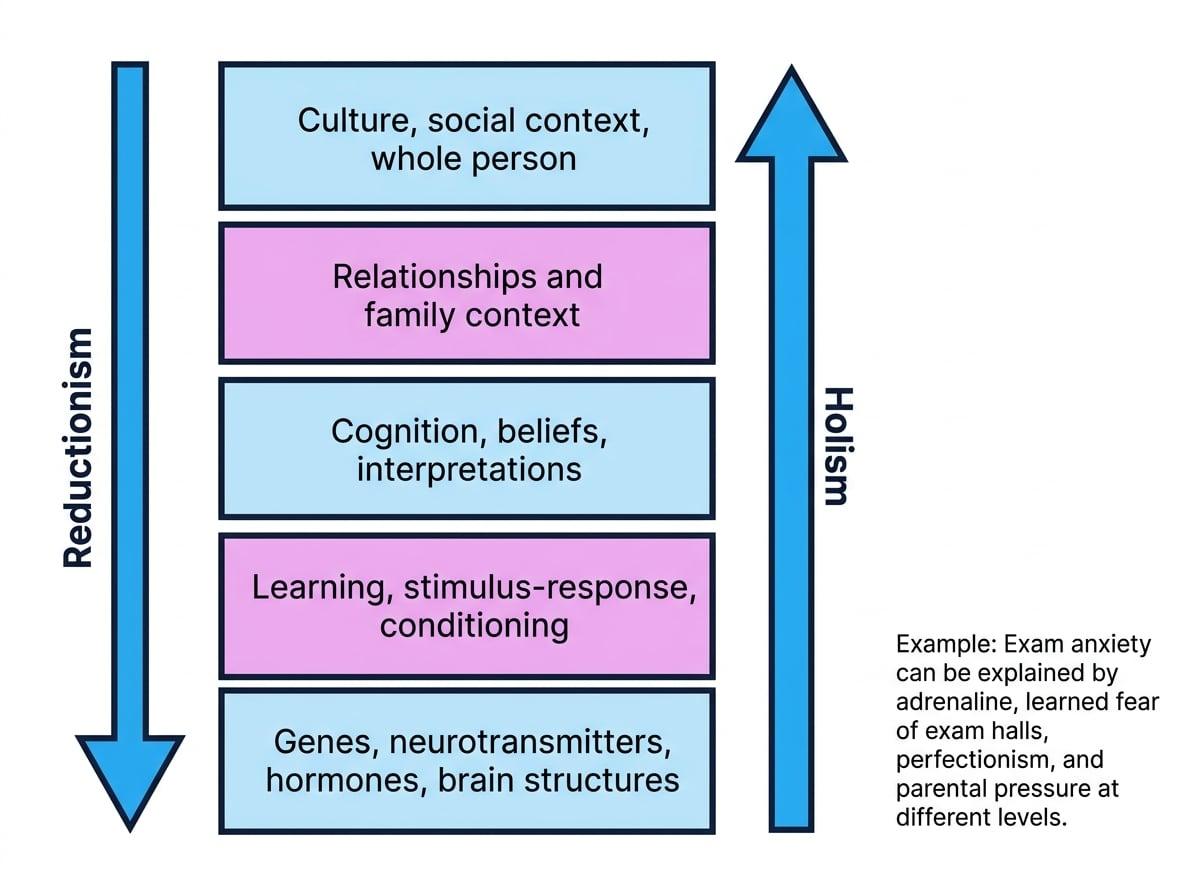
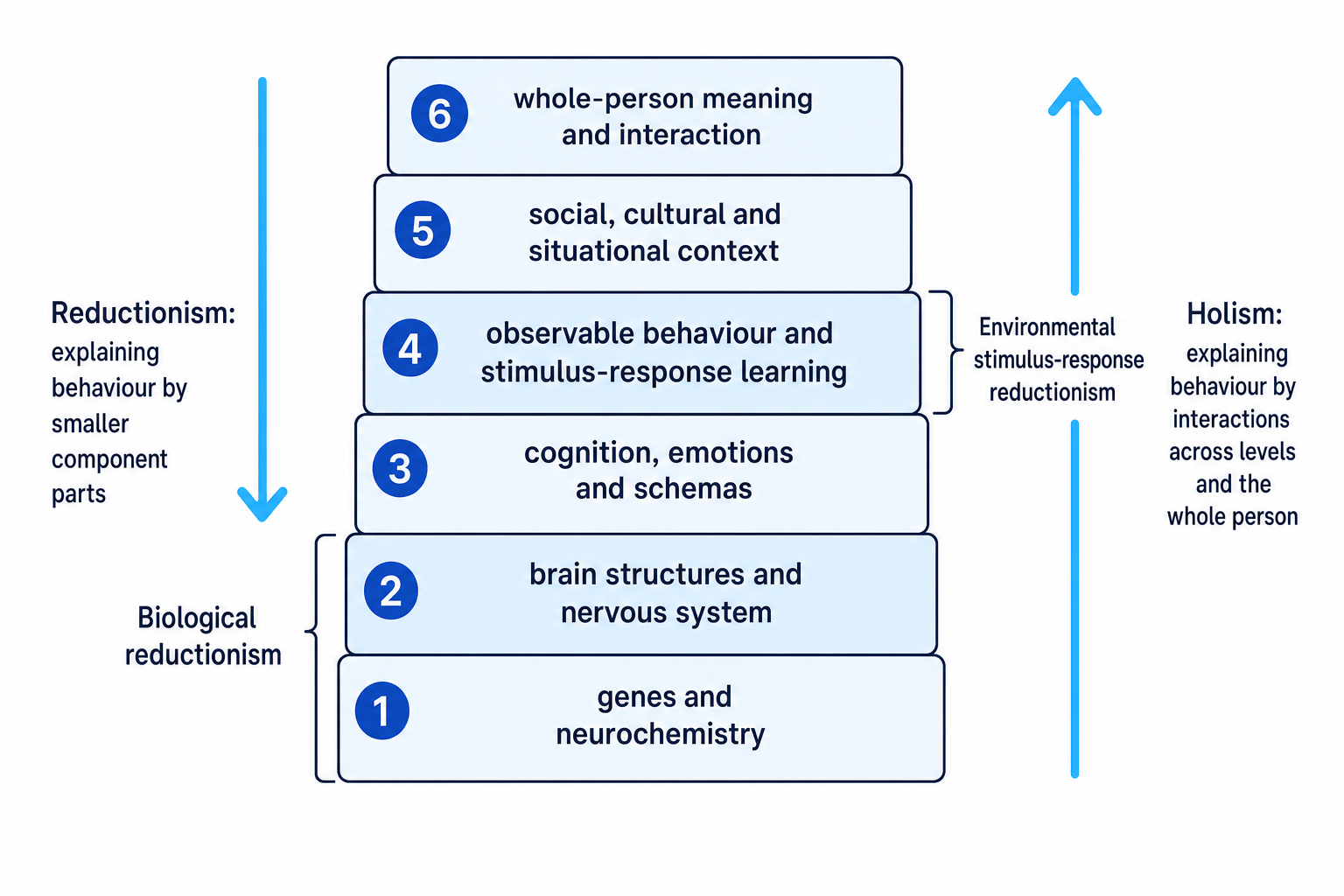
A level of explanation is the scale at which a psychologist explains behaviour. Lower levels focus on smaller internal mechanisms, such as genes or neurotransmitters. Higher levels focus on broader meanings, relationships, culture and the whole person.
This diagram shows how explanations can move from smaller biological parts up towards wider social and whole-person explanations.
Level of explanation
A level of explanation is the particular “scale” used to explain behaviour, such as genes, brain systems, learning, cognition, relationships, culture, or the whole person.
Different levels can all be valid, but they answer different questions. A biological explanation of aggression might focus on testosterone or the limbic system. A social explanation might focus on peer group norms, deindividuation, or family modelling.
Applying levels to exam anxiety
A student feels intense anxiety before exams. Three psychologists give different explanations: one mentions adrenaline, one mentions a learned fear of exam halls, and one mentions perfectionism combined with parental pressure.
- The adrenaline explanation focuses on a biological mechanism inside the body, so it works at a lower biological level of explanation.
- The learned fear explanation links an environmental stimulus, the exam hall, with an anxiety response, so it fits environmental stimulus-response reductionism.
- The perfectionism plus parental pressure explanation combines cognition and social context, so it is more holistic because it explains behaviour through interacting factors.
Lower level does not mean better
Do not write as if biological explanations are automatically more “scientific” and therefore always better. They may be precise and testable, but they can still be incomplete.
Reductionism
Reductionism
Reductionism is the view that complex behaviour can be explained by breaking it down into smaller, simpler components.
Reductionist explanations try to identify the basic parts that produce behaviour. This can be very useful in Psychology because it allows researchers to isolate variables, test hypotheses and create practical treatments.
For example, obsessive-compulsive disorder, or OCD, can be reduced to biological factors such as serotonin activity and genetic vulnerability. This has helped develop drug treatments such as SSRIs, which affect serotonin transmission.
Reductionism in one sentence
Reductionism explains behaviour by moving down to simpler parts, such as genes, neurotransmitters, brain structures, stimuli, responses or reinforcement.
Strengths of reductionism
Reductionism often supports scientific methods. If a researcher focuses on one factor, such as a neurotransmitter, it becomes easier to measure, manipulate and test. This can improve reliability because other researchers can repeat the procedure.
Reductionism can also lead to real-world applications. Biological explanations have contributed to drug therapies. Behaviourist explanations have contributed to treatments such as systematic desensitisation for phobias and token economies in institutional settings.
Weaknesses of reductionism
The main criticism is oversimplification. Human behaviour is usually influenced by several interacting factors. Reducing depression, aggression or attachment to one biological or learning mechanism may ignore personal meaning, social context and individual differences.
Reductionist explanations can also be deterministic, meaning they imply behaviour is caused by forces outside conscious control. This may reduce personal responsibility, but it can also be ethically sensitive because it may label people as biologically or environmentally “programmed”.
Biological reductionism
Biological reductionism
Biological reductionism explains behaviour in terms of biological components, such as genes, hormones, neurotransmitters, brain structures and nervous-system activity.
This is one of the lowest levels of explanation in Psychology. It reduces behaviour to physical processes in the body.
Examples include:
- Explaining OCD through genes and serotonin activity.
- Explaining aggression through testosterone, the amygdala or limbic system.
- Explaining stress responses through the autonomic nervous system and hormones such as adrenaline.
Biological reductionism is common in the biological approach. It is not always wrong — in fact, it can be powerful — but AQA expects you to evaluate whether it gives a complete explanation.
AO3 evaluation of biological reductionism
A strength is that biological explanations are often supported by objective methods, such as brain scans, genetic studies and drug trials. This gives Psychology scientific credibility.
Another strength is practical application. If a disorder is partly biological, biological treatments may reduce symptoms. For example, SSRIs can help some people with OCD by affecting serotonin levels.
However, biological reductionism may ignore psychological and social causes. OCD compulsions may also be maintained by anxiety reduction, which is a learning process, and symptoms may be shaped by life stress. A purely biological account may therefore lack explanatory power.
There are also ethical issues. Biological data can be highly personal, so researchers must protect confidentiality and obtain informed consent. Biological explanations may also create stigma if people are seen as controlled by faulty genes or brain chemistry.
Evaluating a serotonin explanation of OCD
A psychologist claims: “OCD is caused by low serotonin.”
- The claim has a clear biological focus because it explains OCD using a neurotransmitter involved in communication between neurons.
- This is useful because it links to drug treatment, especially SSRIs, giving the explanation practical value.
- The claim is incomplete if presented as the whole cause, because it ignores learning processes, cognitive beliefs about responsibility, and the person’s wider life stressors.
Environmental stimulus-response reductionism
Environmental stimulus-response reductionism
Environmental stimulus-response reductionism explains behaviour as learned responses to environmental stimuli, without needing to refer to internal mental processes.
This form of reductionism is linked to the behaviourist approach. Behaviourists argue that Psychology should study observable behaviour rather than unobservable thoughts or feelings.
A stimulus is something in the environment that triggers behaviour. A response is the behaviour that follows. In classical conditioning, a person learns an association between two stimuli. In operant conditioning, behaviour is shaped by consequences such as reinforcement or punishment.
Watson and Rayner’s study of Little Albert (1920) is a classic example. They showed that a fear response could be conditioned by pairing a white rat with a loud noise. Skinner’s work on operant conditioning, including research using Skinner boxes, showed how reinforcement can shape behaviour.
AO3 evaluation of environmental reductionism
A strength is that behaviourist explanations are testable. Stimuli, responses and reinforcers can be observed and measured, which supports controlled research.
Another strength is application. Behaviourist principles have been used in therapies for phobias, behaviour modification programmes and token economies.
However, stimulus-response reductionism ignores cognition. For example, two people may experience the same stimulus but interpret it differently. This means behaviour cannot always be predicted from the environment alone.
It can also ignore biology. Some fears may be easier to acquire because of evolutionary preparedness, and some behaviours may be influenced by genes or brain systems.
There are ethical concerns too. Watson and Rayner’s Little Albert study would be unacceptable by modern standards because of issues with protection from harm, informed consent and debriefing. Research that manipulates behaviour must respect the right to withdraw and avoid causing lasting distress.
Behaviourism is not the same as all learning explanations
Pure stimulus-response reductionism ignores internal mental processes. Social learning theory is less reductionist because it includes mediational processes such as attention, retention, reproduction and motivation.
Holism
Holism
Holism is the view that behaviour should be understood as a whole, not just as separate parts.
A holistic explanation looks at how factors interact. It may include biology, thoughts, emotions, relationships, culture and personal meaning.
Humanistic Psychology is strongly holistic. For example, Rogers’ person-centred approach focuses on the whole person’s subjective experience, free will, self-concept and need for unconditional positive regard.
Holism is also seen in explanations that combine several levels, such as the biopsychosocial model, which explains behaviour through biological, psychological and social influences.
Strengths of holism
Holism often has high ecological validity because it reflects the complexity of real life. People are not just brains, genes or conditioned responses; they also have relationships, goals, beliefs and cultural backgrounds.
Holistic approaches can be especially useful in therapy. A therapist may need to understand a client’s symptoms, family context, self-beliefs and life history rather than focusing only on one cause.
Weaknesses of holism
The main weakness is that holistic explanations can be harder to test scientifically. If many factors interact at once, it becomes difficult to isolate cause and effect.
Holistic accounts can also become vague. Saying “everything matters” may be realistic, but it may not produce precise predictions or clear treatments.
Best exam judgement
The strongest answer is usually not “holism good, reductionism bad.” A better judgement is that reductionism is useful for precise research and treatment, while holism is useful for understanding complex real-life behaviour.
The interactionist compromise
Many psychologists take an interactionist approach. This means they accept that behaviour is best explained by interactions between different levels.
For example, a diathesis-stress explanation of mental disorder suggests that a person may have a biological vulnerability, but symptoms develop only when triggered by environmental stress. This avoids being purely biological or purely environmental.
In essays, this is a strong line of evaluation because it shows balance. You can argue that reductionist explanations are valuable as partial explanations, but they should often be integrated into a broader holistic account.
Confusing holism with just listing lots of factors
A holistic answer does not simply list biology, cognition and society. It explains how these factors interact to produce behaviour.
Quick comparison
| Issue | Reductionism | Holism |
|---|---|---|
| Main idea | Breaks behaviour into smaller parts | Studies behaviour as a whole system |
| Typical focus | Genes, brain, neurotransmitters, stimuli, responses | Meaning, context, interaction, whole person |
| Strength | Scientific, testable, practical applications | Realistic, complex, person-centred |
| Weakness | Can oversimplify behaviour | Can be difficult to test precisely |
| AQA examples | Biological approach, behaviourism | Humanistic approach, biopsychosocial explanations |
In the exam
- Define the debate clearly: reductionism breaks behaviour into simpler parts, while holism explains behaviour through whole-person or interacting systems.
- Use named types: biological reductionism and environmental stimulus-response reductionism are specifically required by the specification.
- Evaluate both sides: credit reductionism for scientific control and applications, but criticise oversimplification; credit holism for realism, but criticise lack of testability.
Check yourself
- Can you explain the difference between a biological level and an environmental stimulus-response level of explanation?
- Why might a reductionist explanation be useful but incomplete?
- How could a holistic explanation of anxiety include biological, cognitive and social factors?