What you'll learn
- How psychologists define free will and determinism.
- The difference between hard determinism and soft determinism.
- The three main deterministic explanations: biological, environmental and psychic determinism.
- Why psychology’s scientific status often depends on finding causal explanations for behaviour.
The big question: do we choose, or are we caused?
This debate asks whether human behaviour is freely chosen or caused by factors outside our conscious control. In A-Level Psychology, you should be able to describe the positions and evaluate how useful they are for explaining real behaviour.
Free will
Free will is the idea that people can make conscious choices and are responsible for their actions. It does not mean people are unaffected by genes, upbringing or emotions — it means those influences do not completely control behaviour.
Determinism
Determinism is the view that behaviour is caused by internal or external forces, often outside conscious awareness. A deterministic explanation tries to show why a behaviour happened because of prior causes.
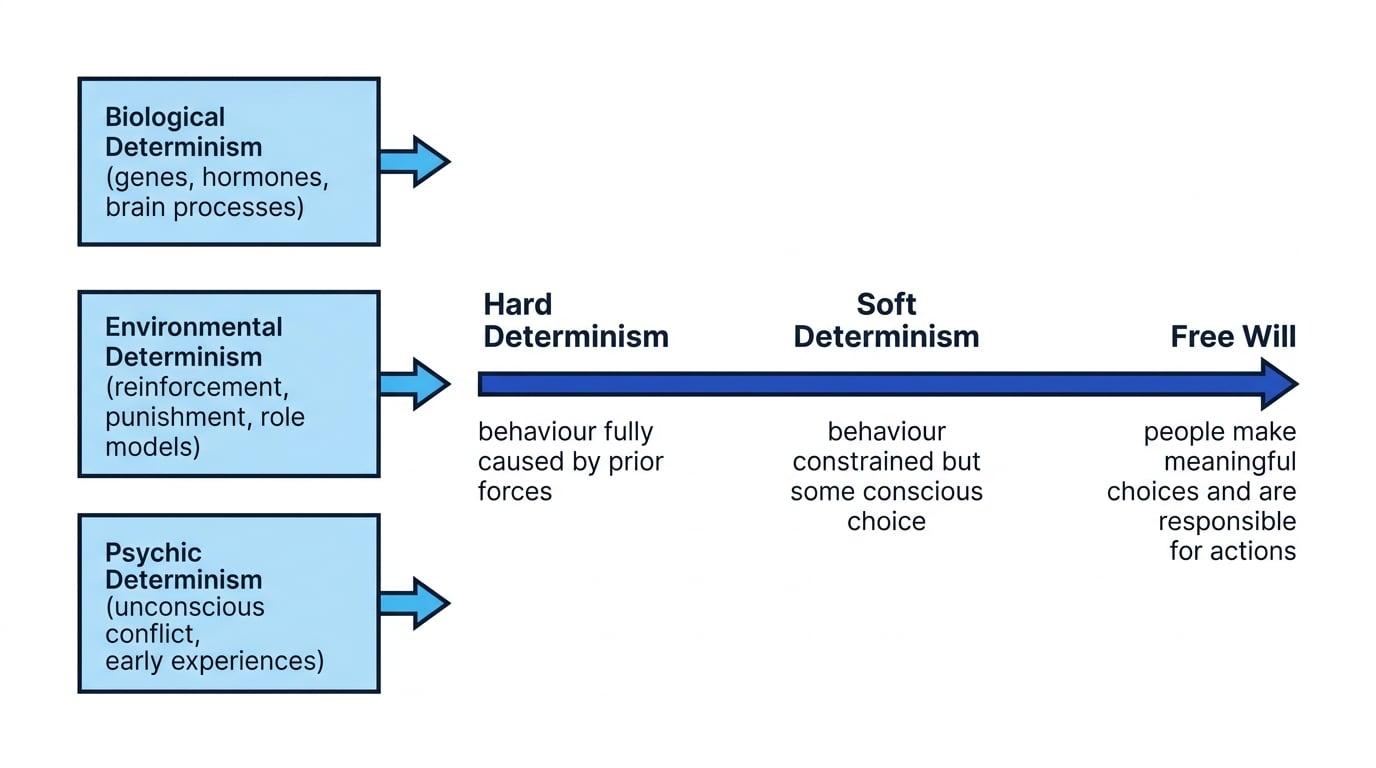
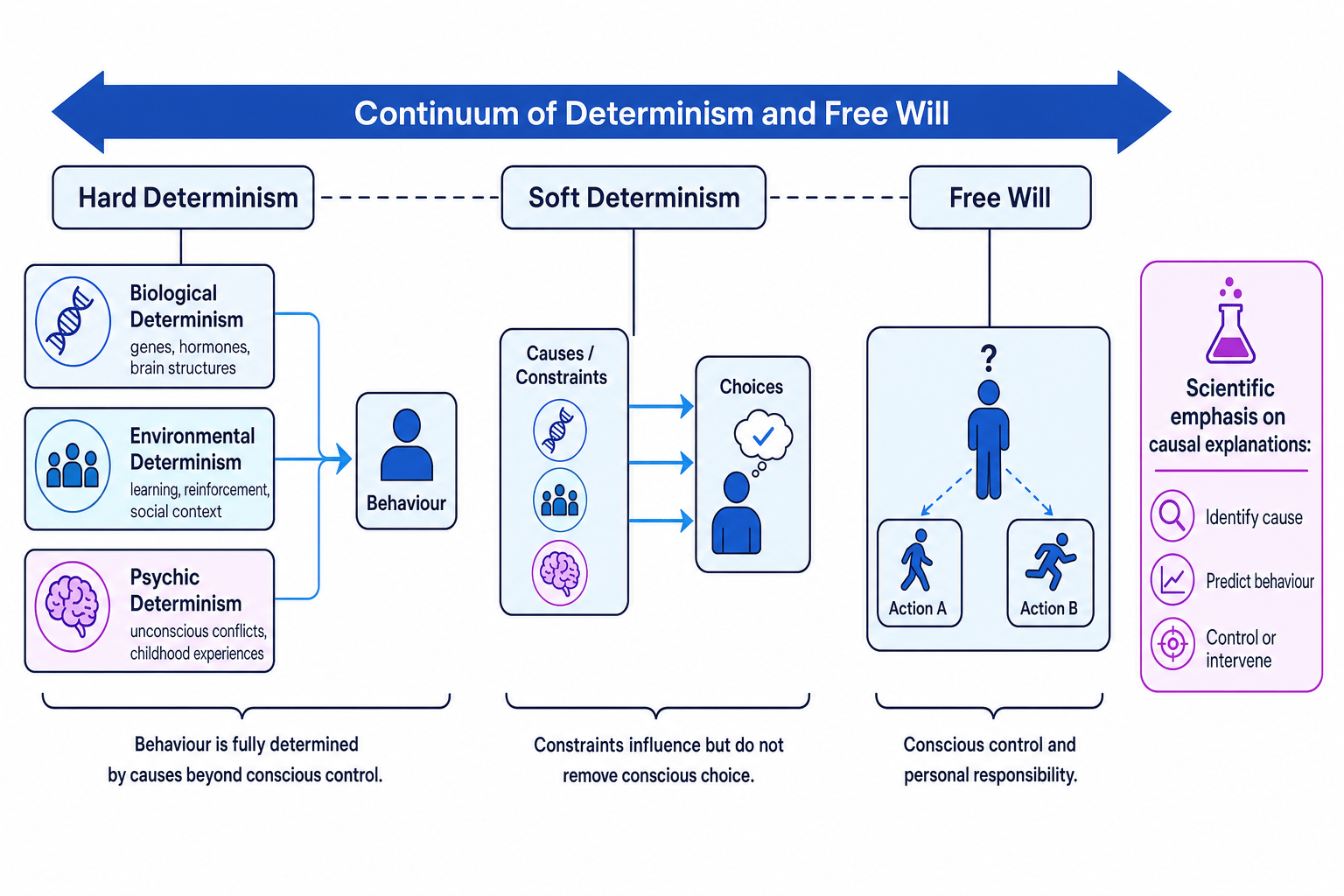
It helps to picture free will and determinism as a continuum rather than two totally separate boxes.
Hard determinism
Hard determinism is the view that all behaviour is completely caused by forces outside a person’s conscious control. This means genuine free choice is an illusion.
A hard determinist would argue that if we knew every relevant cause — for example genes, brain chemistry, reinforcement history and unconscious motives — we could predict behaviour.
This position is linked to incompatibilism, which is the view that free will and determinism cannot both be true.
Hard determinism in one sentence
Hard determinism says behaviour is fully caused, so a person could not truly have acted differently under the exact same conditions.
AO3: evaluating hard determinism
A strength is that hard determinism supports psychology as a science. If behaviour has causes, psychologists can investigate those causes using controlled methods, make predictions and develop interventions.
However, hard determinism can be criticised for being reductionist. Reductionism means explaining complex behaviour in an overly simple way, such as reducing aggression to only genes or only reinforcement. Human behaviour usually has multiple interacting causes.
Hard determinism also raises ethical and legal problems. If offenders are seen as fully determined by biology or childhood experiences, this may reduce blame and support rehabilitation. But it could also excuse harmful behaviour or label people as “dangerous” before they have done anything wrong.
Soft determinism
Soft determinism is the view that behaviour is influenced by causes, but people still have some conscious choice within those limits.
This position is linked to compatibilism, which is the view that free will and determinism can exist together. For example, your upbringing may strongly influence your attitude to education, but you may still choose whether to revise tonight.
Soft determinism in one sentence
Soft determinism says behaviour is constrained, not completely controlled.
Soft determinism is often a balanced position for psychology essays because it recognises causal influences without denying personal responsibility completely.
Applying soft determinism to behaviour
A student feels anxious before an exam because they have a biological tendency towards anxiety and have previously failed a test. They still decide to use breathing techniques and ask their teacher for help.
- The biological tendency and previous failure act as constraints because they make anxiety more likely.
- The student’s decision to use coping strategies shows conscious choice, because they are not simply forced into avoidance.
- A soft determinist conclusion is that the anxiety is caused by prior factors, but the student still has some control over how they respond.
Soft determinism is not the same as total free will
Do not write that soft determinism means “people are completely free”. It means people have choice within limits.
Biological determinism
Biological determinism is the view that behaviour is caused by biological factors such as genes, hormones, brain structures, neurotransmitters and evolution.
For example, a biological determinist explanation of aggression might focus on testosterone, limbic-system activity or genetic vulnerability.
Biological determinism is common in the biological approach, which explains behaviour through physical processes in the body and brain.
AO3: evaluating biological determinism
A strength is that biological explanations can use objective evidence, such as brain scans, hormone measurements or genetic analysis. This can make findings more scientific and replicable.
For example, Libet et al. (1983) found that brain activity linked to movement appeared before participants consciously reported deciding to move. This supports the idea that conscious choice may come after unconscious brain processes. Ethically, this type of laboratory research should involve informed consent, the right to withdraw, protection from harm and debriefing.
A limitation is that biological determinism may ignore environment and personal meaning. A gene or brain difference may increase risk, but it rarely guarantees a behaviour. Caspi et al. (2002), for example, found that genetic vulnerability interacted with childhood maltreatment in predicting antisocial behaviour, which challenges a simple “biology alone” explanation. Because this research involves sensitive personal data, confidentiality and protection from harm are especially important.
Environmental determinism
Environmental determinism is the view that behaviour is caused by external influences, such as learning, reinforcement, punishment, role models and social circumstances.
This is strongly linked to the behaviourist approach, especially Skinner’s idea that behaviour is shaped by consequences. If a behaviour is rewarded, it is more likely to be repeated; if it is punished, it is less likely to occur.
Bandura et al. (1961) showed that children imitated aggressive behaviour after observing an aggressive adult model. This supports the idea that social environments influence behaviour. However, because children were exposed to aggression, ethical issues include protection from harm, parental consent and debriefing.
AO3: evaluating environmental determinism
A strength is that environmental explanations have useful applications. Token economies in institutions, behaviour modification programmes and classroom reward systems all rely on the idea that changing consequences can change behaviour.
A weakness is that environmental determinism may underestimate individual differences. People exposed to the same environment do not always behave in the same way. Bandura’s social learning theory also includes mediational processes, which are mental processes such as attention, retention, reproduction and motivation. This makes it less hard deterministic than strict behaviourism.
Psychic determinism
Psychic determinism is the view that behaviour is caused by unconscious psychological forces, such as unresolved conflicts, defence mechanisms and early childhood experiences.
This is linked to Freud’s psychodynamic approach. Freud argued that slips of the tongue, dreams and symptoms are not random; they reveal unconscious motives.
For example, a person who is unusually hostile towards authority figures might, from a psychodynamic view, be expressing unresolved childhood conflict with a parent.
AO3: evaluating psychic determinism
A strength is that psychic determinism can explain behaviour that seems irrational, such as phobias, compulsions or emotional outbursts. It also helped inspire talking therapies that explore unconscious meaning.
A limitation is that unconscious motives are difficult to test scientifically. If an explanation cannot be clearly falsified, it is harder to judge whether it is true. Freud’s evidence often came from case studies, such as Little Hans (Freud, 1909), which provide rich detail but have limited generalisability. Ethical issues include confidentiality, informed consent and the special protection needed when research involves children.
Classifying deterministic explanations
A psychologist explains a teenager’s aggression in three possible ways: inherited impulsivity, being rewarded for intimidating others, and unconscious anger displaced from family conflict.
- Inherited impulsivity is biological determinism because the proposed cause is genetic or physiological.
- Reward for intimidation is environmental determinism because the behaviour is explained through reinforcement.
- Displaced unconscious anger is psychic determinism because the cause is an unconscious conflict or motive.
The scientific emphasis on causal explanations
A causal explanation identifies a factor that produces a change in behaviour. Psychology often aims to be scientific, so it looks for causes that can be tested, measured and used to make predictions.
For example, an experiment might manipulate an independent variable, such as exposure to an aggressive model, and measure a dependent variable, such as aggressive acts. If the study is controlled, psychologists can argue more confidently that the independent variable caused the behaviour.
Why determinism matters for science
Science depends on the assumption that behaviour is orderly and caused; otherwise prediction, control and intervention become much harder.
AO3: strengths of causal explanations
Causal explanations have practical value. If depression is partly caused by neurotransmitter imbalance, drug therapies may help. If phobias are maintained by avoidance, exposure therapy can target that mechanism. If offending is influenced by reinforcement, rehabilitation programmes can change consequences.
Causal explanations also make psychology more objective. They encourage researchers to collect evidence rather than rely only on opinion.
AO3: limitations of causal explanations
The main danger is oversimplification. Human behaviour is often caused by a combination of biological, psychological and social factors. This is why many psychologists prefer interactionist explanations, where several causes work together.
Another issue is that finding a relationship does not always prove causation. A brain difference may cause behaviour, but behaviour may also change the brain, or a third factor may affect both.
Correlation is not causation
If a study finds that two variables are related, do not automatically claim one caused the other. Causal claims need stronger evidence, usually from controlled experiments or well-designed longitudinal research.
Free will in psychology
The humanistic approach is most closely linked to free will. Humanistic psychologists such as Rogers and Maslow argued that people are active agents who can grow, change and make meaningful choices.
This view is optimistic and has clear real-world value. Counselling and therapy often assume that clients can reflect on their lives and choose healthier behaviours.
However, free will is difficult to study scientifically because it is hard to measure. It may also ignore powerful constraints such as poverty, trauma, addiction or mental illness.
Balanced essay phrasing
A strong conclusion often says that behaviour is neither completely free nor completely determined. Instead, behaviour is influenced by causal factors, but people may still exercise agency within those constraints.
Bringing it together for essays
For AO1, make sure you can clearly define:
- free will
- hard determinism
- soft determinism
- biological determinism
- environmental determinism
- psychic determinism
- causal explanations
For AO2, apply the correct type of determinism to a scenario. Ask: is the proposed cause biological, environmental or unconscious?
For AO3, evaluate using:
- scientific value and prediction
- reductionism
- evidence from research
- ethical and legal implications
- real-world applications
- the possibility of interactionist explanations
In the exam
- Start with clear definitions before evaluating — especially the difference between hard and soft determinism.
- Use named approaches as examples: biological approach for biological determinism, behaviourism for environmental determinism, and psychodynamic approach for psychic determinism.
- For AO3, avoid one-sided answers: explain why determinism helps psychology be scientific, then balance this with reductionism, ethical concerns and evidence for human agency.
Check yourself
- What is the difference between hard determinism and soft determinism?
- How would a biological, environmental and psychic determinist each explain aggression?
- Why does scientific psychology often prefer causal explanations?