What you'll learn
- How media influences can affect aggression through television, films, online content and computer games.
- What desensitisation (reduced reaction to violence), disinhibition (weakened restraints) and cognitive priming (activated aggressive ideas) mean.
- Why computer games may be especially influential because they are interactive.
- How to use AO1 (description), AO2 (application) and AO3 (evaluation) in essay answers.
Starting point: what counts as aggression?
Key starting terms
- Aggression is behaviour intended to harm another person, either physically, verbally or psychologically.
- Media influences are the ways media content may affect thoughts, feelings and behaviour.
- Violent media means media that shows intentional harm, threat, fighting, killing or other aggressive acts.
This topic is not saying that every person who watches violence or plays violent computer games becomes aggressive. A better A-Level answer is probabilistic: violent media may increase the likelihood of aggressive thoughts, feelings or behaviour, especially in certain people and situations.
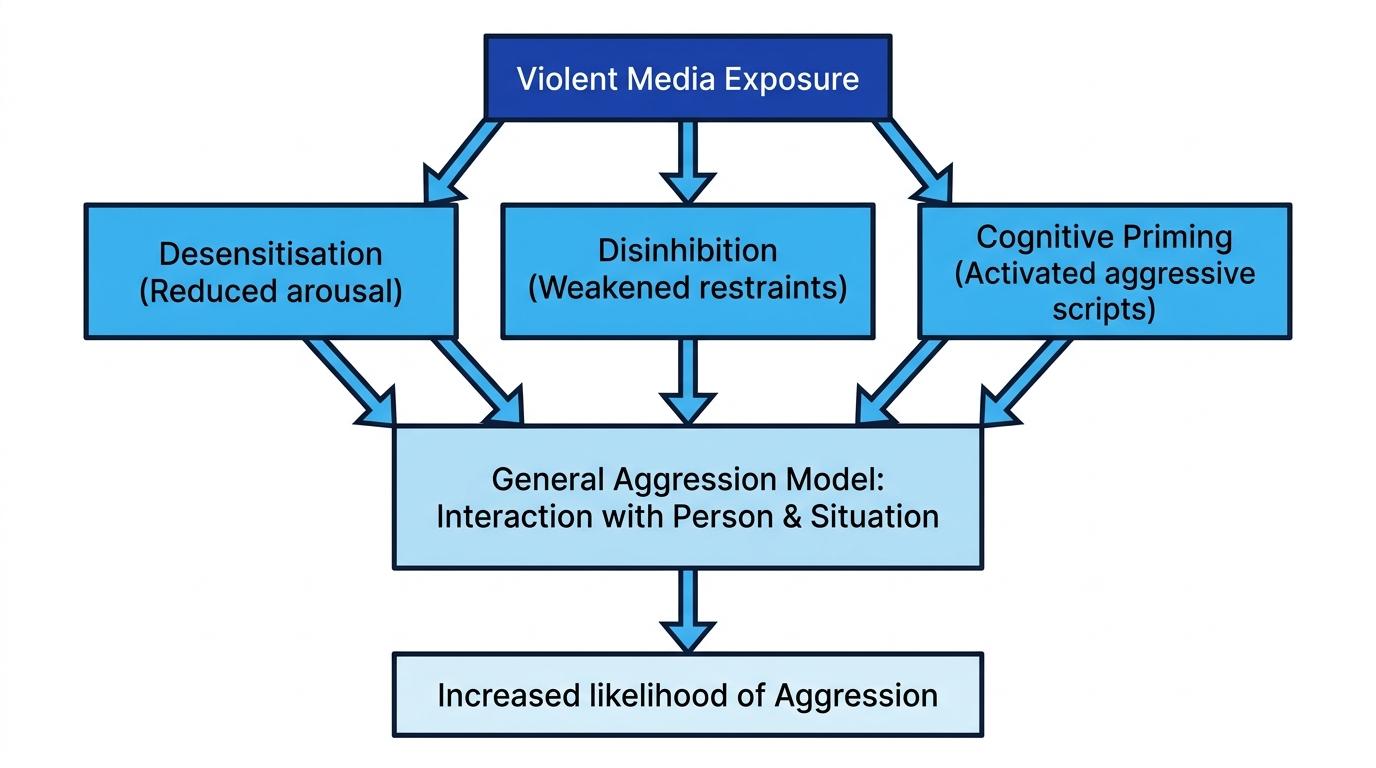
At the broadest level, the spec asks you to understand three routes from violent media exposure to aggression: desensitisation, disinhibition and cognitive priming.
The balanced view
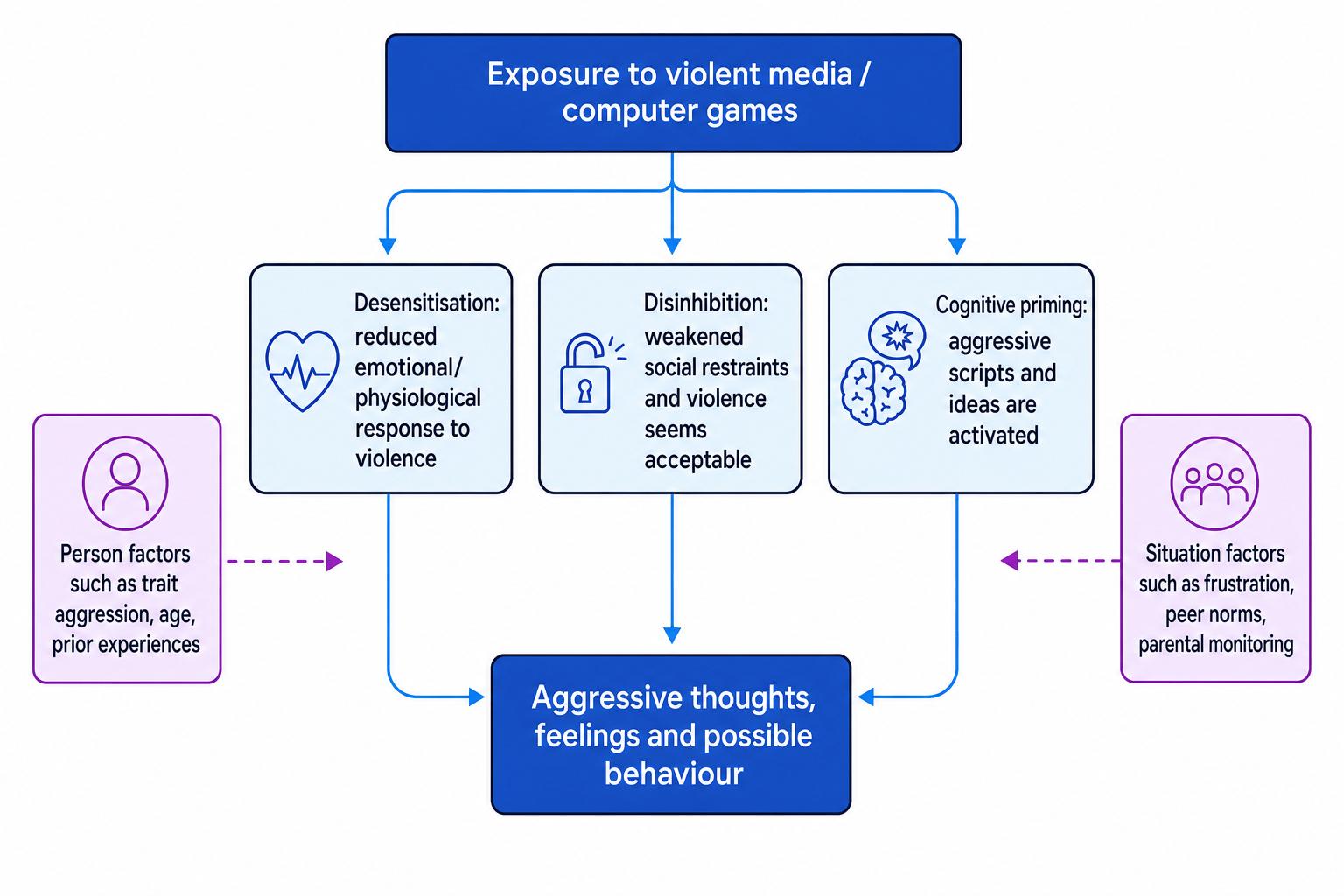
Media violence is best treated as one possible risk factor for aggression, not as a single guaranteed cause. Person factors, such as age or trait aggression, and situation factors, such as frustration or peer norms, affect the outcome.
A useful framework: the General Aggression Model
The General Aggression Model, often shortened to GAM, is a broad explanation suggesting that aggression results from an interaction between:
- Personal factors, such as personality, beliefs, previous experiences and biological influences.
- Situational factors, such as provocation, frustration, peer pressure or violent media.
- A person’s current internal state, meaning their thoughts, emotions and arousal.
In this topic, violent media is a situational input. It may influence aggression by changing what you think is normal, how emotionally shocked you feel by violence, or which aggressive ideas are currently accessible in memory.
Mechanism 1: desensitisation
Desensitisation means becoming less emotionally and physiologically responsive to violence after repeated exposure. Physiological means bodily, such as heart rate, sweating or nervous-system arousal.
If someone repeatedly sees graphic violence in films or games, they may become less shocked by it. This could reduce empathy, which is the ability to understand and share another person’s feelings. It may also make real violence seem less serious.
Carnagey, Anderson and Bushman (2007) found evidence for this. Participants played either a violent or non-violent video game, then watched real-life violent footage while their heart rate and galvanic skin response were measured. Galvanic skin response is a measure of sweating linked to arousal. Those who had played a violent game showed lower physiological arousal when viewing the violent clips, supporting desensitisation.
Ethically, this type of study needs careful protection from harm because participants are exposed to violent material. Researchers should gain informed consent, allow the right to withdraw, monitor distress, protect confidentiality and fully debrief participants afterwards.
AO3: evaluating desensitisation
A strength is that desensitisation has biological evidence, such as reduced arousal, rather than relying only on self-report. This gives the explanation some scientific credibility.
However, lower arousal does not automatically mean someone will behave aggressively. It may simply mean they are less shocked by media violence. Many studies use short-term laboratory tasks, so it is difficult to know whether the effect lasts or transfers to serious real-world aggression.
Mechanism 2: disinhibition
Inhibition means an internal restraint that stops you doing something, such as guilt, fear of punishment or the belief that violence is wrong. Disinhibition means those restraints are weakened.
Violent media may disinhibit aggression if it presents violence as:
- justified, for example revenge against a “bad” character;
- rewarded, for example the hero gains status;
- consequence-free, with little pain, punishment or remorse;
- normal, frequent or socially accepted.
This links to social learning theory because people may observe aggressive models being rewarded. Bandura et al. (1963) found that children imitated aggressive behaviour shown by live, filmed and cartoon models. This suggests media models can influence behaviour, especially for children. Ethical issues are important here because children were exposed to aggression; modern research would require parental consent, child assent where possible, the right to withdraw, protection from harm and careful debriefing.
AO3: evaluating disinhibition
Disinhibition explains why the context of media violence matters. A game where violence is rewarded and realistic may have a different effect from a film where violence has painful consequences.
A limitation is that audiences are not passive. Many viewers can distinguish fiction from reality and may reject the values shown. Strong family norms, school values or cultural beliefs may maintain inhibition even when violent media is available.
Too deterministic
Do not write that violent computer games “make people violent”. A stronger answer says they may lower restraints for some individuals, particularly when aggression is rewarded, normalised or combined with frustration.
Mechanism 3: cognitive priming
Cognitive priming means exposure to a stimulus activates related thoughts in memory. In this topic, violent media may activate aggressive ideas, memories and scripts. A script is a learned sequence of behaviour for a particular situation, such as “if someone disrespects me, hit back”.
After watching or playing violent content, aggressive thoughts may become easier to access. This can affect how a person interprets an ambiguous event. For example, if someone bumps into them accidentally, they may be more likely to see it as deliberate.
Berkowitz (1984) argued that aggressive cues can prime aggressive networks in memory. This is linked to the “weapons effect”: the presence of a weapon may increase aggressive responses because it activates violence-related ideas. Bushman (1998) also found that violent media can increase accessibility of aggressive thoughts. In such studies, deception about the precise aim may be used, so researchers must debrief participants and minimise distress.
AO3: evaluating cognitive priming
Cognitive priming is useful because it explains short-term increases in aggression after violent media exposure. It is especially relevant when a person is already frustrated or provoked.
However, priming effects may be temporary. Also, measuring “aggressive thoughts” is not the same as measuring real aggressive behaviour. This creates a construct validity issue: construct validity means whether a task truly measures the psychological concept it claims to measure.
Applying the three mechanisms
A student plays a violent online game for several hours. Later, after losing a match, another student accidentally knocks into them and they shout aggressively.
- Link the repeated violent exposure to desensitisation: the student may have become less emotionally responsive to aggression, so shouting or threatening behaviour feels less serious than it otherwise would.
- Link the rewarded game violence to disinhibition: if the game presents aggression as successful and consequence-free, the usual restraint of “I should not react aggressively” may be weakened.
- Link the recent gameplay to cognitive priming: violent scripts are active in memory, so the accidental knock may be interpreted as hostile rather than accidental.
- Add balance: the game alone does not prove causation. Frustration from losing, personality, peer reactions and previous experiences may also contribute.
Effects of computer games
Computer games may be especially important because they are interactive. Unlike watching a film, the player actively chooses actions, rehearses behaviour and may be rewarded for aggression.
Possible reasons violent games could influence aggression include:
- Identification: players may feel they are the aggressive character.
- Reinforcement: points, levels or status may reward violent actions.
- Repetition: the same aggressive scripts are practised many times.
- Immersion: realistic sound, graphics and first-person perspectives may increase involvement.
- Competition and frustration: losing, being insulted online or repeated failure may increase arousal and anger.
Anderson and Dill (2000) reported links between violent video game exposure and aggression, including an experiment where violent game play was followed by more aggressive responses in a competitive task. A strength is that experimental designs can use random allocation, which helps test cause and effect. A weakness is that laboratory aggression tasks, such as noise blasts, may not represent serious real-world aggression. Ethical issues include possible deception, exposure to violent content, right to withdraw, confidentiality and debriefing.
Anderson et al. (2010) conducted a meta-analysis, which is a study combining results from many previous studies. They concluded that violent video games were associated with increased aggressive behaviour, aggressive thoughts and aggressive feelings, and reduced empathy and prosocial behaviour. This is strong AO3 support because meta-analyses use large samples across many studies.
However, Ferguson and Kilburn (2010) argued that effects may be smaller once publication bias is considered. Publication bias means significant findings are more likely to be published than non-significant findings. Przybylski and Weinstein (2019), using a preregistered design with adolescents, found little evidence that violent game engagement predicted aggressive behaviour. Preregistration means researchers state their hypotheses and analysis plan before collecting or analysing data, reducing the chance of cherry-picking results.
Wider evidence and real-world application
Some research supports a media-aggression link beyond computer games. Huesmann et al. (2003), a longitudinal study following people over time, found childhood TV violence viewing predicted later adult aggression. Longitudinal research is useful because it can show whether media exposure comes before later aggression. However, it still cannot fully remove confounding variables, such as family environment, peer group or pre-existing aggressive personality.
Charlton et al. (2000) studied St Helena before and after television was introduced. They did not find a major increase in children’s aggression, despite access to violent TV. This is an important contradictory finding. It suggests strong community norms and parental control may reduce media effects. Because the researchers did not randomly assign children to harmful media, the ethical risk was lower than in a lab experiment, though consent and confidentiality were still essential.
Real-world applications include age ratings such as PEGI, the Pan-European Game Information system, parental monitoring, media literacy education and encouraging prosocial or cooperative games. Greitemeyer and Mügge (2014) found that prosocial games can increase prosocial behaviour, suggesting the content and social message of games matter.
AO3 chain for this topic
A strong evaluation chain is: identify the issue, explain why it affects the conclusion, then link back to aggression. For example, “lab aggression tasks are artificial, so findings may not generalise to serious real-world violence, meaning the media-aggression link may be overstated.”
Putting it together for essays
For AO1, clearly outline the three mechanisms. For AO2, apply them to a person in a scenario: what have they watched or played, what has changed in their thinking or restraint, and what aggressive reaction follows? For AO3, avoid one-sided answers. Use research support, but also discuss causality, artificial measures, publication bias, ethics and individual differences.
In the exam
- Define each mechanism before evaluating it: desensitisation is reduced responsiveness, disinhibition is weakened restraint, and cognitive priming is activation of aggressive scripts.
- Use precise AO2 language: explain how a player might interpret an accidental bump as hostile after violent gameplay.
- Be balanced about evidence: experiments show short-term effects, correlational studies have confounds, and meta-analyses often find small average effects.
- Include at least one ethical or methodological issue when using a named study.
Check yourself
- How is desensitisation different from disinhibition?
- Why might computer games have a stronger influence than passive TV viewing?
- What is one methodological problem with measuring aggression in laboratory studies?