When a serious crime occurs, investigators must find the perpetrator as quickly as possible. Offender profiling is a forensic tool designed to help police narrow down their field of suspects. Instead of naming a specific individual, a profile paints a psychological and demographic portrait of the likely offender.
In your AQA A-Level Psychology course, you must master the two contrasting methods of profiling: the American Top-Down (typology) approach and the British Bottom-Up (data-driven) approach.
What you'll learn
- How the FBI's Top-Down approach categorises offenders into "organised" and "disorganised" types.
- How the UK's Bottom-Up approach uses statistical databases and geographical patterns to locate suspects.
- How to critically evaluate both approaches using psychological research, including David Canter’s key studies.
1. Defining Offender Profiling
Before looking at how profiles are built, let's establish what profiling actually is.
Offender profiling
Offender profiling is a behavioral and investigative tool intended to help investigators identify likely suspects, link cases that may have been committed by the same person, and predict the future behavior of an offender.
It is important to remember that profiling does not solve crimes on its own; it is a supportive tool used alongside traditional forensic science (like DNA and fingerprinting) to manage vast quantities of investigative data.
2. The Top-Down Approach (Typology)
The Top-Down approach originated in the United States during the 1970s. The FBI’s Behavioral Science Unit gathered data from in-depth interviews with 36 sexually motivated serial killers (including infamous figures like Ted Bundy and Charles Manson).
By analyzing these interviews alongside crime scene details, the FBI concluded that serial offenders can be classified into one of two distinct categories: organised or disorganised. This approach is "top-down" because the profiler starts with a pre-existing conceptual framework (the two typologies) and fits the evidence from a specific crime scene into one of these two categories.
The Top-Down Logic
If an offender behaves in a certain way at a crime scene, their behavior will reflect their underlying personality, lifestyle, and cognitive style in everyday life.
Organised vs. Disorganised Offender Typologies
The two typologies are characterized by highly contrasting crime scenes and psychological profiles:
| Feature | Organised Offender | Disorganised Offender |
|---|---|---|
| The Crime Scene | Shows evidence of planning; victim is targeted; high level of control; weapon and clues removed from the scene; body hidden. | Unplanned and chaotic; victim selected at random; little control; weapon and clues left at the scene; body left in open view. |
| Offender Characteristics | Above-average intelligence; socially and sexually competent; skilled profession; monitors media coverage of the crime; living with a partner. | Below-average intelligence; socially and sexually incompetent; unskilled worker or unemployed; lives alone near the crime scene. |
The Four Stages of Constructing an FBI Profile
When an FBI profiler is called to a case, they follow four systematic stages to construct a profile:
- Data Assimilation: The profiler collects all available evidence, including photographs of the scene, pathology reports, witness statements, and victim demographics.
- Crime Scene Classification: The profiler decides whether the crime scene displays predominantly organised or disorganised characteristics.
- Crime Reconstruction: The profiler generates a hypothesis about the sequence of events during the crime (e.g., how the victim was approached, how they died, and what happened afterward).
- Profile Generation: The profiler develops a profile of the likely suspect, detailing their age, gender, physical appearance, marital status, employment type, and personality traits.
Classifying a crime scene
- Analyze the physical evidence: Suppose a victim's body is found in a secluded woodland. The body is carefully concealed under branches, and there are no signs of a struggle. The cause of death is a precise, single stab wound. No weapons, fingerprints, or biological fluids are recovered from the scene.
- Assess the level of planning: The lack of a struggle and the precise cause of death indicate the offender had control over the victim. The concealment of the body and the complete absence of weapons or forensic clues demonstrate careful planning and active steps to avoid detection.
- Match to typology and draw a conclusion: These characteristics align directly with the organised typology. The profiler would conclude that the suspect is likely an intelligent, socially competent individual who planned the offense in advance, targeted this specific victim, and likely drives a reliable car to transport the body to a secluded location.
Evaluation of the Top-Down Approach (AO3)
Overstating the scientific validity of the FBI approach
Students often write that the FBI approach is "scientific" because the FBI is a professional organization. In reality, the top-down approach is highly subjective, relying heavily on the profiler's intuition and a very small, biased initial sample.
- Simplistic Dichotomy (Limitation): Real-world crimes are rarely purely organised or disorganised. David Canter et al. (2004) conducted a statistical analysis of 100 serial murders in the US, examining the co-occurrence of 39 aspects of organised and disorganised behavior. While they found evidence of a common "organised" core of behaviors, "disorganised" behaviors did not cluster together in a way that supported a separate type. This suggests the dichotomy is a false one.
- Biased Original Sample (Limitation): The FBI typology was built from interviews with just 36 serial killers. This is an unrepresentative, small sample from which to generalize about all violent crimes. Furthermore, these individuals were highly manipulative and incarcerated, meaning their self-reports about their crimes and motives may have been highly unreliable.
- Outdated Model of Personality (Limitation): The top-down approach is built on a dispositional model of personality—it assumes that an offender's behavior is driven by stable internal traits. However, modern psychologists (such as Walter Mischel) argue that human behavior is highly situational and dynamic. An offender may act in an organised way during one phase of a crime and panic (acting disorganised) in another.
3. The Bottom-Up Approach (Data-Driven)
Developed in the UK by psychologist David Canter, the Bottom-Up approach does not begin with fixed, pre-existing typologies. Instead, it is data-driven.
Profilers build a picture of the offender "from the bottom up" by carrying out a rigorous statistical analysis of the specific details of the crime scene and comparing them to an extensive database of past solved crimes.
The Bottom-Up Logic
Instead of fitting an offender into a pre-existing "box" (like organised or disorganised), the bottom-up approach uses objective statistical analysis of crime scene data to generate a bespoke profile.
The Bottom-Up approach is divided into two main components: Investigative Psychology and Geographical Profiling.
Investigative Psychology
This is the application of psychological theories and statistical analyses to criminal investigations. It relies on three core concepts:
- Interpersonal Coherence: The way an offender behaves at the crime scene, particularly how they treat the victim, reflects how they interact with people in their everyday lives. For example, an offender who is highly controlling and degrading to a victim may be dominating and aggressive in their domestic relationships.
- Significance of Time and Place: The timing and location of the offenses are not random; they reflect the offender's "comfort zone" and daily routines (e.g., committing crimes on their commute home from work).
- Forensic Awareness: If an offender displays behaviors that minimize forensic evidence (e.g., wearing gloves, destroying a phone, or cleaning a crime scene), it suggests they have prior experience with police interrogation or criminal investigations.
Geographical Profiling
Geographical profiling analyzes the spatial locations of a series of connected crimes to identify the offender's most likely operational base (usually their home or workplace). This is often referred to as spatial consistency.
Circle Theory
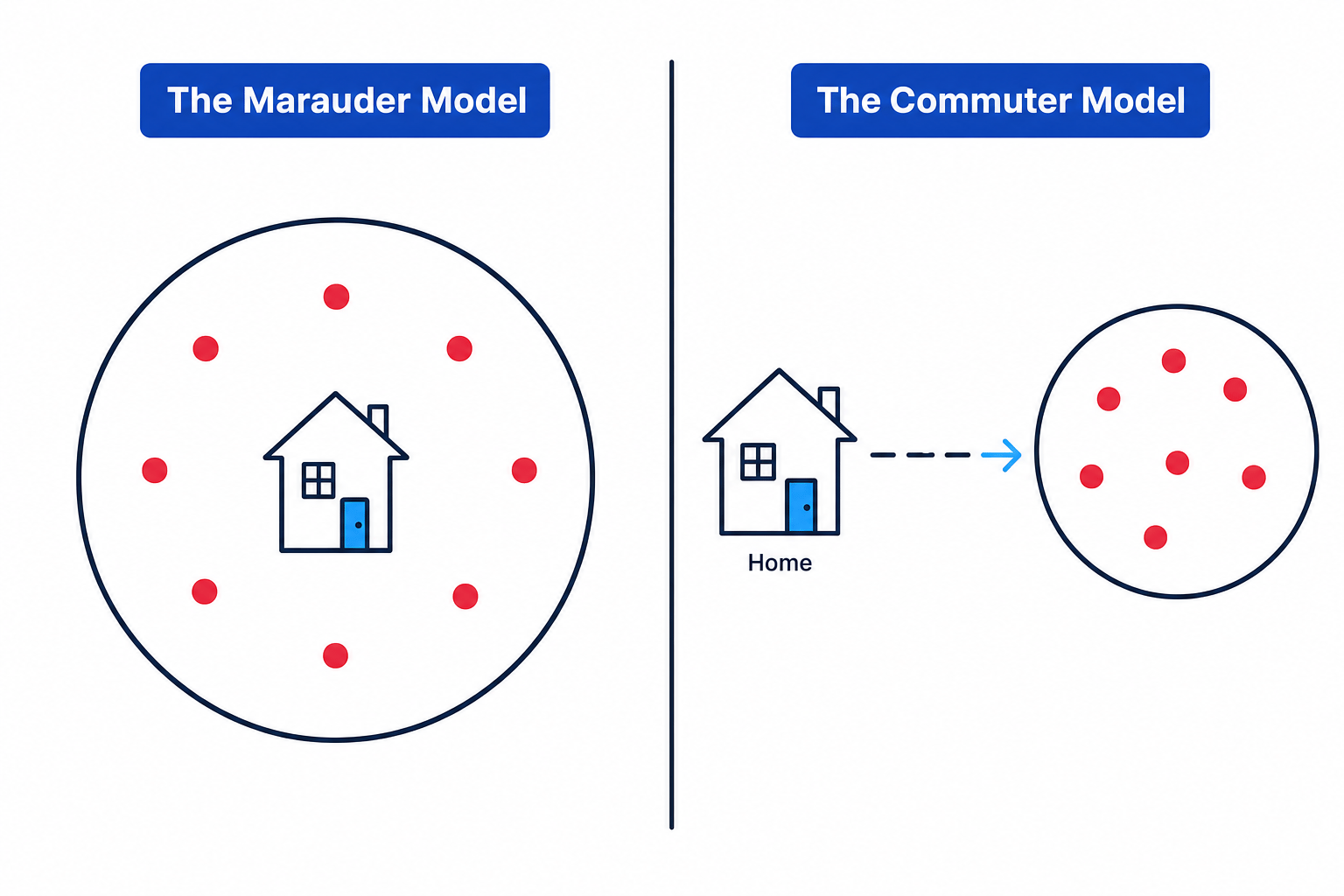
Proposed by Canter and Larkin (1993), Circle Theory suggests that if a circle is drawn around all the linked crime scenes of an offender, the offender's home base will typically be located towards the center of that circle.
Circle theory categorizes serial offenders into two distinct spatial models:
- The Marauder: This offender operates in close proximity to their home base, committing crimes in an area they are highly familiar with.
- The Commuter: This offender travels away from their home base to a different geographical area to commit crimes, meaning their home base lies outside the immediate cluster of crime scenes.
How to remember the difference
Think of a marauder as someone who raids their local neighborhood, while a commuter travels to work elsewhere—just like a regular commuter takes a train to a different city.
Evaluation of the Bottom-Up Approach (AO3)
- Scientific and Objective (Strength): Unlike the subjective intuition used in the top-down approach, investigative psychology uses empirical research, statistical databases, and advanced computer software (such as Canter’s Dragnet system). This makes the bottom-up approach more rigorous, reliable, and grounded in psychological science.
- Wider Application (Strength): The top-down approach is highly restricted and can only realistically be used for extreme crimes like serial murder and rape. Because the bottom-up approach relies on statistical analysis of spatial and behavioral patterns, it can be applied to much more common crimes, such as burglaries, arson, and car theft.
- Mixed Real-World Success (Limitation/Counterpoint): While bottom-up profiling has had famous successes, it is far from foolproof.
- Success (John Duffy): David Canter successfully profiled John Duffy (the "Railway Killer") in the 1980s. Canter correctly predicted 13 of Duffy's personal characteristics, including his geographical home base, his forensic awareness, and his marital status, leading to his arrest.
- Failure (Rachel Nickell Case): In 1992, Rachel Nickell was murdered on Wimbledon Common. Profiler Paul Britton constructed a profile that led police to target an innocent man, Colin Stagg, while ignoring the actual killer, Robert Napper. The police wasted time and resources on a highly controversial "honeytrap" operation based entirely on a flawed profile. This shows that profiling can lead to confirmation bias and miscarriages of justice.
In the exam
- Compare and contrast: If you are asked to compare the two approaches, use a clear structure. Contrast the starting points (the top-down approach starts with pre-existing categories; the bottom-up approach starts with raw data from the specific crime scene) and their origins (US FBI vs. UK academic psychology).
- Use research studies as AO3 evidence: Always cite Canter's research. Use Canter et al. (2004) to criticize the organised/disorganised distinction, and use the case of John Duffy to illustrate the successful application of the bottom-up approach.
- Be careful with evaluation terms: Do not simply say one approach is "better." Frame your comparison around specific criteria: scientific rigor, objectivity, applicability to different crime types, and practical utility.
Check yourself
- Why is the US approach called "Top-Down" while the British approach is called "Bottom-Up"?
- What are the main behavioral differences between an organised crime scene and a disorganised crime scene?
- According to Circle Theory, what is the geographical difference between a "marauder" and a "commuter"?
