What you'll learn
- How personality Types A, B and C are linked to stress-related behaviours.
- What research suggests about personality and physical illness, especially coronary heart disease and cancer.
- How hardiness may protect people from the negative effects of stress.
- How to evaluate this topic using AO1, AO2 and AO3 for essay answers.
The starting point: stress is not the same for everyone
Two people can face the same stressor — for example, exams, workload, family conflict or illness — but respond very differently. A stressor is something that creates a demand or pressure. A stress response is the psychological and biological reaction to that demand, such as anxiety, raised heart rate or release of stress hormones.
AQA’s “individual differences in stress” topic focuses on how personality may affect stress. In Psychology, personality means a relatively stable pattern of thinking, feeling and behaving.
Individual differences
Individual differences are stable variations between people, such as personality traits, that may influence how they experience, cope with and are affected by stress.
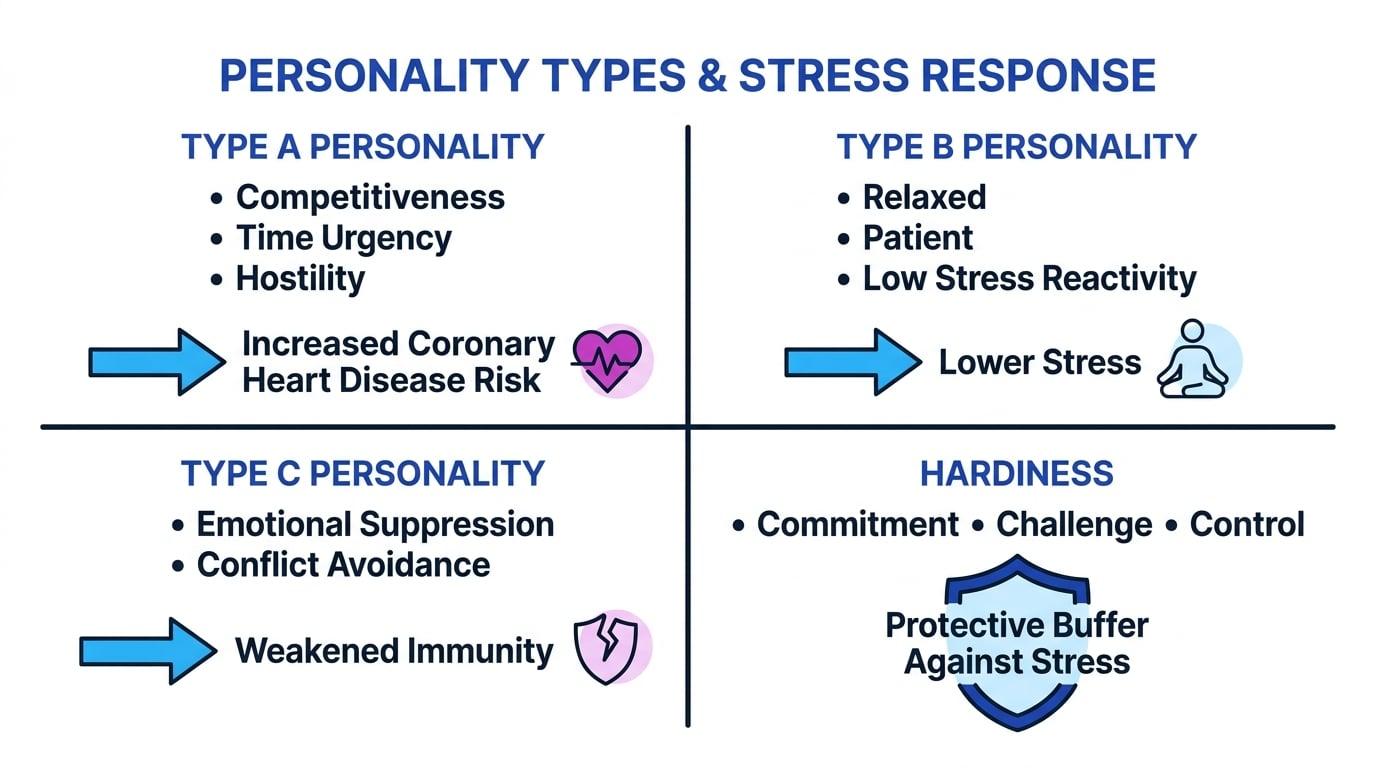
The overview below shows the main ideas: some personality patterns may increase stress vulnerability, while hardiness may act as a buffer.
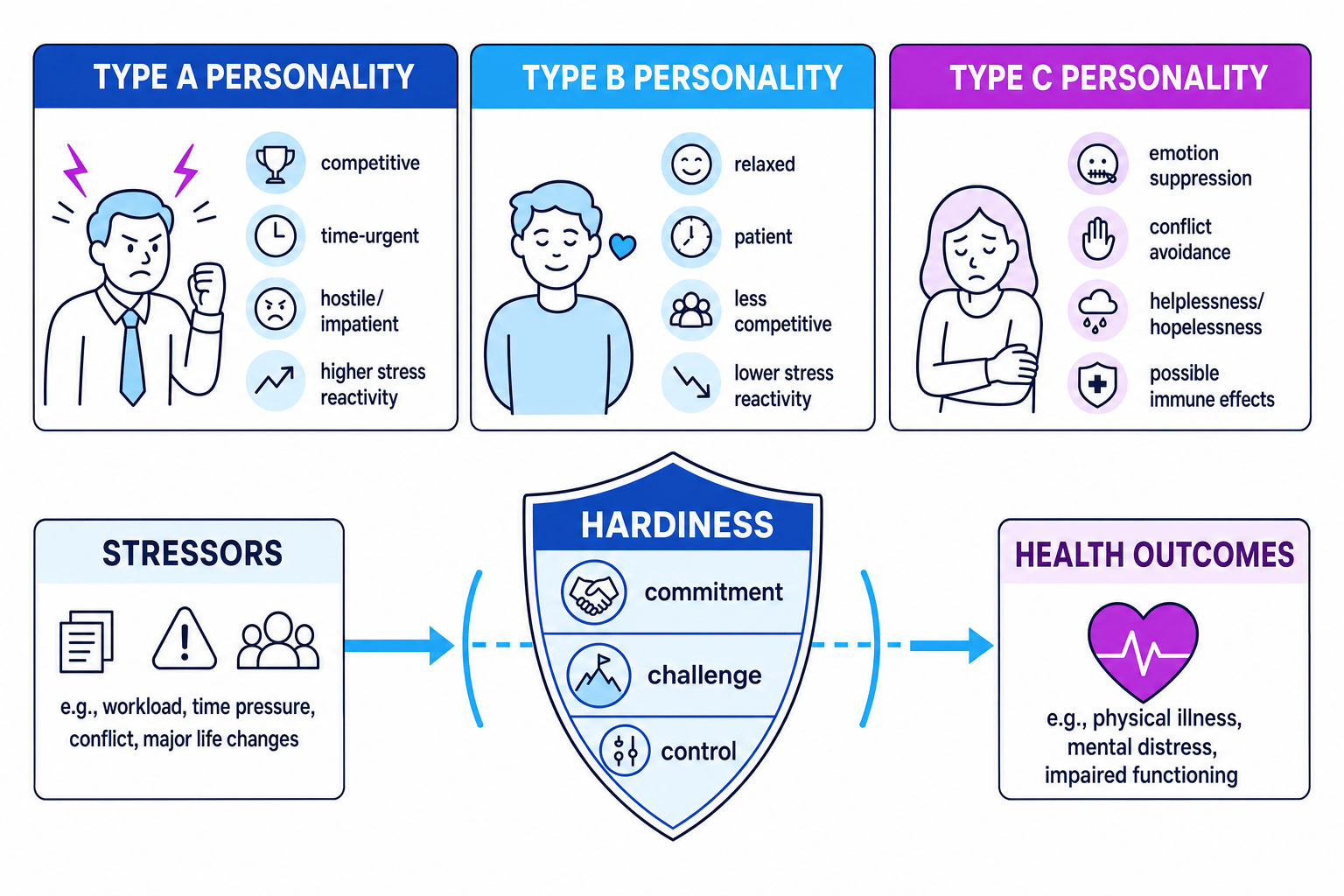
Personality types and stress
Type A personality
Type A personality was proposed by Friedman and Rosenman. It describes a pattern of behaviour linked to high achievement pressure and stress reactivity.
Common Type A behaviours include:
- Competitiveness — wanting to win or outperform others.
- Time urgency — feeling constantly rushed or impatient.
- Hostility — being easily angered, irritable or aggressive.
- High need for achievement — pushing hard to meet goals.
- Impatience — frustration with delays, queues or slow people.
The key idea is that Type A individuals may experience more frequent activation of the body’s stress systems, such as the sympathetic branch of the autonomic nervous system and the hypothalamic-pituitary-adrenal axis. Over time, this may contribute to health problems such as coronary heart disease.
Type A personality
Type A personality is a behaviour pattern involving competitiveness, time urgency, impatience and hostility, which has been associated with increased stress and risk of coronary heart disease.
Type B personality
Type B personality is usually described as the opposite pattern. Type B people tend to be more relaxed, patient and less competitive.
This does not mean Type B people are lazy or unambitious. It means they are less likely to respond to demands with hostility, urgency or constant pressure.
Type B personality
Type B personality is a behaviour pattern involving a more relaxed, patient and less competitive approach to life, generally associated with lower stress reactivity than Type A.
Applying Type A and Type B to workplace behaviour
A teacher is deciding whether two employees show Type A or Type B behaviour.
-
Employee 1 interrupts colleagues, becomes angry when meetings run late, and treats every task as a competition. These behaviours show time urgency, hostility and competitiveness, so they fit Type A.
-
Employee 2 works hard but stays calm when deadlines change, waits patiently for others and does not turn tasks into competitions. These behaviours fit Type B because the person is motivated without showing urgency or hostility.
-
If asked to link this to stress, Employee 1 may experience more frequent stress arousal because they appraise delays as threats or frustrations, whereas Employee 2 may appraise the same situations as manageable.
Evidence for Type A: Friedman and Rosenman
Friedman and Rosenman carried out the Western Collaborative Group Study. In Friedman and Rosenman (1974), over 3000 healthy Californian men aged 39–59 were assessed using a structured interview and classified as Type A or Type B. They were then followed for about 8.5 years to see who developed coronary heart disease.
The study found that Type A men were about twice as likely to develop coronary heart disease as Type B men. This supported the idea that personality-related behaviours may be linked to stress-related physical illness.
Ethically, this kind of research involves sensitive health and personality data. Participants should give informed consent, be told they can withdraw, have confidentiality protected, be debriefed, and be protected from unnecessary anxiety about their health risk.
AO3 evaluation of Type A research
A major strength is that Friedman and Rosenman used a prospective longitudinal design. This means they measured personality before illness developed, rather than asking ill people to remember their past personality. This makes the evidence stronger than a simple retrospective study.
However, the study was correlational. It shows an association between Type A behaviour and coronary heart disease, but it does not prove that Type A personality caused the illness. Other factors, such as smoking, diet, job type, social class or genetics, could also affect heart disease risk.
A further limitation is generalisability. The sample was male, Californian and middle-aged, so the findings may not apply equally to women, younger people or people from different cultures.
Later research also suggests that the whole Type A pattern may be too broad. Myrtek (2001), in a meta-analysis, found only limited evidence that Type A as a whole predicts coronary heart disease. The hostility component appears to be more important than competitiveness or achievement motivation.
Type A and coronary heart disease
For exams, do not just write “Type A causes heart disease”. A stronger answer is: Type A behaviours, especially hostility, have been associated with increased coronary heart disease risk, but the evidence is correlational and not fully consistent.
Type C personality
Type C personality is linked to emotional suppression rather than open hostility. It is sometimes described as a “cancer-prone” personality, although you must be very careful with that phrase.
Type C behaviours include:
- Suppressing negative emotions, especially anger.
- Avoiding conflict.
- Being overly compliant or eager to please.
- Feeling helpless or hopeless.
- Appearing passive in stressful situations.
The proposed mechanism is that long-term emotional suppression may maintain physiological stress responses and weaken immune functioning. This could, in theory, affect the body’s ability to resist or slow disease progression. However, this is much more controversial than simply saying stress affects health.
Type C personality
Type C personality is a pattern involving emotional suppression, conflict avoidance, compliance and helplessness, which has been associated in some research with cancer risk or progression.
Evidence for Type C
Temoshok (1987) studied people with malignant melanoma and found that emotional suppression and Type C characteristics were associated with disease progression. Greer and Morris (1975) also reported that women with malignant breast lumps were more likely to show extreme suppression of anger than women with benign lumps.
These studies raise important ethical issues. Cancer patients are a vulnerable group, so researchers must gain informed consent, protect confidentiality, allow withdrawal, debrief participants sensitively and avoid causing guilt or distress.
AO3 evaluation of Type C research
A key weakness is the problem of reverse causality. If someone has cancer, the illness itself may make them feel helpless, passive or emotionally withdrawn. This means Type C traits could be a consequence of illness rather than a cause.
Another issue is that cancer is influenced by many biological and environmental factors, including genetics, immune functioning, lifestyle, healthcare access and treatment quality. Reducing cancer risk to personality alone is overly simplistic.
There is also an ethical danger in blaming patients. Saying that emotional suppression “causes cancer” could make people feel responsible for their illness, which is both inaccurate and harmful.
Do not overstate Type C
Avoid writing that Type C personality causes cancer. A more accurate exam phrase is: “Some studies have found an association between Type C traits and cancer progression, but the direction of cause and effect is unclear.”
Hardiness: a protective personality style
The spec term is hardiness. This is a personality style that may protect people from the negative effects of stress. It was developed by Kobasa.
Hardiness has three components, often called the three Cs:
| Component | Meaning | What it looks like |
|---|---|---|
| Commitment | Being involved in life rather than detached | “This matters, so I’ll stay engaged.” |
| Challenge | Seeing change as normal and potentially useful | “This is difficult, but I can learn from it.” |
| Control | Believing you can influence events or your response | “I can take steps to manage this.” |
Hardiness
Hardiness is a personality style involving commitment, challenge and control, which may reduce the harmful effects of stress.
Commitment
Commitment means feeling involved in activities, relationships and goals. A hardy person does not withdraw completely when life becomes stressful. They stay engaged and try to find meaning in what they are doing.
Challenge
Challenge means viewing change and difficulty as part of life rather than as purely threatening. A hardy person may see a stressful event as demanding, but also as something that can lead to growth or learning.
Control
Control means believing you can influence outcomes, or at least influence your response. This does not mean believing you can control everything. It means avoiding helplessness and focusing on actions you can take.
Identifying the three Cs of hardiness
A student has received disappointing mock exam grades but wants to improve before the final exams.
-
Commitment is shown if the student stays engaged with Psychology rather than giving up, for example by attending lessons and completing revision tasks.
-
Challenge is shown if the student sees the mock result as feedback and an opportunity to improve, rather than as proof that they will fail.
-
Control is shown if the student creates a revision plan, asks for essay feedback and practises timed questions, because these are actions within their influence.
-
A hardiness explanation would predict lower stress-related harm because the student appraises the situation as manageable and uses active coping.
Evidence for hardiness: Kobasa
Kobasa (1979) studied American male business executives who had experienced high levels of stress. She compared those who became ill with those who stayed healthy. The executives who remained healthier tended to score higher on commitment, challenge and control.
This supports the idea that hardiness may buffer the effects of stressful life events.
Ethically, Kobasa’s research involved personal information about life events, personality and health. This means informed consent, confidentiality, the right to withdraw, sensitive debriefing and protection from distress were important.
AO3 evaluation of hardiness
A strength of hardiness is that it helps explain why not everyone exposed to the same stressor becomes ill. This makes the explanation more realistic than assuming stress affects everyone in the same way.
Hardiness also has useful real-world applications. Hardiness training, associated with Maddi, aims to help people reappraise stressors, develop active coping strategies and focus on controllable actions. This can be useful in workplaces, education and high-pressure occupations. Ethical use of training should involve consent and should not blame people for struggling with stress.
However, the evidence is largely correlational. Kobasa’s findings show that hardiness and health are related, but they do not prove that hardiness causes better health. It is possible that healthier people feel more in control and committed because they are healthier.
Another limitation is measurement. Hardiness is usually measured using questionnaires, so responses may be affected by social desirability or inaccurate self-perception. Hardiness may also overlap with other traits, such as optimism, self-efficacy or low neuroticism.
A final issue is generalisability. Kobasa’s original research focused on male American executives, so the findings may not apply equally to women, younger people, people in lower-paid jobs or people from different cultural backgrounds.
Remember the three Cs
For hardiness, remember: Commitment means staying involved, Challenge means seeing stress as an opportunity, and Control means believing you can take useful action.
Putting the topic together
Personality types and hardiness are both individual-difference explanations, but they work in slightly different ways.
Type A and Type C are usually presented as risk factors. Type A may increase stress through hostility and urgency. Type C may increase stress through emotional suppression and helplessness.
Hardiness is usually presented as a protective factor. It may reduce the impact of stress by changing how a person appraises demands and by encouraging active coping.
Best overall judgement
The strongest exam answers treat personality as one influence on stress, not the whole explanation. Stress-related illness is affected by personality, biology, coping style, social support, lifestyle and the nature of the stressor.
In the exam
-
For AO1, define each personality type clearly and include the behaviours: Type A is competitive/time-urgent/hostile, Type B is relaxed/patient, Type C suppresses emotion, and hardiness involves commitment, challenge and control.
-
For AO2, apply the behaviours to the scenario before naming the personality type. Show why the behaviour fits the concept.
-
For AO3, avoid deterministic claims. Use evidence such as Friedman and Rosenman (1974), Kobasa (1979), Temoshok (1987) and later contradictory findings to show that associations do not prove causation.
Check yourself
- How would you tell the difference between Type A hostility and Type C emotional suppression in a scenario?
- What are the three Cs of hardiness, and how might each reduce stress?
- Why is it risky to claim that personality directly causes illness?