When psychology first emerged as a distinct scientific discipline in the late 19th century, researchers struggled to find an objective way to study the mind. The early behaviourists rejected the vague, subjective method of introspection and argued that a true science of psychology should only study what can be directly observed and measured.
These study notes cover the two primary learning approaches required for your AQA A-Level: the Behaviourist Approach and Social Learning Theory (SLT).
What you'll learn
- How the behaviourist approach uses classical conditioning (learning by association) and operant conditioning (learning by consequence) to explain human behaviour.
- The mechanisms of key research studies by Ivan Pavlov (1927) and B.F. Skinner (1953).
- How Albert Bandura's Social Learning Theory (1961, 1963) bridged the gap between behaviourism and cognitive psychology by introducing mediational processes.
The Behaviourist Approach
The behaviourist approach is built on a few core assumptions:
- Observable behaviour only: We should only study behaviour that can be observed and measured. We cannot scientifically measure thoughts, feelings, or cognitive processes.
- The "Tabula Rasa": Behaviourists believe we are born as a blank slate, and all behaviour is learned from our environment.
- Animal generalisation: The basic laws of learning are shared across all species. Therefore, we can study animals (like rats and pigeons) in highly controlled lab environments and apply the findings to human behaviour.
Classical Conditioning: Learning by Association
Developed by Ivan Pavlov (1927), classical conditioning describes how we learn to associate a stimulus that naturally produces a response with a new, neutral stimulus.
Classical Conditioning
A type of learning in which an organism learns to associate two stimuli, so that a neutral stimulus eventually produces a response that was originally only produced by an unconditioned stimulus.
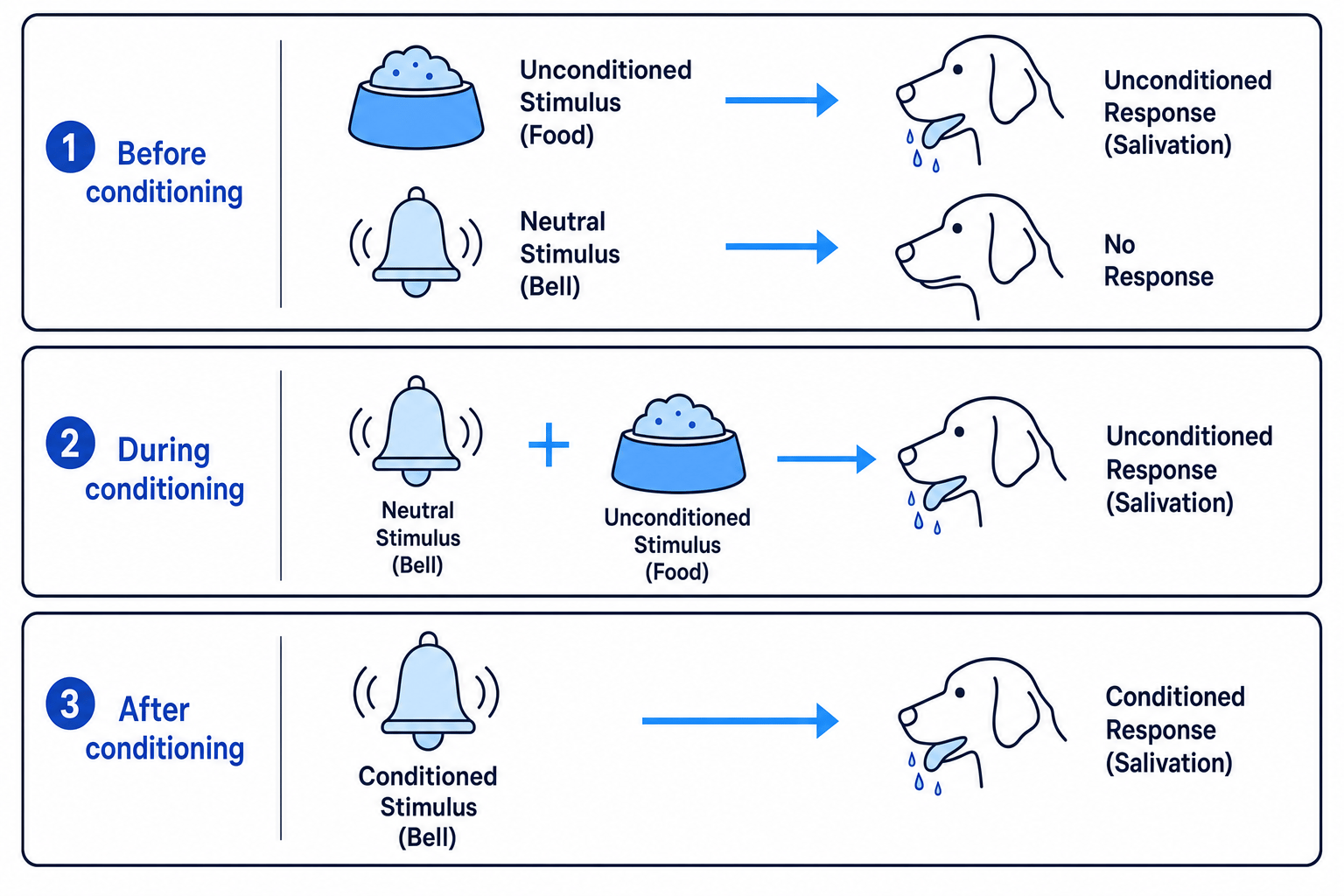
Before conditioning, an animal has natural, unlearned reflexes.
- An Unconditioned Stimulus (UCS) automatically triggers an Unconditioned Response (UCR). For example, food (UCS) naturally makes a dog salivate (UCR).
- A Neutral Stimulus (NS) is something in the environment that does not naturally trigger a response (e.g., the sound of a bell).
During conditioning, the Neutral Stimulus (bell) is repeatedly paired with the Unconditioned Stimulus (food). The animal begins to associate the bell with the food.
After conditioning, the Neutral Stimulus has become a Conditioned Stimulus (CS). It now triggers the response on its own, which is called the Conditioned Response (CR). The dog salivates when it hears the bell, even if no food is present.
Operant Conditioning: Learning by Consequence
While classical conditioning explains reflexive, involuntary responses, B.F. Skinner (1953) argued that active, voluntary behaviours are shaped by their consequences.
Operant Conditioning
A form of learning in which behaviour is shaped and maintained by its consequences. If a behaviour is followed by a desirable consequence, it is likely to be repeated; if followed by an undesirable consequence, it is less likely to be repeated.
Skinner designed an apparatus known as the Skinner Box to study operant conditioning in rats and pigeons. When a rat was placed in the box, it would explore active actions. If it accidentally knocked a lever, it received a food pellet (a reward). The rat quickly learned to repeat this behaviour to get more food.
Skinner identified three main types of consequences that modify behaviour:
- Positive Reinforcement: Receiving a pleasant stimulus/reward when a certain behaviour is performed. This increases the likelihood of the behaviour being repeated (e.g., a rat receiving a food pellet, or a student receiving praise for high-quality homework).
- Negative Reinforcement: The removal or avoidance of an unpleasant (aversive) stimulus when a certain behaviour is performed. This also increases the likelihood of the behaviour being repeated (e.g., a rat pressing a lever to stop a painful electric current, or putting on your seatbelt to stop the annoying beeping sound in your car).
- Punishment: An unpleasant consequence that makes a behaviour less likely to be repeated. This can be positive punishment (adding an unpleasant stimulus, like a detention) or negative punishment (removing a pleasant stimulus, like confiscating a phone).
Reinforcement vs. Punishment
Always remember their core functions:
- Reinforcement (both positive and negative) increases the frequency of a behaviour.
- Punishment decreases the frequency of a behaviour.
Negative Reinforcement is NOT Punishment
Students frequently write that negative reinforcement reduces a behaviour or is a form of punishment. This is incorrect! "Negative" simply means taking something away. Negative reinforcement means taking away something bad to reward a good behaviour. Both positive and negative reinforcement always increase the likelihood of the behaviour being repeated.
Worked Example: Applying Conditioning Concepts
In the exam, you may be given a scenario and asked to identify and apply conditioning concepts (AO2 application).
Identifying Types of Consequences
Scenario: Leo is a primary school child who often disrupts class. When he makes jokes, his classmates laugh, which he loves. To stop this, his teacher implements two new rules:
- Every time Leo completes a task quietly, he is awarded a gold star.
- If he shouts out in class, he is kept in at break time.
Task: Using operant conditioning terms, identify and explain the three consequences affecting Leo's behaviour.
- Analyze the first behaviour (classmates laughing): Laughing acts as positive reinforcement. Leo makes jokes (the behaviour) and receives a pleasant consequence (his peers laughing). This increases the frequency of his joke-making behaviour.
- Analyze the second behaviour (gold stars): The gold star acts as positive reinforcement. When Leo completes a task quietly (the behaviour), the teacher adds a pleasant stimulus (the gold star). This increases the likelihood that Leo will complete his tasks quietly in the future.
- Analyze the third behaviour (shouting out): Being kept in at break time acts as negative punishment. When Leo shouts out (the behaviour), the teacher removes a pleasant stimulus (his free time at break). This decreases the likelihood that Leo will shout out in class in the future.
Social Learning Theory (SLT)
In the 1960s, Albert Bandura argued that the strict behaviourist view was too simplistic. He proposed Social Learning Theory (SLT) as a development of behaviourism, suggesting that humans learn through observing others within a social context.
Unlike behaviourists, Bandura believed that cognitive (mental) processes play a crucial role in learning, serving as a mediator between stimulus and response.
Social Learning Theory (SLT)
A way of explaining behaviour that includes both direct and indirect reinforcement, combining learning theory with cognitive factors.
Key Concepts of SLT
To write a strong AO1 description of SLT, you must define and use its precise terminology:
- Imitation: Copying the behaviour of others. This is much faster than operant conditioning because the entire sequence of behaviour can be learned at once.
- Modelling: A person performs a behaviour that is observed by others. This person is called a model. Models can be live (e.g., a parent, teacher, or peer) or symbolic (e.g., a character in a TV show or a celebrity).
- Identification: An observer associates themselves with a model and wants to be like them. People are more likely to identify with models who are of a similar age, the same gender, or who possess high status and attractiveness.
- Vicarious Reinforcement: Learning by observing the consequences of someone else's behaviour. If an observer sees a model get rewarded for an action, they are highly likely to imitate it. If they see the model get punished, they are much less likely to copy it.
Vicarious Reinforcement
Indirect reinforcement which occurs when an observer sees a model being rewarded for a behaviour. The observer expects similar rewards and is motivated to imitate the behaviour.
The Role of Mediational Processes
Bandura identified four cognitive factors, known as mediational processes, that determine whether a new response is acquired. Two of these govern the learning of the behaviour, and two govern its performance.
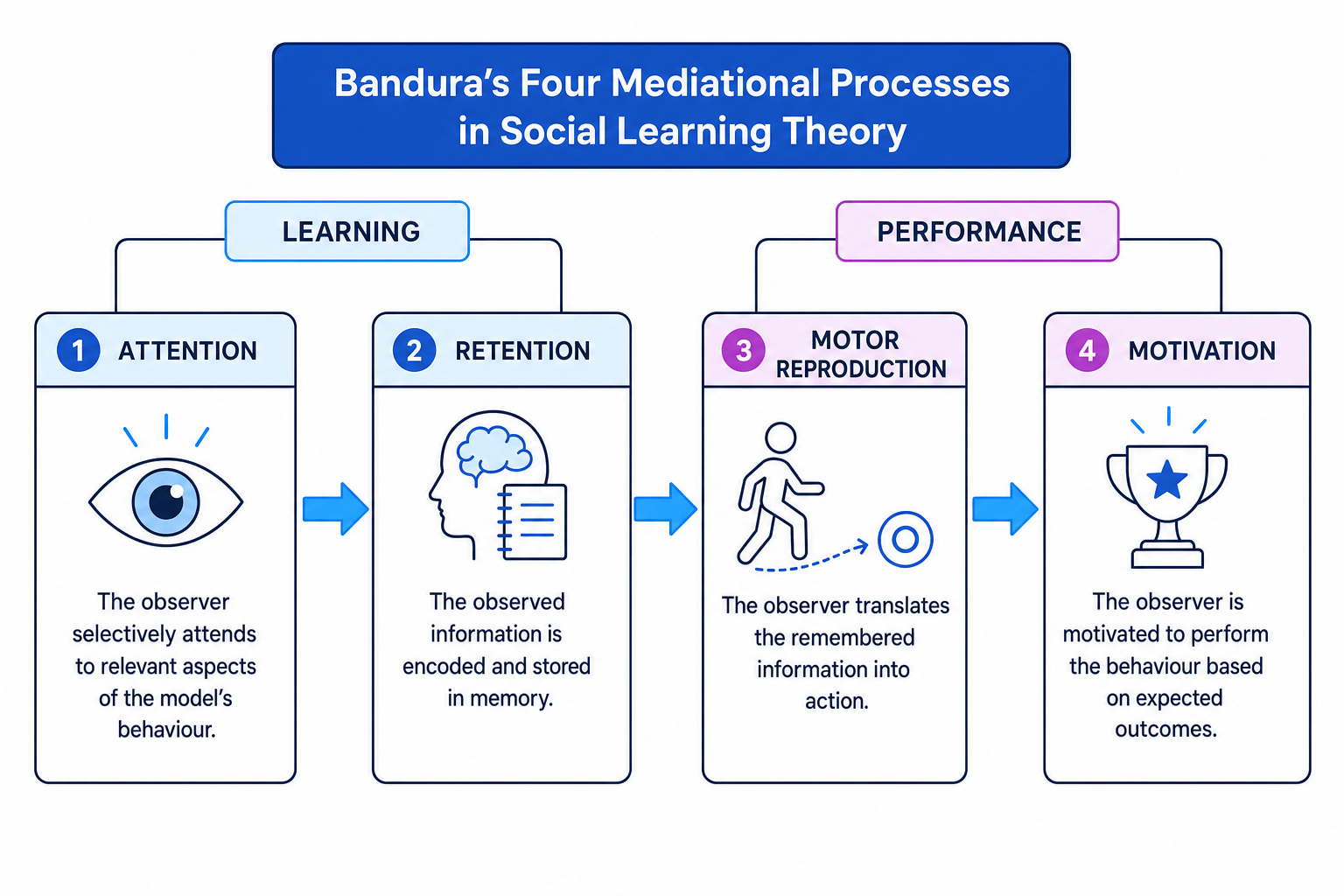
- Attention (Learning): The extent to which we notice the behaviour. We cannot learn a behaviour unless we pay attention to it.
- Retention (Learning): How well the behaviour is remembered. The observer must store a mental representation of the behaviour in their memory.
- Motor Reproduction (Performance): The physical ability of the observer to perform the behaviour. We might see a gymnastics routine and pay full attention, but we cannot reproduce it if we lack the physical skill.
- Motivation (Performance): The will to perform the behaviour. This is heavily influenced by whether the model was rewarded (vicarious reinforcement) or punished.
Learning vs. Performance
Unlike behaviourists, Bandura noted that learning and performance do not have to occur at the same time. An observer can learn a behaviour (Attention and Retention) but store it away, only performing it later (Motor Reproduction and Motivation) when the context is right.
Bandura's Key Research: The Bobo Doll Studies
Bandura conducted controlled laboratory experiments to test SLT:
- Bandura, Ross & Ross (1961):
- Method: 72 young children (aged 3 to 5) observed an adult model interacting with an inflatable plastic "Bobo Doll". Group 1 saw the adult behave aggressively toward the doll (hitting it with a mallet, kicking it, shouting abuse). Group 2 saw a non-aggressive adult playing quietly. Group 3 was a control group who saw no model. The children were then taken to a playroom with toys, including a Bobo doll, but were initially told they couldn't play with the best toys to trigger mild frustration.
- Findings: Children who observed the aggressive model reproduced a high number of identical physical and verbal aggressive behaviours. Children in the non-aggressive or control groups showed virtually no aggression.
- Bandura & Walters (1963):
- Method: Children watched a film of an adult being aggressive to the Bobo Doll. Group 1 saw the model praised/rewarded for their aggression. Group 2 saw the model scolded/punished. Group 3 (control) saw the model receive no consequence.
- Findings: Group 1 (rewarded model) showed the highest level of aggression. Group 2 (punished model) showed the lowest level of aggression. This clearly demonstrated the power of vicarious reinforcement.
Evaluating Learning Approaches (AO3)
For your AQA exams, you must be able to critically evaluate these theories. Here is a breakdown of the key strengths and limitations for essay answers.
Evaluating the Behaviourist Approach
Strengths
- Scientific Credibility: Behaviourism brought the language and methods of the natural sciences into psychology. By focusing on observable behaviour in highly controlled lab settings, behaviourists emphasized replication and objectivity. This helped establish psychology as a credible scientific discipline.
- Real-World Applications:
- Token Economies: Used in prisons and psychiatric wards, these reward desirable behaviour with tokens that can be exchanged for privileges (operant conditioning).
- Therapy: Systematic desensitization utilizes classical conditioning principles to extinguish phobias by pairing the feared object with relaxation.
Limitations
- Environmental Determinism: The approach sees all behaviour as determined by past experiences that have been conditioned. Skinner famously argued that "free will is an illusion." This ignores any conscious decision-making or personal choice in human behaviour.
- Animal Extrapolation and Ethical Issues: While Skinner and Pavlov maintained high control, they used animals. Critics argue that human cognitive processing is far too complex to be explained using rats or dogs. Furthermore, animals in the Skinner box were often kept hungry (to motivate them) and exposed to stressful, painful conditions, raising ethical concerns.
Evaluating Social Learning Theory (SLT)
Strengths
- Cognitive Integration: SLT provides a more comprehensive explanation of human learning than behaviourism by recognizing the role of mediational processes. It acknowledges that humans do not merely react to their environment; we interpret and think about the consequences of our actions.
- Explains Cultural Differences: Because SLT relies on observation, it can explain how cultural norms are passed down through generations. Children learn behaviors (such as gender roles or social customs) by observing models around them, explaining differences across cultures.
Limitations
- Over-reliance on Lab Evidence (Demand Characteristics): Bandura's Bobo doll experiments were highly artificial. The primary purpose of a Bobo doll is to be knocked over. Critics argue that the children were simply behaving in a way they thought was expected of them (demand characteristics), rather than expressing genuine aggression.
- Underestimates Biological Factors: Bandura paid very little attention to biological influences. In the Bobo doll studies, boys were consistently more aggressive than girls across all conditions. This could be explained by biological factors like higher levels of testosterone in boys, which is linked to aggressive behaviour, rather than purely social learning.
In the exam
- Never confuse Classical and Operant Conditioning. When a question asks you to outline the "behaviourist approach", ensure you clearly split your answer into Pavlov (classical) and Skinner (operant) with their respective terms.
- Be highly precise with SLT terms. Don't just say "learning by watching". Use the words modelling, imitation, identification, and vicarious reinforcement. Make sure you can name and define all four mediational processes in order.
- Use the "PEEL" structure for AO3. State your Point (e.g., One strength of SLT is its recognition of cognitive factors), Explain it (describe mediational processes), provide Evidence/Example (contrast it with behaviorism's passive view), and Link it back to the question (showing why this makes the theory more complete or valid).
Check yourself
- Can you explain why Pavlov's dog salivating to a bell is a conditioned response, but salivating to meat is an unconditioned response?
- A parent stops nagging their teenager once the teenager cleans their bedroom. Is this positive reinforcement, negative reinforcement, or punishment? Explain why.
- What is the crucial difference between imitation and identification in Social Learning Theory?
- How did Bandura and Walters (1963) demonstrate the concept of vicarious reinforcement?
