What you'll learn
- What the cognitive approach means by “internal mental processes”.
- How schemas help us process information, but can also bias perception and memory.
- How psychologists use models and inference to study processes they cannot directly observe.
- How to evaluate the cognitive approach for AO3 essay answers.
The basic idea: behaviour is shaped by thinking
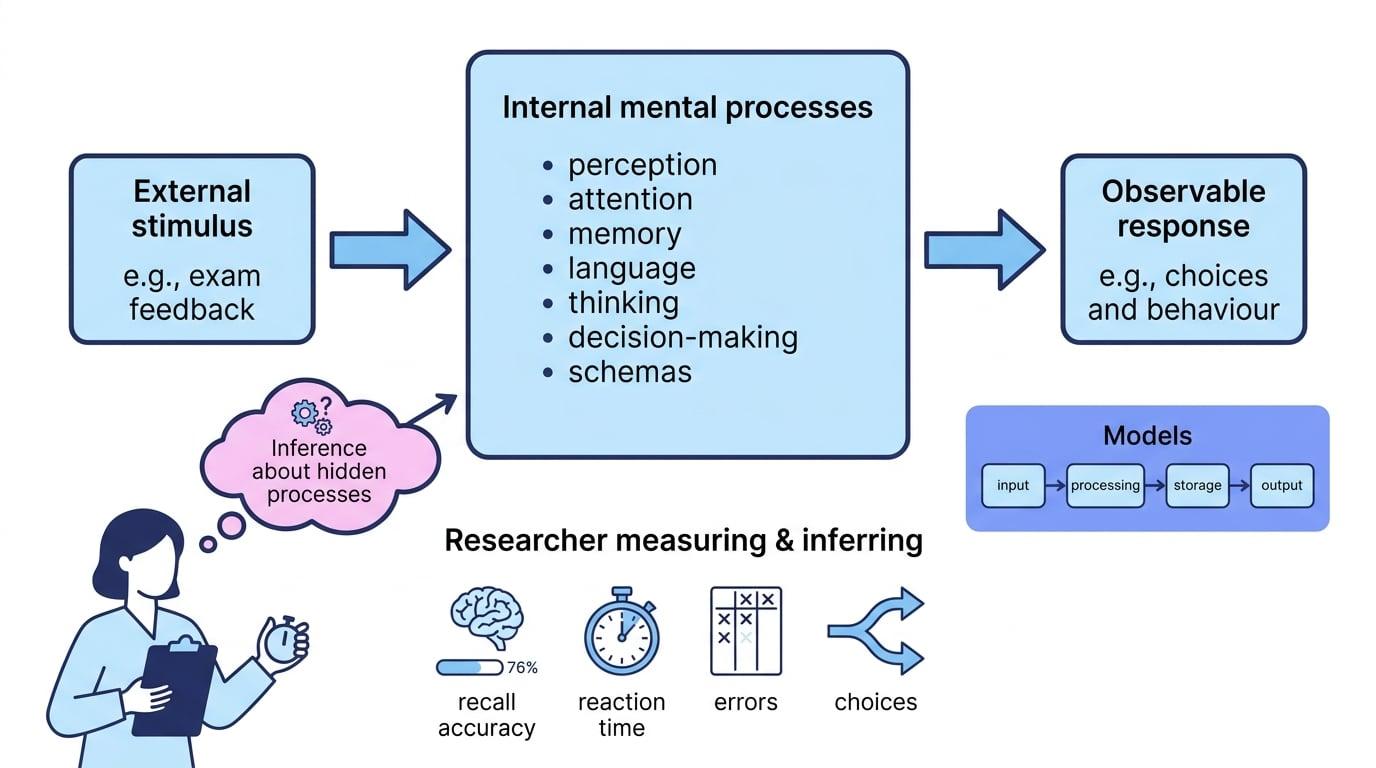
The cognitive approach developed partly as a response to behaviourism, which focused mainly on observable stimulus-response links. Cognitive psychologists agreed that behaviour matters, but argued that we also need to study what happens between a stimulus and a response.
For example, if two students receive the same exam feedback but react differently, the cognitive approach would ask: How did each student interpret the feedback? What did they remember? What did they expect? What decision did they make next?
Cognitive approach
The cognitive approach is an approach in psychology that studies internal mental processes, such as perception, attention, memory, language, thinking and decision-making.
These processes are “internal” because they happen inside the mind and cannot be directly observed in the same way as behaviour.
Core assumption
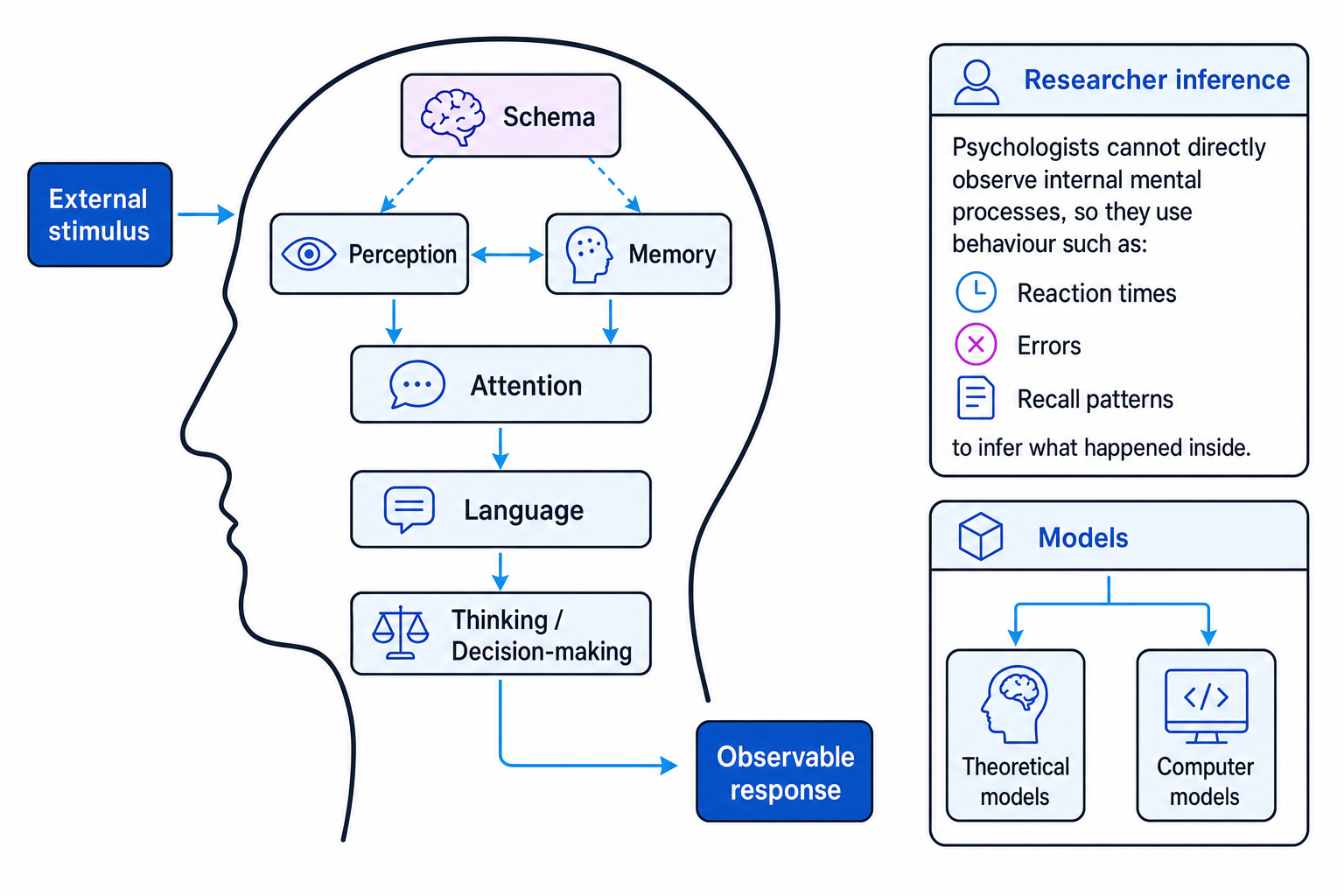
The cognitive approach assumes that behaviour is influenced by how people process information, not just by the external situation itself.
Internal mental processes
What counts as an internal mental process?
An internal mental process is a private cognitive activity that helps a person interpret the world and produce behaviour. Important examples include:
- Perception — organising and interpreting sensory information.
- Attention — selecting some information for processing while ignoring other information.
- Memory — encoding, storing and retrieving information.
- Language — understanding and producing words and meaning.
- Thinking — manipulating information, solving problems and making judgements.
Cognitive psychologists often describe humans as information processors. This means the mind is seen as taking in information, transforming it, storing it and using it to guide behaviour.
The mind as an information processor
A simple analogy is a computer: information is input, processed, stored and used to produce output. The analogy is useful, but it is not perfect — human thinking is emotional, social and biological too.
Studying processes we cannot directly see
A major challenge is that we cannot directly watch someone’s memory, attention or decision-making. Instead, psychologists measure observable behaviour, such as reaction times, mistakes, recall accuracy or choices, and use these to make careful conclusions.
Inference
An inference is a logical conclusion about an internal mental process based on observable evidence, such as behaviour or brain activity.
For example, if a participant takes longer to name the ink colour of the word “BLUE” when it is printed in red ink, a researcher may infer that reading the word interfered with attention and response selection.
Inferring a mental process from behaviour
A researcher gives participants two memory tasks. In Task A, words are grouped into categories. In Task B, the same number of words are random. Participants recall more words in Task A.
- Compare the observable behaviour: recall is higher when words are organised into categories than when they are random.
- Link the difference to a possible internal process: categories may help participants organise the information during encoding and retrieval.
- Make the inference: memory is not just passive storage; it is affected by how information is processed and structured.
Do not say thoughts are directly observed
Cognitive psychologists do not directly observe internal mental processes. They infer them from evidence, often using controlled experiments.
Schemas: mental frameworks
A key concept in the cognitive approach is the schema.
Schema
A schema is a mental framework of knowledge and expectations that helps us interpret information quickly.
Schemas are built from experience. You probably have schemas for classrooms, restaurants, teachers, exams, friendships and many other things. These frameworks help you make sense of the world without processing every detail from scratch.
For example, when you enter a restaurant, you do not need to relearn what tables, menus, waiters or ordering food mean. Your restaurant schema helps you understand the situation quickly.
How schemas affect processing
Schemas are useful because they make information processing faster and more efficient. They help with:
- Perception — noticing and interpreting what is happening.
- Memory — organising information so it can be stored and retrieved.
- Prediction — anticipating what is likely to happen next.
However, schemas can also distort processing. We may notice information that fits our expectations and ignore information that does not. This means schemas can contribute to bias.
Schemas are helpful but risky
Schemas speed up thinking, but they can also lead to inaccurate memories, stereotypes and biased interpretations.
Research support: Bartlett 1932
A classic study of schemas is Bartlett (1932). He asked British participants to read a Native American folk story called The War of the Ghosts and later recall it.
Participants often changed details to make the story fit their own cultural expectations. For example, unfamiliar details were left out or altered. Bartlett concluded that memory is reconstructive, meaning people actively rebuild memories using schemas rather than replaying a perfect recording.
Ethically, this study was low-risk, but by modern standards researchers would still need informed consent, the right to withdraw, confidentiality and debriefing.
Applying schemas to a scenario
A student remembers a teacher saying, “This paragraph needs improvement,” as “This essay is terrible.” The student already believes the teacher dislikes them.
- Identify the relevant schema: the student has a “teacher dislikes me” schema.
- Apply it to the interpretation: the neutral feedback is processed through this expectation, making it seem more negative.
- Link it to behaviour: the student may feel upset or avoid asking for help because their schema has biased their interpretation.
Schemas do not always cause errors
Do not write as if schemas are only bad. Schemas are essential for efficient thinking; the AO3 point is that they can sometimes produce bias or distortion.
Models in the cognitive approach
Because mental processes cannot be directly observed, cognitive psychologists use models to represent how they might work.
Model
A model is a simplified representation of a mental process, used to explain how information may be processed.
Models are not meant to be exact copies of the mind. They are tools for explanation, prediction and research.
Theoretical models
A theoretical model represents mental processes using concepts, diagrams or stages. For example, memory models often show information moving through stages such as encoding, storage and retrieval.
A theoretical model is useful because it breaks a complex process into smaller parts. This makes it easier to test predictions.
For instance, a model might suggest that short-term memory and long-term memory are separate stores. Researchers can then test whether different types of evidence support that separation.
Computer models
A computer model compares the mind to a computer system. It may describe mental processes in terms of:
- Input — information coming in from the environment.
- Processing — operations performed on the information.
- Storage — holding information for later use.
- Output — the resulting behaviour or response.
Some computer models are actual simulations, where researchers create programs designed to imitate aspects of human thinking.
Model vs theory
A model is usually a simplified representation of a process. A theory is a broader explanation. In essays, you can say models help cognitive psychologists turn abstract mental processes into something testable.
Cognitive neuroscience
Although the spec extract focuses on internal processes, schemas and models, it is useful to know the wider development of the approach: cognitive neuroscience.
Cognitive neuroscience
Cognitive neuroscience is the scientific study of how brain structures and biological processes are linked to cognitive processes.
This area grew as brain-scanning techniques improved. For example, researchers can use fMRI to investigate which brain areas are active during memory tasks or language processing.
This strengthens the cognitive approach because it connects abstract mental processes to physical brain activity. However, brain activity still needs interpretation: seeing an area “light up” does not automatically explain the exact thought process taking place.
AO3 evaluation of the cognitive approach
Strength: scientific methods
The cognitive approach often uses controlled laboratory experiments. This allows researchers to control extraneous variables and establish cause-and-effect relationships more confidently.
For example, memory researchers can manipulate the type of word list participants learn and measure recall accuracy. This makes cognitive research more objective than simply asking people what they think happened.
Strength: useful real-world applications
The cognitive approach has had important applications, especially in education, therapy and eyewitness testimony.
For example, cognitive ideas about memory and schemas help explain why eyewitnesses may misremember events. Research such as Loftus and Palmer (1974) showed that leading questions can affect memory reports. Participants who heard the verb “smashed” estimated higher car speeds than those who heard “hit”.
Ethically, Loftus and Palmer involved some deception because participants were not fully aware of the study’s aim. However, the research was relatively low-risk, and participants should be debriefed, protected from harm and allowed to withdraw.
Weakness: machine reductionism
The computer analogy can be criticised for machine reductionism.
Machine reductionism
Machine reductionism is the criticism that the cognitive approach may oversimplify human thinking by comparing the mind too closely to a computer.
Humans are not just information-processing machines. Emotions, motivation, social context and biology can all affect thinking. For example, anxiety can influence attention and memory, which a simple computer model may not fully explain.
Weakness: inference can be uncertain
Because internal mental processes are private, psychologists must infer them from behaviour. This means explanations may be less direct than in approaches that measure observable behaviour or biological activity.
For example, poor recall might be due to weak encoding, poor retrieval, low motivation, distraction or misunderstanding the task. The researcher must design studies carefully to rule out alternative explanations.
Balanced point: not anti-biological
The cognitive approach is sometimes wrongly treated as completely separate from biology. In fact, modern cognitive psychology often overlaps with neuroscience. Cognitive neuroscience is a good example of this interaction.
Strong AO3 balance
A balanced evaluation can say: cognitive research is scientific and useful, but internal mental processes are still inferred, so conclusions depend heavily on the quality of the research design.
AO2: applying the approach in exam scenarios
If a scenario describes someone interpreting, remembering, attending to or deciding something, you can usually apply the cognitive approach.
For example:
- A person avoids dogs after remembering a frightening childhood event.
- A witness gives inaccurate evidence because a leading question changed their recall.
- A student assumes they will fail because they have a negative schema about exams.
- A person reacts slowly because two sources of information compete for attention.
When applying the approach, name the internal process and explain how it affects behaviour.
Application must go beyond naming
Do not just write “this is due to memory” or “this is due to schemas”. Explain how the person’s thinking changes their interpretation, recall or response.
In the exam
- For AO1, define the key term clearly: internal mental processes, schema, inference or model.
- For AO2, link the scenario to a specific process, such as attention, memory, perception or decision-making.
- For AO3, evaluate with a clear strength and limitation: scientific evidence, real-world applications, machine reductionism, or the problem of inference.
Check yourself
- What is meant by an internal mental process, and why can it not be directly observed?
- How can a schema help thinking but also create bias?
- What is the difference between a theoretical model and a computer model?