What you'll learn
- How genetic explanations suggest some people inherit a vulnerability to OCD.
- How neural explanations link OCD to neurotransmitters and brain circuits.
- How drug therapy, especially SSRIs, is used to treat OCD.
- How to evaluate these explanations and treatments using AO3 evidence and limitations.
Starting point: what is OCD?
Obsessive-compulsive disorder, or OCD, is a mental disorder involving obsessions, compulsions, or both.
Obsessions and compulsions
- Obsessions are repeated, intrusive, unwanted thoughts, images, impulses or doubts that cause anxiety.
- Compulsions are repetitive behaviours or mental acts carried out to reduce anxiety or prevent a feared event.
For example, a person may have an obsession that their hands are contaminated, and a compulsion to wash them repeatedly. The compulsion usually reduces anxiety in the short term, but it does not remove the obsession permanently.
OCD is not just liking things tidy
In exam answers, avoid describing OCD as simply “being neat” or “being organised”. OCD is distressing, time-consuming, and involves unwanted thoughts and/or repetitive actions that interfere with daily life.
What does the biological approach assume?
The biological approach explains behaviour and mental disorders in terms of physical processes, such as genes, brain structures, neurotransmitters and hormones.
Biological approach to OCD
For OCD, the biological approach focuses on two main explanations: genetic vulnerability and neural abnormality. It also leads to drug therapy, which aims to change brain chemistry.
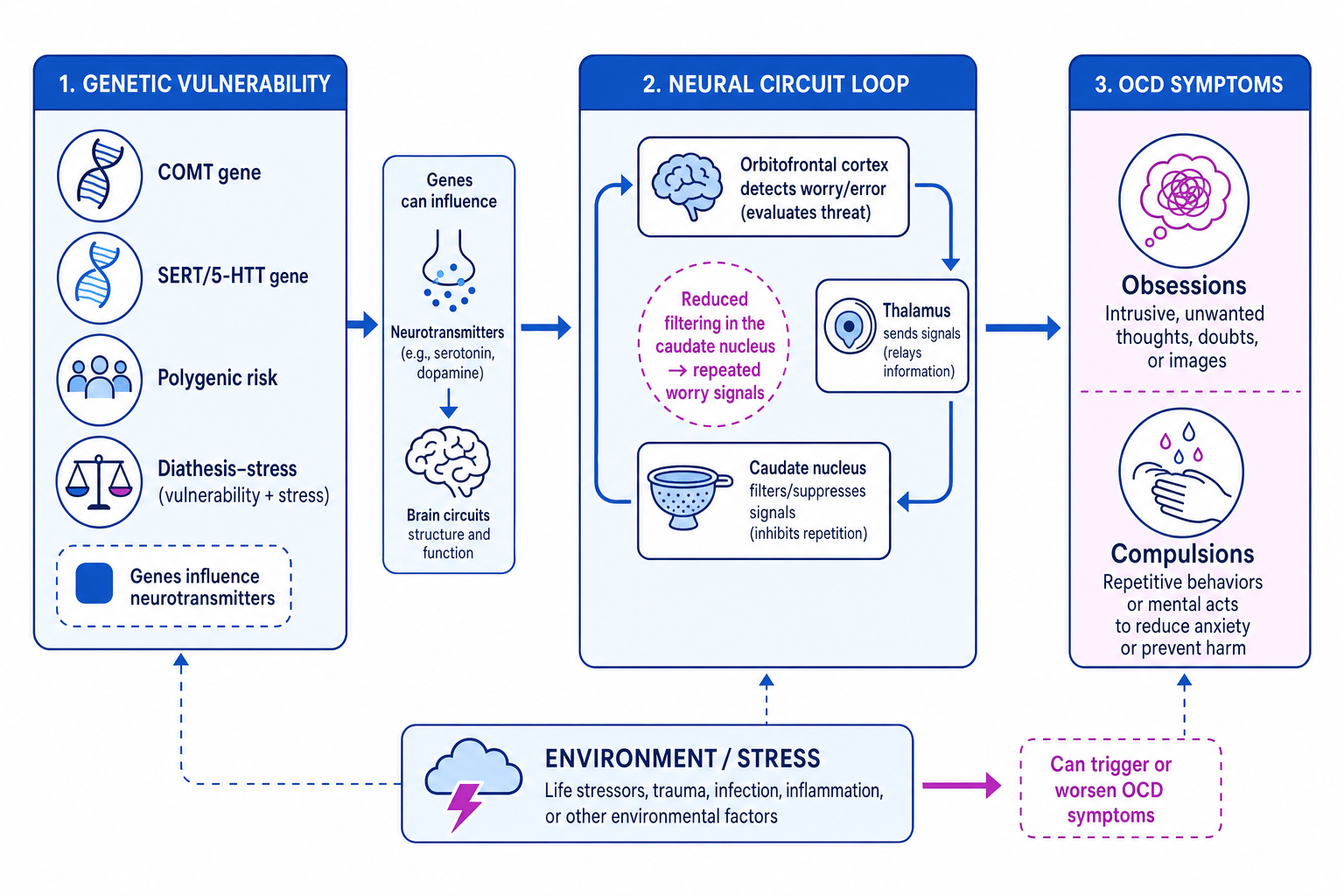
The diagram below shows how the biological explanation fits together: genes may influence neurotransmitters and brain circuits, while stress or environment can trigger symptoms.
Genetic explanations of OCD
A gene is a section of DNA that influences a characteristic, such as eye colour or aspects of nervous system functioning. A genetic explanation of OCD suggests that some people inherit genes that make them more vulnerable to developing OCD.
This does not mean there is one “OCD gene”. Most psychologists argue that OCD is polygenic, meaning many genes each make a small contribution to risk.
Polygenic
A disorder is polygenic if it is influenced by several genes rather than one single gene.
Two candidate genes often discussed are:
- COMT gene: affects the breakdown of dopamine, a neurotransmitter involved in movement, reward and attention.
- SERT / 5-HTT gene: affects serotonin transport, which may influence mood and anxiety regulation.
OCD is also thought to be aetiologically heterogeneous. This means different people may develop OCD for different biological reasons. One person’s OCD may be linked more strongly to serotonin, while another person’s may involve different genes or circuits.
Diathesis-stress
The diathesis-stress model says a person may inherit a biological vulnerability, but the disorder may only develop if environmental stress triggers it.
Evidence for genetic explanations
Family and twin studies support a genetic role. Lewis (1936) found that 37% of OCD patients had parents with OCD, and 21% had siblings with OCD. More recent twin research, such as Nestadt et al. (2010), found higher concordance rates for OCD in identical twins than non-identical twins.
A concordance rate is the probability that one twin has a trait or disorder if the other twin has it.
Applying a genetic explanation to OCD symptoms
A student, Amira, develops checking compulsions after moving away to university. Her mother has a history of OCD.
- Amira’s family history suggests she may have inherited a genetic vulnerability, rather than OCD appearing randomly.
- The move to university could act as an environmental stressor, so the diathesis-stress model explains why symptoms emerge now rather than earlier.
- A strong answer would avoid saying “her mother caused her OCD”. Instead, it would say genes may increase risk, while stress helps trigger the disorder.
- To strengthen AO2, link the explanation to symptoms: the vulnerability may affect brain chemistry or worry circuits, contributing to repeated checking.
Evaluating genetic explanations
A strength is that there is consistent evidence from family and twin studies. If OCD were purely environmental, identical twins would not usually show higher concordance than non-identical twins.
However, twin studies do not prove that genes cause OCD. Identical twins often share more similar environments than non-identical twins, so higher concordance could partly reflect shared experiences. Also, concordance is not 100%, which shows OCD is not fully genetic.
Genetic research also raises ethical issues. Researchers must gain informed consent, protect confidentiality because genetic data is sensitive, remind participants of their right to withdraw, and provide a debrief. They should also protect participants from harm, such as anxiety about discovering a genetic risk.
AO3 shortcut
For genetic explanations, a balanced conclusion is: “Genes appear to increase vulnerability, but they do not determine OCD on their own.”
Neural explanations of OCD
A neural explanation explains OCD through the brain and nervous system. This includes neurotransmitters and brain structures.
Neurotransmitter
A neurotransmitter is a chemical messenger that passes signals between neurons across a synapse.
Serotonin and dopamine
The neurotransmitter most commonly linked to OCD is serotonin, which is involved in mood and anxiety regulation. Low or disrupted serotonin activity may make it harder for a person to regulate anxiety and intrusive thoughts.
Dopamine may also be involved, especially in repetitive behaviours and reward-related learning. This links to the COMT gene, because COMT helps regulate dopamine levels.
Brain circuits: the worry loop
Several brain areas are linked to OCD:
- The orbitofrontal cortex is involved in detecting threat, worry and possible mistakes.
- The thalamus relays information around the brain.
- The caudate nucleus helps suppress or filter repeated worry signals.
In OCD, the caudate nucleus may fail to filter worry signals properly. As a result, the thalamus keeps sending signals back to the orbitofrontal cortex. This can create a loop of repeated anxiety, doubt and checking.
Tracing the neural loop in a contamination obsession
A person repeatedly thinks, “My hands are contaminated,” even after washing them.
- The orbitofrontal cortex detects a possible threat: contamination.
- The caudate nucleus should filter out the threat signal once the person has washed their hands, but in OCD this filtering may be inefficient.
- The thalamus continues to relay the threat signal, so the person still feels anxious.
- The person washes again to reduce anxiety, but the underlying neural loop remains active.
Evaluating neural explanations
A strength is that brain-scanning research has found abnormal activity in areas such as the orbitofrontal cortex and caudate nucleus in people with OCD. This gives the explanation scientific support because brain scans provide objective biological evidence.
However, neural evidence is often correlational. If a person with OCD has unusual brain activity, we cannot be certain whether the abnormality caused OCD or developed because of repeated obsessive-compulsive behaviour.
Another limitation is biological reductionism. Neural explanations can ignore learning, cognitive beliefs and life experiences. For example, two people may have similar biological vulnerabilities, but only one develops OCD after trauma or chronic stress.
Ethically, brain-imaging studies should ensure consent, confidentiality and protection from harm. Participants may feel anxious if told their brain activity is “abnormal”, so researchers should explain findings carefully during debriefing.
Serotonin is not the whole explanation
Do not write that OCD is simply “caused by low serotonin”. The evidence is more complex: serotonin is involved, but genes, brain circuits and environment also matter.
Drug therapy for OCD
Drug therapy means using medication to reduce symptoms. The main biological treatment for OCD is SSRIs.
SSRI
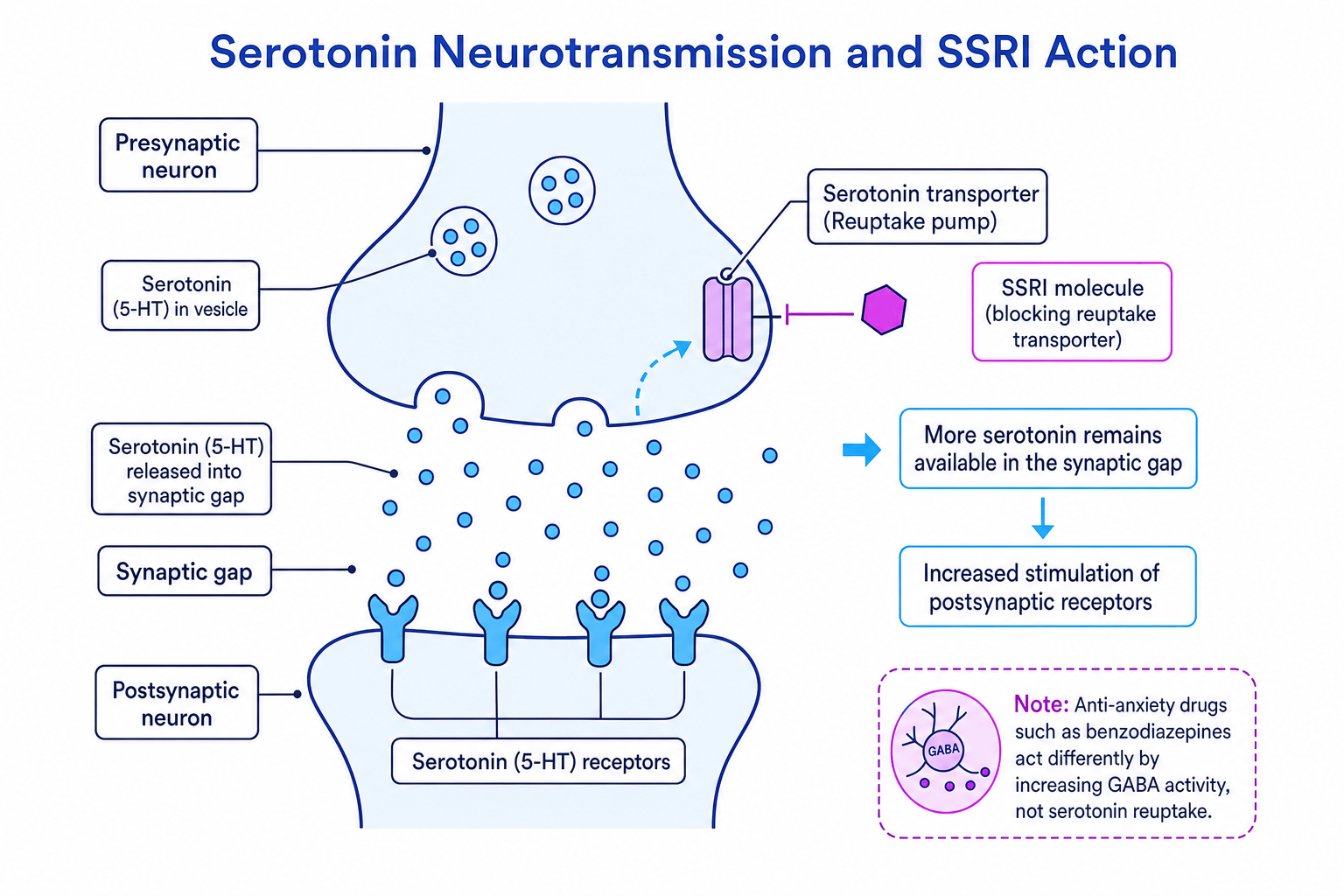
A selective serotonin reuptake inhibitor, or SSRI, is a drug that blocks the reuptake of serotonin, leaving more serotonin available in the synapse.
Normally, after serotonin is released into the synapse, it is reabsorbed by the presynaptic neuron. This is called reuptake. SSRIs block this process, so serotonin remains available for longer and continues to stimulate postsynaptic receptors.
Common SSRIs used for OCD include fluoxetine, sertraline and fluvoxamine. They often take several weeks to reduce symptoms, and may be combined with cognitive behavioural therapy.
Alternatives to SSRIs
If SSRIs are ineffective, a doctor may prescribe clomipramine, a tricyclic antidepressant that also affects serotonin. However, it often has more side effects than SSRIs.
Some patients may be given SNRIs, which affect serotonin and noradrenaline. Anti-anxiety drugs such as benzodiazepines work differently by increasing GABA activity, but they are not usually the main long-term treatment for OCD because of risks such as dependence and sedation.
Choosing a drug treatment for an OCD scenario
A patient with severe checking compulsions is offered fluoxetine by their GP.
- Fluoxetine is an SSRI, so its biological target is serotonin reuptake rather than the content of the patient’s thoughts.
- Blocking reuptake should increase serotonin availability at synapses, which may reduce anxiety and obsessive symptoms over time.
- If symptoms do not improve, the doctor might consider another SSRI, clomipramine, or combining medication with CBT.
- A balanced answer should mention that medication may reduce symptoms, but it may not address the psychological meaning of the obsessions.
Evaluating drug therapy
A major strength is effectiveness. Soomro et al. (2008) reviewed studies of SSRIs and found them more effective than placebos in reducing OCD symptoms. This supports the idea that serotonin is involved in OCD and that SSRIs can be useful treatments.
Drug therapy is also relatively cheap and convenient compared with some psychological therapies. Medication does not require the same level of motivation as exposure-based CBT, so it may help patients who are too distressed to engage in therapy at first.
However, drugs can have side effects, including nausea, insomnia, headaches and sexual dysfunction. Some people stop taking medication because side effects are unpleasant. Symptoms may also return when medication is stopped, suggesting drug therapy may manage symptoms rather than cure OCD.
There are also ethical issues in drug trials. Participants should give informed consent, be told about possible side effects, have the right to withdraw, and be protected from harm. If placebos are used, researchers must consider whether it is ethical to withhold effective treatment from people experiencing severe distress. Deception should be avoided where possible, and participants should be debriefed.
Treatment link
Drug therapy is a logical treatment if OCD is partly biological: change neurotransmitter activity, and symptoms may reduce. But success of drug therapy does not prove OCD is only biological.
In the exam
- Separate genetic explanations, neural explanations and drug therapy clearly so your AO1 is organised.
- For AO3, use evidence precisely: twin/family studies support genetic vulnerability; SSRI effectiveness supports serotonin involvement; both still have limitations.
- Avoid deterministic wording. Say genes and neural abnormalities increase vulnerability or are associated with OCD, not that they always cause it.
- In scenario questions, link the biological point directly to the person’s symptoms, such as checking, washing, intrusive thoughts or anxiety.
Check yourself
- What is the difference between a polygenic explanation and a single-gene explanation of OCD?
- How might a faulty caudate nucleus contribute to repeated obsessive thoughts?
- Why is it inaccurate to say that SSRIs “prove” OCD is caused by low serotonin?
