What you'll learn
- What the interactionist approach means in schizophrenia.
- How the diathesis-stress model explains why some people develop schizophrenia and others do not.
- Key research evidence, especially Tienari et al. (2004).
- How interactionist thinking affects treatment, including combining antipsychotics with psychological therapies.
The starting point: one explanation is rarely enough
In schizophrenia, you have already met biological explanations such as genes and dopamine, and psychological explanations such as family dysfunction and cognitive explanations.
The interactionist approach says we should not treat these as rivals where only one can be right. Instead, schizophrenia is best understood as the result of biological, psychological and social factors working together.
Interactionist approach
The interactionist approach is the view that schizophrenia is caused and maintained by an interaction between different levels of explanation, especially biological vulnerability and environmental stress.
This matters because schizophrenia is complex. For example, someone may inherit a genetic risk, but never develop schizophrenia. Another person may experience severe life stress, but also never develop it. The interactionist approach explains this by saying risk depends on the combination of vulnerability and stress.
The big idea
Schizophrenia is not usually explained as “genes or environment”; it is better explained as genes and environment interacting.
Diathesis-stress model
The best-known interactionist explanation of schizophrenia is the diathesis-stress model.
Diathesis-stress model
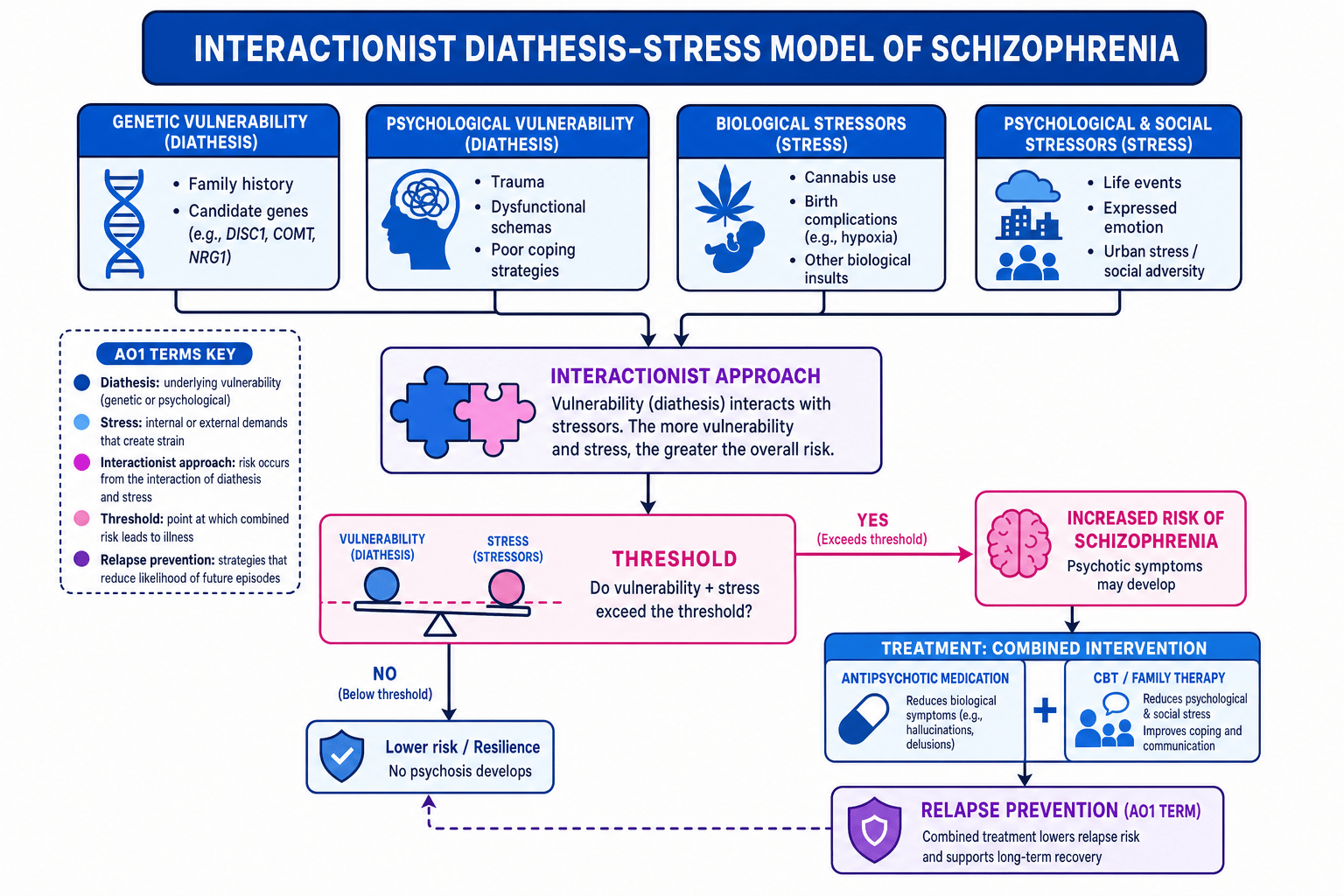
The diathesis-stress model explains schizophrenia as the result of an underlying vulnerability, called a diathesis, being triggered by environmental or psychological stress.
Diathesis
A diathesis is a predisposition or vulnerability that makes a person more likely to develop a disorder. In schizophrenia, this could be genetic risk, early trauma, abnormal brain development, or poor coping skills.
Stress
Stress means any factor that places pressure on a person and may trigger symptoms. In schizophrenia, stressors can include life events, family conflict, high expressed emotion, drug use such as cannabis, or social adversity.
A simple version is:
- Diathesis only: the person is vulnerable, but symptoms may not appear.
- Stress only: the person experiences pressure, but may not develop schizophrenia if they have low vulnerability.
- Diathesis plus stress: the combined risk may pass a threshold and trigger schizophrenia.
Meehl’s original version
One early version was proposed by Meehl (1962). He suggested that a single “schizogene” created a biological vulnerability to schizophrenia. This vulnerability produced a schizotypic personality, meaning the person might show unusual thinking, social withdrawal or odd beliefs.
According to Meehl, schizophrenia would only develop if this genetic vulnerability was combined with stress, such as a highly disturbed family environment.
Today, psychologists no longer accept the idea of one single “schizogene”. Modern genetic research suggests schizophrenia is polygenic, meaning many genes each contribute a small amount of risk.
Polygenic
A disorder is polygenic if it is influenced by many genes rather than one single gene.
The modern diathesis-stress model
The modern version is broader than Meehl’s original model.
A diathesis does not have to be purely genetic. It could include:
- Genetic vulnerability, such as having a close biological relative with schizophrenia.
- Neurodevelopmental vulnerability, such as abnormal early brain development.
- Psychological vulnerability, such as childhood trauma or insecure attachment.
- Cognitive vulnerability, such as poor coping strategies or dysfunctional thinking patterns.
Stress can also be biological, psychological or social. Examples include:
- Cannabis use, especially high-potency cannabis.
- Major life events, such as bereavement or relationship breakdown.
- High levels of family criticism or hostility.
- Urban stress, poverty, discrimination or social isolation.
Treating diathesis as only genetic
In AQA essays, avoid saying the diathesis is always “a schizophrenia gene”. Modern versions allow the diathesis to be genetic, biological, psychological, or a mixture of these.
Applying diathesis-stress to a scenario
A student is told about Amir, whose father has schizophrenia. Amir later experiences bullying, starts using cannabis heavily, and begins reporting auditory hallucinations.
-
Identify the diathesis: Amir has a family history of schizophrenia, so he may have inherited genetic vulnerability.
-
Identify the stressors: bullying is a social and psychological stressor, while heavy cannabis use can be a biological stressor affecting brain chemistry.
-
Explain the interaction: the model would not claim that family history alone caused schizophrenia, or that cannabis alone caused it. It would argue that Amir’s vulnerability and stressors combined, increasing the risk that symptoms would emerge.
Evidence for the interactionist approach
Twin and family evidence
Biological evidence supports the idea of vulnerability. Gottesman (1991) reviewed twin studies and found higher concordance rates for schizophrenia in identical twins than non-identical twins.
Concordance rate
A concordance rate is the percentage likelihood that two people who share genes, such as twins, will both show the same disorder or trait.
If schizophrenia were entirely genetic, identical twins would have a concordance rate of 100%. They do not. This supports an interactionist explanation: genes matter, but environment also matters.
Tienari et al. (2004)
A key piece of evidence comes from Tienari et al. (2004), a Finnish adoption study.
The researchers studied children whose biological mothers had schizophrenia. These children were adopted into different families, some healthier and some more disturbed in their communication patterns. The children were more likely to develop schizophrenia-related symptoms if they had both:
- a biological genetic risk, and
- an adoptive family environment with high levels of dysfunction or communication deviance.
This is strong support for the diathesis-stress model because it separates biological inheritance from the rearing environment.
Why Tienari matters
Tienari et al. (2004) supports the idea that genetic risk may only lead to schizophrenia when combined with an adverse environment.
There are ethical issues in this kind of research. Adoption and mental health data are highly sensitive, so researchers must protect confidentiality. Participants also need informed consent, careful debriefing, and protection from psychological harm, especially if findings imply family risk or family dysfunction.
Trauma and cannabis evidence
Research also supports the role of environmental stressors. For example, Varese et al. (2012) found that childhood trauma was associated with an increased risk of psychosis. Cannabis use has also been linked to increased risk, particularly when use begins young and involves high-potency forms.
However, these findings are not always simple. People who are already vulnerable may be more likely to use cannabis or experience social difficulties, so it can be hard to prove clear cause and effect.
Evaluation of the explanation
Strength: it is more holistic
The interactionist approach is a strength because it avoids being too reductionist. A purely biological explanation may ignore family stress, trauma and social context. A purely psychological explanation may ignore genetic and neurological vulnerability.
The interactionist model gives a more complete account by combining levels of explanation.
Strength: it explains individual differences
Not everyone with a family history develops schizophrenia. Not everyone who experiences trauma develops schizophrenia. The diathesis-stress model explains this by suggesting that people differ in vulnerability and in the amount of stress needed to cross the threshold.
This is especially useful for AO2 scenario questions, where you may be asked to explain why one person develops symptoms while another does not.
Strength: it has useful treatment implications
The model has real-world value because it suggests treatment should also be interactionist. If schizophrenia involves biological vulnerability and psychological stress, then treatment should target both.
This supports the use of:
- Antipsychotic medication to reduce symptoms such as hallucinations and delusions.
- Cognitive behavioural therapy for psychosis, often called CBTp, to help the person manage beliefs and distress.
- Family therapy to reduce relapse risk by lowering criticism, hostility and emotional over-involvement.
This fits with NICE guidance, which recommends antipsychotic medication alongside psychological interventions such as CBTp and family intervention.
Relapse
A relapse is the return or worsening of symptoms after a period of improvement.
Limitation: the model can be vague
A weakness is that “diathesis” and “stress” can mean many different things. If almost anything can count as a vulnerability and almost anything can count as a stressor, the model becomes difficult to test precisely.
For example, one researcher might define stress as family conflict, while another defines it as cannabis use or urban poverty. This makes it harder to produce one clear, measurable theory.
Limitation: measuring stress is difficult
Stress is often measured using interviews or self-report questionnaires. These can be affected by memory errors, social desirability or interpretation. For instance, someone may under-report cannabis use or may not remember early childhood adversity accurately.
This creates methodological problems because the model depends on accurately identifying both vulnerability and stress.
Limitation: risk of blaming families
The interactionist approach can accidentally lead to family blame, especially when discussing expressed emotion or dysfunctional communication. This is ethically sensitive. Families may already be under stress and may feel blamed for causing schizophrenia.
A balanced exam answer should make clear that family stress may contribute to relapse risk, but it is not a simple cause and does not mean families are responsible for the disorder.
Balanced AO3 phrasing
A strong evaluation sentence is: “This does not mean schizophrenia is caused by one factor; rather, biological vulnerability may make some people more sensitive to environmental stress.”
Interactionist treatment
The interactionist approach is important not only for explaining schizophrenia, but also for treating it.
A biological approach alone might recommend antipsychotic drugs. A psychological approach alone might recommend CBTp or family therapy. An interactionist approach argues that combined treatment is often better because it targets multiple causes and maintaining factors.
Antipsychotic medication
Antipsychotics are drugs used to reduce psychotic symptoms, especially hallucinations and delusions. They are usually linked to dopamine activity in the brain.
Medication may reduce symptom intensity, making it easier for the person to engage with therapy. However, medication can have side effects, and some people discontinue treatment.
CBTp
CBTp helps people make sense of symptoms and reduce distress. It does not necessarily remove hallucinations, but it can help a person challenge unhelpful interpretations. For example, someone who hears a voice may learn to question whether the voice really has power over them.
Family therapy
Family therapy aims to reduce relapse by improving communication and lowering expressed emotion.
Expressed emotion
Expressed emotion refers to high levels of criticism, hostility or emotional over-involvement shown by family members towards a person with schizophrenia.
High expressed emotion is linked with relapse, so family therapy can help relatives respond in calmer and more supportive ways.
Choosing an interactionist treatment plan
A psychologist is planning support for Lena, who has delusions, hears voices, and lives with relatives who often argue about her symptoms.
-
Match treatment to biological symptoms: antipsychotic medication may help reduce the intensity of hallucinations and delusions.
-
Match treatment to psychological distress: CBTp may help Lena evaluate her beliefs and develop coping strategies for voices.
-
Match treatment to environmental stress: family therapy may reduce arguments and expressed emotion, lowering the risk of relapse.
Evidence for combined treatment
Research generally supports combining biological and psychological treatments. Pharoah et al. (2010) reviewed family intervention studies and found that family therapy can reduce relapse and improve medication adherence, although results varied between studies.
Jauhar et al. (2014) found CBTp had only a modest effect on symptoms, which suggests psychological therapy is useful but not a complete replacement for medication.
This supports an interactionist treatment approach: medication and therapy may each help, but in different ways.
Saying combined treatment cures schizophrenia
Combined treatment can reduce symptoms, distress and relapse risk, but schizophrenia is usually managed rather than simply “cured”. Avoid overclaiming in evaluation.
How to turn this into an essay
For AO1, describe the model clearly:
- Schizophrenia results from an interaction between vulnerability and stress.
- Vulnerability can be genetic, biological or psychological.
- Stress can include trauma, cannabis, family dysfunction or life events.
- Symptoms emerge when combined risk passes a threshold.
- Treatment should combine biological and psychological therapies.
For AO3, evaluate using evidence and implications:
- Twin research supports genetic vulnerability but not genetic determinism.
- Tienari et al. supports gene-environment interaction.
- The model is holistic and explains individual differences.
- The model can be vague and difficult to test.
- It has real-world treatment value but may risk blaming families.
In the exam
-
Define both key terms: diathesis as vulnerability and stress as a trigger or pressure.
-
Use at least one named study, especially Tienari et al. (2004), to support gene-environment interaction.
-
For treatment questions, explain why combined therapy follows logically from the explanation: medication targets biological symptoms, while CBTp or family therapy targets psychological and social stress.
Check yourself
-
What is the difference between a diathesis and a stressor?
-
Why does the diathesis-stress model explain why identical twins do not always both develop schizophrenia?
-
How can the interactionist approach be applied to treatment?
