What you'll learn
- How cognitive behaviour therapy for psychosis (CBTp) is used to help people manage hallucinations and delusions.
- How family therapy reduces relapse risk by changing communication and stress in the home.
- How to evaluate both treatments using evidence, limitations, ethics and real-world applications.
- How to apply these therapies to scenario questions in AO2.
Starting point: why use psychological therapies?
Schizophrenia is a severe mental disorder involving symptoms such as hallucinations, delusions, disorganised thinking, and negative symptoms such as reduced motivation or emotional expression.
Drug treatments, especially antipsychotic medication, are often used first because they can reduce symptoms linked to dopamine activity. However, medication does not always remove symptoms completely, and some people experience distress, side effects or relapse.
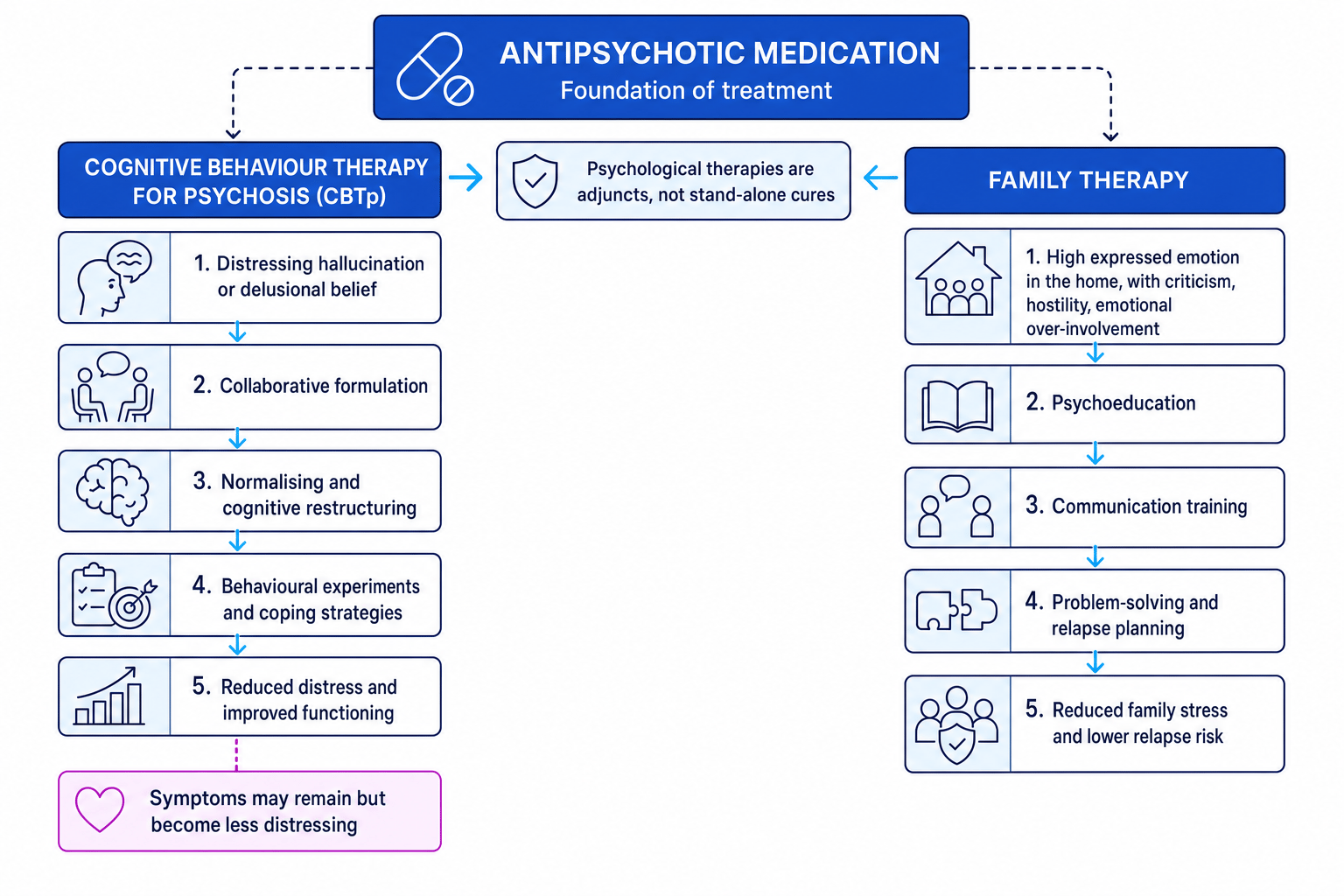
Psychological therapies aim to help the person understand, cope with and reduce the impact of symptoms. They are usually used alongside medication, not as a replacement for it.
Psychological therapy
A psychological therapy is a treatment that uses structured conversations, learning and behaviour change to improve mental health and everyday functioning.
Core idea
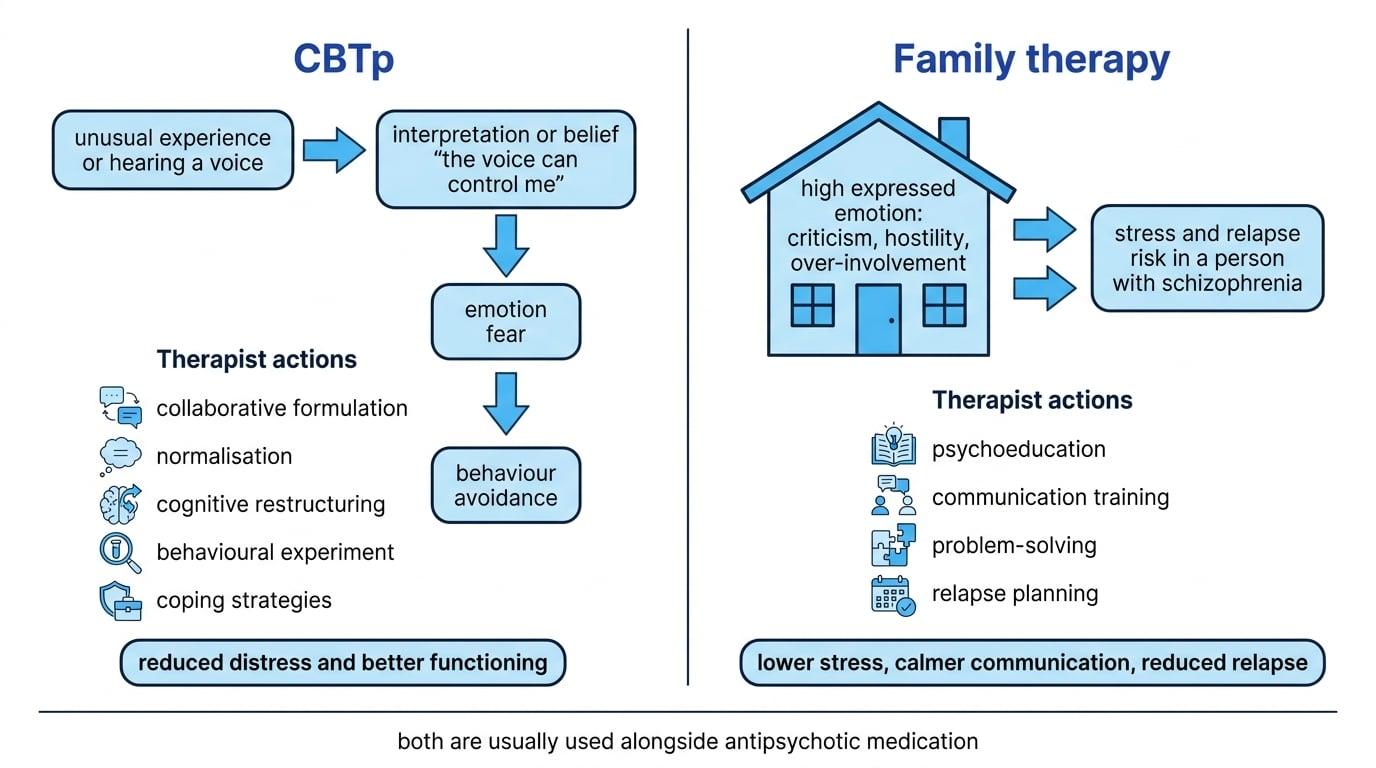
CBT mainly targets the person’s interpretation of symptoms, while family therapy mainly targets the social environment around the person.
Cognitive behaviour therapy for psychosis
What is CBT?
Cognitive behaviour therapy, often shortened to CBT, is a talking therapy based on the idea that thoughts, feelings and behaviours influence each other.
For schizophrenia, the adapted form is often called CBTp, meaning cognitive behaviour therapy for psychosis.
CBTp
Cognitive behaviour therapy for psychosis (CBTp) is a structured talking therapy that helps a person with schizophrenia identify, question and manage distressing beliefs linked to hallucinations, delusions and other symptoms.
CBTp does not simply tell the person “your belief is wrong”. That would usually damage trust. Instead, therapist and client work collaboratively to explore evidence, alternative explanations and coping strategies.
The CBT model in schizophrenia
CBTp often uses a basic sequence:
- The person has an experience, such as hearing a voice.
- They interpret the experience, for example “the voice is a demon and it can control me”.
- This interpretation creates emotion, such as fear.
- The emotion affects behaviour, such as avoiding going outside.
- Avoidance may maintain the fear because the person never tests whether the belief is accurate.
The aim is to reduce distress and impairment, even if the symptom itself does not fully disappear.
Delusion
A delusion is a strongly held false belief that is not accepted by others in the person’s culture and is resistant to evidence against it.
Hallucination
A hallucination is a sensory experience, such as hearing a voice, that occurs without an external stimulus.
What happens in CBTp?
CBTp usually includes several techniques.
1. Assessment and collaborative formulation
A formulation is a shared explanation of how the person’s experiences, beliefs, emotions and behaviours are connected.
The therapist might ask:
- When did the voice start?
- What does the person think the voice means?
- What makes it worse or better?
- What does the person do when it happens?
The goal is to make the experience feel understandable rather than mysterious and uncontrollable.
2. Normalisation
Normalisation means helping the person see that unusual experiences can occur in many people, especially under stress, sleep loss or trauma.
This does not dismiss the person’s distress. It reduces shame and fear by showing that symptoms are not a sign of being “broken” or beyond help.
3. Cognitive restructuring
Cognitive restructuring means gently challenging unhelpful beliefs and developing more balanced interpretations.
For example, instead of “the voice proves I am evil”, the person might learn to consider “the voice is a symptom of my illness and becomes worse when I am stressed”.
4. Behavioural experiments
A behavioural experiment is a planned activity used to test a belief.
For example, if someone believes “if I ignore the voice, it will punish me”, they might gradually test ignoring it for a short period while using coping strategies. The therapist and client then review what happened.
5. Coping strategy enhancement
The person develops practical ways to reduce distress, such as:
- listening to music when voices become intrusive
- keeping a symptom diary
- using relaxation techniques
- planning activities to reduce negative symptoms
- identifying early warning signs of relapse
Applying CBTp to a voice-hearing scenario
A person hears a voice saying, “You are in danger.” They stop leaving the house.
- Identify the link between symptom, belief and behaviour: the hallucination is the voice, the belief is “I am unsafe outside”, and the behaviour is avoidance.
- Consider the consequence of the belief: staying inside may reduce anxiety briefly, but it also stops the person testing whether outside is genuinely dangerous.
- Develop a more balanced interpretation: the voice may be a symptom that becomes stronger under stress, rather than reliable evidence of danger.
- Plan a behavioural experiment: the person might go outside briefly with support, then record whether the predicted danger actually happened.
- Review the outcome: if the feared event does not occur, this weakens the original belief and can reduce distress over time.
Saying CBT cures schizophrenia
CBTp is best described as helping people manage symptoms and reduce distress. It is not usually presented as a complete cure for schizophrenia.
Evaluation of CBTp
Strength: research support and clinical recommendation
CBTp is recommended by NICE for people with schizophrenia, usually alongside antipsychotic medication. This gives it strong real-world credibility because NICE recommendations are based on reviews of evidence and cost-effectiveness.
Meta-analyses such as Wykes et al. (2008) found that CBTp can have beneficial effects on symptoms and functioning. This supports the view that CBTp has practical value, especially for people who continue to experience distressing symptoms despite medication.
Limitation: effects may be modest
Not all reviews find large effects. Jauhar et al. (2014) reported that CBTp had only a small effect on overall symptoms, and effects on core positive symptoms such as hallucinations and delusions were not always strong when studies were more tightly controlled.
This means CBTp may be helpful, but exam answers should avoid exaggerating it.
Strength: fewer biological side effects
Unlike antipsychotic drugs, CBTp does not cause physical side effects such as weight gain, sedation or movement problems. This makes it useful for people who struggle with medication side effects or who want more control over their treatment.
However, CBTp can still be emotionally demanding because it involves discussing frightening beliefs and experiences.
Limitation: access and engagement
CBTp requires trained therapists, time and regular attendance. Some people with severe symptoms, very low motivation or poor insight may find it difficult to engage.
This matters because schizophrenia can involve negative symptoms such as avolition, meaning reduced motivation. A treatment that depends on active participation may not be equally suitable for everyone.
Methodological issues in CBTp research
Therapy trials are difficult to conduct perfectly. Participants usually know whether they are receiving therapy, so blinding is difficult. Improvements may also be due partly to therapist attention, expectations or the quality of the therapeutic relationship.
Blinding
Blinding means preventing participants or researchers from knowing which treatment condition someone is in, to reduce bias.
Ethical considerations
CBTp should involve informed consent, confidentiality and protection from harm. Therapists must avoid mocking or directly confronting delusions in a way that increases distress. If risk issues arise, such as serious self-harm or harm to others, confidentiality may need to be limited to keep people safe.
Family therapy
What is family therapy?
Family therapy for schizophrenia involves the person with schizophrenia and members of their family or household. It aims to reduce stress, improve communication and create a more supportive environment.
Family therapy
Family therapy is a psychological treatment that works with the patient and their relatives or carers to improve relationships, reduce stress and lower the chance of relapse.
It is not about blaming the family for schizophrenia. Instead, it recognises that the home environment can affect recovery and relapse.
The role of expressed emotion
A key idea is expressed emotion, often shortened to EE.
Expressed emotion
Expressed emotion (EE) refers to a family communication style involving high levels of criticism, hostility or emotional over-involvement towards a person with schizophrenia.
Research by Brown et al. (1972) found that people with schizophrenia were more likely to relapse when returning to families with high expressed emotion.
High EE can include comments such as:
- “You’re just being lazy.”
- “You’re ruining this family.”
- “I must watch you every second or something terrible will happen.”
The stress-vulnerability model helps explain why this matters. A person may have a biological vulnerability to schizophrenia, but high stress in the environment can trigger or worsen symptoms.
Why family therapy helps
Family therapy reduces relapse risk by lowering stress in the home and helping relatives respond more calmly and constructively.
What happens in family therapy?
Family therapy usually includes several features.
1. Psychoeducation
Psychoeducation means teaching the family about schizophrenia, symptoms, medication, relapse signs and stress.
This can reduce blame. For example, relatives may learn that low motivation can be a negative symptom, not deliberate laziness.
2. Communication training
Families practise clearer, calmer communication. This may include using “I” statements, listening without interrupting and avoiding hostile criticism.
3. Problem-solving
The therapist helps the family break problems into manageable steps. For example, if medication routines are causing conflict, the family may agree on reminders that are supportive rather than controlling.
4. Reducing emotional intensity
Family therapy can help relatives reduce guilt, anger and over-involvement. The aim is a balanced relationship: supportive, but not intrusive.
5. Relapse planning
The family learns early warning signs, such as sleep disruption, withdrawal or increased suspiciousness. They agree what to do if these signs appear.
Using family therapy to reduce relapse risk
A student with schizophrenia returns home after hospital treatment. Their parent frequently says, “You never try hard enough,” and arguments become common.
- Identify the family factor: repeated criticism suggests high expressed emotion, which is linked to increased relapse risk.
- Reframe the behaviour: the therapist helps the parent understand that low motivation may be a negative symptom, not deliberate refusal.
- Change communication: the family practises replacing criticism with specific, calm requests, such as “Can we plan one small task for this morning?”
- Add problem-solving: the family agrees on realistic routines for medication, rest and social contact.
- Create a relapse plan: everyone lists early warning signs and agrees who to contact if symptoms worsen.
Blaming parents
Do not write as if families cause schizophrenia. Family therapy focuses on reducing stress and relapse risk, not blaming relatives for the disorder.
Evaluation of family therapy
Strength: evidence for reducing relapse
A major strength is evidence that family therapy can reduce relapse and hospital readmission. Pharoah et al. (2010) reviewed family intervention studies and found benefits such as reduced relapse rates and improved medication compliance, although the findings were not completely consistent.
This supports family therapy as a useful part of treatment, especially when the person has regular contact with relatives.
Strength: real-world application
Family therapy can improve everyday life for both the person with schizophrenia and their carers. It may reduce arguments, increase understanding and help families respond earlier to relapse signs.
It may also be cost-effective because relapse and hospital admission are expensive for the NHS. If family therapy prevents readmission, it can save resources as well as reduce distress.
Limitation: evidence is mixed
Some studies vary in quality, sample size and treatment content. “Family therapy” is not always the same across studies, which makes it difficult to compare findings.
Also, families who agree to take part may already be more supportive or motivated than families who refuse. This creates a possible sampling bias.
Sampling bias
Sampling bias occurs when the people included in a study are not representative of the wider target population.
Limitation: not suitable for everyone
Family therapy depends on having relatives or carers who are available and willing to participate. It may not be appropriate where family relationships are abusive, unsafe or completely broken down.
It can also be challenging in families with work pressures, language barriers or cultural differences in communication and caregiving.
Ethical considerations
Family therapy involves several people, so confidentiality is more complex. The therapist must be clear about what information can be shared. Everyone should give informed consent and have the right to withdraw.
There is also a risk that sessions could increase distress if blame or conflict emerges, so therapists must manage sessions carefully to protect participants from harm.
Comparing CBTp and family therapy
CBTp and family therapy are both psychological treatments, but they work at different levels.
CBTp focuses mainly on the individual’s beliefs, interpretations and coping strategies. Family therapy focuses mainly on the social environment, especially communication and stress in the home.
They can work well together. For example, CBTp may help a person reinterpret a threatening voice, while family therapy helps relatives respond calmly when the person becomes distressed.
Essay shortcut
For AO1, describe what happens in the therapy. For AO3, evaluate how effective it is, who it helps, and what limits its usefulness.
AO2: applying therapies to scenarios
If a scenario mentions someone saying “the voices control me” or avoiding situations because of paranoid beliefs, CBTp is likely to be relevant.
If a scenario mentions family criticism, arguments, overprotectiveness or relapse after returning home, family therapy is likely to be relevant.
In the exam
- For CBTp, explain that the aim is to change the meaning and emotional impact of symptoms, not simply remove hallucinations or delusions.
- For family therapy, use the term expressed emotion and link criticism, hostility or over-involvement to relapse risk.
- In evaluation, balance evidence with limitations: mention NICE/research support, but also modest effects, access issues and ethical concerns.
Check yourself
- How does CBTp help someone who believes a voice has power over them?
- What is expressed emotion, and why is it important in family therapy?
- Give one strength and one limitation of each therapy for schizophrenia.