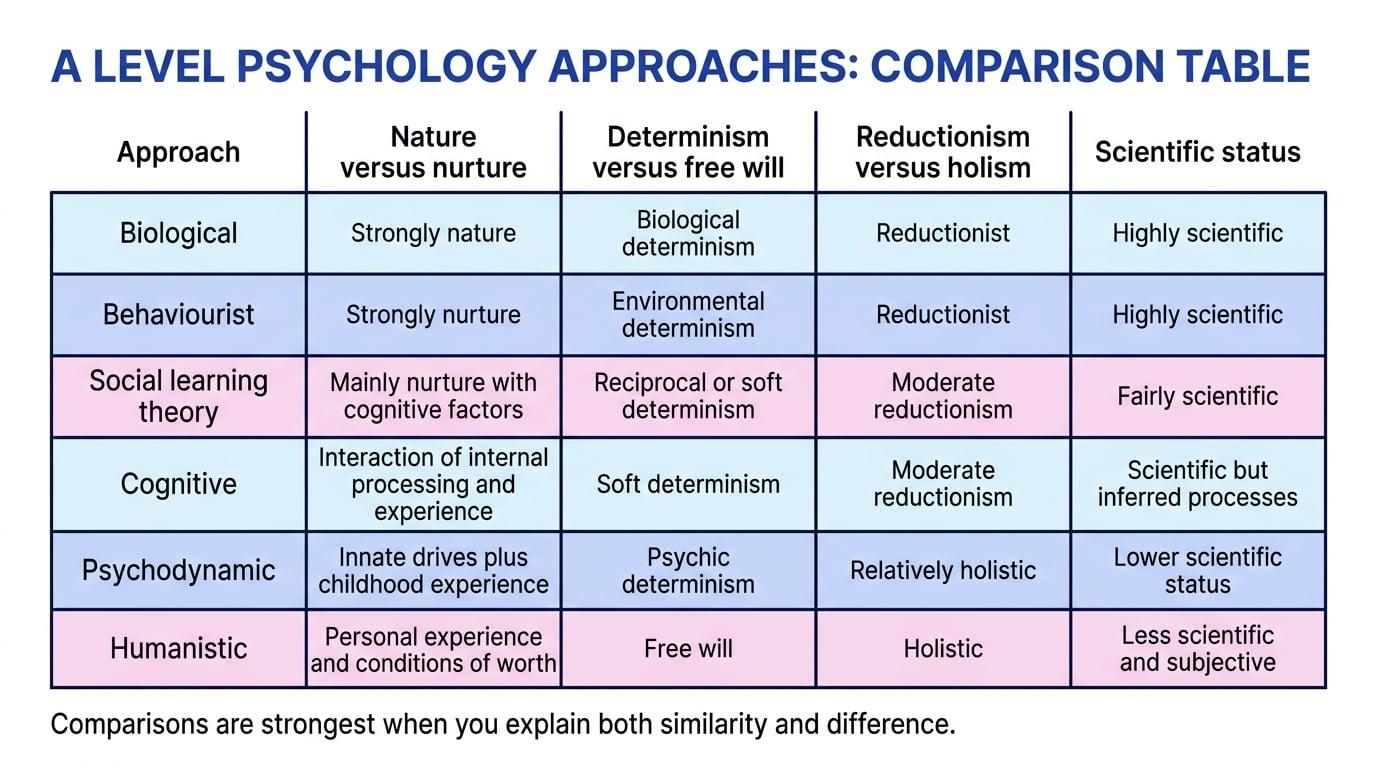
What you'll learn
- How to compare the main AQA approaches rather than describing them separately.
- The key “comparison dimensions”: nature–nurture, determinism–free will, reductionism–holism, science, and idiographic–nomothetic.
- How to turn comparisons into AO3 evaluation points for 16-mark essays.
- How to apply approaches to the same behaviour or scenario.
Why this topic matters
In earlier Approaches work, you learn each approach one at a time. In this A-level-only section, the focus shifts: you need to compare them.
That means asking: How are they similar? How are they different? Which gives the stronger explanation, and why?
Approach
An approach is a broad perspective in psychology: a set of assumptions about what causes behaviour and how psychologists should study it.
A strong comparison does not sound like six mini-essays. It uses a clear dimension, such as “scientific method” or “free will”, and compares approaches directly.
The six approaches you are comparing
You should be comfortable with these core assumptions:
- Behaviourist / learning approach: behaviour is learned through classical conditioning and operant conditioning. It focuses on observable behaviour.
- Social learning theory: behaviour is learned by observing and imitating role models, especially when behaviour is rewarded through vicarious reinforcement.
- Cognitive approach: behaviour is influenced by internal mental processes, such as memory, perception, attention, and schemas.
- Biological approach: behaviour is caused by genes, brain structures, neurotransmitters, hormones, and evolution.
- Psychodynamic approach: behaviour is influenced by the unconscious mind, early childhood experiences, defence mechanisms, and conflicts between parts of personality.
- Humanistic approach: behaviour is shaped by free will, personal growth, self-concept, and the drive towards self-actualisation.
Use this comparison map as a starting point, but remember that essays need explanation, not just labels.
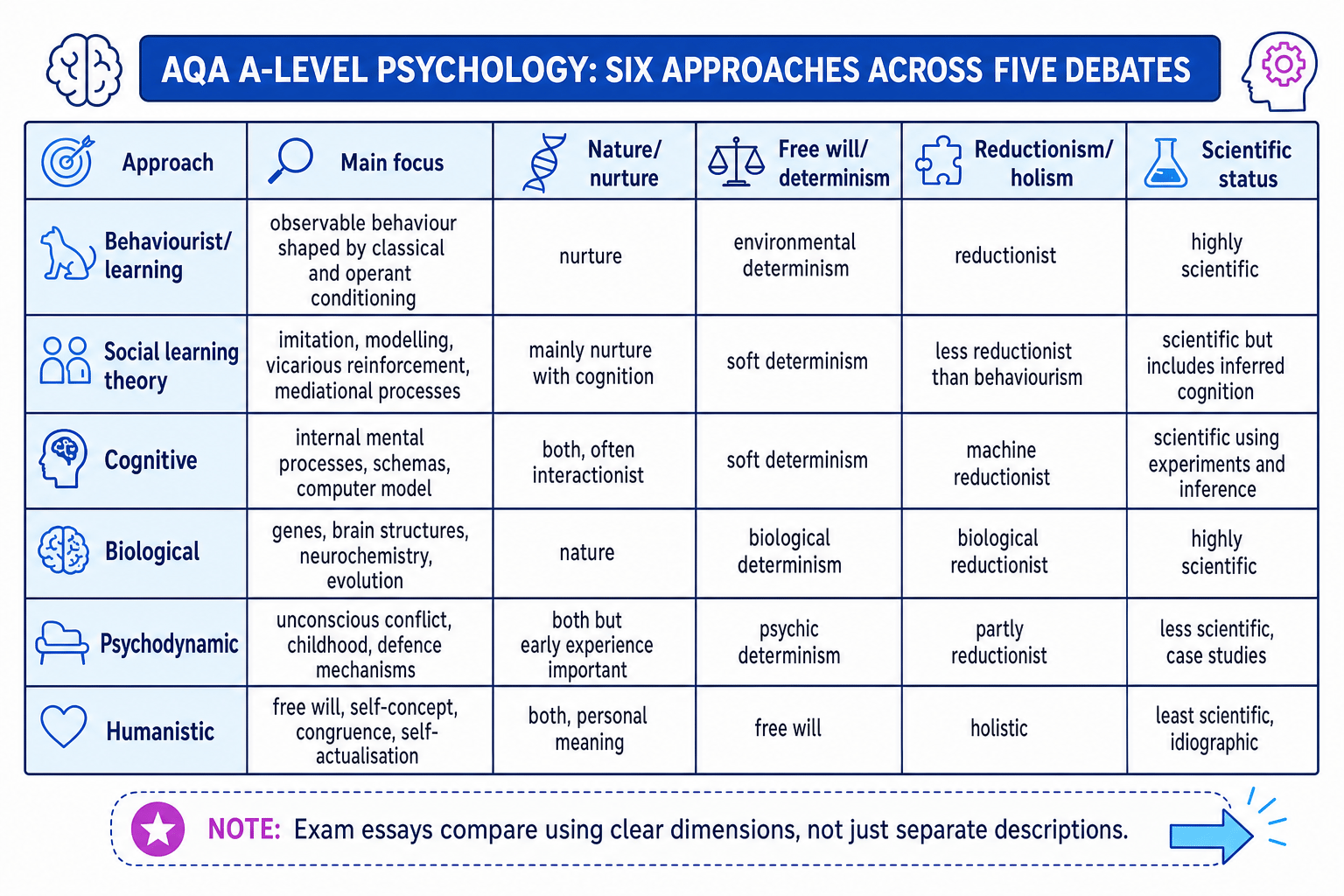
The comparison rule
Compare approaches using the same dimension. For example: “The biological approach is more deterministic than the humanistic approach because…”
Comparison dimension 1: nature and nurture
Nature and nurture
The nature–nurture debate asks whether behaviour is mainly caused by biological factors, such as genes and brain chemistry, or by environmental factors, such as learning, upbringing, and culture.
The biological approach is closest to the nature side because it explains behaviour through genetics, brain structures, neurochemistry, and evolution.
The behaviourist approach is strongly nurture-based because it sees behaviour as learned from the environment. For example, Watson and Rayner’s Little Albert study (1920) showed how a fear response could be conditioned, although the study raises serious ethical issues around consent, protection from harm, and debriefing.
Social learning theory is also mainly nurture-based, but it is less simple than behaviourism because it includes cognitive factors such as attention, retention, motivation, and judgement.
The psychodynamic approach uses both: Freud saw instinctive drives as important, but also believed early childhood experiences shaped adult personality. The cognitive and humanistic approaches can also be interactionist because they recognise personal interpretation and experience.
Comparison dimension 2: determinism and free will
Determinism and free will
Determinism is the view that behaviour is caused by forces outside a person’s conscious control. Free will is the view that people can make genuine choices about their behaviour.
The biological approach is often biologically deterministic: behaviour may be explained by genes, brain activity, or neurotransmitters.
The behaviourist approach is environmentally deterministic: behaviour is controlled by rewards, punishments, and learned associations.
The psychodynamic approach is psychically deterministic: behaviour is driven by unconscious conflicts and early experiences.
The humanistic approach is the strongest supporter of free will. Rogers argued that people can choose to move towards congruence, where the self-concept and ideal self match more closely.
The cognitive approach and social learning theory are often seen as soft determinist: they accept that behaviour is influenced by causes, but also allow some role for conscious thought and decision-making.
Treating all determinism as the same
Do not just write “this approach is deterministic”. Say what kind of determinism it is: biological, environmental, psychic, or soft determinism.
Comparison dimension 3: reductionism and holism
Reductionism and holism
Reductionism explains behaviour by breaking it down into simpler parts. Holism explains behaviour by considering the whole person and their broader context.
The biological approach is biologically reductionist because it may explain complex behaviour through genes, brain areas, or neurotransmitters. This can be useful because it leads to drug treatments, but it may ignore social and psychological causes.
The behaviourist approach is also reductionist because it reduces behaviour to stimulus–response links and reinforcement histories.
The cognitive approach can be machine reductionist when it compares the mind to a computer. This is helpful for producing testable models, but it may oversimplify emotion, motivation, and social context.
The humanistic approach is the most holistic because it studies the whole person, including meaning, values, self-worth, and personal growth.
Comparison dimension 4: scientific status
Scientific method
The scientific method involves objective, controlled, replicable investigation, often using experiments to test falsifiable predictions.
The behaviourist, biological, and cognitive approaches are usually seen as the most scientific.
Behaviourists study observable behaviour in controlled settings. Biological psychologists use methods such as brain scanning, twin studies, and drug trials. Cognitive psychologists use lab experiments and make inferences about mental processes from measurable behaviour.
However, being scientific is not always a complete advantage. Highly controlled lab research may lack ecological validity, meaning it may not reflect real-life behaviour well.
The psychodynamic and humanistic approaches are often criticised as less scientific. Freud’s case studies, such as Little Hans (1909), produced rich qualitative data but are difficult to generalise and depend heavily on interpretation. Humanistic psychologists often prefer idiographic methods, such as interviews, because they value subjective experience.
Balanced scientific evaluation
A good answer does not simply say “scientific = good” and “unscientific = bad”. Scientific methods improve objectivity and replication, but qualitative approaches may capture personal meaning more deeply.
Comparison dimension 5: nomothetic and idiographic
Nomothetic and idiographic
A nomothetic approach tries to produce general laws of behaviour that apply to many people. An idiographic approach focuses on the unique individual.
The biological, behaviourist, and cognitive approaches are mainly nomothetic because they look for general principles: reinforcement laws, memory models, or links between brain activity and behaviour.
The psychodynamic approach uses both. Freud made general claims about personality development, but his evidence often came from detailed individual case studies.
The humanistic approach is strongly idiographic because it argues that each person’s subjective experience is unique.
Applying several approaches to the same behaviour
AQA may give you a scenario and ask you to apply or compare approaches. The trick is to explain how each approach would interpret the same behaviour differently.
Comparing explanations of a fear of dogs
A student, Maya, becomes extremely anxious whenever she sees a dog after being bitten as a child.
-
The behaviourist approach would explain Maya’s fear through classical conditioning: the dog was originally neutral, but after being paired with the painful bite, dogs became associated with fear.
-
The cognitive approach would focus on Maya’s thoughts and schemas. She may now have a schema such as “dogs are dangerous”, causing her to interpret even calm dogs as threatening.
-
The biological approach might explain why Maya is especially reactive, perhaps through heightened activity in brain systems linked to fear or a genetic vulnerability to anxiety.
-
The comparison is that the behaviourist explanation focuses on learning from the environment, the cognitive explanation focuses on interpretation and mental processes, and the biological explanation focuses on internal physiology.
High-value comparisons for essays
Behaviourist approach vs social learning theory
Both approaches are learning theories and both emphasise nurture. However, social learning theory is less reductionist because it includes mediational processes — mental processes that come between observing behaviour and imitating it.
Bandura’s Bobo doll study (1961) supports social learning theory because children imitated aggressive role models, especially when aggression was rewarded. Ethically, though, the study exposed children to aggression and may have caused distress, raising protection-from-harm issues.
Cognitive approach vs biological approach
Both are scientific and often use controlled methods. Both also make inferences about hidden processes: cognitive psychologists infer memory or attention, while biological psychologists infer brain mechanisms from scans or physiological measures.
The key difference is level of explanation. The cognitive approach explains behaviour through thoughts and information processing, whereas the biological approach explains behaviour through genes, brain structures, hormones, and neurotransmitters.
Psychodynamic approach vs humanistic approach
These approaches are similar because both are less experimentally scientific than behaviourism or biology, and both are used in therapy.
However, they are almost opposites on free will. Freud’s psychodynamic approach is deterministic because unconscious conflicts influence behaviour. Humanistic psychology argues that people have free will and can make choices to grow.
Biological approach vs humanistic approach
This is one of the clearest contrasts. The biological approach is nature-based, deterministic, reductionist, nomothetic, and scientific. The humanistic approach is more nurture-and-meaning based, free-will focused, holistic, idiographic, and less concerned with laboratory science.
Listing instead of comparing
Avoid writing one paragraph on the biological approach, then one paragraph on the humanistic approach, with no direct link. Use comparison words: whereas, similarly, in contrast, more than, less than.
Real-world applications as evaluation
Approaches can also be compared by usefulness.
The behaviourist approach led to therapies such as systematic desensitisation and token economies. The cognitive approach contributed to CBT. The biological approach supports drug therapies and genetic explanations. The psychodynamic approach influenced psychoanalysis. The humanistic approach influenced client-centred counselling.
This matters for AO3 because practical applications suggest an approach has value. However, successful treatment does not prove every assumption of an approach is correct.
The strongest overall position: interactionism
Modern psychology often prefers interactionism, the idea that behaviour is best explained through the interaction of biological, psychological, and environmental factors.
For example, depression might involve genetic vulnerability, neurotransmitter activity, negative schemas, stressful life events, and social reinforcement patterns. This does not make individual approaches useless — it shows that each may explain part of the picture.
In the exam
-
Choose a clear comparison dimension first: science, determinism, nature–nurture, reductionism, or applications.
-
Make the comparison explicit using phrases such as “whereas”, “in contrast”, “similarly”, and “both”.
-
Add AO3 judgement: explain why the similarity or difference matters for validity, usefulness, ethics, or scientific credibility.
-
Avoid one-sided claims. Most approaches have strengths and limitations depending on the behaviour being explained.
Check yourself
- Which approach is most clearly linked to free will, and why?
- How is social learning theory different from the behaviourist approach?
- Why might a reductionist explanation be both useful and limited?