What you'll learn
- How to distinguish sex, gender, gender role, gender expression and gender identity.
- What is meant by binary, non-binary and gender-fluid identities.
- How the Bem Sex Role Inventory measures gender-related traits.
- How to evaluate this measurement method for AO3 essays.
The starting point: sex, gender, roles and identity
Before you can discuss gender identities clearly, you need to separate several ideas that are often mixed together in everyday language.
Sex and gender
- Sex refers to biological characteristics, such as chromosomes, hormones and reproductive anatomy.
- Gender refers to the psychological, social and cultural meanings attached to being male, female, both, neither, or another identity.
AQA expects you to know that gender is not just about biology. It includes how people understand themselves, how they present themselves and what society expects from them.
Gender identity
Gender identity is a person’s internal sense of their own gender, such as being a man, a woman, non-binary, gender fluid, or another identity.
Gender role
A gender role is a set of behaviours, traits or expectations that a culture associates with a particular gender. For example, some cultures stereotype assertiveness as “masculine” and gentleness as “feminine”.
Gender expression means how a person presents their gender outwardly, such as through clothing, hairstyle, voice, behaviour or mannerisms. Expression may or may not match cultural stereotypes.
Identity is not the same as behaviour
A person’s gender identity is based on how they understand themselves, not on whether their clothing, interests or personality fit traditional gender stereotypes.
Separating identity from expression
Alex says, “I am a man,” but often wears clothing that his school friends describe as “feminine”.
- Alex’s statement “I am a man” identifies his gender identity as male, which is a binary identity.
- His clothing is part of his gender expression, not proof of a different identity.
- The best conclusion is that Alex has a binary male identity with a non-stereotypical gender expression; you should not label him non-binary unless he identifies that way.
Binary, non-binary and gender-fluid identities
Binary gender identity
A binary gender identity means identifying as one of the two traditional gender categories: male/man or female/woman.
A person may be cisgender, meaning their gender identity matches the sex they were assigned at birth. A person may also be transgender, meaning their gender identity differs from the sex they were assigned at birth. A transgender man or transgender woman can still have a binary gender identity.
Non-binary identity
A non-binary identity means a person does not identify exclusively as male or exclusively as female. Non-binary is often used as an umbrella term, meaning it can include several identities, such as agender, bigender or genderqueer.
The important point for A-Level Psychology is that non-binary identities challenge the assumption that everyone fits neatly into one of two gender categories.
Gender-fluid identity
A gender-fluid identity means a person’s gender identity changes over time or across situations. For example, someone may identify as more masculine at one time, more feminine at another, or outside the male–female binary altogether.
Gender fluidity is often considered part of the wider non-binary umbrella, but individuals vary in the labels they use.
A quick distinction
Binary = identifies as male or female.
Non-binary = does not identify exclusively as male or female.
Gender fluid = gender identity changes over time or context.
Using stereotypes to decide someone’s identity
Do not assume someone is non-binary or gender fluid because they have interests, clothes or behaviours associated with another gender. In psychology, identity should be based on the person’s own self-description.
Applying identity terms
Sam says, “Some days I feel more like a man, some days more like neither a man nor a woman.”
- Sam is not describing a fixed identity as only male or only female, so a straightforward binary label is not the most precise fit.
- Because Sam describes their identity as changing across time, gender fluid is the most accurate term.
- Sam might also describe themselves as non-binary, because gender fluidity often sits within the broader non-binary category.
Measuring gender: why psychologists need operationalisation
Psychologists cannot study an idea scientifically unless they decide how to measure it.
Operationalisation
Operationalisation means turning an abstract concept into something observable or measurable. For example, “gender role traits” could be measured using scores on a questionnaire.
This matters because gender identity is best measured by asking how someone identifies. However, older psychological tools often measured gender roles or gender-related personality traits instead. The key example for AQA is the Bem Sex Role Inventory.
The Bem Sex Role Inventory
Bem Sex Role Inventory
The Bem Sex Role Inventory, or BSRI, is a self-report questionnaire developed by Sandra Bem in 1974 to measure how far a person identifies with personality traits culturally labelled as masculine or feminine.
The BSRI does not directly measure whether someone is binary, non-binary or gender fluid. Instead, it measures self-rated traits linked to traditional gender roles.
How Bem developed the BSRI
Bem (1974) asked people to rate traits according to how socially desirable they were for men and women in American society at the time.
From this, Bem selected:
- 20 traits judged as traditionally masculine, such as assertive, independent or dominant.
- 20 traits judged as traditionally feminine, such as affectionate, sympathetic or gentle.
- 20 neutral filler traits, which were not strongly linked to masculinity or femininity.
Participants rate how much each trait describes them, usually on a 7-point scale from “never or almost never true” to “always or almost always true”.
How scoring works
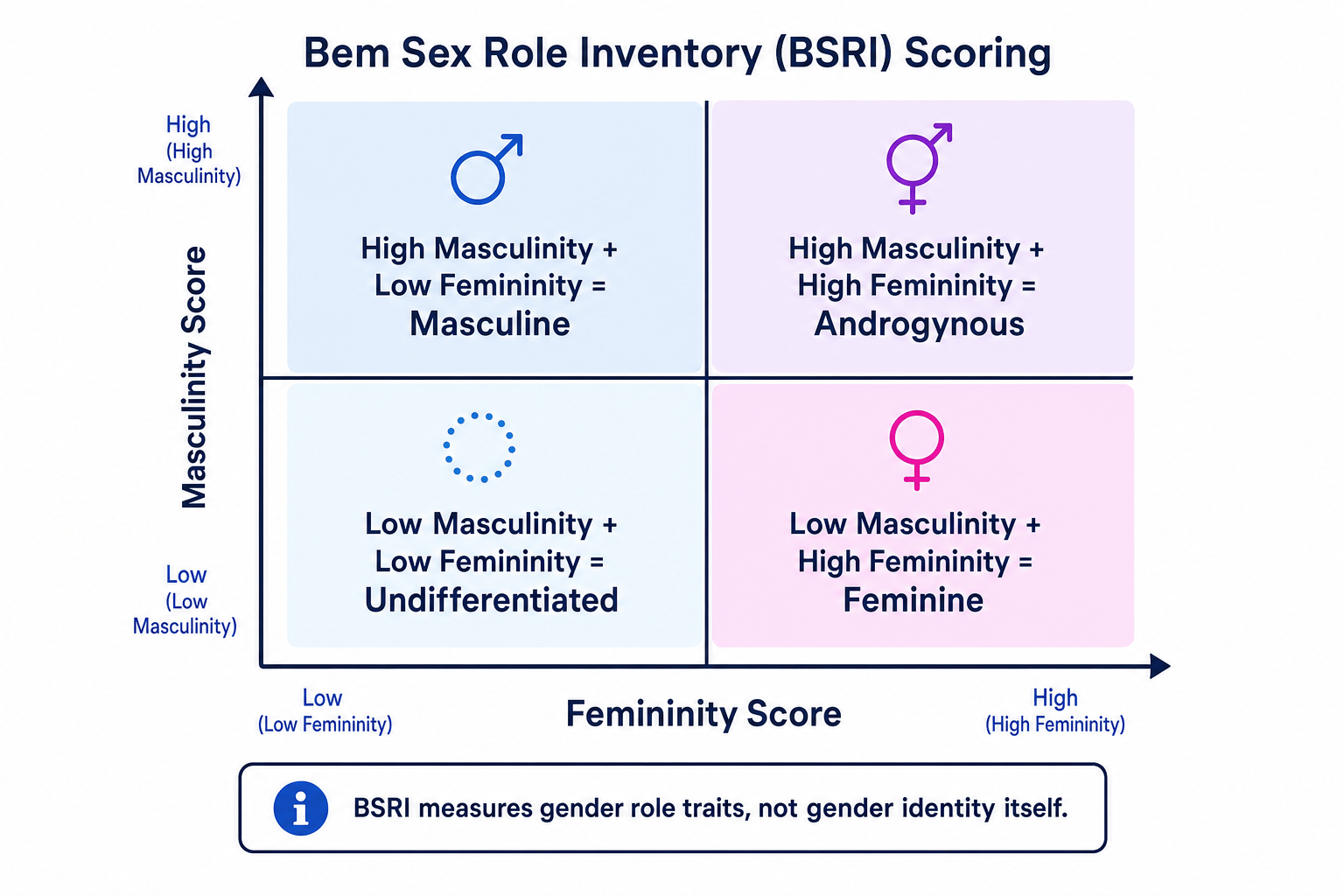
The BSRI produces two separate scores:
- A masculinity score, based on masculine items.
- A femininity score, based on feminine items.
This was important because Bem argued that masculinity and femininity are not opposite ends of one scale. A person can score high on both, low on both, or high on one and low on the other.
Psychological androgyny
Psychological androgyny means scoring highly on both traditionally masculine and traditionally feminine traits. Bem argued that androgynous people may be more flexible because they can draw on a wider range of behaviours.
The four BSRI categories are:
- Masculine: high masculinity, low femininity.
- Feminine: low masculinity, high femininity.
- Androgynous: high masculinity, high femininity.
- Undifferentiated: low masculinity, low femininity.
Classifying a BSRI profile
A participant has a masculinity score of 5.3 and a femininity score of 5.0. In this sample, the median masculinity score is 4.8 and the median femininity score is 4.6.
- Compare the masculinity score with the masculinity median: 5.3>4.85.3 > 4.85.3>4.8, so the participant is high on masculinity.
- Compare the femininity score with the femininity median: 5.0>4.65.0 > 4.65.0>4.6, so the participant is high on femininity.
- Combine the two judgements: high masculinity plus high femininity gives an androgynous BSRI classification.
- Interpret the result carefully: this means the participant self-rated highly on both sets of gender-role traits; it does not mean they are non-binary or gender fluid.
The BSRI’s big idea
The BSRI treated masculinity and femininity as independent dimensions, rather than assuming that being more masculine automatically means being less feminine.
Evaluating the BSRI
Strength: it challenged rigid gender stereotypes
Before Bem, many approaches treated masculinity and femininity as opposites. The BSRI was useful because it showed that someone could be both assertive and caring, both independent and sensitive.
This made the BSRI important historically because it challenged traditional sex-role stereotypes and encouraged psychologists to think more flexibly about gender.
Strength: it is standardised and produces quantitative data
The BSRI uses the same items and rating scale for each participant, which makes it more standardised than an informal interview. This helps researchers compare scores across people and groups.
Bem (1974) also reported good reliability, meaning the measure produced reasonably consistent results over time.
Weakness: it measures gender-role traits, not gender identity
The biggest issue is construct validity, which means whether a test really measures the concept it claims to measure.
The BSRI measures agreement with traits that were culturally labelled masculine or feminine. It does not directly ask someone whether they identify as male, female, non-binary or gender fluid.
Calling BSRI categories gender identities
Do not write that “androgynous” on the BSRI means the same as “non-binary”. Androgyny is a pattern of trait scores; non-binary is a gender identity.
Weakness: cultural and historical bias
The BSRI was developed in 1970s American culture. Traits judged as “masculine” or “feminine” then may not be judged the same way today or in other cultures.
This creates a problem of temporal validity, which means whether findings remain valid across time. A questionnaire based on old stereotypes may not measure modern gender roles accurately.
Weakness: self-report can reduce validity
The BSRI is a self-report questionnaire, so it depends on participants honestly and accurately describing themselves.
A key issue is social desirability bias, where participants answer in a way that makes them look good. For example, someone may rate themselves highly on traits such as “independent” or “understanding” because those traits are socially valued.
Mixed evidence about androgyny
Bem argued that androgynous individuals may be more psychologically flexible because they are not restricted by rigid gender roles.
However, later reviews such as Taylor and Hall (1982) suggested that the benefits linked to androgyny may sometimes be due more to “masculine” instrumental traits, such as confidence and assertiveness, rather than androgyny itself. This weakens the claim that being high on both masculine and feminine traits is always the key factor.
Ethical considerations
Research on gender can be sensitive because it concerns personal identity. Researchers should ensure informed consent, the right to withdraw, confidentiality, protection from harm and debriefing.
Modern researchers should also avoid forcing participants into binary response options if the study is about gender identity, because this could exclude or misrepresent non-binary and gender-fluid participants.
Ethical sensitivity
A measure like the BSRI should not be used to diagnose someone’s identity or pressure them into a label. It is a research tool for gender-role traits, not a test of who someone “really” is.
Bringing it together for AQA
For AO1, you need to describe the key identity terms and outline how the BSRI works. For AO2, apply the correct label to a scenario based on the person’s self-description. For AO3, evaluate the BSRI as a measurement tool, especially its validity, cultural bias and ethical issues.
In the exam
- Define gender identity before discussing binary, non-binary and gender-fluid identities, so your answer does not rely on stereotypes.
- When describing the BSRI, include the 60-item self-report format, masculine and feminine trait scores, and the four possible classifications.
- For evaluation, make the key distinction: the BSRI is reliable and historically useful, but it measures gender-role traits rather than modern gender identity.
- In scenario questions, base your answer on the person’s own stated identity, not their hobbies, clothes or personality.
Check yourself
- How would you explain the difference between non-binary and gender-fluid identities?
- Why is the BSRI better described as a measure of gender-role traits than gender identity?
- Give one strength and one limitation of using the BSRI in psychological research.
