What you'll learn
- How chromosomes influence biological sex development.
- How hormones such as testosterone, oestrogen and oxytocin may affect gender-related behaviour.
- How to apply biological explanations to scenarios, including prenatal hormone exposure.
- How to evaluate this explanation using evidence, limitations and ethical issues.
Starting point: sex, gender and biological explanations
A biological explanation argues that gender development is influenced by physical factors, especially genetics and hormones. It does not mean biology explains everything about gender. A strong A-Level answer should show that biology interacts with social and cognitive influences.
Sex and gender
Sex usually refers to biological characteristics such as chromosomes, hormones and reproductive anatomy. Gender refers to psychological and social aspects, such as gender identity, gender roles and expectations about masculinity or femininity.
For this topic, you are mainly learning the role of chromosomes and hormones in shaping sex-linked development and, possibly, some gender-related behaviours.
Main idea
Chromosomes start a biological pathway, hormones help organise and activate development, but gender development is not determined by biology alone.
Chromosomes: the genetic starting point
A chromosome is a long strand of DNA found in the nucleus of cells. DNA contains genes, which are instructions for building proteins and influencing development.
Humans typically have 23 pairs of chromosomes. The 23rd pair are the sex chromosomes. These are usually:
- XX: typically associated with female biological development.
- XY: typically associated with male biological development.
The egg cell always contributes an X chromosome. The sperm cell contributes either an X or a Y chromosome. So, in typical development, the sperm determines whether the embryo is XX or XY.
Sex chromosomes
Sex chromosomes are the chromosome pair most directly involved in biological sex development. Typical patterns are XX and XY, although variations also exist.
The SRY gene and gonadal development
The Y chromosome usually carries the SRY gene. This gene triggers the development of undifferentiated gonads into testes. Gonads are the organs that produce sex cells and sex hormones: testes in males and ovaries in females.
If the SRY gene is present and functioning, the testes begin producing hormones such as testosterone. This supports male-typical development of internal and external sex organs.
If there is no functioning SRY gene, the gonads usually develop into ovaries, and female-typical development follows.
This pathway is easier to understand as a sequence.
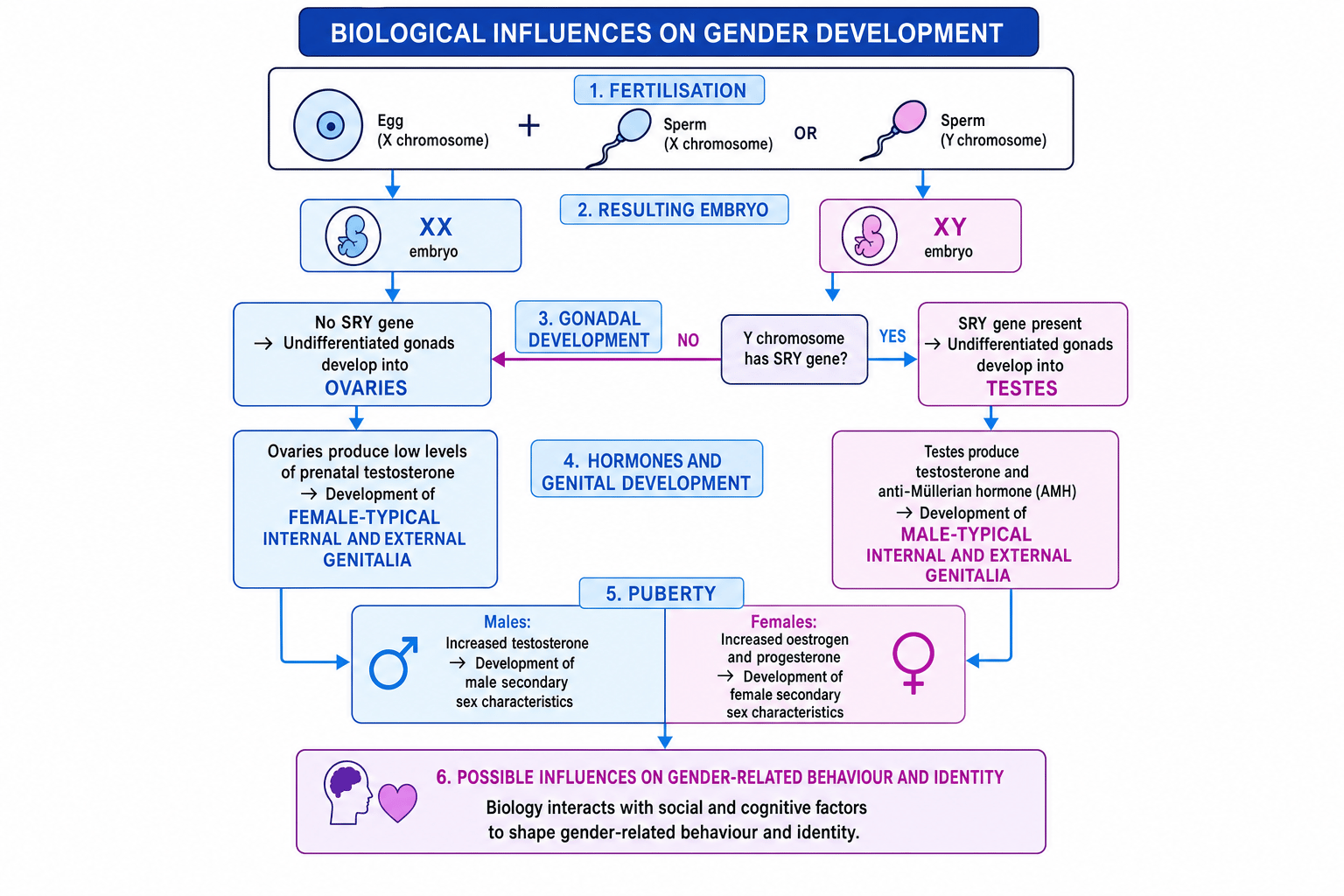
Applying the SRY pathway
Imagine an embryo has a Y chromosome, but the SRY gene is not functioning.
-
Start with the chromosome pattern: the embryo is chromosomally XY, so you might expect male-typical development.
-
Apply the SRY rule: because the SRY gene is not functioning, the gonads are not triggered to develop into testes in the usual way.
-
Link this to hormones: without typical testes development, prenatal testosterone levels are much lower than in typical XY development.
-
Draw the conclusion carefully: this shows that chromosomes influence development through genes and hormones, not by a simple “XY always equals male development” rule.
Overstating chromosome effects
Do not write that chromosomes directly “cause gender identity”. A better answer is that chromosomes influence biological development, which may then affect some aspects of gender-related behaviour, alongside social and cognitive factors.
Hormones: chemical messengers
A hormone is a chemical messenger released by glands into the bloodstream. Hormones affect target organs and tissues, including the brain.
Hormones
Hormones are chemical messengers produced by endocrine glands. They can influence physical development, brain development and behaviour.
In gender development, AQA expects you to know the role of testosterone, oestrogen and oxytocin.
Testosterone
Testosterone is an androgen, meaning a hormone associated with male-typical development. It is produced in much higher levels by testes, although all sexes produce some testosterone.
Before birth, testosterone helps masculinise the reproductive system. It may also influence brain development in ways linked to later gender-related behaviours, such as rough-and-tumble play, toy preferences or activity levels.
At puberty, testosterone contributes to male secondary sex characteristics such as facial hair, a deeper voice and increased muscle mass.
Oestrogen
Oestrogen is produced in higher levels by ovaries, though all sexes produce some oestrogen. It is important in female reproductive development and puberty.
At puberty, oestrogen contributes to female secondary sex characteristics such as breast development and the menstrual cycle. It may also influence mood and social behaviour, but its role in gender development is less direct than the role usually claimed for testosterone.
Oxytocin
Oxytocin is a hormone linked to childbirth, breastfeeding, bonding and social attachment. It is sometimes associated with nurturing behaviour.
However, it is too simplistic to call oxytocin a “female bonding hormone”. All sexes produce oxytocin, and social behaviour is shaped by learning, relationships and culture as well as biology.
Calling hormones male or female
Avoid saying “testosterone is the male hormone” or “oestrogen is the female hormone”. A more accurate phrase is: testosterone is found in higher average levels in males, and oestrogen in higher average levels in females.
Prenatal hormones and later behaviour
Prenatal means before birth. Some biological explanations argue that hormones before birth have organisational effects: they shape the development of the body and brain in long-lasting ways.
Hormones can also have activational effects later in life, meaning they temporarily activate behaviours or physical changes, such as during puberty.
Evidence often comes from cases where hormone exposure is atypical. For example, girls with congenital adrenal hyperplasia, usually shortened to CAH, are genetically XX but are exposed to unusually high levels of androgens before birth.
Berenbaum and Bailey (2003) found that girls with CAH showed more male-typical toy and activity preferences than girls without CAH. This supports the idea that prenatal androgen exposure can influence gender-related behaviour.
Explaining CAH findings
A researcher finds that girls with CAH are more likely than a control group to choose cars and construction toys.
-
Identify the biological factor: CAH involves higher prenatal androgen exposure, including hormones similar in effect to testosterone.
-
Link hormone exposure to development: the biological explanation would argue that prenatal androgens may organise brain development in a way that increases interest in some male-typical activities.
-
Avoid a deterministic conclusion: the finding does not prove that hormones alone cause toy preference, because parents, peers, media and wider culture may also shape play behaviour.
-
Evaluate the evidence: CAH is useful because it is a naturally occurring condition, but samples are often small and participants may have had unusual medical or social experiences.
Research evidence and evaluation
Support from atypical hormone exposure
CAH research is one of the strongest sources of support for hormonal explanations. It suggests that prenatal androgens are linked to later preferences and behaviour.
However, CAH research is not perfectly controlled. Parents may treat a child differently if they know about the condition. Medical appointments, surgery or social reactions may also affect development. This means the evidence is useful but not a simple “hormones caused behaviour” proof.
Ethically, researchers must be especially careful when studying children and people with differences in sex development. Issues include informed consent from parents and assent from children, confidentiality, protection from harm and respectful reporting that does not stigmatise participants.
Support from animal studies
Animal research has also been used. For example, Young et al. (1964) found that female monkeys exposed to testosterone before birth showed more male-typical behaviour, such as rough-and-tumble play.
This supports a cause-and-effect link because hormone exposure can be manipulated more directly in animal studies. However, humans have language, culture, identity and social norms, so findings from animals cannot be applied too directly to human gender development.
There are also ethical issues in animal research, including whether the potential scientific value justifies harm or interference with normal development.
The David Reimer case
The case of David Reimer is often used in evaluation. David was biologically male but, after a medical accident in infancy, was raised as a girl following advice from John Money. Money argued that gender identity could be shaped mainly by socialisation. However, David experienced distress, rejected the female identity and later lived as male. Diamond and Sigmundson (1997) reported the case as evidence that biological factors are important.
This case supports the idea that biology cannot simply be overridden by upbringing. However, it is a single case study, so it cannot prove a general rule. It also raises serious ethical concerns: consent, psychological harm, deception, confidentiality and the protection of a vulnerable child were all major issues.
AO3: strengths and limitations
Strengths
One strength is that biological explanations are supported by scientific evidence. Chromosomes, genes and hormones are measurable, so the explanation appears objective and testable.
Another strength is evidence from atypical development, such as CAH, which suggests prenatal hormones can influence later behaviour. This gives the theory real-world relevance, especially for understanding differences in sex development and improving sensitive clinical support.
Limitations
A major limitation is biological determinism. This means assuming behaviour is fixed by biology. Gender development is also influenced by social learning, culture, family, peers, media and personal identity.
Another limitation is reductionism. Biological explanations may reduce a complex topic to chromosomes and hormones, ignoring the meaning people attach to gender in their own lives.
Evidence can also be correlational. For example, if higher testosterone is linked to a behaviour, that does not prove testosterone caused it. Behaviour and social context can also affect hormone levels.
Balanced essay wording
Use phrases like “may influence”, “is associated with” and “interacts with”. These sound more accurate than saying biology simply “causes” gender.
How to turn this into an essay answer
For AO1, describe the biological pathway:
- sex chromosomes are usually XX or XY;
- the Y chromosome usually carries the SRY gene;
- SRY triggers testes development;
- testes produce testosterone;
- hormones influence prenatal development and puberty;
- testosterone, oestrogen and oxytocin may affect some gender-related behaviours.
For AO3, evaluate using:
- supporting evidence from CAH and animal studies;
- methodological issues such as small samples and generalising from animals;
- ethical issues in research with children and atypical development;
- the problem of biological determinism;
- the interaction between biology and social/cognitive explanations.
In the exam
-
For a short AO1 question, give a clear chain: chromosomes → SRY gene → gonads → hormones → development.
-
For AO2 scenarios, identify the biological factor first, then link it to a specific outcome without overstating causation.
-
For AO3 essays, use at least one piece of evidence, one methodological limitation and one interaction point showing that biology is not the whole explanation.
Check yourself
- How does the SRY gene influence the development of testes and testosterone?
- Why is CAH useful evidence for hormonal explanations of gender development?
- What is one problem with saying gender is “caused” by chromosomes and hormones?
