Welcome to the Issues and debates in Psychology topic! This unit is highly conceptual and provides the critical tools you need to evaluate theories and studies across the entire A-Level course.
When writing high-scoring essays (AO3), you shouldn't just memorise evaluation points; you need to engage with deeper debates about how psychology is conducted. Understanding gender and culture bias is your gateway to doing exactly that.
What you'll learn
- How the search for universality in psychology can lead to unintended bias.
- The distinction between alpha bias and beta bias, and how they relate to androcentrism.
- How ethnocentrism and cultural relativism influence our understanding of human behaviour.
- How to identify and evaluate these biases in classic psychological research.
The core problem: Bias vs. Universality
Before we dive into the specific biases, we need to understand the ultimate goal of psychological research: universality.
Universality
Universality refers to any theory or finding that can be applied to all people, regardless of gender, culture, upbringing, or historical era.
Psychologists seek to discover universal truths about human nature (such as how memory works, or how the brain processes fear). However, most researchers are individuals with their own cultural backgrounds, personal values, and gendered perspectives. When researchers allow their own assumptions to distort the objective observation of human behaviour, bias occurs.
Rather than producing universal truths, biased research produces findings that only apply to the specific group that was tested, yet are mistakenly claimed to apply to everyone.
Gender bias in Psychology
For most of its history, psychology was dominated by male academics studying male participants. This historical imbalance has left a legacy of gender bias.
Gender bias
Gender bias is the psychological distortion or misrepresentation of the differences or similarities between men and women. It occurs when research or theory does not layout an objective or justifiable view of either sex.
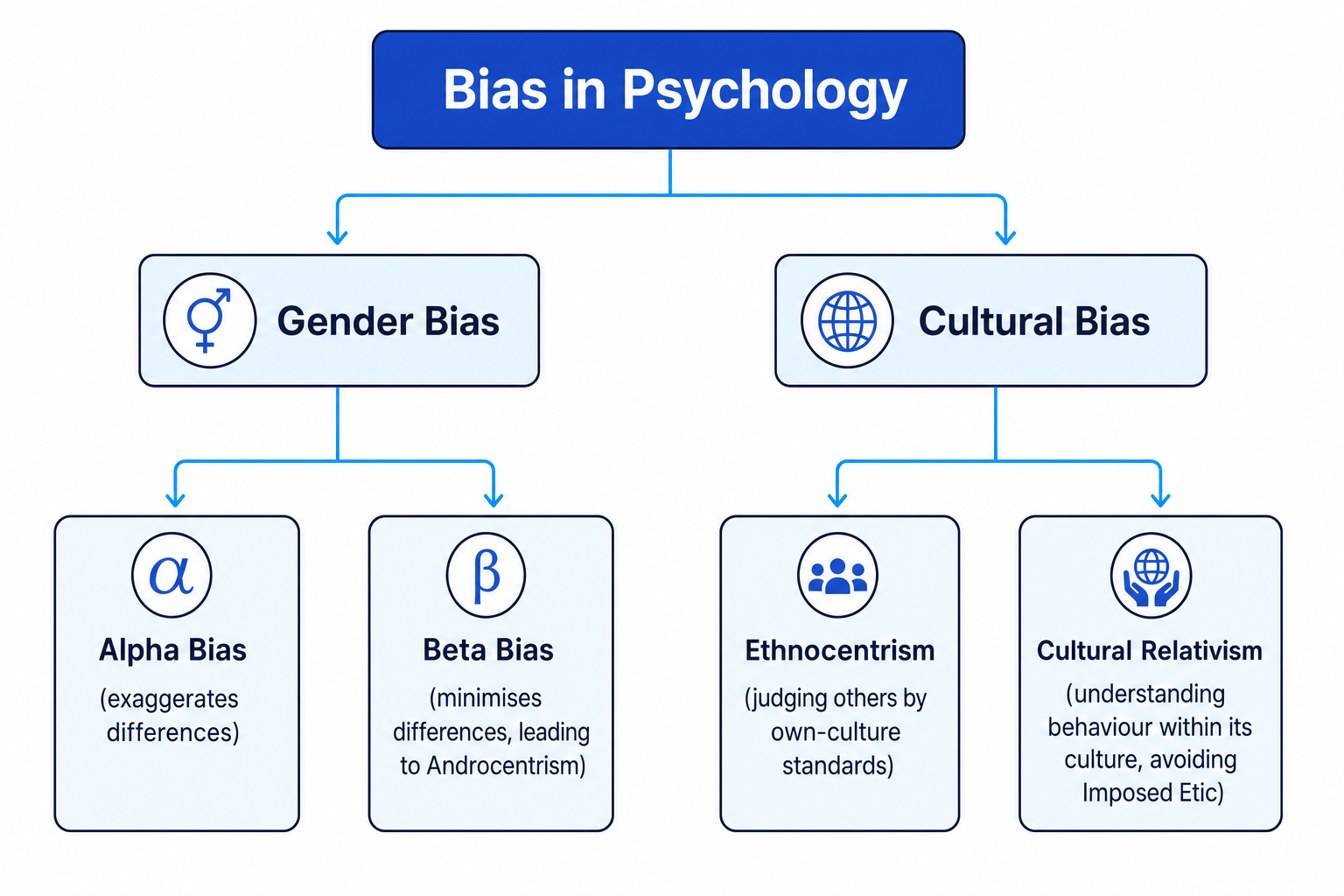
Gender bias generally takes one of two forms: alpha bias or beta bias.
Alpha bias: Exaggerating the differences
Alpha bias occurs when a theory exaggerates or overestimates the differences between men and women. These differences are often presented as fixed, inevitable, and biological, rather than shaped by society.
- The danger: Alpha-biased theories typically devalue one gender (almost always women) relative to the other.
- Classic Example (Freud, 1905): In his psychoanalytic theory, Sigmund Freud argued that girls experience "penis envy" during the phallic stage of psychosexual development. He viewed feminine development as a failed or deviant version of masculine development, arguing that because girls cannot experience castration anxiety, they develop weaker superegos than boys. This artificially exaggerates a difference between the sexes and paints women as morally inferior.
- Biological Example (Evolutionary Psychology): Evolutionary explanations of relationships often argue that men are naturally programmed to be dominant and highly promiscuous to scatter their genes, while women are evolutionary programmed to be coy and nurturing to protect their limited eggs. This exaggerates biological differences and is often used to justify double standards in modern sexual behaviour.
Beta bias: Minimising the differences
Beta bias occurs when a theory ignores, minimises, or underestimates the differences between men and women.
- The danger: It often happens because researchers assume that whatever is true for men must also be true for women. This leads to female experiences being completely ignored.
- Classic Example (Fight-or-flight research): Early physiological research into the "fight-or-flight" response was conducted almost exclusively on male laboratory animals (usually rats) and male humans. It was assumed that the biological response to stress was universal. However, Shelley Taylor et al. (2000) discovered that females actually exhibit a "tend-and-befriend" response. Under stress, females produce oxytocin, which encourages them to protect their offspring (tend) and seek social support (befriend) rather than fight or run away. By ignoring sex differences, early biology-based psychology was beta-biased.
- Developmental Example (Kohlberg, 1968): Lawrence Kohlberg based his highly influential theory of moral development entirely on a longitudinal study of US boys. He then applied his stages of moral development universally to both males and females. When women were tested, they scored lower than men, leading Kohlberg to conclude that women are less morally developed—a classic consequence of assuming a male template fits all.
Mixing up Alpha and Beta
A common exam error is confusing alpha and beta bias. Remember:
- Alpha = Apart (it pulls the genders apart by exaggerating differences).
- Beta = Blended (it blends them together by ignoring differences).
Androcentrism: The male as the standard
Beta bias frequently leads to a state called androcentrism.
Androcentrism
Androcentrism is a male-centred perspective. It occurs when "normal" human behaviour is defined by looking only at male behaviour. Consequently, any female behaviour that differs from this arbitrary "norm" is viewed as abnormal, deficient, or pathological.
A clear modern example of androcentrism can be seen in how anger is conceptualised. When a man reacts aggressively to stress, it is often viewed as a rational, evolutionary response to a threat. When a woman exhibits similar behaviour, it has historically been medicalised or dismissed as "premenstrual syndrome" (PMS) or emotional instability. The male reaction is treated as the logical baseline; the female reaction is treated as a hormonal deviation from the norm.
Cultural bias in Psychology
Psychology has historically been a Western enterprise. The vast majority of psychological researchers, journal editors, and study participants have lived in North America and Europe. Despite this, psychologists have routinely published theories claiming to describe "human nature" as if they applied to everyone on the planet.
Cultural bias
Cultural bias is the tendency to judge all people and human behaviour through the lens of one’s own cultural assumptions, ignoring the potent influence of cultural differences.
Ethnocentrism: Our way is the right way
Ethnocentrism is a major driver of cultural bias.
Ethnocentrism
Ethnocentrism is the belief in the superiority of one's own cultural group. It involves using the values, customs, and standards of your own culture as a "yardstick" to evaluate and judge the behaviours of people from other cultures.
The cultural spectacles
Imagine wearing a pair of green-tinted sunglasses. Everything you look at appears green, and you might conclude that the world is naturally green. Ethnocentrism is like wearing "cultural spectacles". If you grow up in an individualistic society, you view the world through a lens of independence and self-reliance. When you look at a collectivist society, you might view their interdependence not as a positive cultural value, but as "codependency" or a lack of personal autonomy.
- The Classic Example (Ainsworth's Strange Situation, 1978): Mary Ainsworth designed the Strange Situation to measure infant attachment types. She based her criteria for a "secure attachment" (such as showing moderate distress when a caregiver leaves and seeking comfort upon reunion) on middle-class US parenting values. When researchers applied this tool to other cultures, they found "deviant" results. For example, van Ijzendoorn and Kroonenberg (1988) noted that German infants showed high levels of avoidant behaviour. Through an ethnocentric lens, German mothers might be judged as cold and rejecting. In reality, German culture highly values early independence, meaning these infants were showing healthy, culturally appropriate self-reliance, not an insecure attachment.
Cultural relativism: Emic vs. Etic
To avoid ethnocentrism, psychologists must embrace cultural relativism.
Cultural relativism
Cultural relativism is the principle that an individual's beliefs and activities should be understood in terms of that person's own culture. There is no universal standard of "normal" behaviour; normality can only be defined within a specific cultural context.
To understand how cultural relativism works in research, we must distinguish between the etic and emic approaches:
- An etic approach looks at behaviour from outside a culture and attempts to identify laws of behaviour that are universal (across all cultures).
- An emic approach functions from within a culture and aims to identify behaviours that are specific and unique to that culture.
The bias occurs when a researcher takes an emic concept (something created within one culture) and tries to apply it as an etic (a universal law) to other cultures. This is known as an imposed etic.
Ainsworth’s Strange Situation is a textbook example of an imposed etic. Ainsworth studied parenting inside one culture (emic) and then incorrectly applied her attachment criteria globally (imposed etic), mislabeling healthy attachment behaviours in Japan and Germany as insecure.
Classifying research bias in scenario analysis
In the exam, you may be given a short description of a hypothetical research study and asked to identify and explain the biases present. Let's work through one together.
Scenario: A psychologist wants to study conformity. They recruit a sample of 100 male undergraduate students from a university in London. The participants are asked to complete a perceptual task in a group of confederates who give incorrect answers. The researcher finds that 32%32\%32% of participants conform on at least half of the trials. In their write-up, the researcher concludes: "Humans have an innate, evolutionary tendency to conform to social pressure to maintain group cohesion."
How would you identify and explain the biases in this scenario?
-
Analyse the sample demographics for gender: The sample consists of 100%100\%100% males. However, the researcher's conclusion refers to "humans" as a collective whole. This is a beta bias because the researcher has minimised potential differences between genders. By assuming findings from a male-only sample apply universally to females, the researcher is also demonstrating androcentrism.
-
Analyse the sample demographics for culture: The sample is recruited from a university in London (a Western, individualist culture). Yet, the conclusion claims an "innate, evolutionary tendency" for all humans. This represents an imposed etic and ethnocentrism. The researcher has designed a task in a Western setting and assumed it measures a universal human trait, ignoring how conformity rates differ significantly in collectivist cultures (where conforming is viewed as a positive, socially supportive act rather than a weakness).
-
Formulate a clear, structured response: First, name the bias. Second, define it briefly. Third, link it explicitly back to the scenario. Drafting the response: "The researcher exhibits beta bias. This is when differences between genders are minimised. In the scenario, the researcher only tested London male students but generalized the findings to all 'humans'. This is beta-biased because it ignores potential differences in how women conform (for instance, research suggests females may show higher levels of conformity due to socialisation)."
Evaluation (AO3): Assessing bias in Psychology
When writing a 16-mark essay on gender or culture bias, you must evaluate the implications of these biases and explore how psychology can move forward to resolve them.
1. Real-world consequences of gender bias
Gender bias is not just an academic issue; it has real, damaging consequences for women in everyday life.
- Pathologising female behaviour: Androcentric research can validate discriminatory practices. For example, if "normal" behaviour is defined by male standards, female traits are easily pathologised. PMS has been criticized as a social construct that medicalises female anger, whereas male anger is often viewed as a rational response to external pressures.
- Economic impacts: If psychological research unfairly claims women are less suited for leadership or are "naturally" programmed to be stay-at-home caregivers (as some evolutionary theories imply), this provides scientific justification for the gender pay gap and glass ceilings in workplaces.
2. Real-world consequences of cultural bias
Cultural bias has historically been used to justify prejudice, discrimination, and even eugenics.
- US Army IQ Tests: Before World War I, the US Army used IQ tests designed by white, middle-class Western psychologists. Unsurprisingly, European immigrants and African-Americans scored lower on these tests. Rather than realising the test was culturally biased (relying heavily on specific Western cultural knowledge), ethnocentric researchers claimed these groups were genetically less intelligent. This led to systemic discrimination and fueled the eugenics movement in the early 20th century.
3. Countering gender bias: Reflexivity and Feminist Psychology
How do we fix gender bias? Modern psychologists do not just try to be "gender-neutral"; they actively reflect on their own biases.
- Reflexivity: Researchers now embrace reflexivity—they openly recognise that their own values and life experiences influence their research. Rather than trying to eliminate this subjective element, they reflect on it as an essential part of the scientific process. For example, Dambrin and Lambert (2008) kept reflective diaries during their study of the lack of women in accounting firms to monitor how their own gendered perspectives influenced their data interpretation.
- Feminist Psychology: This approach aims to redress the balance by actively researching women in their own right, using collaborative methods where female participants are active contributors rather than passive subjects of laboratory experiments.
4. Countering cultural bias: Indigenous Psychologies and Global Teams
To combat ethnocentrism, psychologists have developed strategies to ensure research is culturally sensitive.
- Indigenous Psychologies: This involves developing theories from within specific cultures (an emic approach). For example, Afrocentricity is a movement that argues theories of black psychology must be rooted in African values and history, rather than trying to fit African experiences into Eurocentric models.
- Cross-cultural collaborations: Rather than a Western researcher flying into a country, collecting data, and leaving (known as "helicopter research"), modern psychologists form international teams. They work with local academics who understand the language, customs, and nuances of the participants, reducing the risk of an imposed etic.
In the exam
- Never confuse Alpha and Beta bias. If you get these mixed up, your entire essay will quickly lose coherence. Keep the "Apart" vs. "Blended" mnemonic in mind.
- Always link to a classic study. If you are discussing gender bias, use Kohlberg or the fight-or-flight response. If you are discussing culture bias, use Mary Ainsworth’s Strange Situation. State why it is biased and what the real-world consequence is.
- Use the terminology. Examiners look for key terms like androcentrism, imposed etic, collectivist vs. individualist, and reflexivity. Ensure you define them clearly.
- Avoid sweeping statements. Don't just say "all psychology is biased." Instead, say "psychology has historically suffered from androcentric and ethnocentric biases, though modern research methods increasingly attempt to address these issues through reflexivity and cross-cultural collaboration."
Check yourself
- Can you explain the difference between alpha and beta bias using a psychological theory or study as an example for each?
- What is an "imposed etic", and how does Ainsworth's Strange Situation demonstrate it?
- How does androcentrism lead to the pathologisation of normal female behaviour?
