Before psychologists could conduct complex laboratory observations on human infants, they often looked to the animal kingdom to understand the basic biological drives behind early bonds.
What you'll learn:
- How Lorenz's research on baby geese revealed the process of imprinting.
- How Harlow's research on rhesus monkeys challenged the idea that babies only attach to the person who feeds them.
- How to evaluate these studies, specifically regarding ethical issues and whether we can generalise animal behaviour to humans.
Why study animals?
Psychologists study animals for a mix of practical and ethical reasons. Animals mature much faster than humans, allowing researchers to study a full lifespan in a fraction of the time. However, studying animals brings up a major debate: to what extent can we extrapolate (apply) findings from birds or monkeys to complex human social behaviour?
We will look at two classic animal studies of attachment: Lorenz (1935) and Harlow (1958).
Lorenz (1935): Imprinting in geese
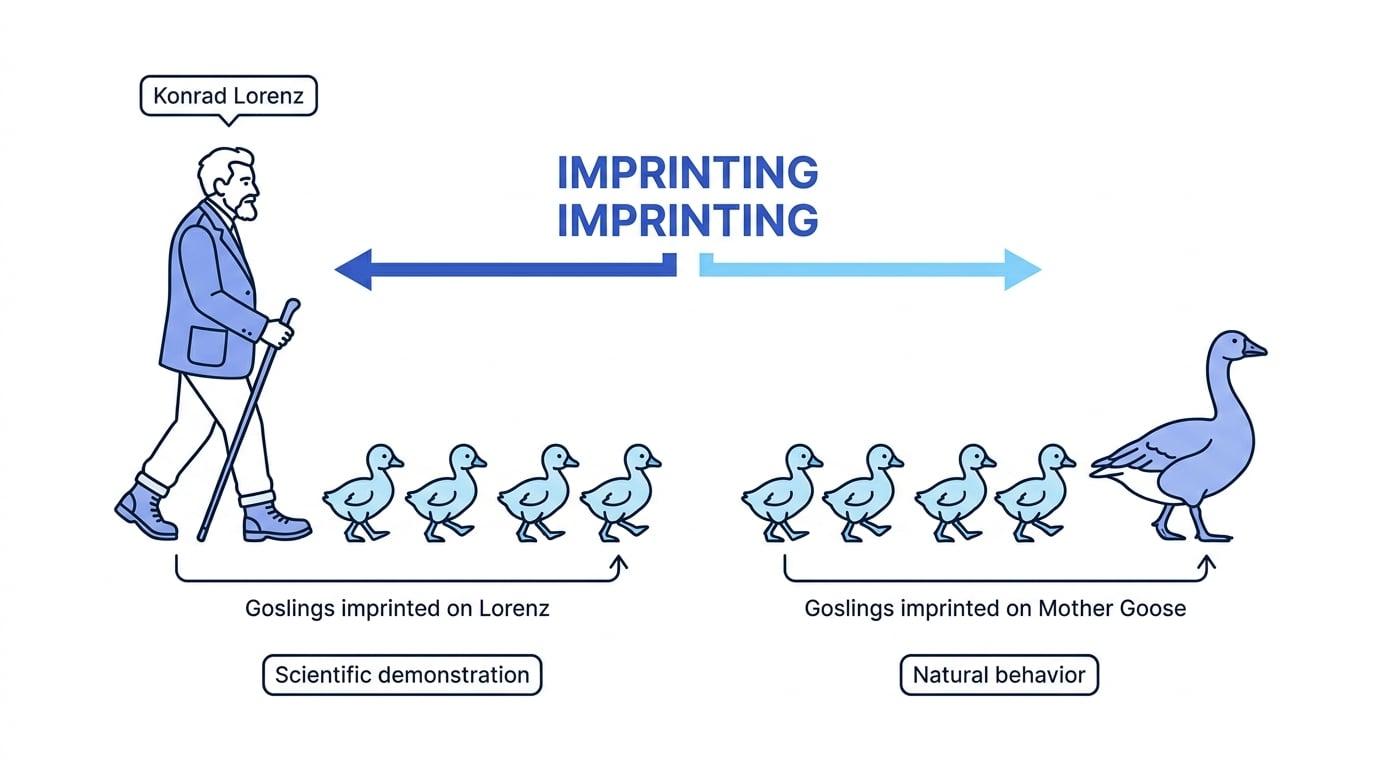
Konrad Lorenz was an ethologist (a scientist who studies animal behaviour in their natural environment). He wanted to investigate how certain species of birds form early attachments.
The Procedure
Lorenz randomly divided a clutch of goose eggs into two groups:
- Control group: Half the eggs were left with the mother goose in their natural environment.
- Experimental group: Half the eggs were placed in an incubator. When they hatched, the first moving object they saw was Lorenz himself.
He then marked the two groups of goslings so he could tell them apart, placed them all together under an upturned box, and lifted the box to see who the goslings would follow.
The Findings
When the box was lifted, the naturally hatched goslings immediately went to their mother, while the incubator-hatched goslings went straight to Lorenz. This bond was irreversible; the experimental group showed no bond to their biological mother.
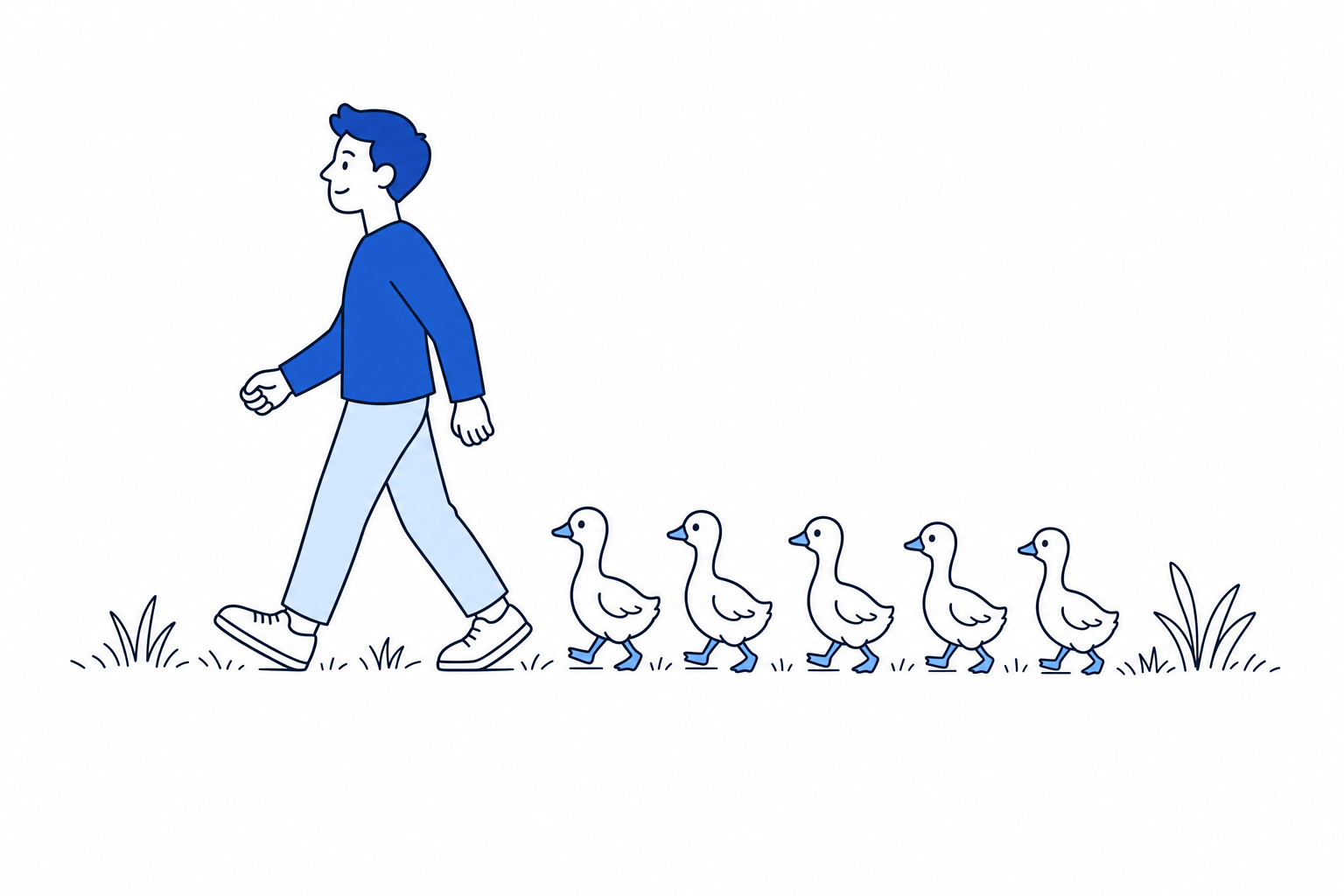
From this, Lorenz identified a phenomenon called imprinting.
Imprinting
An innate readiness to develop a strong bond with the mother, which takes place during a specific time in development (often within hours of birth). If it doesn't happen during this time, it probably never will.
Lorenz also noted that imprinting has a strict critical period. For geese, this was just a few hours after hatching. If imprinting did not occur within this critical period, Lorenz found that the chicks did not attach themselves to a mother figure at all.
He later observed that imprinting also influences future mating preferences, a process he called sexual imprinting. Birds that imprinted on humans would often later direct courtship behaviour toward humans!
Evaluating Lorenz (AO3)
When evaluating Lorenz, you need to consider how well his findings hold up against later research and whether they apply to humans.
- Generalisability to humans: The mammalian attachment system is very different from that of birds. Mammalian mothers show more emotional attachment to young than birds do, and mammals can form attachments at any time (though it is easier in infancy). Therefore, it is hard to apply Lorenz's findings about goslings directly to human babies.
- Contradictory research: Lorenz believed imprinting was permanent and irreversible. However, later researchers like Guiton et al. (1966) found that chickens who imprinted on yellow washing-up gloves would try to mate with them as adults, but with experience, they eventually learned to prefer mating with other chickens. This suggests that the effects of imprinting are not as permanent as Lorenz believed.
Harlow (1958): Contact comfort in monkeys
While Lorenz studied birds, Harry Harlow worked with rhesus monkeys—mammals that are much closer to humans on the evolutionary tree. At the time, the dominant theory (Learning Theory) was that infants attach to whoever feeds them (often called "cupboard love"). Harlow wanted to test if this was actually true.
The Procedure
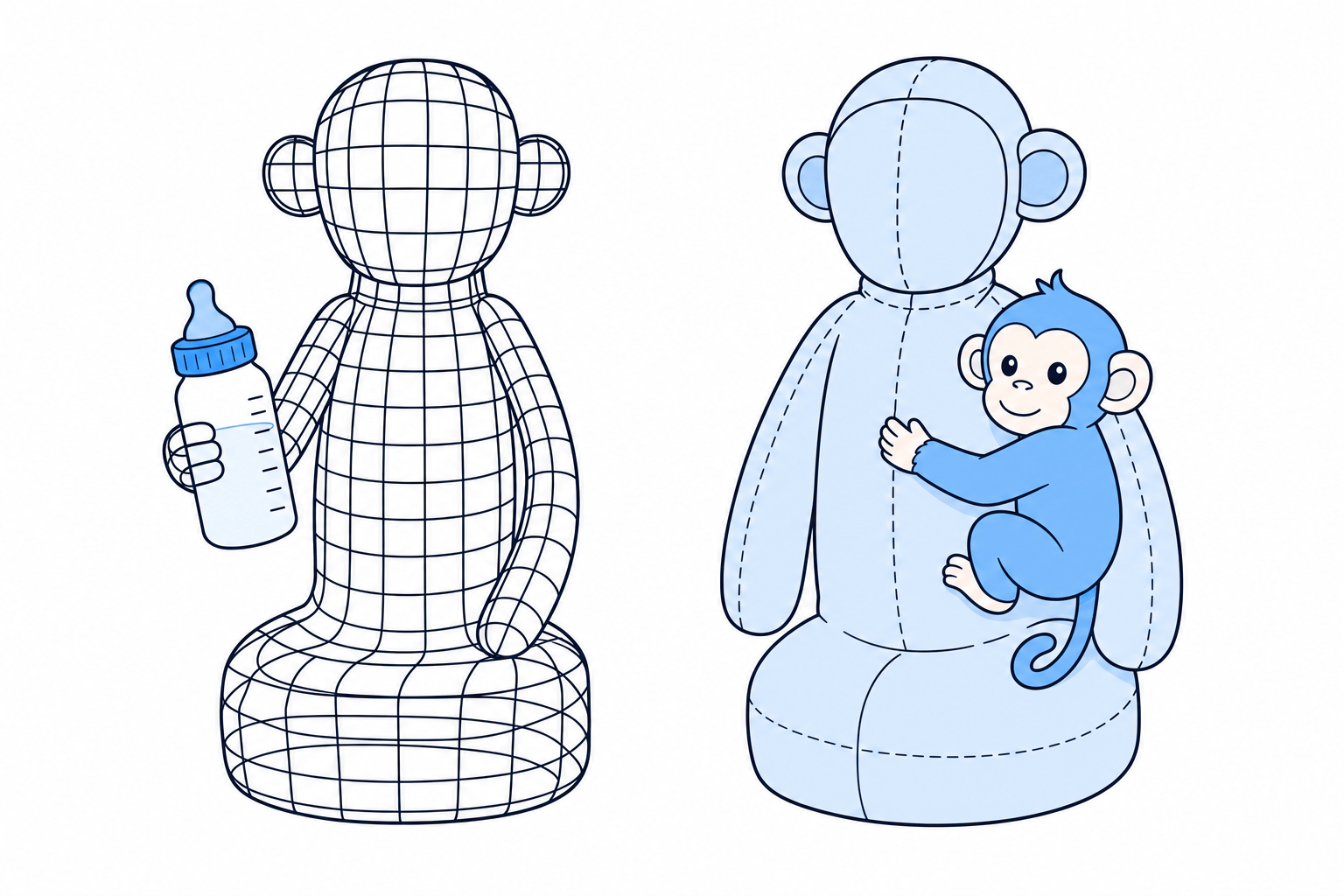
Harlow reared 16 baby rhesus monkeys with two wire model "mothers".
- In one condition, milk was dispensed by the plain wire mother.
- In a second condition, milk was dispensed by a cloth-covered mother.
He measured how much time the monkeys spent with each surrogate mother. He also observed their reactions when frightened (by placing a noisy mechanical teddy bear in their cage) to see which mother they used as a "safe base".
The Findings
The baby monkeys cuddled the soft cloth mother in preference to the wire one, regardless of which mother was dispensing milk. When frightened, they sought comfort from the cloth mother.
Contact Comfort
Harlow concluded that "contact comfort" was more important to the monkeys than food when it came to forming an attachment. The biological need for physical warmth and softness overrides the simple provision of food.
Harlow also followed these monkeys into adulthood to see the long-term effects of maternal deprivation. The monkeys raised by wire mothers were the most dysfunctional, but even those raised by a soft toy did not develop normal social behaviour. They were more aggressive, less sociable, and when they became mothers themselves, they often neglected or even attacked their own young. Like Lorenz, Harlow concluded there was a critical period for these monkeys—a mother figure had to be introduced within 90 days for an attachment to form. After this time, attachment was impossible, and the damage was irreversible.
Evaluating Harlow (AO3)
- Theoretical value: Harlow's work fundamentally changed how psychologists understand mother-infant attachment. He proved that attachment doesn't develop from being fed, but from contact comfort. It also showed the profound importance of early relationships for later social development.
- Practical value: This research has had important real-world applications. For instance, it helped social workers understand risk factors in child neglect and abuse, allowing them to intervene to prevent it (Howe, 1998). It also improved the care of captive monkeys in zoos and breeding programmes.
- Ethical issues: The monkeys suffered immense intentional distress. Because rhesus monkeys are closely related to humans, their suffering was likely very human-like. Harlow was well aware of this suffering, even referring to the wire mothers as "iron maidens" (a medieval torture device). The counter-argument is that Harlow's research was so important that it justified the ethical costs, but this remains highly controversial.
Applying your knowledge
In the exam, you might be given a scenario and asked to apply your knowledge of animal studies (AO2). Let's look at how you could use Harlow's findings to evaluate a real-world claim.
Applying animal studies to caregiver beliefs
Scenario: A nursery worker tells a new mother, "Don't worry about picking your baby up when he cries, he only cares about who gives him his bottle." Use psychological research to explain why the nursery worker is incorrect.
Here is how you would step through applying Harlow's findings to counter this claim:
- Identify the theory being claimed: The nursery worker is suggesting that attachment is based entirely on food provision (the Learning Theory / "cupboard love" approach).
- State the opposing research: Harlow's (1958) research on rhesus monkeys directly challenges this.
- Apply the specific findings: Harlow found that baby monkeys spent significantly more time with a soft, cloth-covered surrogate mother than a bare wire surrogate, even when the wire mother dispensed milk.
- Draw the final conclusion for the scenario: This shows that "contact comfort" (the physical comfort from holding and cuddling) is more important for forming attachments than food. Therefore, the nursery worker is incorrect; the baby needs the mother to pick him up and provide comfort, not just the bottle.
Using animal studies for AO3
A great way to boost your marks in other topics (like Learning Theory of attachment or Bowlby's theory) is to use Lorenz and Harlow as AO3 evaluation points. If an essay asks you to evaluate Learning Theory, you can use Harlow's cloth mothers as contradictory evidence!
In the exam
- Be specific with procedures: Don't just say "Lorenz used geese". Explain how he divided the eggs (natural environment vs. incubator).
- Remember the critical periods: Both researchers noted a critical period (hours for geese, 90 days for monkeys). Mentioning this shows detailed AO1 knowledge.
- Weigh ethics vs. value: When evaluating Harlow, try to show balance. Acknowledge the severe harm caused to the monkeys, but balance it against the immense theoretical and practical breakthroughs the research provided.
Check yourself
- What is the difference between the control group and the experimental group in Lorenz's study?
- Which surrogate mother did Harlow's monkeys spend the most time with, and why?
- Give one reason why it might be problematic to generalise findings from animal studies to human attachments.