Welcome to Eyewitness Testimony (EWT). When someone witnesses a crime or an accident, their memory of the event becomes a crucial piece of evidence. However, human memory isn't a perfect video recording.
What you'll learn:
- How misleading information (leading questions and post-event discussion) can distort a witness's memory.
- Why the level of anxiety a witness experiences can both positively and negatively impact their recall.
- How police use the Cognitive Interview to help eyewitnesses remember more accurate details.
Misleading Information: Leading Questions
When police or lawyers question a witness, the specific wording they use can subtly prompt the witness to give a desired answer.
Eyewitness testimony (EWT)
The ability of people to remember the details of events, such as accidents and crimes, which they themselves have observed.
A leading question is a question that, either by its form or content, suggests to the witness what answer is desired or leads them to the desired answer.
Loftus and Palmer (1974): The Car Crash Study
To test this, Loftus and Palmer showed participants a video of a car crash and asked them questions about it. The crucial question was about the speed of the cars. They divided the participants into five groups, changing just one verb in the question for each group: "About how fast were the cars going when they hit/smashed/collided/bumped/contacted each other?"
The results were striking. The estimated speed was significantly affected by the verb used:
- The verb smashed resulted in the highest average estimate (40.5 mph).
- The verb contacted resulted in the lowest average estimate (31.8 mph).
Why do leading questions affect EWT?
Psychologists offer two main explanations:
- Response-bias explanation: The wording of the question doesn't change the person's actual memory, but it influences how they decide to answer. Seeing the word "smashed" encourages them to choose a higher speed estimate.
- Substitution explanation: The wording actually changes the participant's memory of the event. Loftus and Palmer followed up a week later and asked participants if they saw any broken glass (there wasn't any). Those who heard "smashed" were more likely to say yes, suggesting their original memory had been altered.
Evaluating leading questions
- Strength: Loftus's research has immense real-world application. It transformed the criminal justice system by showing that police officers need to be very careful about how they phrase questions.
- Weakness: The study lacks ecological validity. Watching a video in a lab doesn't generate the same emotional arousal or consequence as witnessing a real, terrifying car crash. Participants may also suffer from demand characteristics, giving the answer they think the researcher wants.
Misleading Information: Post-Event Discussion (PED)
Eyewitnesses rarely observe an event in total isolation. If there are multiple witnesses, they often talk to each other before the police arrive. This is called post-event discussion.
Gabbert et al. (2003): Co-witness Conformity
Gabbert studied PED by putting participants in pairs. Each partner watched a video of the same crime, but filmed from different angles. This meant one partner could see elements of the event that the other could not (e.g., seeing the title of a book the criminal was carrying). Both partners then discussed what they had seen before completing an individual test of recall.
The findings showed that 71% of the participants mistakenly recalled aspects of the event that they did not see in the video but had picked up in the discussion. In a control group where there was no discussion, the corresponding figure was 0%.
Confusing memory conformity with memory contamination
Make sure you know the difference between the two explanations for why PED reduces EWT accuracy:
- Memory contamination: When co-witnesses discuss a crime, they mix (mis)information from other witnesses with their own memories. The original memory is actually altered or distorted.
- Memory conformity: Witnesses go along with each other to win social approval or because they believe the other witnesses are right and they are wrong (informational social influence). The actual memory is unchanged; they just change their report.
Applying EWT factors to a scenario
Scenario: Mia and Sam see a man snatch a woman's handbag. They talk about it while waiting for the police. Sam says, "Did you see his red jacket?" Mia later tells the police the man was wearing a red jacket, even though he was actually wearing a blue one. The police officer then asks Mia, "Was the man holding the knife in his left hand or his right hand?" Mia replies, "His left hand," even though the man was unarmed.
If an exam question asks you to explain two reasons why Mia's memory might be inaccurate, here is how you would break it down:
- Identify the first factor from the text: Mia has discussed the event with Sam before the police arrived. State that this is an example of post-event discussion.
- Apply the relevant psychological concept: Explain that Mia's memory may have been affected by memory conformity (agreeing with Sam because she assumes he saw the colour better) or memory contamination (Sam's information became mixed into her own memory trace).
- Identify the second factor from the text: The police officer asks about "the" knife, presuming a knife was there. State that this is an example of a leading question.
- Apply the relevant psychological concept: Explain the substitution explanation, stating that the presupposition of the knife in the question may have actively altered Mia's memory of the event so she now "remembers" seeing one.
The Effect of Anxiety
Witnessing a crime is usually highly stressful. Anxiety is a state of emotional and physical arousal, but psychologists have found contradictory evidence about whether it makes our memory worse, or better.
1. Anxiety has a negative effect on recall
When we are anxious, our bodies are flooded with physiological arousal. Johnson and Scott (1976) argued this reduces our ability to pay attention to crucial details.
They set up a situation where participants sat in a waiting room believing they were going to take part in a lab study.
- Low-anxiety condition: Participants heard a casual argument next door, and a man walked out carrying a pen with grease on his hands.
- High-anxiety condition: Participants heard a heated argument and the sound of breaking glass. A man walked out holding a paper knife covered in blood.
When asked to identify the man from 50 photos, 49% of participants in the low-anxiety condition were correct, compared to only 33% in the high-anxiety condition. This is known as the weapon focus effect: the anxiety of seeing a weapon narrows the witness's focus onto the weapon itself, at the expense of other details like the attacker's face.
2. Anxiety has a positive effect on recall
Alternatively, the stress of a situation triggers the physiological fight or flight response, increasing alertness and improving memory for the event.
Yuille and Cutshall (1986) studied a real-life shooting in a gun shop in Canada. The shop owner shot a thief dead. There were 21 witnesses, and 13 agreed to take part in the study. The researchers interviewed them 4–5 months after the incident and compared their accounts to the original police interviews.
They found that witnesses were highly accurate in their accounts, and those who reported the highest levels of stress at the time of the event were the most accurate (about 88% compared to 75% for the less-stressed group).
Reconciling the contradiction: The Yerkes-Dodson Law
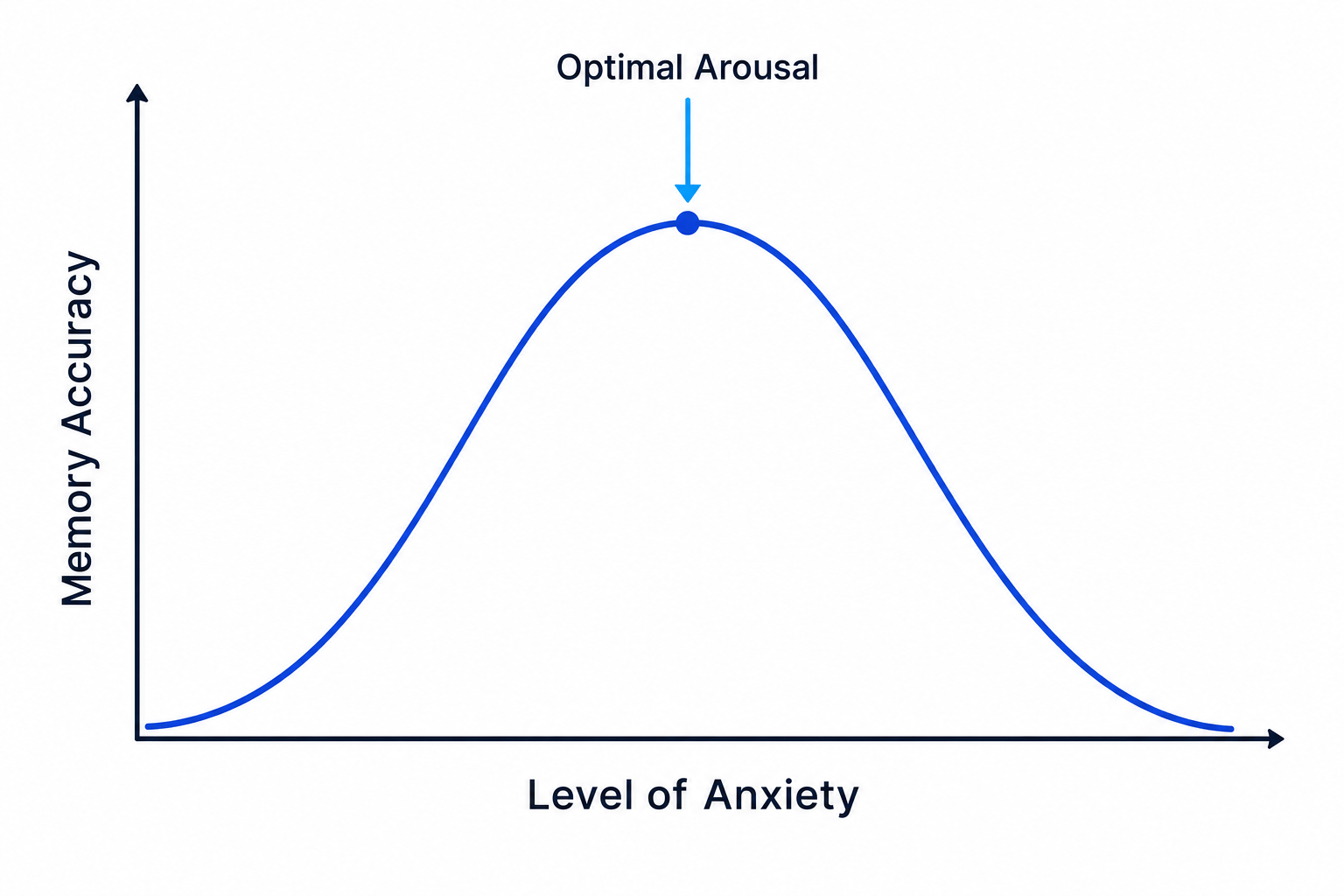
How can anxiety both improve and impair memory? Deffenbacher (1983) applied the Yerkes-Dodson Law (an inverted-U theory) to EWT.
According to this theory, lower levels of anxiety produce lower levels of recall accuracy. Memory becomes more accurate as anxiety increases, but only up to an optimal point. If an eyewitness experiences extreme anxiety past this optimal point (like in Johnson and Scott's weapon focus study), their recall suffers a drastic decline.
Evaluating Anxiety studies
Johnson and Scott's study is a lab experiment, meaning they could tightly control the variables (the weapon vs the pen). However, it suffers from ethical issues (protection from harm) as participants were deceived and exposed to a stressful, bloody scenario. Yuille and Cutshall’s study is a field study of a real crime. It has high ecological validity, but the researchers had no control over extraneous variables (like witnesses talking to each other or reading the news in the 5 months between the event and the interview).
Improving EWT: The Cognitive Interview
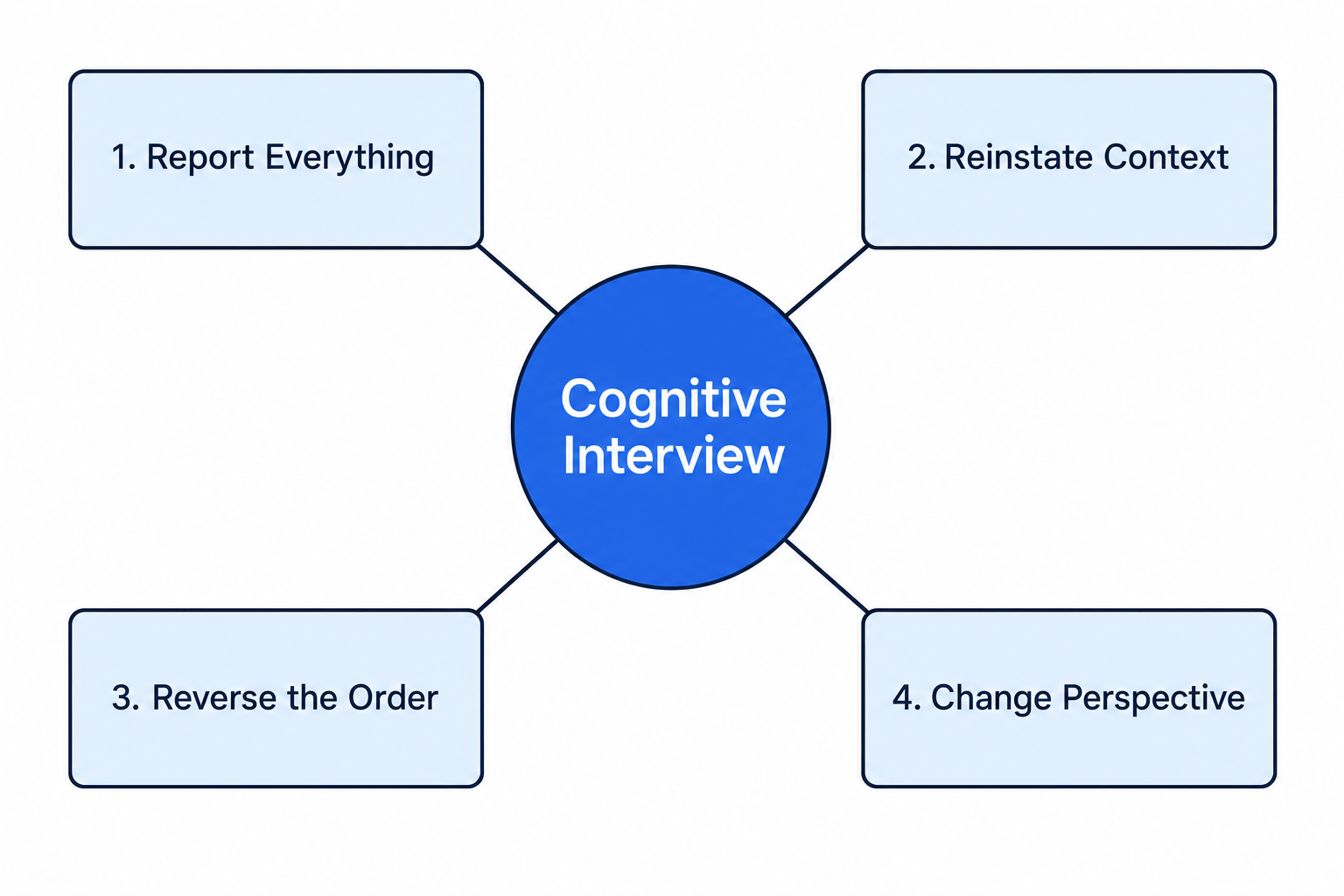
Because psychological research proved that standard police interviews were flawed and often relied on leading questions, Fisher and Geiselman (1992) developed the Cognitive Interview (CI). It is based on psychological principles of memory and features four main techniques:
1. Report everything
Witnesses are encouraged to include every single detail of the event, even if it seems irrelevant or they aren't fully confident about it. Trivial details may act as a 'trigger' for other important memories.
2. Reinstate the context
The witness should return to the original crime scene 'in their mind' and imagine the environment (e.g., what the weather was like, what they could see) and their emotions. This is tied to context-dependent forgetting — recreating the environmental and emotional cues can help retrieve the memory.
3. Reverse the order
Events should be recalled in a different chronological order to the original sequence (e.g., from the end back to the beginning). This prevents people from reporting their expectations of how the event must have happened, and it makes it much harder to lie.
4. Change perspective
Witnesses should recall the incident from other people's perspectives (e.g., how it would have looked to another witness or to the perpetrator). This disrupts the effect of schemas (our pre-existing mental frameworks of how situations normally play out) on recall.
The Enhanced Cognitive Interview (ECI)
Fisher et al. (1987) later added social dynamics to the CI. The ECI focuses on knowing when to establish eye contact, reducing eyewitness anxiety, minimising distractions, and asking open-ended questions.
The limitations of the Cognitive Interview
While the CI generally produces more accurate information than standard police interviews, it also has flaws. It is time-consuming, requiring more time to establish rapport than is often available. It also requires special training which police forces may not have the budget for. Furthermore, Köhnken et al. (1999) found an 81% increase in correct information but also a 61% increase in incorrect information when using the ECI compared to standard interviews.
In the exam
- Always connect theories back to the core question: does this make memory better or worse, and why?
- For AO2 application questions, explicitly identify the EWT factor in the stem (e.g., quote the leading question from the text) before launching into the theory.
- When evaluating (AO3), try to contrast lab studies (high control, low ecological validity, potential ethics issues) with field studies (low control, high ecological validity) to show deeper methodological understanding.
Check yourself
- Can you explain the difference between the substitution explanation and the response-bias explanation for leading questions?
- What are the four techniques used in the Cognitive Interview?
- How does the Yerkes-Dodson inverted-U hypothesis explain the contradictory findings regarding anxiety and EWT?
- What were the specific findings of Gabbert's study on post-event discussion?
